
The belief that “more call = more money” is one of the most persistent, costly myths in physician compensation. It is not just wrong; it is how smart hospitals and groups quietly extract cheap labor from exhausted doctors who think they are being “team players.”
Let’s dismantle it.
The Core Myth: Call As Automatic Income Booster
The story you hear from colleagues, recruiters, and sometimes even partners goes like this:
- Take more call.
- Be a hero.
- Get paid more.
- Fast-track to partnership or bonuses.
Reality: in many contracts, extra call barely moves your effective hourly rate, and in some cases, it lowers it. You end up subsidizing the system with your nights and weekends.
The right question is not “How much do they pay per call?”
It is: “What does my effective hourly rate become once call is included?”
Because here’s what the data and real contracts show.
How Call Really Affects Your Pay
Let me walk through something I have actually done with physicians in contract reviews: the math behind “good” vs “bad” call.
Say you are a hospital-employed cardiologist making $500,000 base. No profit share. No collections bonus that matters.
You work:
- 45 hours/week on-site (clinic/procedures/admin)
- Plus 1:4 home call, q4 nights and 1 weekend a month
- Home call is “light” but you average:
- 2 hours of charting/phone per call night
- 1 late-night inpatient admission or consult twice a week
Now look at your real schedule. With call, your time turns into:
- ~55–60 hours/week total work (clinic + call effort)
- Occasional 70+ hour weeks when call is heavy
So your effective hourly pay is not $500,000 / (45 hr/week x 48 weeks) = ~$231/hour.
It might be more like:
$500,000 / (58 hr/week x 48 weeks) ≈ $179/hour.
That is a 22% pay cut per hour once you include call.
And if your contract says “call is part of your duties” with no stipend? You just gave away 10–15 extra hours a week for free. That’s not “more money.” That’s forced charity work for your employer.
Now compare that to a colleague in the same specialty at another hospital:
- $520,000 base
- 1:6 call
- $1,000 per weekday call, $3,000 per weekend day of call
- Similar total clinical hours
Their effective hourly rate often ends up higher than yours even if their base is only slightly better, because they are not donating half their nights and weekends.
The number of call shifts alone tells you nothing. The structure matters.
Where Call Actually Pays – And Where It Does Not
To stop getting gamed, you have to separate three fundamentally different models of call pay. They behave very differently for your wallet.
| Model Type | How It Pays | Typical Outcome For You |
|---|---|---|
| Included in base only | No extra for call | Lower effective rate |
| Stipend per shift/day | Fixed $ per call | Sometimes fair, often low |
| RVU/collections during call | Paid for work produced | Good if high acuity |
1. “Call Is Included” (The Scam Dressed As “Team Culture”)
Call is “a part of your responsibilities as a full-time physician.” No stipend. No differential. No separate RVU bump for nights.
This is most common in:
- Hospital-employed primary care with inpatient rounding
- Smaller surgical programs where call has “always been this way”
- Some academic roles where people are told to suck it up for the “mission”
What actually happens:
- Admin quietly offloads more call onto “younger” or more compliant docs.
- The people saying “we don’t get paid extra for call either” are often:
- Near retirement
- Have side income
- Do minimal actual work when on call
If your group has a 1:5 call rotation and then a new hire is slow to arrive or someone leaves, suddenly you are 1:3. Same salary. Twice the nights.
That is not a pay raise. That is a 30–40% cut in effective hourly pay.
2. Flat Stipend Per Call (The Illusion Of Fairness)
Here’s where most people get fooled.
Say you are offered:
- $600,000 base
- $400 per weekday call
- $1,000 per 24-hr weekend call
- 1:4 call
Looks fine on paper, right? “Extra” $30k a year or so for call.
Run the math.
Average year:
- Weekdays: about 60 call days → 60 x $400 = $24,000
- Weekends: about 13 full weekends → 26 weekend days x $1,000 = $26,000
- Total call pay: ≈ $50,000
So your “headline” comp is $650,000.
Now estimate time:
- Each weekday call: 2–3 hours of actual work (calls, notes, late procedures)
- Each weekend day: 6–10 hours between hospital and calls
Even conservatively:
- Weekdays: 60 x 2.5 hr = 150 hours
- Weekends: 26 x 7 hr = 182 hours
- Total call work: ≈ 330 hours/year
Call pay: $50,000 / 330 hr ≈ $152/hour.
Meanwhile your daytime work rate (ignoring call) is:
$600,000 / (45 hr/week x 48 weeks) ≈ $278/hour.
So your call “premium” is actually a 45% discount.
You are selling your nights and weekends at a clearance price while convincing yourself you are “making bank” because there is a line item on the contract.
You can guess who wins in that setup. Not you.
3. RVU- or Collections-Based Call (Where It Sometimes Actually Pays)
This is the rare case where more call can legitimately mean more money. But only if:
- Call is busy enough.
- The payer mix is not terrible.
- You are actually credited for the wRVUs or collections from that call work.
- Your base is not quietly reduced to “offset” the opportunity.
Example that can work:
- Surgeon on a 60/40 MGMA median base plus RVU bonus.
- Paid market RVU rate for all call cases and consults (not just elective).
- Call is 1:6 but high acuity, good payer mix, trauma center, etc.
In that world, more call can push your total comp higher because:
- More emergencies = more RVUs.
- You are not capped.
- The RVUs are credited correctly and transparently.
But I have also seen the opposite: hospitals that keep your base “competitive,” then carve out call work at a joke RVU credit or poor payer accounting, so your late-night cases produce little or nothing on your bonus.
You assume “I’m working so much; my bonus will be huge.”
It is not. Because the contract was written to decouple your effort from your income during call.
What The Market Data Actually Shows
There is no single national number for “call pay,” but we have decent survey data from MGMA, SullivanCotter, and state medical societies. The pattern is pretty consistent.
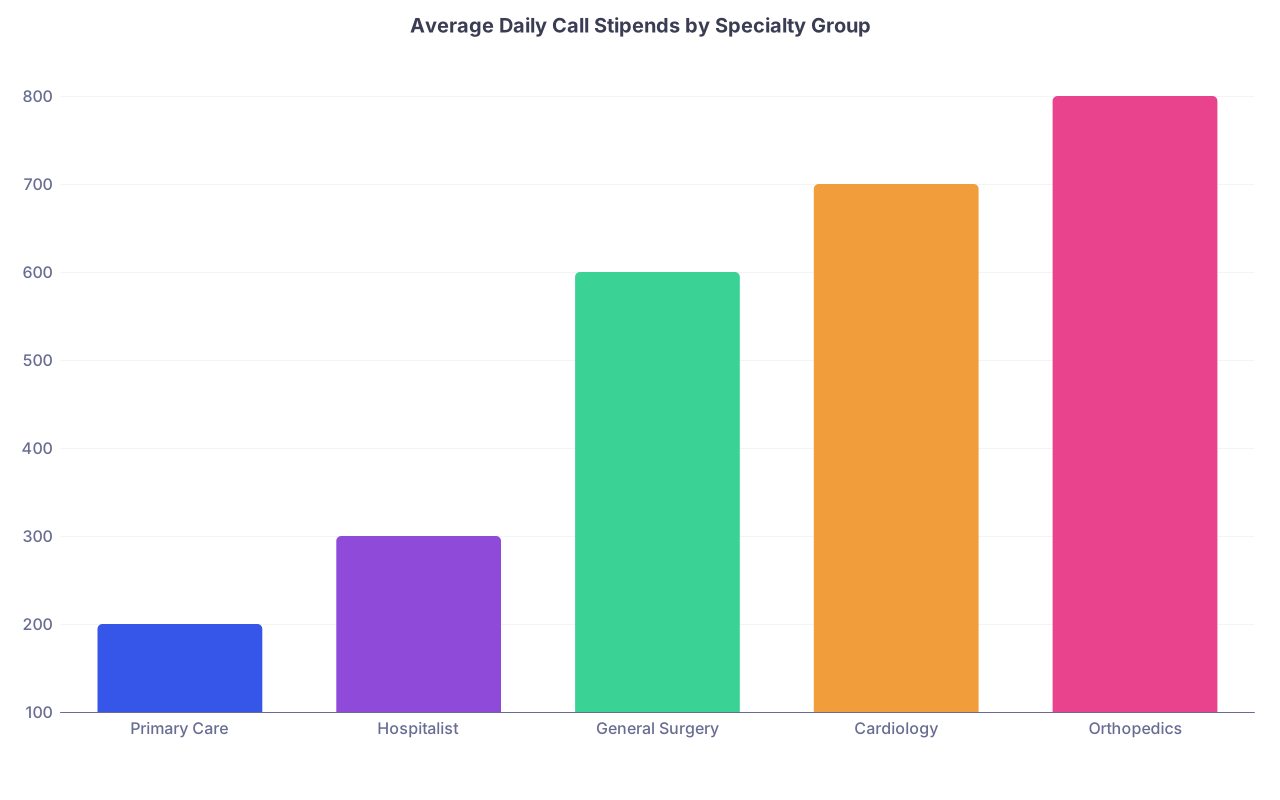
| Category | Value |
|---|---|
| Primary Care | 200 |
| Hospitalist | 300 |
| General Surgery | 600 |
| Cardiology | 700 |
| Orthopedics | 800 |
Typical ranges (per 24 hours of call, often in community settings):
- Primary care: $100–$300 (often nothing in employed models)
- Hospitalists: $200–$500 if extra shifts beyond FTE
- General surgery: $500–$1,200
- Cardiology: $500–$1,200
- Ortho, neurosurgery: $800–$2,000+ in some markets
Now overlay that with actual intensity:
- Many $200–$400 stipends are for call that wrecks your sleep and your next clinic day.
- Plenty of $0 call for “non-competitive” or mission-heavy systems where admin leans on guilt and “service” language.
So no, there is no automatic, proportional relationship between more call and more money. In a shocking number of setups, more call just means the hospital widened its margin.
The Legal Traps: Where Call And Compliance Collide
There is another layer most physicians completely miss: federal law.
You cannot just jack up call pay “because we feel like it.” Hospitals live (or die) under:
- Stark Law
- Anti-Kickback Statute
- Fair market value (FMV) and commercial reasonableness standards
That means:
- Call stipends must be within “FMV” ranges based on surveys.
- You cannot be paid oversize stipends in exchange for referrals.
- Differentials between similar physicians have to be justifiable.
What this looks like in real life:
- Admin tells you they “cannot” pay you more for call because compliance will block it. Often partially true, but also convenient.
- They cite MGMA or other surveys, but only the low end.
- They almost never show you the full FMV analysis that sets their internal ceiling.
This is why some groups push everything into “base salary including call” — it is administratively easier and hides how cheap the call coverage actually is.
You are not going to negotiate your way to $5,000 a night in a community hospital for low-intensity call. But you absolutely can:
- Ask what FMV data they used and where you are within that range.
- Push to be at median or above if call is more frequent or more intense than peers.
- Get explicit language on what happens to call compensation if the schedule changes.
Vague language is the enemy. Because vague language always favors the party with more power and more lawyers.
Concrete Ways To Stop Losing Money On Call
If you want to bust the “more call = more money” trap in your own career, you need to think in systems, not feelings.
Here’s what that looks like.
1. Always Calculate Effective Hourly Rate Including Call
Do not stop at “total comp.”
Take the total of:
- Base salary
- Guaranteed bonuses
- Average realistic performance bonus
- Call stipends
Then divide by:
- Daytime clinical/admin hours per year
- Plus your realistic estimate of call work hours per year
Compare:
- Effective hourly without call
- Effective hourly with call
If the second number is much lower, you are subsidizing the system.
2. Look For These Red Flags In Your Contract
These phrases show up over and over in bad call deals:
- “Call duties as reasonably assigned by the employer.”
- “Physician shall participate in call per group needs; specific schedule not guaranteed.”
- “Call compensation is subject to change at employer discretion to comply with FMV requirements.”
Translation: they can crank the call up without increasing your pay in any meaningful way, and you have agreed to it.
You want, at minimum:
- Defined call expectations (e.g., no more than 1:4 weekday and 1:4 weekends without mutual agreement).
- Defined call compensation method (stipend schedule, RVU credit, or both).
- Clear provisions for renegotiation if call frequency increases beyond X%.
3. Understand The Opportunity Cost
Every extra night of call is not just “one more shift.”
It is:
- Worse sleep → lower clinic productivity next day → fewer RVUs.
- More burnout → higher chance you cut back or leave early → lost income.
- Less time for side gigs or procedural niches that might pay better.
If you can trade one weekend of brutal call per month for:
- One half-day of procedures that pay at full RVU rate, or
- One clinic session that you can grow into a steady base, or
- Time to actually think and improve your efficiency
that often beats the call stipend you are clinging to.
“More call for more money” is often just “more call instead of building anything else.”
4. Strategically Use Call – Do Not Let It Use You
There are times where taking short-term heavy call makes sense:
- First 1–2 years in a new town when you are trying to build referral relationships.
- Temporary coverage while negotiating a better long-term call structure.
- Moonlighting in residency/fellowship where the marginal dollar really matters.
But even then, treat it as a defined phase, not your identity.
Spell it out:
- “I will do 1:3 call at this rate for 12 months, after which we move to 1:4 or adjust compensation by X.”
- Or: “I will cover additional call for $Y per shift beyond my standard 1:5.”
If they will not write it down, they do not intend to honor it.
A Simple Flow: Should You Accept More Call?
Use this mental model before you say yes to more call “for more money.”

| Step | Description |
|---|---|
| Step 1 | Offered more call |
| Step 2 | Reject or renegotiate |
| Step 3 | Probably not worth it |
| Step 4 | Limit or decline |
| Step 5 | Short term only with written terms |
| Step 6 | Paid extra? |
| Step 7 | Effective hourly higher? |
| Step 8 | Burnout risk acceptable? |
If any of those “Yes” nodes fail, more call is not “more money.” It is just more risk and less life.
Years from now, you will barely remember what your 2026 base salary was. You will remember whether you were constantly tired, resentful, and missing your own life because someone sold you the lie that every extra night on call was a financial opportunity.
Most of the time, it was just you working cheap.