
The way most physicians compare job offers is broken. They glance at base salary, ask about sign‑on and call, then “go with their gut.” That is how you leave $50,000+ a year on the table without realizing it.
You need a scorecard. A simple, brutal, numbers‑first tool that forces you to see the real compensation picture across two offers, not the sales pitch each recruiter wants you to remember.
I will walk you through exactly how to build and use that scorecard. Step by step. By the end, you will be able to put two job offers side‑by‑side, assign each a single composite score, and know which one truly pays more for your time and risk.
Step 1: Stop Thinking “Base Salary” and Start Thinking “Total Economic Package”
Base salary is the loudest number in the offer. It is rarely the most important.
I have seen this exact scenario play out:
- Job A: $350k base, “average” benefits, wRVU bonus, heavy call.
- Job B: $310k base, strong benefits, lighter call, better 401(k), big relocation, PSLF‑eligible.
Most residents glance at that and say, “Job A is 40k more.” They are wrong. When you actually run the numbers, Job B often wins by $30–50k per year in total value.
So the first mental shift: you are comparing economic packages, not just paychecks.
Break each offer into these components:
- Guaranteed cash (base salary, guaranteed stipend, guaranteed minimums)
- Performance‑based pay (wRVU bonuses, collections bonuses, quality incentives)
- Employer retirement contributions
- Health, disability, and malpractice coverage value
- Time value (PTO, call, nights/weekends)
- One‑time payments (sign‑on, relocation, loan repayment) amortized
- Hidden costs (non‑compete risk, tail coverage exposure, productivity traps)
You will turn each of these into a line on your scorecard.
Step 2: Build a Simple Compensation Scorecard Template
You do not need an MBA spreadsheet. You need a one‑page tool that you can update in 20 minutes.
Set up a scorecard with:
- Columns:
- Column A: Category
- Column B: Details / assumptions
- Column C: Annual dollar value for Offer 1
- Column D: Annual dollar value for Offer 2
- Column E: Notes (risks, unknowns)
| Category | Example Detail |
|---|---|
| Base salary (guaranteed) | 3-year guarantee, $300k |
| Expected bonus (wRVU/quality) | Modeled from prior volumes |
| Employer 401(k)/403(b) match | 5% of salary |
| Health insurance subsidy | Employer pays 80% of premium |
| Disability + life paid by employer | Group LTD + term life |
| Malpractice + tail coverage | Claims-made with tail covered |
You will add more rows, but this is your skeleton. The trick is to force everything into an annual dollar value. If you cannot estimate a value, you flag it as a risk and discount that line.
Step 3: Quantify the Core Compensation Lines
Let us turn the fuzzy offer language into hard numbers.
3.1 Base Salary and Guarantees
This part is straightforward:
- Base salary = annual guaranteed pay for clinical work.
- If they guarantee a minimum for 2–3 years, write:
- “$300k, 3‑year guarantee, then wRVU‑only” in the detail column.
Use the guaranteed amount for your comparison. Do not assume you will hit heroic RVUs on day one unless you are inheriting a full panel in a practice with proven numbers.
3.2 Expected Performance Pay (wRVU, Collections, Quality)
This is where most physicians get played.
The recruiter says: “Our average docs make $450k.” You ask, “How?” They say: “Base of $280k plus production. You will easily hit the bonus.”
No. Run your own model.
Ask for:
- wRVU rate (e.g., $50 per wRVU over threshold)
- Annual wRVU target for base salary (e.g., 5,000 wRVUs)
- Actual median and 75th percentile wRVUs generated by current physicians in your specialty at that site
- Whether you are inheriting a panel, joining a saturated market, or starting cold
Then do this:
- Choose a conservative volume scenario based on what others actually do there, not what the recruiter “hopes.”
- Calculate expected bonus:
- Example:
- Threshold: 5,000 wRVUs
- Your expected: 6,000 wRVUs (based on existing docs)
- Rate: $50 per wRVU over threshold
- Bonus = (6,000 – 5,000) × $50 = $50,000
- Example:
- Put that $50,000 in your “Expected bonus” row.
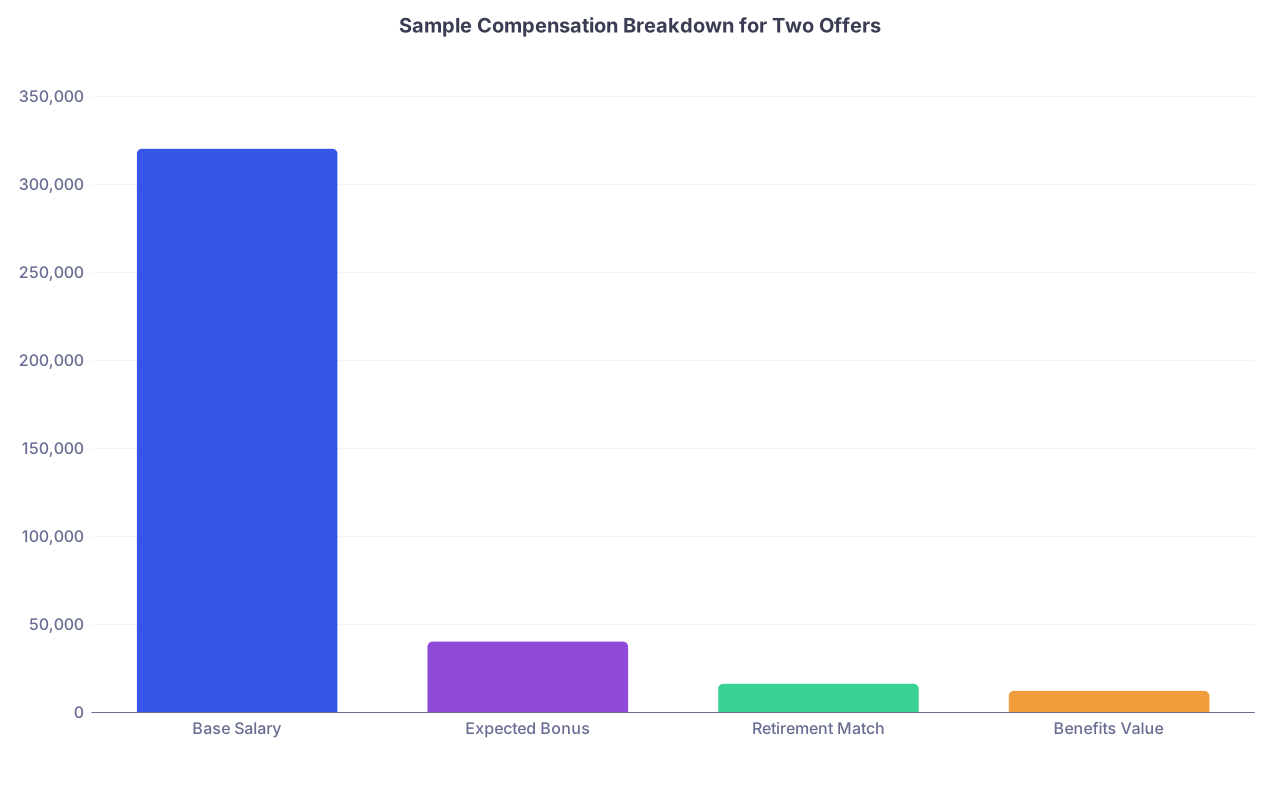
| Category | Value |
|---|---|
| Base Salary | 320000 |
| Expected Bonus | 40000 |
| Retirement Match | 16000 |
| Benefits Value | 12000 |
If the group refuses to share real wRVU data for current physicians, you mark that line with a red flag and heavily discount the expected bonus in your model. I often plug in 50% of what they claim as a rough “BS discount.”
3.3 Retirement Contributions
This part is quietly huge over a 20‑year career.
You want:
- Percentage of salary match (e.g., 5% match on 6% contribution)
- Any profit sharing / discretionary contributions
- Vesting schedule (this matters if you might leave in 2–3 years)
Convert to dollars:
- If salary is $320k and match is 5% of salary, employer match = $16,000 per year.
- If they also do a 3% nonelective contribution, that is another $9,600.
Write the total expected employer contribution as an annual dollar figure.
3.4 Health, Disability, and Other Benefits
Most people hand‑wave this completely. Lazy.
You do not need perfect numbers, but you can estimate:
- Health insurance:
- Ask: “What is my monthly premium for family coverage?”
- Compare to what you would pay on the open market (~$1,500–2,000/month family for many plans).
- If your premium is $400/month, assume employer is effectively covering $1,000/month = $12,000/year.
- Disability insurance:
- Group LTD premiums for physicians are often $1,500–$3,000/year if bought individually.
- If employer pays for a standard group LTD policy, call it $1,500–2,000 of annual value.
- Life insurance:
- A basic 1x salary term life group plan maybe $300–500/year if you bought it yourself.
You are not trying to be actuarially perfect. You are trying to avoid treating “good benefits” vs “bad benefits” as vague feelings.
Add an “Other benefits” line if one offer includes:
- CME funds
- Paid CME days
- Licensing/board/DEA fees
- Parking stipends
- Cell phone stipend
Estimate what you would otherwise pay out of pocket and put that as a positive number for the richer offer, or a lower number for the stingy one.
Step 4: Put a Price on Time, Call, and Burnout Risk
This is the part almost nobody quantifies. Which is absurd, since your time is the true currency here.
4.1 Normalize to an “Effective Hourly Rate”
Two jobs:
- Offer 1: $350k, 1.0 FTE, 50–55 clinical hours a week, q4 call, 15 days PTO.
- Offer 2: $310k, 0.9 FTE, 40–45 hours, q8 call, 30 days PTO.
If you only look at salary, Offer 1 “wins.” But if you divide by real hours worked, Offer 2 is often ahead.
Rough method:
- Estimate total annual work hours:
- Weeks worked per year × average hours per week (include time spent on charts at home if that is part of the culture).
- Include call burden as extra hours:
- For in‑house call: count actual hours.
- For home call: come up with a rough equivalent. Example: each 24‑hour home call where you get frequent calls might count as 8–10 additional “effective” hours.
Then compute:
Effective hourly rate = (Total annual economic package) / (Total annual work hours)
You do not need to be perfect. You only need to be internally consistent across offers.
4.2 Value PTO Differences
Thirty days PTO vs 15 is not a “nice to have.” It is economic.
If Offer 1 gives 15 days PTO and Offer 2 gives 30 days, that is 15 extra days off.
Convert that to money:
- Daily rate ≈ base salary / (weeks per year × days per workweek)
- Example: $320k salary / (48 working weeks × 5 days) ≈ $1,333 per day.
- Extra 15 days ≈ 15 × $1,333 = $19,995 of time.
Now, you can handle this two ways:
- You can:
- Treat the extra PTO as a positive compensation line for the offer with more time off (valued at the daily rate).
- Or:
- Adjust effective hourly rate by changing total hours worked.
I prefer to do both: adjust hours and show a PTO value line, so you see clearly why 30 days off dwarfs a slightly higher base.
4.3 Call Stipends and Call Value
If call is:
- Paid (e.g., $500 per 24‑hour call), add that into the annual cash line.
- Unpaid but heavy, you do not just shrug.
I usually assign a “call penalty” in dollars:
- Decide what extra compensation you would demand for that level of call in an ideal world (based on locums rates, for instance).
- If Offer 1 has twice the call volume of Offer 2 with no extra pay, you can:
- Subtract a notional “burnout cost” from Offer 1 (e.g., –$15k/year).
- Or inflate the work hours in the effective hourly rate.
You are allowed to penalize an offer for wrecking your life. In fact, you should.
Step 5: Amortize One‑Time Payments the Right Way
Sign‑on bonuses and relocation money distort judgment. They are sugar highs.
To compare fairly, you:
- Add up all one‑time payments:
- Sign‑on bonus
- Relocation reimbursement
- Loan repayment (only if truly guaranteed, not “maybe if budget allows”)
- Divide by the minimum commitment period or a realistic stay duration.
Example:
- Offer 1: $40k sign‑on, $10k relocation, 3‑year payback clause.
- Amortized: ($40k + $10k) / 3 ≈ $16,667 per year.
- Offer 2: $25k loan repayment over 5 years (guaranteed if you stay), $5k relocation.
- Amortized if you plan to stay 5 years: ($25k + $5k) / 5 = $6,000 per year.
Add a “One‑time payments amortized” line to the scorecard.
Do not let a big sign‑on bonus seduce you into ignoring a bad compensation structure. You only get that check once. You get underpaid every year.
Step 6: Account for Risk: Non‑Compete, Tail, and Contract Traps
Some contract terms are economic time bombs. You need them on the scorecard.
6.1 Malpractice and Tail Coverage
Ask directly:
- Claims‑made or occurrence?
- Who pays tail? Under what conditions?
If:
- Employer covers tail unconditionally → good.
- Employer covers tail only if you work X years → risk.
- You must pay tail if you leave → major red flag, especially in surgical and procedural specialties where tail can be $50k–$150k.
How to score it:
If you are likely to stay 3+ years and tail is covered, you do not adjust.
If you might leave earlier and tail is on you, estimate tail cost and amortize:
- Example: Tail estimated at $90k; realistically you may leave after 3 years.
- Amortized risk cost = $90k / 3 = $30k/year.
- You can subtract $30k from that offer’s annual economic package as a risk‑adjusted cost.
- Example: Tail estimated at $90k; realistically you may leave after 3 years.
Even if that feels harsh, it forces you to see the downside.
6.2 Non‑Compete Clauses
Non‑competes are harder to put a number on, but you can still do it.
Consider:
- Geographic scope (e.g., 20 miles vs 5 miles)
- Duration (1 year vs 2 years)
- Whether it applies to leaving without cause and leaving for cause
You cannot easily turn that into a dollar, but you can:
- Assign a “risk penalty” line item, say –$5k to –$25k per year, depending on how much it would realistically cost you to uproot your family if things go bad.
- Or if one offer has no non‑compete in a dense market and the other has a brutal one, penalize the restrictive one more heavily.
Not scientific. But better than pretending the restriction has zero value.
6.3 Other Contract Gotchas
Watch for:
- Unilateral RVU target changes
- “Market adjustment” clauses that only ever adjust down
- Long notice periods and liquidated damages
If an offer has multiple ways to cut your pay or trap you, I assign a blunt penalty (–$10k to –$30k per year) in a “contract risk” line.
Step 7: Build the Side‑by‑Side Comparison
Now you pull this together.
Create a table for Offer 1 vs Offer 2 with line items and totals.
| Line Item | Offer 1 | Offer 2 |
|---|---|---|
| Base salary (guaranteed) | $320k | $300k |
| Expected bonus | $40k | $20k |
| Employer retirement | $16k | $24k |
| Benefits (health, LTD, etc.) | $10k | $18k |
| Amortized one-time payments | $8k | $15k |
| PTO value adjustment | $0 | $15k |
| Call / lifestyle adjustment | –$10k | $0 |
| Tail / contract risk adjustment | –$20k | –$5k |
| **Risk‑adjusted total annual value** | **$364k** | **$387k** |
Suddenly, your “lower salary” job is $23k ahead per year once you factor everything in.
Now add one more step: effective hourly rate.
Say:
- Offer 1: 50 hours/week × 48 weeks = 2,400 hours.
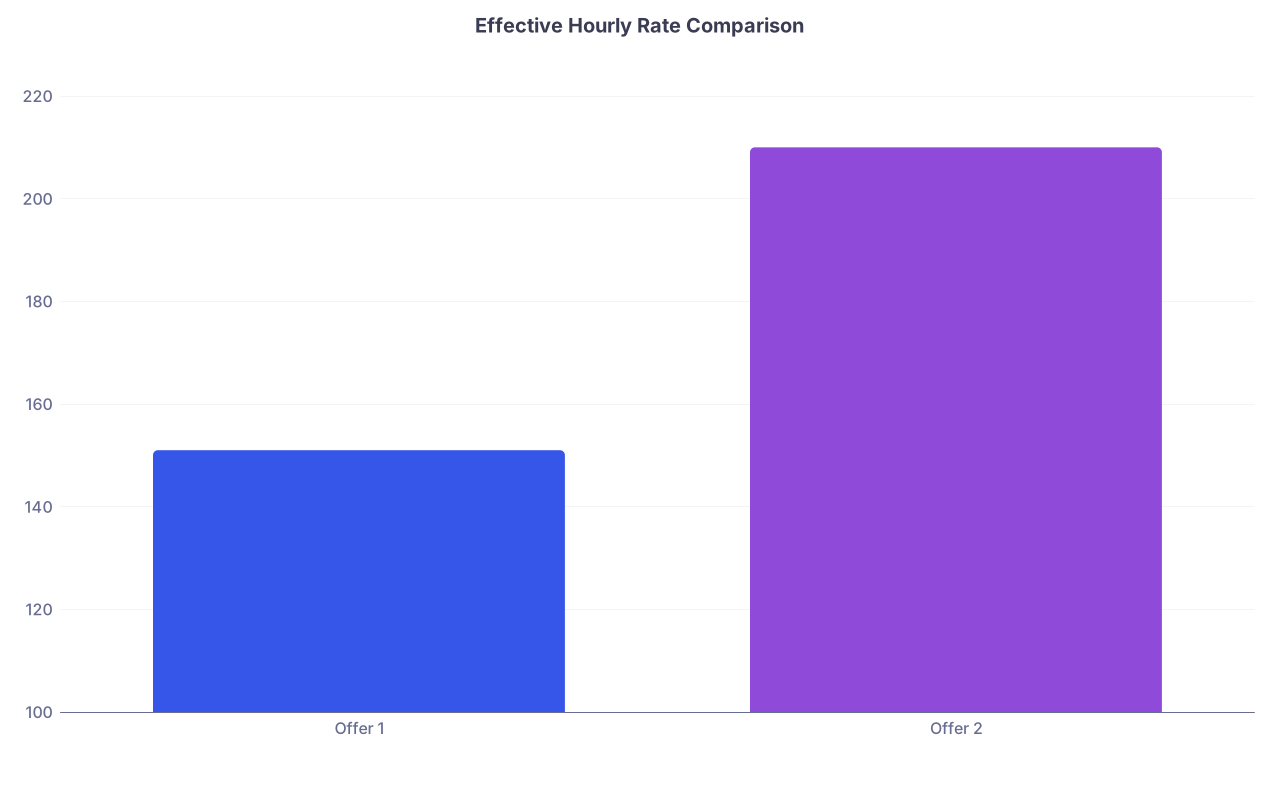
- Effective rate ≈ $364,000 / 2,400 ≈ $151/hour.
- Offer 2: 40 hours/week × 46 weeks (more PTO) = 1,840 hours.
- Effective rate ≈ $387,000 / 1,840 ≈ $210/hour.
Offer 2 is paying you ~40% more per hour of your life. The scorecard makes that impossible to ignore.
| Category | Value |
|---|---|
| Offer 1 | 151 |
| Offer 2 | 210 |
Step 8: Layer in Subjective Weighting – But Only After the Math
You are not a robot. Location, colleagues, academic vs private practice, and spouse’s job all matter. But here is the mistake:
Most physicians start with “We like City X more,” then rationalize the worse job.
Flip that. Start with the math, then adapt.
Assign subjective weights:
- Compensation and economic package: 50–60%
- Lifestyle (hours, call, PTO): 20–30%
- Professional fit (scope, autonomy, growth): 10–20%
- Location and family factors: 10–20%
You can even create a parallel score (1–10) for:
- Fit with colleagues
- Academic vs community preference
- Teaching/research opportunities
- Spouse/partner employment
- School systems, cost of living, etc.
Just do it after you have the objective financial score. The scorecard’s job is to keep you honest.
Step 9: Use the Scorecard as a Negotiation Weapon
Here is where this becomes very practical.
Once you have your scorecard:
- Identify what makes Offer 2 clearly stronger.
- Decide if Offer 1 is otherwise attractive (location, colleagues, etc.).
- Then go back to Offer 1 and say something like:
“I appreciate the $320k base. When I compare the total package to another offer I have, your retirement contribution, PTO, and tail coverage are putting you about $30–40k behind in total annual value. If we could add 5 additional PTO days and commit to covering malpractice tail if I complete three years, I would sign.”
You are not guessing. You are referencing real gaps.
You can even selectively share anonymized parts of your model:
- “Their 401(k) match is 8% vs 5% here.”
- “They cover tail after two years; you currently do not.”
- “They grant 30 days PTO vs 20 here.”
Recruiters take you more seriously when it is clear you have actually done the math. They know you are not going to be blindsided and bitter in year two.

| Step | Description |
|---|---|
| Step 1 | Receive Two Offers |
| Step 2 | Build Scorecard |
| Step 3 | Quantify All Components |
| Step 4 | Calculate Total Annual Value |
| Step 5 | Negotiate Small Improvements |
| Step 6 | Identify Specific Gaps |
| Step 7 | Negotiate Targeted Changes |
| Step 8 | Recalculate Scores |
| Step 9 | Choose Offer And Sign |
| Step 10 | Clear Winner? |
Step 10: Do Not Get Paralyzed – Use a Simple Decision Rule
You can chase perfect modeling forever. Do not.
Once you have:
- Risk‑adjusted total annual value for each offer
- Effective hourly rate
- A quick subjective 1–10 score for fit and location
Use a simple rule:
- If one offer is ≥ $30k/year higher in risk‑adjusted value and has a higher effective hourly rate, that is your default choice unless there is a massive non‑financial factor.
- If they are within $10–20k/year, choose based on:
- Lifestyle
- Fit
- Location
- If the lower‑paying job has clearly better lifestyle and fit, ask:
- “Would I pay $X per year for this difference in life?”
- Example: If Job B is $15k lower but gives you half the call and double the PTO, many rational people would “pay” that.
- “Would I pay $X per year for this difference in life?”
The goal is not to “optimize” every dollar. It is to make the trade‑off explicit so you are not surprised later.
Practical Example: Running a Real Comparison
Let me give you a concrete scenario that looks familiar to most graduating residents.
Offer A – Community Hospital Employed
- Base: $340k, 2‑year guarantee, then RVU.
- Expected bonus: recruiter claims “average docs make 420k”.
- 401(k): 4% match.
- PTO: 20 days vacation + 5 CME days.
- Call: q4, no extra pay.
- Health: you pay $500/month for family.
- Malpractice: claims‑made, tail on you if you leave before 5 years.
- Sign‑on: $25k, relocation $10k.
Offer B – Large Academic Affiliate
- Base: $305k, 3‑year guarantee, modest RVU upside.
- Expected bonus: realistic $15k based on wRVUs.
- 403(b): 10% nonelective (regardless of your contribution).
- PTO: 30 days vacation + 5 CME.
- Call: q8, modest in‑house.
- Health: you pay $250/month.
- Malpractice: occurrence, no tail.
- Sign‑on: $15k, relocation $10k, PSLF eligible.
Run the numbers, roughly:
Offer A:
- Base: 340k
- Realistic bonus (discount their hype): say 40k
- 4% match: ~13.6k
- Health subsidy difference vs “market”: ~12k
- Benefits/LTD/etc: 5k
- Amortized sign‑on/relocation over 3 years: (25+10)/3 ≈ 11.7k
- Tail risk: assume 80k tail, likely leave in 3 yrs → 26.7k cost → –26.7k
- PTO vs baseline 20 days: minimal positive or zero
- Call penalty vs Offer B: –10k (heavier q4 vs q8)
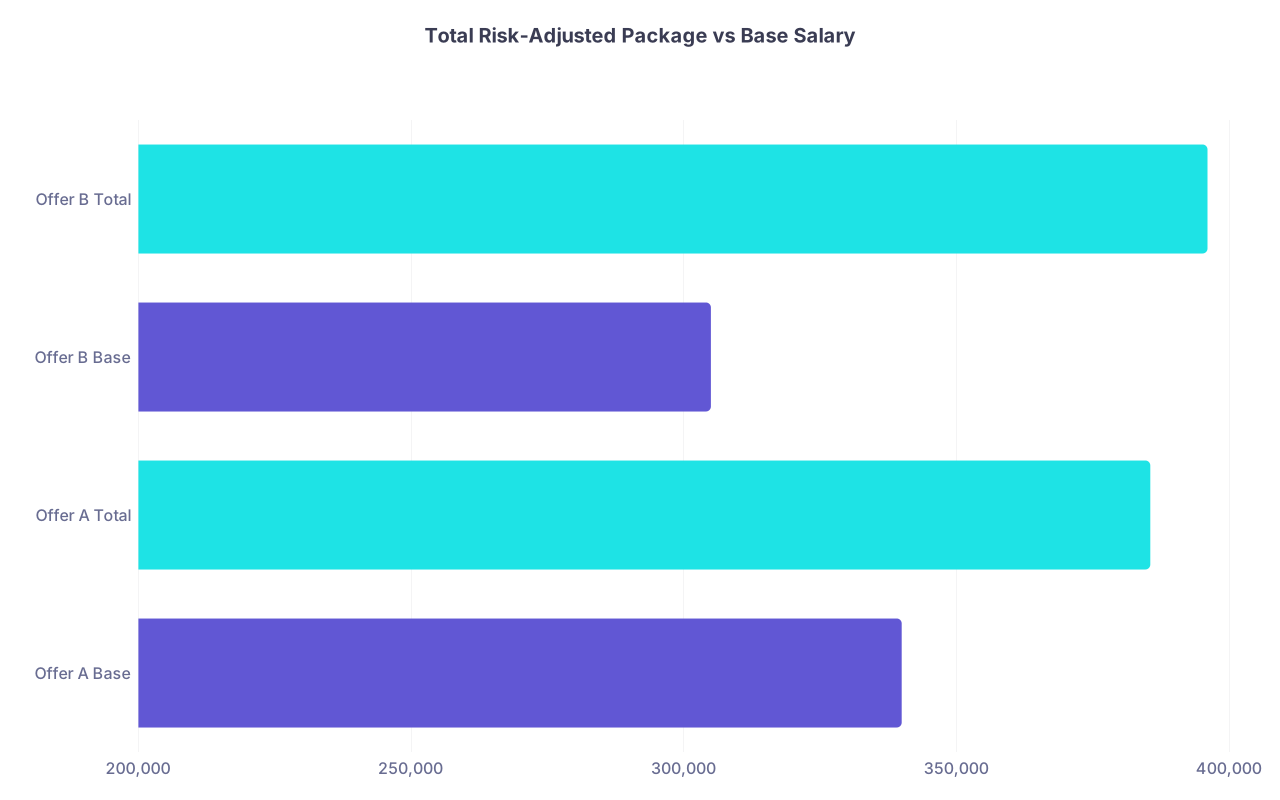
- Total ≈ 340+40+13.6+12+5+11.7–26.7–10 ≈ $385.6k
Offer B:
- Base: 305k
- Bonus: 15k
- 10% retirement: 30.5k
- Health subsidy: maybe 14k
- Benefits/LTD/etc: 6k
- Amortized sign‑on/relocation over 3 yrs (if you think you will leave sooner) = (15+10)/3 ≈ 8.3k
- PSLF potential: very hard to quantify; conservatively +5k/year on expectation
- Extra PTO vs baseline (20 days): +10 vacation days ≈ daily rate (305k/ (46×5) ≈ 1,326/day ×10 ≈ 13.3k
- Malpractice tail risk: 0 (occurrence)
- Call penalty: 0 (lighter call)
- Total ≈ 305+15+30.5+14+6+8.3+5+13.3 ≈ $396.1k
On paper, Offer B quietly beats Offer A by ~10k/year and has:
- Better hours
- Safer contract
- More retirement
- More PTO
- PSLF upside
Without a scorecard, most people would see 340k vs 305k and lean Offer A.
With a scorecard, the choice is almost embarrassingly clear.
| Category | Value |
|---|---|
| Offer A Base | 340000 |
| Offer A Total | 385600 |
| Offer B Base | 305000 |
| Offer B Total | 396100 |
Your Next Step Today
Open a blank spreadsheet and set up the scorecard framework right now:
- Column A: Line item (base, bonus, retirement, benefits, PTO value, call adjustment, one‑time amortized, risk penalties).
- Columns B–D: For each offer you are considering (or will consider), start filling in real numbers and conservative estimates.
- At the bottom, add two formulas:
- Total annual risk‑adjusted value
- Effective hourly rate
Then, the next time a recruiter sends you “an amazing opportunity,” you do not guess. You plug it into your scorecard and see, in black and white, whether it is truly better than what you already have.