
Loan forgiveness is overrated. Blindly chasing the highest salary is reckless. You need a system, not vibes, to choose.
You are not choosing between “good person on PSLF” and “sellout in private practice.” You are choosing between two financial engines that behave very differently over 10–20 years. If you do this by gut feeling, you will almost certainly leave six figures on the table one way or the other.
Let me walk you through a decision framework I use when I sit down with residents and new attendings. We are going to make this practical:
- Concrete numbers
- A repeatable comparison method
- Red flags that should instantly push you toward one side
No generic “it depends.” I will show you exactly what it depends on and how to calculate it.
Step 1: Get Your Numbers Out of Fantasy Land
You cannot compare loan forgiveness vs higher salary using vibes or round guesses. You need four numbers written down, not in your head.
Write these on paper (or a spreadsheet):
Total federal loan balance
- Include all Direct loans. Ignore Perkins/FFEL unless already consolidated.
- Example: $300,000.
Average interest rate (federal)
- Look at your actual weighted average, not what a co-resident told you.
- Example: 6.5 %.
Your realistic attending salaries in two lanes:
- Lane A: Forgiveness-eligible path (e.g., academic hospital, VA, FQHC, 501(c)(3))
- Lane B: High-income path (e.g., private group, locums-heavy, high RVU community job)
- Use realistic ranges, not brochure numbers.
Household income and life plan basics
- Are you single or married?
- Will spouse have income?
- Planning kids within 5–10 years?
- High cost-of-living vs low cost-of-living?
Without these, everything else is noise.
Step 2: Understand the Two Engines: Forgiveness vs High Salary
You are basically choosing between two very different “loan-killing machines.”
Engine 1: The Forgiveness Path (PSLF or Long-Term IDR Forgiveness)
This is usually:
- 10-year Public Service Loan Forgiveness (PSLF) for qualifying nonprofit/government work
- Or 20–25 year IDR forgiveness (SAVE, PAYE, IBR) if you do not meet PSLF criteria
PSLF basics (for your framework):
- 120 qualifying monthly payments
- While working full-time for a qualifying employer (most academic centers, large hospital systems, VA, FQHCs, county hospitals)
- On a qualifying income-driven plan (IDR: SAVE, PAYE, IBR, etc.)
- Remaining balance is forgiven tax-free
IDR long-term forgiveness (non-PSLF):
- 20–25 years of IDR payments
- At the end, remaining balance forgiven
- But the forgiven amount is currently taxable as income under federal law (unless Congress changes rules again)
Key characteristics of the Forgiveness engine:
- Monthly payments tied to income, not to loan size.
- Keeping income lower can actually improve the outcome (weird but true).
- Time in residency/fellowship counts toward PSLF if you are at a qualifying employer and on IDR.
- You are playing a long game: 10+ years minimum.
Engine 2: The High-Salary, Aggressive Payoff Path
This is usually:
- Private practice, for-profit systems, productivity-heavy jobs, locums
- Sometimes academics in very high-paying specialties, but usually non-PSLF-eligible workplaces
Here you:
- Refinance federal loans to a lower interest rate (often 3–5 % variable/fixed) with a private lender
- Commit to paying them off in ~3–7 years using an aggressive portion of your higher salary
- No forgiveness. You are choosing speed and certainty.
Characteristics of the High-Salary engine:
- Higher monthly cash flow but no PSLF.
- You intentionally live “resident-plus” for a few years and throw $5k–$10k/month (or more) at loans.
- After they are gone, your free cash flow explodes.
Step 3: Build Two Concrete Scenarios (Not Hypotheticals)
Let us run a sample case with numbers. Then you plug your own in.
Case Example
- Debt: $300,000 federal
- Interest rate: 6.5 %
- Single, no kids yet
- Resident currently at a large academic 501(c)(3) hospital, on IDR (SAVE), PGY-3 internal medicine
You are choosing between:
Path A (PSLF / Forgiveness path)
- Academic hospitalist job: $240,000
- Employer is 501(c)(3), PSLF eligible
- Stay in academic/public hospitals for at least 7 more years
Path B (High salary / Refinance path)
- Community hospitalist job: $320,000
- For-profit system, not PSLF eligible
- You refinance and aim to be debt-free in 5 years
Now you do some basic math.
Step 4: Estimate Yearly Cash Flow Under Each Path
I am not doing full tax returns here. I am giving you a usable estimate.
4A. Path A: PSLF / Academic
Step 1: Count your PSLF-eligible years
- Residency: 3 years (already done or nearly done)
- Fellowship (if any): add those years
- Planned academic attending: at least 7 more years
Total: You will hit 10 years of qualifying payments fairly early in your attending career.
Step 2: Approximate IDR payments
On SAVE, your payment is a percentage of discretionary income. I will simplify:
- Residency IDR payments: maybe $150–$300/month for 3 years
- Early attending on $240k: maybe $1,200–$1,800/month (single, no kids)
Call it an average of $1,500/month for the bulk of the attending phase. Real numbers will vary; the framework does not.
Step 3: Rough loan cost and forgiveness
Let us estimate 10 years of payments:
Years 1–3 (residency):
- $250/month × 36 = $9,000 total
Years 4–10 (attending at $240k):
- $1,500/month × 84 = $126,000
Total cash paid: ~$135,000 over the full 10 years.
Now, what gets forgiven? With $300k at 6.5 %, interest is brutal. Your balance may grow during residency, then flatten and eventually shrink somewhat. But commonly:
- Starting balance: $300,000
- After 10 years: maybe $200,000–$300,000 forgiven (range depending on exact payments and timing)
For framework purposes, say you pay $135k and get $200k forgiven tax-free.
Cash flow perspective:
- Salary: $240,000
- Estimated federal/state/local taxes: assume ~30–35 % combined (depends on state)
- Take-home ~$156,000–$168,000
- Loan payment: ~$18,000/year
Net “life money” after loans: call it $140k–$150k/year.
4B. Path B: High Salary / Private Practice / Refinance
Same person. Different engine.
Step 1: Refinance after residency
- Initial balance after residency: maybe grown to ~$330,000 (interest capitalized)
- Refinance to 4 % for a 5-year term
Monthly payment to kill this in 5 years at 4 % interest is roughly:
- About $6,000–$6,100/month
- Call it $72,000–$75,000/year
Step 2: Cash flow estimate
- Salary: $320,000
- Taxes (same assumptions): maybe 32–37 % total
- Take-home: roughly $200k–$215k
- Loan payment: say $75k/year
Net “life money” after loans: ~$125k–$140k/year during those 5 years.
But then in year 6:
- Loans gone
- Your “life money” jumps by ~$75k/year
- Now you are at $200k+ net ongoing, assuming no major lifestyle explosion
Step 5: Compare Total 10-Year Outcomes, Not Just Yearly Pain
You are not trying to minimize pain in any single year. You are trying to maximize net worth over 10–15 years.
Let us compare 10-year windows.
5A. Path A 10-Year Summary (PSLF)
Assume:
- You continue academic work at $240k for at least 7 attending years
- You finish PSLF in that window
Totals (rough):
- Total gross earnings (10 years including residency):
- 3 years residency low pay + 7 years attending at $240k
- Just for attending years: 7 × $240k = $1.68M
- Total loan payments: ~$135k
- Forgiven tax-free: say $200k
- At year 10: loans gone, income moderate, solid security.
5B. Path B 10-Year Summary (High Salary)
You do 7 years as an attending at $320k.
- Attending earnings: 7 × $320k = $2.24M
- Total loan payments:
- 5 years × $75k = $375k
- Then 2 years with zero loan payments
At year 10:
- Loans gone, higher cumulative income, higher future earning base.
Here is a simple side-by-side:
| Metric | PSLF Path (Academic) | High-Salary Path (Private) |
|---|---|---|
| Attending salary | $240k | $320k |
| Loan payments (10 yrs) | ~$135k | ~$375k |
| Amount forgiven | ~$200k (tax-free) | $0 |
| 7-year attending earnings | $1.68M | $2.24M |
The question is not “Who spent less on loans?” That is obviously PSLF. The real question:
Does the extra $560,000 in gross income from the higher-salary path over 7 years beat the roughly $200k tax-free forgiveness advantage?
In this sample, yes. Even if you haircut that $560k for higher taxes and some lifestyle creep, your net worth potential is usually higher with the bigger income, as long as you actually follow through on the aggressive payoff.
That is the key: only if you actually behave aggressively.
Step 6: The Behavioral Reality Check
Most physicians do not have a math problem. They have a behavior problem.
If you choose the high-salary path but then:
- Buy the $1.2M house in year 1
- Lease two luxury cars
- Take 3 international vacations a year
- Make only minimum payments on your refinanced loans
You just turned the mathematically superior option into a disaster.
Here is the core rule:
High income only beats forgiveness if you are willing to live like a slightly upgraded resident until the loans are gone.
That usually means:
- Commit to a clear payoff window (3–7 years)
- Save or invest 20–30 % of gross income during that period
- Keep fixed expenses (housing, car, daycare, etc.) constrained for the first 3–5 years
If that sounds miserable or totally unrealistic for you and your partner, do not lie to yourself. The forgiveness path with lower mandatory payments and more stable jobs may actually fit your behavior better, even if the raw math favors private practice.
Step 7: Use This 9-Question Decision Framework
Here is the decision checklist I use when advising someone. Answer honestly.
1. Are your loans federal, and is your employer PSLF-eligible?
- If your loans are mostly private OR you plan to work for for-profit hospitals, PSLF is off the table.
- In that case, your choice is really: refinance + high salary vs slow-drip IDR. Almost always, refinance + aggressive payoff paired with a strong income is better.
2. How large is your loan balance relative to your income?
Rule of thumb:
- Debt > 2x expected attending salary → PSLF/federal forgiveness deserves serious consideration
- Debt ≤ 1x expected attending salary → Refinance and aggressive payoff usually wins
Example:
- $500k debt, $220k academic salary: PSLF can be a monster win.
- $250k debt, $400k income specialty: private, refinance, kill it.
3. How likely are you to stay in public/academic/nonprofit practice for 10+ years?
Be ruthless here. I have seen too many residents swear they will “definitely stay in academics,” then jump ship in year 3.
Ask yourself:
- Do I actually enjoy academic politics, research pressure, promotion tracks, and teaching expectations?
- Or do I just feel morally obligated to say I do?
If there is a good chance you bolt for private practice by year 4–5, planning your life around PSLF is risky. You might end up:
- With a bloated balance that has grown on IDR
- No PSLF
- Then needing to refinance and pay off a much larger number
For many, that is the worst-case scenario.
4. Are you willing to think like a business owner?
High-income private jobs often come with:
- RVU pressure
- Metrics, throughput, call schedules that creep up over time
- Less “institutional loyalty” – you are a producer
If you can handle that and approach your career like a business—negotiating, changing jobs, optimizing pay—then the higher-income engine is incredibly powerful.
If that makes you nauseous, and you want stability and predictability, PSLF-eligible systems may be more aligned.
5. What are your family and geography constraints?
Some forgiveness-friendly jobs cluster in:
- Urban academic centers
- VA systems
- FQHCs in underserved areas
High-salary jobs might be:
- Smaller cities, suburbs, rural areas
- Less “brand name” institutions
If your partner’s career, children’s schools, or extended family location locks you to a specific metro where private demand is insane and pay is huge, that tilts you toward high salary.
If you are committed to staying in a big coastal academic center, PSLF jumps up the priority list.
6. How risk-averse are you?
PSLF is politically popular now, but it has had real rule changes over the years. Long-term IDR forgiveness (20–25 years) also faces future legislative risk, especially the tax angle.
Higher salary + refinance is simple and under your control. You could model it as:
- “I will be debt-free in 5 years unless I blow myself up.”
If you hate policy risk, forgiveness may annoy you. If you hate income volatility and negotiating with employers, high-salary paths may stress you out.
7. Are you maximizing IDR and PSLF counting today?
If you are:
- In residency or fellowship
- At a 501(c)(3), government, or VA hospital
- Not on IDR and not submitting PSLF forms yearly
You are burning qualifying years.
Action items:
- Make sure loans are consolidated to Direct loans if needed
- Enroll in a qualifying IDR plan (SAVE currently best for most)
- Submit PSLF Employment Certification forms annually
You can keep your future options open while you decide. Banking 3–6 years of PSLF-eligible time now costs you very little and protects future flexibility.
8. How disciplined are you with “extra” money?
Let me be blunt: if you have never budgeted, never invested, and tend to spend whatever is in your account, PSLF with lower required payments is often safer. You are less likely to blow your opportunity.
On the other hand, if you:
- Already track expenses decently
- Already invest something (even during training)
- Can point to times you hit financial goals
Then the high-salary + aggressive payoff option is a very sharp tool that you will actually use correctly.
9. Run your specific numbers through a simple comparison
Stop reading other people’s case studies and run your own.
Build a very simple table for yourself:
| Category | PSLF / Forgiveness Path | High-Salary / Refinance Path |
|---|---|---|
| Attending salary | ||
| 10-year loan payments | ||
| Expected forgiveness | ||
| Years to debt-free | ||
| 10-year total income |
Fill it out. If the high-salary path beats PSLF by only $20k over 10 years, but requires a miserable commute, terrible shifts, and you hate the environment, it is probably not worth it.
If the high-salary path beats PSLF by $300k+ and you think you would actually like that style of work, the decision becomes clearer.
Step 8: Visualize the Trade-Off Over Time
Here is what the two strategies usually look like across 10 years for many physicians:
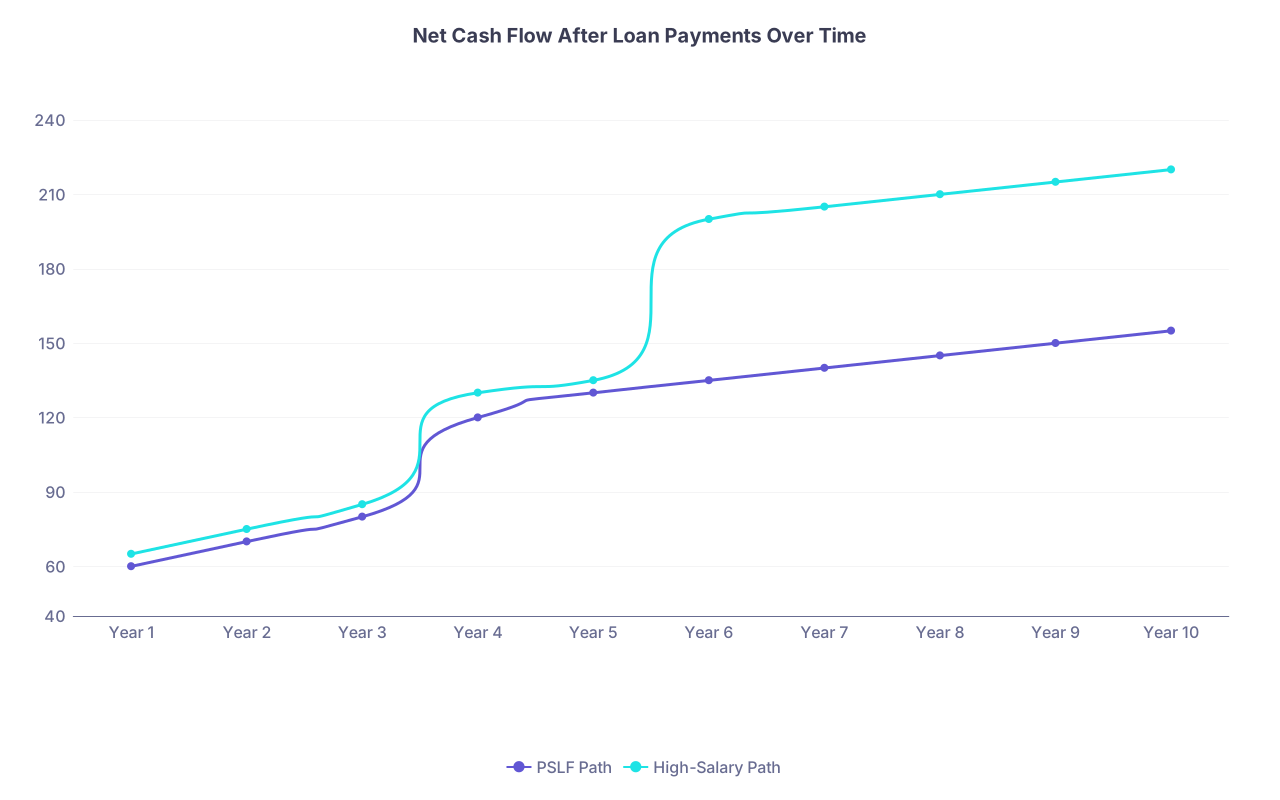
| Category | PSLF Path | High-Salary Path |
|---|---|---|
| Year 1 | 60 | 65 |
| Year 2 | 70 | 75 |
| Year 3 | 80 | 85 |
| Year 4 | 120 | 130 |
| Year 5 | 130 | 135 |
| Year 6 | 135 | 200 |
| Year 7 | 140 | 205 |
| Year 8 | 145 | 210 |
| Year 9 | 150 | 215 |
| Year 10 | 155 | 220 |
You can see:
- PSLF path: smoother, more stable, less dramatic jumps
- High-salary path: tighter early years, then big jump after payoff
You need to decide: When do you want your flexibility? Early (PSLF, lower payments) or later (debt gone, huge free cash flow)?
Step 9: The “No-Regrets” Protocol
Here is the protocol I recommend for most residents and early fellows who are not sure yet:
Enroll in IDR (SAVE) immediately.
- Get payments tied to income.
- Stop any forbearance nonsense.
File PSLF Employment Certification yearly if at a qualifying hospital.
- Bank qualifying months while you evaluate your future path.
Do not refinance during training if there is any chance you use PSLF.
- Once you refinance to private loans, PSLF is gone permanently for those loans.
Track your specialty’s real-world salary data:
- Use MGMA reports, physician forums, colleagues’ contracts.
- Build realistic “academic” and “private” salary assumptions, not fantasy numbers.
At 6–12 months before finishing training:
- Run full 10-year projections both ways
- Do not just look at total loan cost. Look at:
- 10-year earnings
- Years to debt-free
- Expected lifestyle impact
Make a decision and commit hard for 5 years.
- If you choose PSLF:
- Stay in qualifying employment, optimize IDR, keep forms up to date.
- If you choose high salary:
- Refinance with competitive lenders.
- Set an automatic, large monthly payment that guarantees payoff in 3–7 years.
- Treat that payment as non-negotiable.
- If you choose PSLF:
Reevaluate at the 5-year mark
- If PSLF path: you are likely close to forgiveness. Finish.
- If high salary path: ideally your loans are gone. Now increase savings, down payments, and investments aggressively.
Practical Example by Specialty Type
To make this real, let me show you how this framework tends to shake out across different specialties. This is not gospel, but it matches what I see repeatedly.
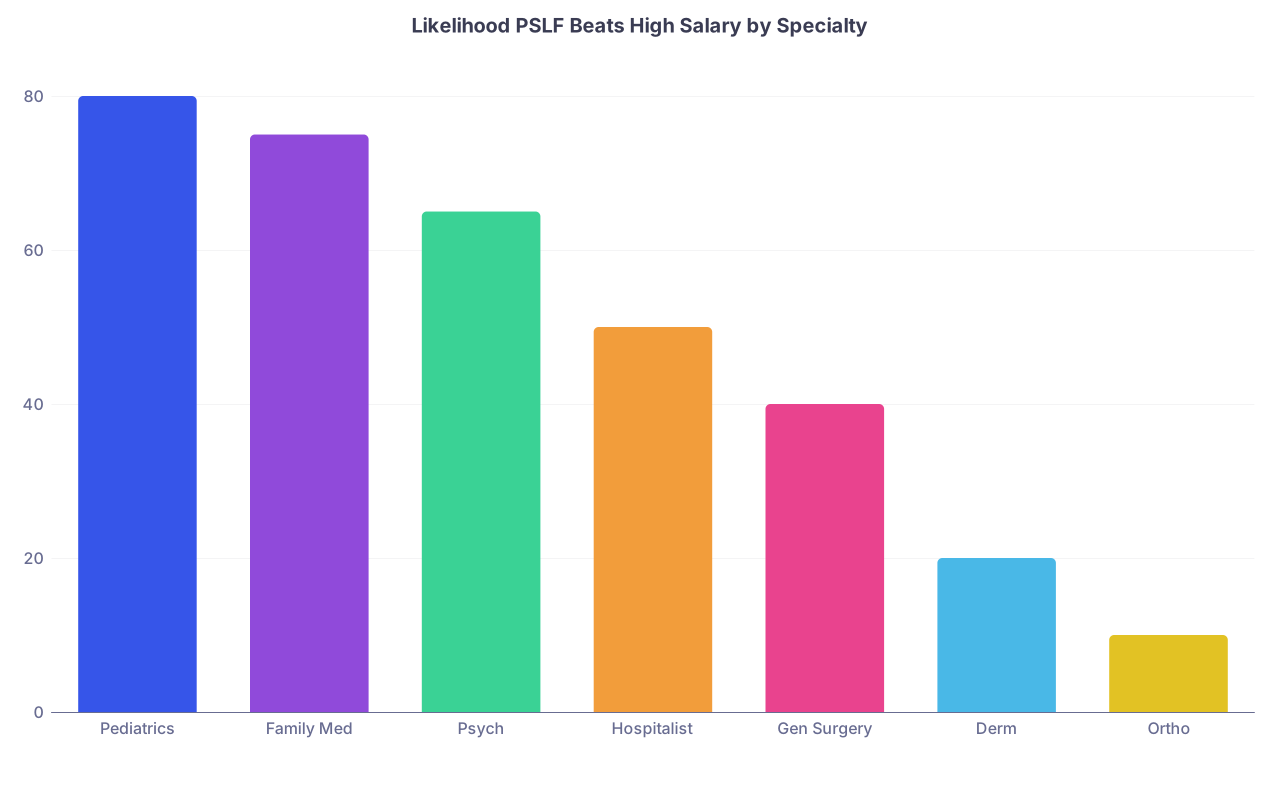
| Category | Value |
|---|---|
| Pediatrics | 80 |
| Family Med | 75 |
| Psych | 65 |
| Hospitalist | 50 |
| Gen Surgery | 40 |
| Derm | 20 |
| Ortho | 10 |
Pediatrics, Family Medicine, some Psych
- Lower private salaries relative to debt
- PSLF often a big win, especially if debt > $300k
Hospitalist, Gen Internal Medicine, some Surgical Subspecialties
- Depends heavily on local job markets
- Both PSLF and high-salary can win; need real numbers
Derm, Ortho, ENT, Anesthesia, IR
- High private practice pay dwarfs PSLF advantage for many
- Refinance + aggressive payoff often best, unless debt is extreme and you truly want academics
Action Checklist: What You Should Do This Month
Stop hand-wringing and take concrete steps:
Pull your actual loan data
- NSLDS or studentaid.gov
- Total balance, loan types, interest rates
Confirm your current and target employers’ PSLF status
- HR or benefits office can confirm 501(c)(3) or government status
Enroll or confirm enrollment in an IDR plan
- Preferably SAVE for most, unless you have a special situation
File PSLF forms if eligible
- Even if you think you might not stay in public/academic, bank the time
Sketch two 10-year paths
- Conservative PSLF path
- Aggressive high-salary + refinance path
Discuss with your partner (if any)
- Align on lifestyle expectations for the first 5 years
- Decide how much of that big attending pay raise is truly "available" for loans
Set a decision deadline
- Ideally 6–12 months before training ends
- After that, commit and stop second-guessing every month
Visualizing Your First Five Years as an Attending
Here is a simple flow diagram for how your first five years should run under either strategy if you want to avoid financial regret:

| Step | Description |
|---|---|
| Step 1 | Finish Training |
| Step 2 | Estimate PSLF vs Private Pay |
| Step 3 | Focus on High Salary and Refinance |
| Step 4 | Stay Public/Academic and Maximize PSLF |
| Step 5 | Consider Private Offers and Refinance |
| Step 6 | Refinance Loans |
| Step 7 | Stick to IDR Payments |
| Step 8 | Set 3 to 7 Year Payoff Plan |
| Step 9 | File PSLF Forms Yearly |
| Step 10 | Automate Large Monthly Payments |
| Step 11 | Reassess at Year 5 |
| Step 12 | PSLF Eligible Employer? |
| Step 13 | PSLF Advantage > 150k? |
One More Reality Check
The worst outcomes I see are not from “wrong” choices. They are from indecision and half-commitments:
- People who stay in academic centers but never file PSLF paperwork
- People who move to private practice, never refinance, and just make minimum payments on 6–7 % loans for 15 years
- People who get PSLF almost done, then switch jobs at year 8 without understanding they just blew hundreds of thousands of forgiveness
Do not do that.
Pick an engine. Run it hard. Either one can make you wealthy and free if you actually commit and behave like an adult with your money.

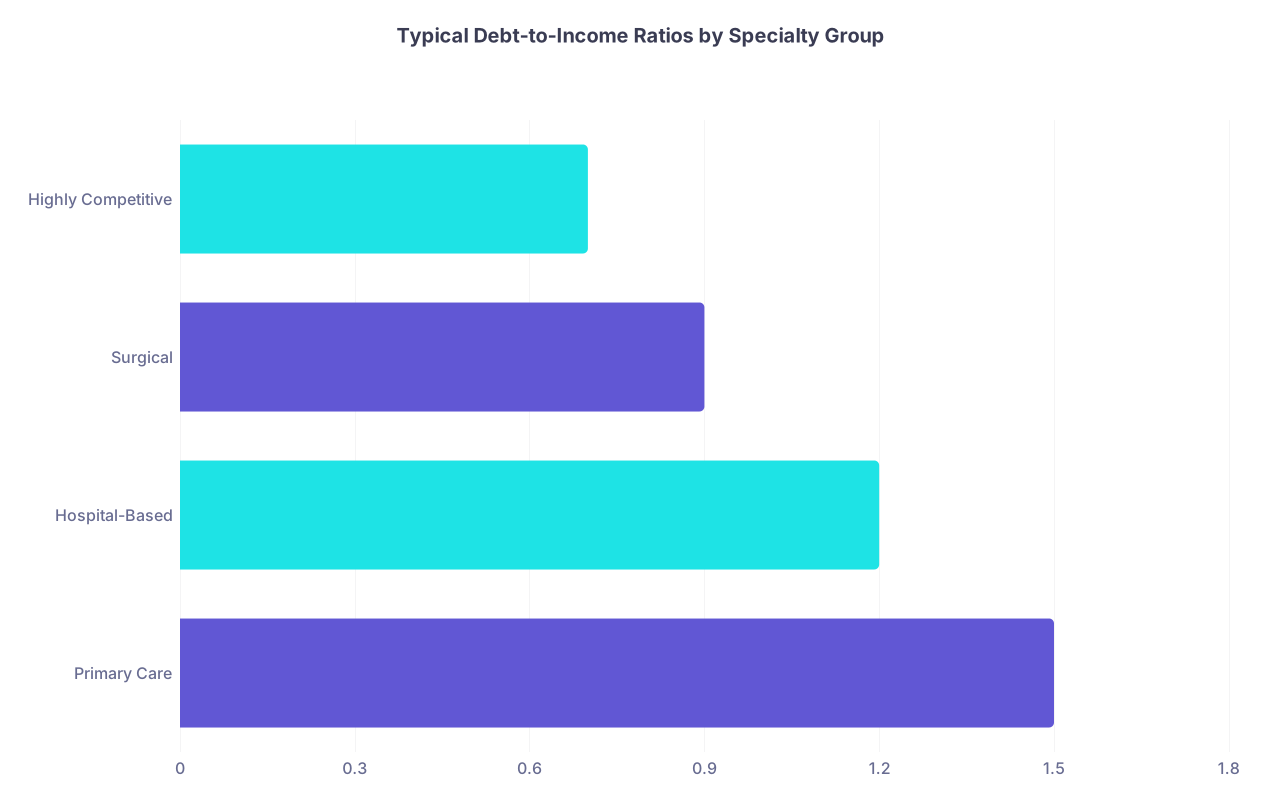
| Category | Value |
|---|---|
| Primary Care | 1.5 |
| Hospital-Based | 1.2 |
| Surgical | 0.9 |
| Highly Competitive | 0.7 |


| Step | Description |
|---|---|
| Step 1 | Resident with Federal Loans |
| Step 2 | Enroll in IDR |
| Step 3 | Confirm Employer PSLF Eligible |
| Step 4 | File PSLF Form Each Year |
| Step 5 | Plan Career Around PSLF Completion |
| Step 6 | Explore Private and High Pay Offers |
| Step 7 | Run 10 Year Comparison |
| Step 8 | Drop PSLF Plan and Refinance After Training |
| Step 9 | Like Academic/Public Path? |
| Step 10 | Private Clearly Better? |