
It is 8:15 p.m. You are staring at an employment offer email on your laptop. Base salary, a vague RVU target, a “competitive” sign‑on bonus, and a non‑compete clause that makes you queasy. Your spouse is asking, “So… are we taking it?”
Your gut says the number is low. Your brain says, “I have loans. Match is over. I cannot blow this.”
This is the moment most physicians fold. They either sign as‑is or fire off a timid email that changes nothing. Then they spend the next three years resenting the contract they agreed to.
Let us fix that.
You do not need to become a negotiation ninja. You need a script, a structure, and clarity on what to say and what to absolutely not say.
Step 1: Set Your Baseline Before You Speak
You cannot negotiate intelligently if you do not know your market value and priorities.
A. Get real numbers, not vibes
You should have a tight salary range in your head before any offer conversation.
Use:
- MGMA, AMGA, SullivanCotter, or state medical society data
- Colleagues 1–5 years out at similar practice types
- Recruiters (filter for nonsense, but they have volume data)
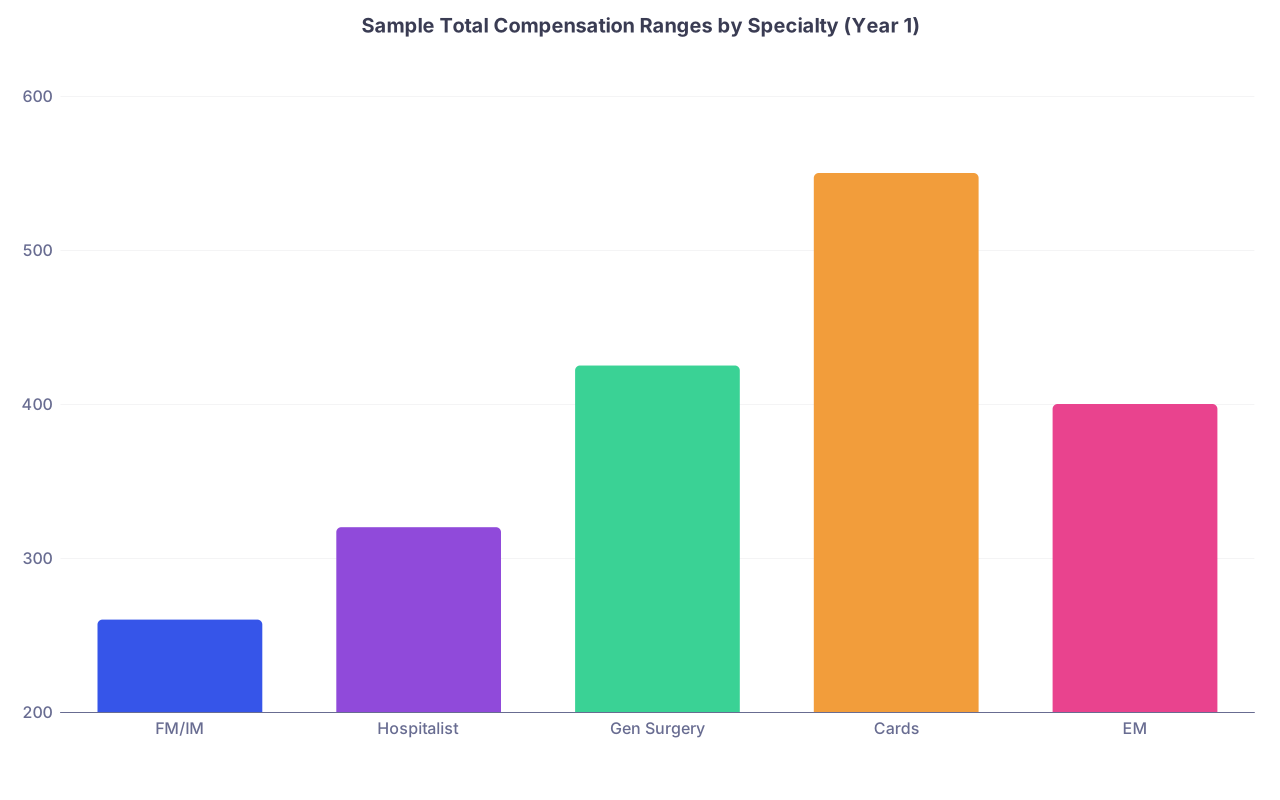
| Category | Value |
|---|---|
| FM/IM | 260 |
| Hospitalist | 320 |
| Gen Surgery | 425 |
| Cards | 550 |
| EM | 400 |
You do not need perfect precision. You need a defensible range, like:
- “For hospital‑employed cardiology in the Midwest, early‑career total comp typically runs 500–650k once ramped.”
That becomes your internal anchor.
B. Decide your “non‑negotiables” vs “nice to haves”
Write these down. Literally.
Non‑negotiables might be:
- Minimum base salary
- Maximum RVU target or call frequency
- Geography / commute
- Tail coverage and non‑compete radius
Nice‑to‑haves:
- Extra CME money
- Moving expense cap increase
- Slightly higher sign‑on bonus
- Admin time
This matters because you will trade. You cannot push on everything.
Step 2: The First Conversation – What to Say and Not Say
Assume you have done an initial interview and the group/hospital is interested.
A. When they ask: “What are your salary expectations?”
This is where many physicians tank their leverage by blurting out a low number.
Your goals:
- Avoid giving a hard number first
- Show you know the market
- Invite them to put their cards down
Good phrases to use:
“From my research on MGMA and colleagues in similar roles, compensation for this type of position tends to fall in the range of X to Y, depending on call and productivity. I am sure you have a structured range for this role—can you share how you typically compensate someone with my training and experience?”
“Compensation is important, but the overall fit, schedule, and support are equally critical. I would like to understand your typical package for a new hire in this specialty.”
“I am looking for a total compensation package that is competitive for this region and specialty. How have you structured offers for recent hires?”
Phrases to avoid:
“I just want something fair.”
(Too vague. They will define “fair,” not you.)“I am not really sure what is standard.”
(Signals ignorance. They will anchor low.)“Honestly, I would be happy with anything around 250k.”
(You just low‑balled yourself and cannot easily climb out.)“Money is not that important to me.”
(They will believe you.)
If they absolutely push you for a number:
Use this structure:
- “Based on MGMA 50th–75th percentile for [region/practice type] and discussions with peers, for a position with comparable call and RVU expectations, I would expect total compensation in the range of [X–Y]. I am open to how that is structured between base, productivity, and incentives.”
That sounds informed, not greedy.
Step 3: Responding to the Written Offer
Now you have the actual offer in writing. Time to dissect, then respond once. Not with emotional paragraphs. With a crisp, prioritized counter.
A. Decode the offer in a structured way
Pull the key elements into a simple grid so you can see the levers.
| Component | Offer #1 | Your Target |
|---|---|---|
| Base Salary | $270,000 | $300,000 |
| RVU Target | 6,000 RVUs | 5,200–5,500 RVUs |
| Sign-on Bonus | $15,000 | $25,000 |
| CME | $3,000 | $5,000 |
| Non-compete | 20 miles / 2y | 10 miles / 1y |
You will not fix everything. Pick 2–3 top priorities.
B. Email structure for your response
Use email. Keep it tight. Three parts:
- Brief appreciation and enthusiasm
- Clear, numbered list of requested changes
- Reaffirmation that you want to make this work
Template (customize, do not copy word‑for‑word):
Dr. Smith,
Thank you for sending the formal offer. I am very enthusiastic about the opportunity to join [Group/Department], especially given the patient population and the collegial feel I experienced on my visit.
After reviewing the contract and comparing it with current benchmarks for [specialty] in [region/practice type], there are a few areas I would like to discuss to see if we can align more closely:
- Base salary: The offered base of $270,000 is somewhat below what I am seeing for similar hospital‑employed positions in this region for my specialty. Based on MGMA data and recent discussions with colleagues, I was expecting a base in the $300,000 range.
- RVU target: A 6,000 RVU target for full bonus appears higher than typical for a starting physician, especially in year one while building a panel. Is there flexibility to reduce the target to around 5,200–5,500 RVUs initially, with adjustment once volume is established?
- Non‑compete: The current restriction of 20 miles for 2 years feels broad for this area. Would you consider narrowing this to 10 miles for 1 year?
I am very interested in this position and hope we can address these points so that the agreement reflects both the value I aim to bring and the norms for our market.
Sincerely,
[Your Name]
Notice:
- No rambling biography.
- No guilt, no desperation.
- Specific, reasonable asks.
C. Phrases that strengthen your position
Sprinkle these in conversation or follow‑up calls:
- “My goal is to structure this so it is sustainable long‑term—for me and for the practice.”
- “I want the targets to be aggressive but realistic, especially in the ramp‑up period.”
- “I am looking for alignment with current regional benchmarks for this specialty.”
- “Assuming we can get closer on these points, I would be ready to move forward quickly.”
D. Phrases that weaken or kill your leverage
Avoid like the plague:
- “I am probably overthinking this; it is fine as is.”
- “I really need this job, so I will sign whatever you send.”
- “If you cannot change it, I understand, I will still accept.” (Do not say this until you are actually ready to accept.)
- “Another group offered me X, can you beat it?” (Sounds like an auction; use comparisons more subtly.)
Step 4: Live Conversation – How to Talk Through the Numbers
Most of the real movement happens on a phone or Zoom call, not over email. This is where exact phrasing really matters.
A. When they say: “This is our standard offer”
You will hear this a lot. Often it is not entirely true.
Good responses:
“I understand you have standard templates. In my experience, there is usually some flexibility for candidates based on market conditions and specialty. Which pieces have the most room to adjust—base, incentives, or non‑compete?”
“I respect that you have standard contracts. At the same time, I want to be sure the agreement reflects current benchmarks. Where have you made exceptions for recent hires when needed to stay competitive?”
“If we keep everything else the same, what flexibility do you have specifically on [base salary / RVU target / sign‑on]?”
Bad responses:
- “Oh, if it is standard, okay then.”
- “If no one else has asked for changes, I do not want to rock the boat.”
- “I do not want to be difficult.”
You are not being difficult. You are doing basic business.
B. Discussing salary without sounding aggressive
You can be firm and collegial at the same time.
Example phrasing:
“Given my fellowship training in [subspecialty] and the call responsibilities we discussed, I believe a base in the low 300s would be more consistent with the market. How close can you get to that?”
“For a first‑year attending in [specialty], especially with unblocked clinic and call coverage, a base of around [X] seems appropriate based on current data. If [X] is not feasible, what is the highest base the group has offered in the last 12 months for a similar role?”
“I am comfortable tying a portion of my compensation to productivity, but I also want to avoid being under‑guaranteed while building volume. Can we adjust the base to [X] with a ramp‑up period for RVU expectations in year one?”
C. Talking about competing offers (without being tacky)
You can and should use other offers for leverage—but with tact.
Good phrases:
“I am in advanced discussions with another group in [city] where the base is somewhat higher and the non‑compete narrower. I am very interested in your practice for the clinical environment, so I wanted to see how close we can come on those elements.”
“Another opportunity I am considering is at [hospital type], with total compensation closer to [X]. I prefer this location and group dynamics here, so if we can come closer on base and call structure, I would be inclined to choose you.”
What not to say:
- “If you don’t match this exact number, I am walking.”
- “Group X is paying 340k; you need to beat that.”
- “I am just going to take the highest bidder.”
That frames you as transactional and unreliable. Hospitals hate that.
Step 5: Negotiating Non‑Salary Components (Where You Can Win Big)
Many physicians focus on base salary and ignore everything else. Mistake. There is often more flexibility in the “edges.”
A. RVUs and productivity
RVU traps are common. Do not step in blindly.
Key phrases:
“Can you walk me through how many RVUs your average physician in this specialty actually produced in year one and year two?”
“The target of 7,500 RVUs looks high compared to national benchmarks for a new attending. Are you open to a lower target for the first 12–18 months, with a step‑up when volume is established?”
“Is there a floor or guarantee for the first year if referrals are slower than expected?”
If their answers sound vague or defensive, that is a red flag.
B. Call responsibilities
Call can destroy your lifestyle and your effective hourly rate.
Good negotiation language:
“How many nights of call per month are typical, and how much of that is in‑house vs home call?”
“The call schedule you described sounds heavier than some other offers I am considering. If we keep that level of call, I would expect compensation to reflect that—either through an increased base or a defined call stipend. What options do you have there?”
“If call exceeds [X] nights per month on average, is there additional compensation?”
C. Bonuses, sign‑on, relocation, and CME
These are often the “easy” levers for an employer.
Phrases that work:
“The sign‑on bonus of $10,000 is a bit lower than what I am seeing locally. Is there room to increase that to $20,000, especially given my loan burden and relocation costs?”
“Relocation support of $7,500 may not fully cover the move for my family from [city]. Is there any flexibility to increase that to $10,000?”
“I would like to ensure I have adequate support for maintaining certification and licensure. Can we increase CME funds to $5,000 and 5 days annually?”
If they balk on salary, you can sometimes recoup value here.
D. Non‑compete, tail coverage, and term
This is the legal landmine territory. Get a physician contract attorney involved. Still, you need words.
For non‑compete:
- “I prefer not to have a non‑compete, but if that is not possible, I would like to significantly narrow the geographic radius and duration. Would you consider limiting it to 10 miles for one year, and only for locations where I actually practiced?”
Avoid saying:
- “I do not really understand non‑competes, but it seems okay.”
- “I am sure it will not be enforced.” (You do not know that.)
For tail coverage:
“Can you clarify who is responsible for tail coverage if I leave the group or if the group terminates my employment without cause?”
“Given the cost of tail coverage, I would like that obligation to fall to the employer in cases of termination without cause or non‑renewal on the employer side. Is that something you include for other physicians?”
Step 6: What to Say When They Say “No”
They will push back. That is their job.
A. If they say, “We cannot move on base salary”
You have options.
Option 1: Trade
- “If the base truly cannot move, can we adjust the structure in other ways—like a higher sign‑on bonus, increased relocation support, or a more realistic RVU threshold for bonuses?”
Option 2: Ask for justification
“Help me understand how you arrived at this base, given current benchmarks for [specialty] in this region.”
“What flexibility have you had historically for hard‑to‑recruit specialties or candidates with fellowship training?”
Option 3: Calm, conditional acceptance
If you decide to accept despite no movement:
- “I would prefer to see the base closer to [X], but I value the team and practice environment here. If we can clarify [RVU expectations/non‑compete/tail] in the contract as discussed, I will be comfortable moving forward.”
Notice: You are not groveling. You are making a rational trade.
B. If they say, “We do this for everyone, we cannot change it for you”
This line is often used reflexively. Sometimes it is true. Sometimes not.
Response:
- “I understand the desire for consistency. At the same time, market conditions and candidate backgrounds differ. Can we look at whether any elements—such as the non‑compete terms or initial RVU targets—have seen exceptions in recent years?”
If everything is “absolutely non‑negotiable,” that tells you a lot about how they will treat you as an employee.
Step 7: Phrases That Protect You Long‑Term
You are not just negotiating money. You are buying your future stress level.
Here are some high‑yield lines to use while reviewing the contract with them (and with your attorney):
“Can you point me to where in the contract the verbal understandings we discussed about call frequency and ramp‑up expectations are written?”
“I want to avoid surprises. If the group decides to change compensation models in the future, how would that affect current physicians? Is that addressed in the agreement?”
“If the hospital reduces support staff or changes clinic templates, does that impact RVU expectations or evaluation of my performance?”
If what they are promising is not in writing, it is not real.
Step 8: Mindset Check – How to Sound Like a Colleague, Not a Beggar
You are not asking for a favor. You are negotiating a business relationship in which you will generate millions of dollars over time.
Keep your tone:
- Calm
- Curious
- Data‑based
- Collaborative
Examples of balanced statements:
“I want this to be a win‑win. I am committed to building a strong practice here, and I want the agreement to reflect both the value I aim to bring and the realities of the current market.”
“I am sure you want physicians who feel fairly treated and are likely to stay. Getting this right up front increases that likelihood.”
“I am not trying to nickel‑and‑dime; I am trying to align incentives and expectations so I can focus on taking good care of patients.”
Contrast that with weak framing:
- “Sorry to bother you again, but…”
- “I hate to ask this, but…”
- “I know I am being a pain…”
Lose the apology reflex. You are negotiating a multi‑hundred‑thousand‑dollar annual contract. Serious business gets serious questions.
Step 9: A Simple Negotiation Flow You Can Follow
Use this as your operational checklist. No guesswork.

| Step | Description |
|---|---|
| Step 1 | Get written offer |
| Step 2 | Research benchmarks |
| Step 3 | List top 3 priorities |
| Step 4 | Attorney review |
| Step 5 | Email with specific asks |
| Step 6 | Phone or Zoom discussion |
| Step 7 | Confirm revisions in writing |
| Step 8 | Decide - accept or walk |
| Step 9 | Sign final contract |
| Step 10 | Did they move enough? |
Step 10: Concrete Phrases – Quick Reference
You probably want a shorter list you can literally have open during calls. Here it is.
Best phrases to use
- “Based on MGMA data and what I am hearing from colleagues, I was expecting…”
- “How much flexibility do you have on [base / RVUs / sign‑on / non‑compete]?”
- “Can you help me understand how you arrived at that number?”
- “If we cannot adjust X, could we look at improving Y and Z?”
- “I am very interested in this position and want to make the numbers work for both of us.”
- “Assuming we can get closer on these points, I am ready to move forward.”
- “I prefer not to have a non‑compete; if it must remain, can we narrow the radius and duration?”
- “I would like that obligation—especially tail coverage—to fall to the employer if the contract is not renewed on your end.”
Phrases to avoid
- “I will take whatever you think is fair.”
- “Money is not important to me.”
- “I am just happy to have a job.”
- “I am sure it will all work out.”
- “I do not really understand this part, but I am sure it is standard.”
- “I do not want to be a problem, so I will just sign.”
- “If you do not match this exact number, I am out.”
A Quick Look at Where Physicians Actually Get Burned
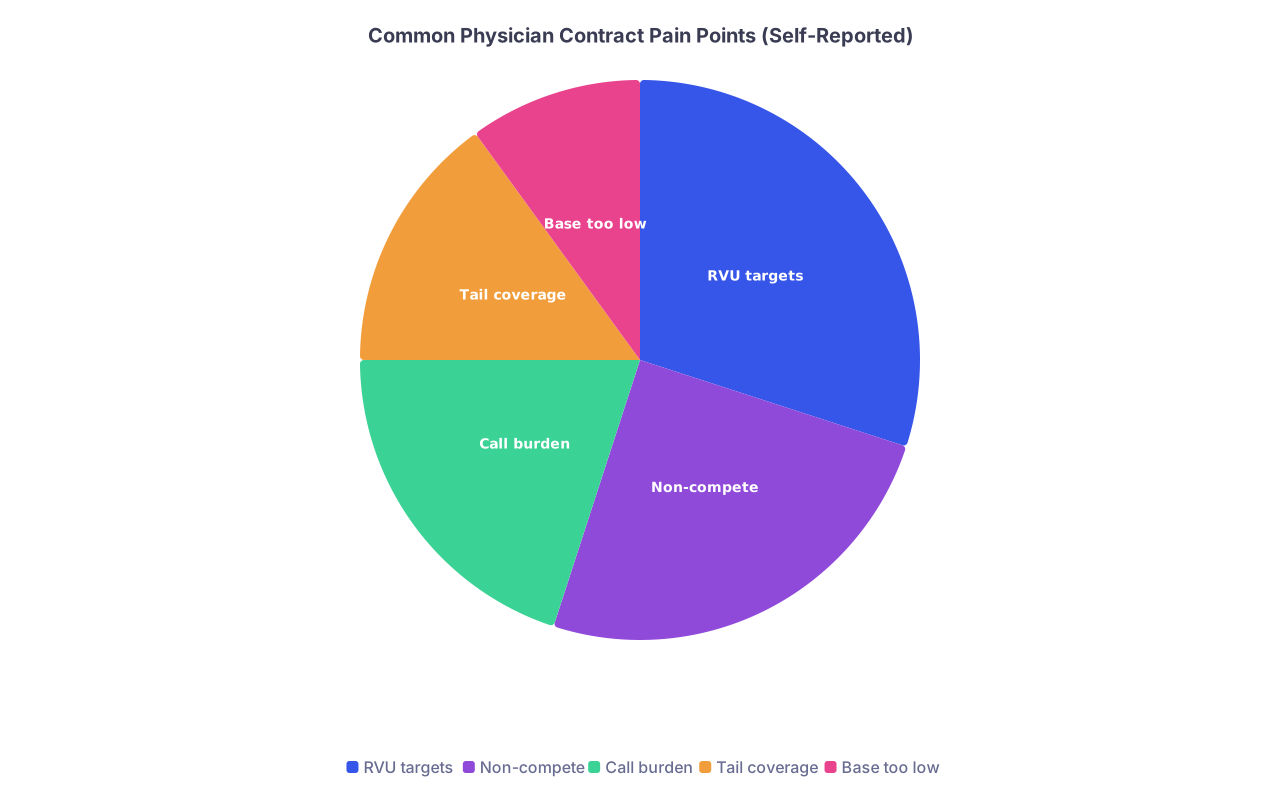
Most pain does not come from the base salary alone. It comes from the traps around it.
| Category | Value |
|---|---|
| RVU targets | 30 |
| Non-compete | 25 |
| Call burden | 20 |
| Tail coverage | 15 |
| Base too low | 10 |
If you remember nothing else, remember this: spend as much energy on RVUs, call, non‑compete, and tail as you do on base salary.
Your Move: One Action to Take Today
Do this now. Not tomorrow. Now.
Open a blank document and type three headings:
- “My realistic market range”
- “My non‑negotiables”
- “Phrases I will and will not use”
Under #3, copy in at least five “good” phrases from this article and five “bad” ones you refuse to say.
That becomes your personal negotiation script. When the next recruiter calls or an offer lands in your inbox, you will not improvise from a place of anxiety. You will execute a plan.
That is how you stop being the physician who “just signed whatever they sent” and start being the colleague who quietly, calmly, gets paid what they are worth.