
The way most physicians work with recruiters leaves money and control on the table. You are treating them like helpers instead of like leverage.
Let me fix that.
You are in a system where hospitals and groups pay recruiters five or six figures to bring them physicians. Yet you are approaching those same recruiters like you owe them something. That is backwards. The job is to use recruiters strategically to generate multiple offers, then use those offers to improve your salary, schedule, and protections.
Not “be grateful for whatever they bring.”
This is a playbook. Follow it and you will:
- Attract more and better offers in less time
- Turn those offers into real leverage
- Avoid the contracts that quietly destroy your income and freedom
I will assume you already know your specialty’s basic market (for example: hospitalist vs ortho vs EM). If not, you will learn fast using this approach.
1. Understand the Recruiter Game (So You Can Exploit It)
Recruiters are not your career coach. They are sales reps with quotas.
There are two main types:
- Agency / external recruiters – Third‑party firms (Merritt Hawkins, CompHealth, Jackson & Coker, Staff Care, etc.). They get paid per placement, often with big bonuses for signing quickly.
- In‑house recruiters – Employed by a hospital or large group. Their job is to sell you their organization.
Their incentives:
- Fill the job, fast
- For agency recruiters: maximize fee to the client, which often scales with your first‑year comp
- Minimize friction (questions, lawyers, delays)
Your incentives:
- Maximize lifetime income and control
- Avoid traps: non‑compete, RVU games, toxic call, impossible productivity targets
- Keep options open and offers coming in
Those incentives only partially overlap. So you must:
- Treat recruiters like information sources and negotiators, not advisors
- Never rely on a single recruiter
- Never assume “this is standard” is true without verification
Quick example from real life:
A hospitalist was offered $290k base “standard for our region” by an in‑house recruiter. Two phone calls later with agency recruiters, he had comparative data from 5 nearby systems paying $320–350k plus better sign‑ons. He went back to the original hospital with specifics. Result: $340k, a 20k sign‑on, and a lighter night schedule. Same recruiter. Same hospital. Very different posture.
2. Set Your Strategy Before You Talk to Anyone
Walking into this blind makes you easy to manipulate. You need a simple strategy:
A. Define your non‑negotiables
Write these down. Seriously, on paper:
- Minimum base salary
- Maximum acceptable call (nights/weekends)
- Must‑have location constraints (city radius, schools, spouse job)
- Deal‑breaker clauses (harsh non‑compete, tail coverage exposure, uncompensated call)
For example:
- “Base not less than $275k for outpatient IM, 4‑day clinic.”
- “No more than 1:4 call, no in‑house nights.”
- “Non‑compete must be ≤ 10 miles and ≤ 1 year or I walk.”
- “Employer must pay full tail if they terminate without cause.”
If you do not know your minimums, recruiters will define them for you.
B. Decide your timeline and offer strategy
Decide now:
- When you want to sign
- Whether you want to batch offers to expire around the same time
Your power multiplies if you can honestly say:
“I have two other offers expiring in 10 days. If you can get close to X/Y, I will sign with you.”
That only works if you orchestrate timing. More on that in Section 5.
3. Build a Small, Controlled Recruiter Bench
Most physicians either:
- Rely on the first recruiter who calls, or
- Blast their CV to 20 firms and lose all control
Both are lazy and expensive.
You want 3–5 active recruiters at any given time. Enough to cover the market. Few enough that you can actually manage them.
A. How to pick your 3–5
Use:
- Colleague recommendations (not from people who “felt good” about them, from people who got strong offers)
- Firm reputation in your specialty
- Demonstrated ability to speak your language (RVUs, call ratios, payor mix)
When you talk to a new recruiter, listen for red flags:
- “We have something perfect for you, just send me your CV first.” – Translation: I do not know your needs and I do not care.
- “Everything is negotiable” without giving ballpark numbers. – Usually means they are hiding a weak offer.
- “This is the best you will find in this area” before you have even heard three options.
Better signs:
- They talk numbers quickly and specifically
- They volunteer the downside of an opportunity without you pulling teeth
- They know competing hospitals in your region and quote real figures
B. Control your CV distribution
This matters. A lot. Random CV spam hurts you.
Protocols:
- Never give blanket permission to send your CV “anywhere that fits.”
- Require a list of specific facilities before they submit you.
- Approve each submission by name, in writing (email is fine).
Why? Because:
- If two recruiters submit you to the same job, many employers will dump you. They do not want to get caught in a fee dispute.
- Recruiters who blast your CV everywhere reduce your negotiating power. You look desperate and disorganized.
Quick script:
“I am happy to work with you, but I do not allow broad CV distribution. Send me the specific positions and facilities you want to present me to. I will approve in writing before you submit anywhere. No submissions without written approval.”
If they push back, they do not respect you. Move on.
4. Extract Market Intelligence Before You Negotiate
Before you even think about “What can you offer me?” you need a clear picture of the real market.
Recruiters are sitting on a massive dataset: every offer, every counter, every placement. Your job is to mine that.
Here is what you ask different recruiters about the same geographic area:
- Sample base salary range for your specialty
- RVU targets and dollar per RVU
- Sign‑on bonuses and common repayment terms
- Call structure and typical coverage
- Non‑compete range (miles and years)
You want hard numbers, not vibes.
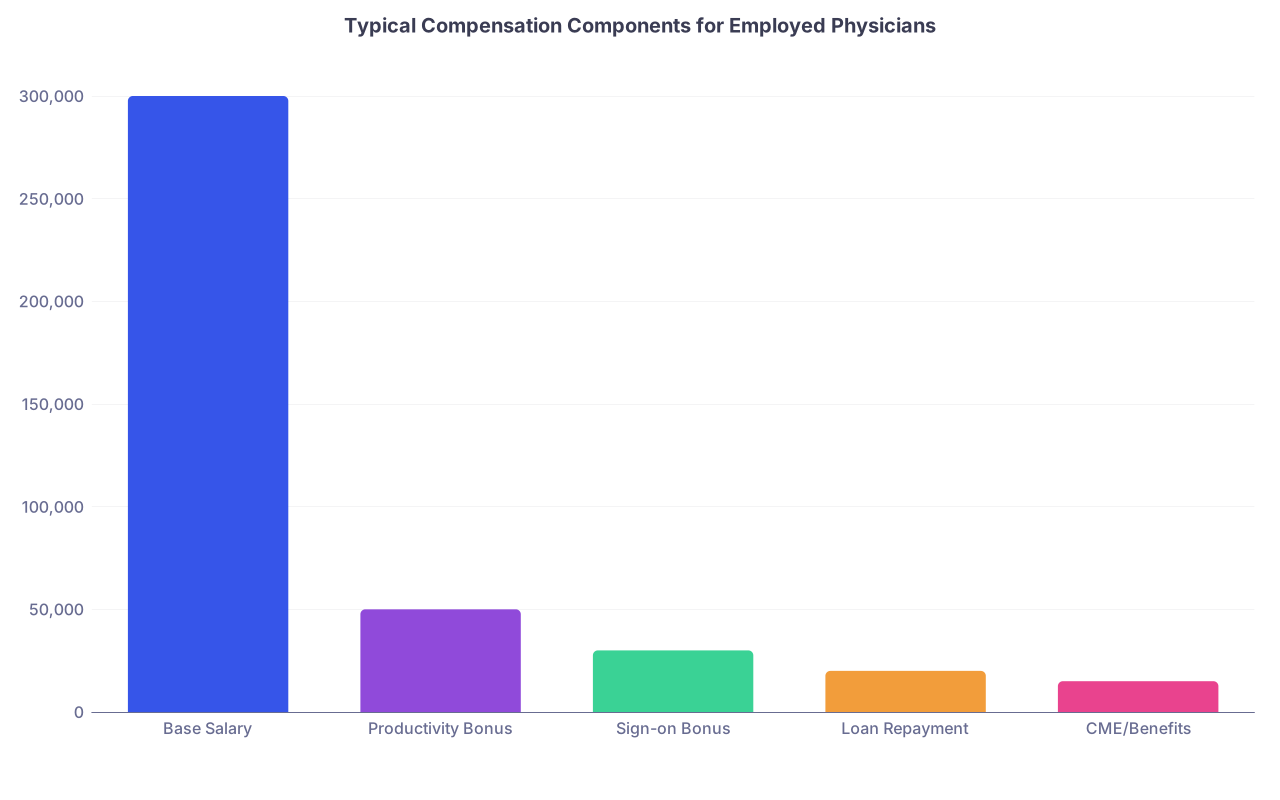
| Category | Value |
|---|---|
| Base Salary | 300000 |
| Productivity Bonus | 50000 |
| Sign-on Bonus | 30000 |
| Loan Repayment | 20000 |
| CME/Benefits | 15000 |
This chart is a generic pattern I have seen repeatedly:
- Base is the bulk
- Productivity can be meaningful or a mirage
- One‑time money (sign‑on, loan repayment) is negotiable if there are competing offers
- Benefits are less negotiable, but structure matters (tail, retirement match)
Ask each recruiter:
- “What are the top 3 offers you have seen in the last 12 months in [city/region] for my profile?”
- “Where does this offer sit – top quartile, median, or bottom of your recent placements?”
- “What levers have you actually moved before – base vs sign‑on vs RVU rate vs call compensation?”
You are not asking for favors. You are asking for data.
Then you cross‑check across recruiters. Patterns will jump out.
5. Orchestrate Multiple Offers On Purpose
Most physicians stumble into multiple offers by accident. You can do better.
A. Tighten your search window
If you want real leverage, compress your active interview period into 4–8 weeks.
That means:
- Week 0–1: Activate your 3–5 recruiters, state your target start date, and ask for all realistic options within driving/flying distance range
- Week 1–3: Phone screens / virtual interviews
- Week 3–6: Onsite interviews for the 3–5 best fits
- Week 5–8: Offers rolling in
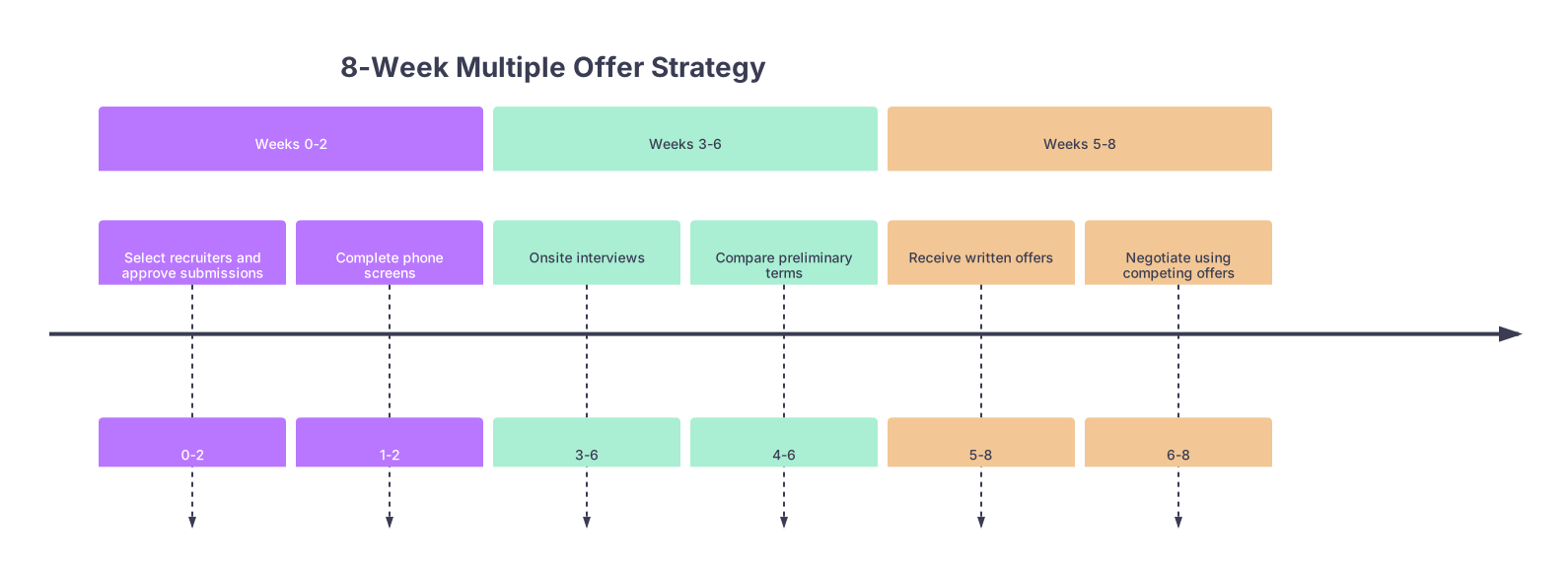
| Period | Event |
|---|---|
| Weeks 0-2 - Select recruiters and approve submissions | 0-2 |
| Weeks 0-2 - Complete phone screens | 1-2 |
| Weeks 3-6 - Onsite interviews | 3-6 |
| Weeks 3-6 - Compare preliminary terms | 4-6 |
| Weeks 5-8 - Receive written offers | 5-8 |
| Weeks 5-8 - Negotiate using competing offers | 6-8 |
You want overlap. If one place is far ahead, you slow them down:
“I am very interested. I have two other visits scheduled in the next three weeks. Could we plan to talk about formal terms after those visits so I can compare everything thoughtfully?”
Most reasonable groups accept that.
B. Get written offers, not “verbal promises”
Verbal numbers are worthless for leverage.
Your script:
“Thank you, that range sounds promising. I would like to review a written offer or at least a term sheet with the base, bonus structure, call schedule, and non‑compete. Once I have that, I can compare it with my other opportunities and respond quickly.”
You need at least:
- Base salary and duration (guaranteed? ramp‑up?)
- Bonus structure (RVU or collections formula, thresholds, dollar per unit)
- Call expectations and compensation
- Non‑compete radius and term
- Tail coverage responsibility
- Sign‑on / relocation / loan repayment and their repayment terms
Only then do competing offers become real leverage.
6. Use Recruiters as Negotiation Weapons (Without Burning Bridges)
You do not threaten. You inform. But you inform strategically.
A. What to tell recruiters about your other offers
To each recruiter (and, later, to each employer via the recruiter), you say some version of:
“I am very interested in this position. I want to be transparent that I have [number] other offers in [settings/regions] with base salaries in the [range] plus [key perks like sign‑on or reduced call]. If this role can be brought closer to that package, I would prioritize it.”
Key points:
- Give ranges, not exact numbers, unless it helps you
- Mention what matters most to you (e.g., protected admin time, flexible schedule, non‑compete)
- Keep the tone matter‑of‑fact, not emotional
Let the recruiter sell for you. Good recruiters love having a story:
- “Doctor X has two other offers at 320–340, but really prefers your location. If you could match 330 with a 25k sign‑on, I think we could get this done this week.”
You gave them the ammunition. Let them shoot.
B. What not to do
Do not:
- Fabricate offers. Recruiters talk. Hospitals talk. You will get caught.
- Use one offer purely to squeeze another if you would never actually take it. People remember.
- Let a recruiter rush you with artificial deadlines (“This will be gone by Friday”). Real hospitals have real needs; genuine ultimatums are rare.
You must be willing to walk away. That is not drama. It is the backbone of any negotiation.
7. Use Recruiters to Improve Non‑Salary Terms
The real financial damage in physician contracts is rarely the base salary. It is in the fine print.
Here is where recruiters can help you improve the stuff most doctors ignore.
| Term | Bad Version | Better Target |
|---|---|---|
| Non-compete | 25 miles, 2 years, any practice | 5–10 miles, 12 months, same specialty |
| Tail coverage | Physician pays full tail | Employer pays full or majority |
| RVU threshold | 7000 RVUs to hit bonus | 5000–5500 RVUs for meaningful bonus |
| Call | 1:3, no extra pay | 1:4+ or paid call rate |
| Sign-on/relocation | Large clawback if leave before 3 years | Prorated forgiveness over 2–3 years |
A. Give recruiters your priority list
After you receive an initial offer, tell the recruiter exactly what you want tweaked, in order:
“My priorities, in order:
- Shorten the non‑compete to 10 miles and 12 months.
- Employer to cover full malpractice tail if they terminate without cause.
- Either raise base from 300 to 320, or keep 300 and add a 25k sign‑on.
- Clarify that call above 1:4 is compensated at [X] per shift.”
A good recruiter loves this. It is a clean ask list they can take to the group.
B. Know what is usually moveable
From actual placements, I will tell you what tends to move:
- Sign‑on bonus and relocation – Often the easiest. Quick win.
- Non‑compete radius and term – More flexible than you think, especially outside big‑name systems.
- Tail coverage – Harder, but often negotiable to “employer pays if they terminate without cause.”
- Call schedule and call pay – Very negotiable in overworked groups.
- Base – Moveable, but sometimes less than other levers.
What is usually rigid:
- Core benefit structure (health, dental, basic retirement)
- RVU conversion factor at big systems (though thresholds and guarantees can move)
- System‑wide policies (PTO caps, CME limits) – but you can sometimes get exceptions with the right pressure.
Push where the wall is thin.
8. Protect Yourself Legally Without Killing Deals
You are in the Financial and Legal phase. This is where many physicians either over‑lawyer and lose offers, or under‑lawyer and get stuck.
Here is a sane middle.
A. Use the recruiter to normalize lawyer review
You do not need to apologize for wanting a lawyer. Use the recruiter as your ally:
“I appreciate the offer. My standard process is to have a physician contract attorney review before I sign anything. Once I have the draft, I will turn it around quickly, usually within a week. Can you let the group know that is my plan?”
Most large employers expect this.
What kills deals is:
- Going dark for 3 weeks after getting a contract
- Having your lawyer send a 5‑page redline trying to rewrite every policy under the sun
B. Coordinate timing with multiple offers
When you have more than one contract in hand:
- Tell each recruiter you are sending the contract to an attorney this week.
- Give each employer the same review timeline (for example, 7–10 days).
- When your attorney flags issues, prioritize the same 3–5 points across all contracts (non‑compete, tail, base, call, bonuses).
Then you can say to Employer A, via recruiter:
“I have contracts from two groups. Both others have agreed to [shorter non‑compete / tail coverage / better call]. If we can get close to that, you are my first choice.”
Again, you are not threatening. You are calibrating.
9. Know When to Say Yes (And Stop Shopping)
Endless shopping destroys credibility. There is a point where one more “maybe” does more harm than good.
Here is my rule: Once you have 2–3 solid written offers that all:
- Meet your minimums
- Have acceptable non‑compete and tail terms
- Come from environments you could see yourself in for 3+ years
… your job shifts from searching to choosing.
Use this short checklist:
- Money: Which offer has the highest realistic total comp over 3 years (base + expected productivity + sign‑on/loan help + retirement match)?
- Control: Which gives you the best control over schedule, location, and exit options (weakest non‑compete, best tail)?
- Sanity: Which practice culture felt least dysfunctional during your visit? (You know the answer; stop pretending you do not.)
One more trick: Ask each recruiter privately,
“If this were you or your spouse with my specialty and situation, which of these would you pick and why?”
You will sometimes get surprising honesty. They have seen physicians crash and burn in certain groups.
Once you decide, stop using recruiters to squeeze more out of other offers you would never take. That is where people remember you as “the difficult doc.” Not worth it.
10. After You Sign: Keep Recruiters As Long‑Term Assets
Do not disappear after you sign. You just trained a set of recruiters to understand your value.
Here is how you turn them into long‑term leverage:
- Let them know where you landed, start date, and what you finally negotiated.
- Once you are settled (6–12 months), send an occasional brief update: “I am doing X volume, Y RVUs, Z leadership roles.”
- Make it clear you are open to hearing exceptional opportunities but are not actively looking.
Why? Because 2–3 years from now, when:
- Your group sells to a private equity firm
- The new administrator decides RVU targets must jump 20%
- Your “guaranteed” base evaporates
… you want those recruiters to already have you in their mental “high‑value candidate” file.
They will call you first with strong options. And once again, you will use multiple offers to reset your income and control.
FAQ (Exactly 3 Questions)
1. Should I ever work with just one recruiter exclusively?
Generally, no. Exclusive arrangements usually benefit the recruiter more than you. The only exception is if a single recruiter clearly dominates your niche (for example, high‑end ortho in a specific region) and can demonstrably access almost every job you would want. Even then, keep informal contact with one or two others as a hedge.
2. How much should I tell a recruiter about my current salary?
Give ranges, not exact numbers, and always anchor to the market, not your current underpayment. For example: “I am currently in the mid‑200s, but based on my RVUs and what I am seeing in the market, I am targeting low‑ to mid‑300s with reasonable call.” Do not let them frame every offer as “a raise” over your current job. That is not the relevant benchmark.
3. When is it too late in the process to negotiate via the recruiter?
Once you have formally signed the contract, you are largely done. Before signature, it is fair game, even if you are “just about ready to sign,” as long as you are reasonable and focused on a few key points. The most effective time to push is after you have a written offer but before you have verbally committed. That is when your leverage (and the recruiter’s motivation to close) is highest.
Key points to walk away with:
- Recruiters are tools, not bosses. Use 3–5, control your CV, and extract the market data they sit on.
- Engineer multiple written offers on a tight timeline, then use those offers to move not just salary, but non‑compete, tail coverage, call, and bonuses.
- Involve a physician contract attorney early, negotiate through the recruiter on a short list of high‑impact items, decide promptly, and keep those recruiters as long‑term allies for your next move.