
You are almost certainly being underpaid more than you think. And the way most attendings try to fix it—vague grumbling, passive hints, or waiting for “recognition”—does not work.
You fix this with a process. Not emotion. Not loyalty speeches. A clear, evidence-based, businesslike negotiation that your employer cannot easily ignore.
Let me walk you through that process.
Step 1: Confirm You Are Actually Underpaid (With Numbers, Not Vibes)
You do not open a salary conversation with “I feel underpaid.” That gets you a sympathetic nod and nothing else. You open with data.
You need three buckets of information:
- Market compensation for your specialty and region
- Your actual productivity and value to the group/hospital
- Your contract terms and how they compare
Do this in order.
1.1 Get Real Compensation Data
Stop guessing. Pull credible benchmarks.
Use at least two of these:
- MGMA (Medical Group Management Association)
- AMGA (American Medical Group Association)
- AAMC (for academic salaries)
- Specialty society surveys (e.g., ACEP, ASA, ACR, AAFP)
- Large recruiter reports (Merritt Hawkins, Doximity, Medscape as a rough reference, not gospel)
If you do not have institutional access to MGMA/AMGA, ask:
- Your department chair / practice manager (“Do we have access to MGMA data for compensation benchmarking?”)
- Colleagues in leadership roles
- Your hospital’s business office or physician compensation committee
Capture:
- Base salary percentiles (25th, 50th, 75th, 90th) for:
- Your specialty
- Your region (or at least similar regions: Midwest vs West Coast vs Southeast, etc.)
- Practice type (academic vs private vs hospital-employed)
- wRVU or productivity-based benchmarks if applicable
- Incentive/bonus norms
| Metric | 25th %ile | 50th %ile | 75th %ile |
|---|---|---|---|
| Base Salary (Non-Op IM) | $230k | $260k | $300k |
| Total Comp (Non-Op IM) | $250k | $290k | $340k |
| wRVUs per Year | 4,000 | 4,800 | 5,400 |
Your goal: know exactly where you sit in this distribution. Not “about average.” A number.
1.2 Quantify Your Own Value
Hospitals and groups understand three things:
- Volume
- Revenue
- Risk
If you cannot show them those, you are negotiating blind.
Collect the following from your EMR, billing office, or practice administrator:
- wRVUs for the past 12–24 months
- Total encounters / procedures per month
- Call burden:
- Number of call shifts per month
- In-house vs home call
- Actual intensity (pages, consults)
- Non-clinical work:
- Committees, leadership roles
- QI projects
- Teaching and supervision
- EHR optimization, scheduling, etc.
Put this into something that looks like a report. One simple page.
For example:
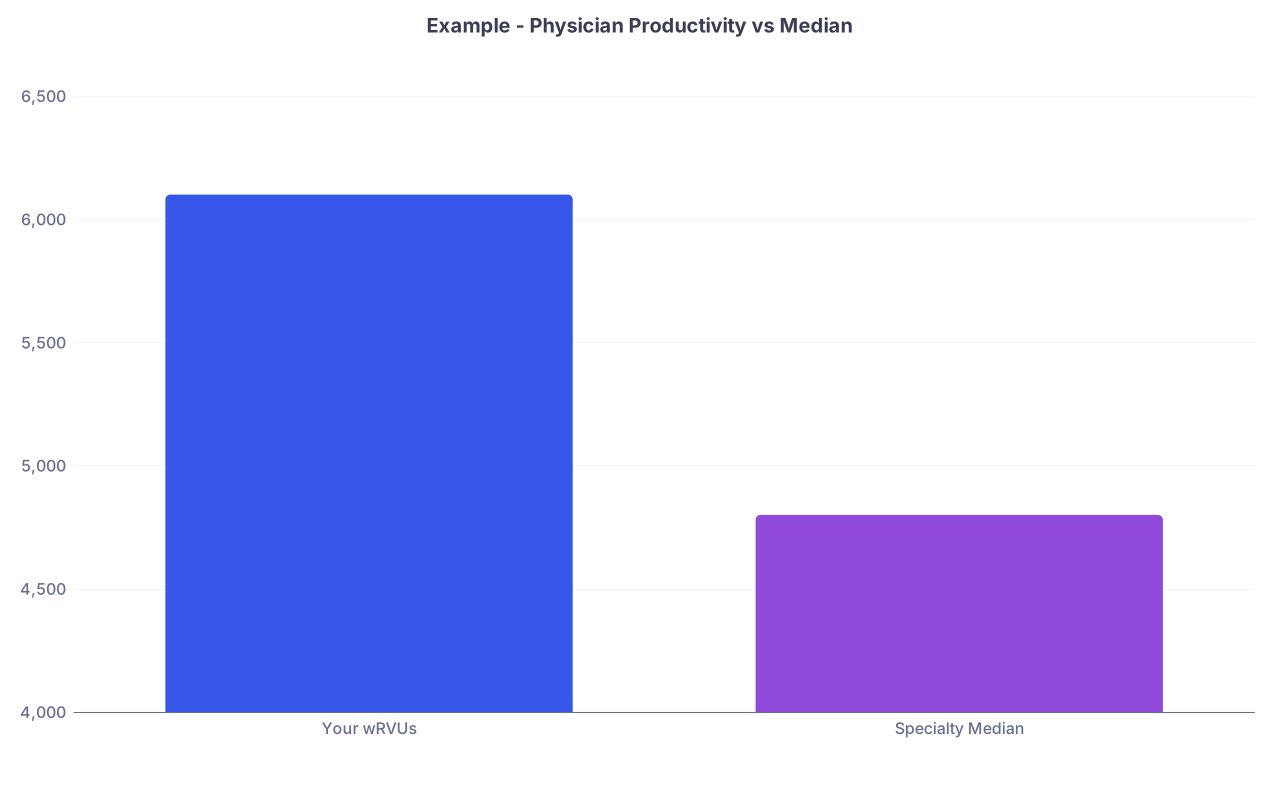
- “Over the last 12 months, I averaged 6,100 wRVUs per year.”
- “The median MGMA for my specialty is 4,800 wRVUs; I am at ~127% of median productivity.”
- “I take 8 call shifts per month vs group average of 5.”
If you can get collections or gross revenue tied to your billing, even better. Many hospital-employed physicians cannot, but ask. Sometimes someone in finance will quietly hand you a report if you are direct.
| Category | Value |
|---|---|
| Your wRVUs | 6100 |
| Specialty Median | 4800 |
1.3 Read Your Current Contract Like a Lawyer (Briefly)
You do not need to become an attorney. You do need to stop being surprised by your own contract.
Pull out:
- Base salary and how it is adjusted (annual, discretionary, formula-based)
- Bonus structure:
- Threshold wRVUs
- Conversion factor (e.g., $50/wRVU)
- Quality metrics or other gates
- Call pay:
- Per shift
- In-house vs home call
- Holiday differentials
- Non-compete:
- Radius and duration
- Termination clauses:
- Without cause: notice period (60/90/120 days)
- With cause: what triggers it
- Automatic renewal:
- Evergreen or fixed term
- When renegotiation windows occur
Mark anything that looks like this:
- “May be adjusted at employer’s sole discretion”
- “Subject to annual review” without specifics
- “Productivity bonus as determined by employer”
Those are opportunities. And risks.
Step 2: Translate “Underpaid” Into a Specific Ask
You are still not ready to talk to anyone. You need the actual number and structure you will request.
Aim for something you can say in one breath.
“Based on my productivity and current market data, I am requesting my salary be adjusted from $X to $Y, and that my wRVU threshold be aligned with MGMA median.”
Your ask must be:
- Specific (not “more money”)
- Justified (tied to real data)
- Reasonable but assertive (aim for solidly above median if your productivity supports it)
2.1 Build a Simple Comparison
Take your data and put it in a clean table like this:
| Item | You Now | Market Median | 75th Percentile |
|---|---|---|---|
| Base Salary | $260,000 | $290,000 | $330,000 |
| Total Comp (Est.) | $285,000 | $320,000 | $370,000 |
| Annual wRVUs | 6,100 | 4,800 | 5,400 |
| wRVUs as % of Median | 127% | 100% | 113% |
Then translate that into a reasonable target.
If you are at 127% of median productivity and being paid at 50th percentile comp, asking for 75th percentile total compensation is completely reasonable.
Something like:
“Given that my productivity is 127% of median and my current compensation is around the 50th percentile, I believe an adjustment into the 75th percentile range is appropriate. That would be in the range of $X–$Y.”
2.2 Decide on Structure, Not Just Amount
Most physicians only talk about base salary. Big mistake.
You should think in terms of:
- Base salary
- Productivity incentives
- Call pay
- Protected time / FTE percentage
- Non-monetary support
Examples of structural asks:
- Increase base by $30,000 and raise wRVU conversion factor from $44 to $50
- Lower wRVU threshold for bonus from 5,000 to 4,500
- Add $500 per 24-hour call and $1,000 for major holidays
- Convert 0.1 FTE to protected admin time with no pay cut
You may not get them all, but knowing your priorities keeps you from getting “bought off” by a small, shiny raise that does not fix the underlying problem.
Step 3: Pick Your Timing and Venue Like a Professional, Not a Victim
You do not renegotiate a salary in the hallway between cases. Or after a night of brutal call when everyone is exhausted.
3.1 Timing: Hit Natural Leverage Points
Your best windows:
- Contract renewal (3–6 months before expiration)
- End of fiscal year / annual review cycle
- After a major positive change you created, such as:
- Taking on a new leadership role
- Covering an additional clinic or service
- Driving significant growth in volume
- Implementing a QI project that cut length of stay, readmissions, etc.
If your contract auto-renews, you still can ask. Aim 6–12 months after starting if you significantly exceeded promised productivity, or after any major change in responsibilities.
Avoid:
- Right after a big institutional loss or layoff round
- In the middle of a public scandal or merger chaos
- During budget freezes if leadership has explicitly said “no comp changes this cycle”
Still ask eventually. Just do not walk into a buzzsaw when they are already primed to say no to everything.
3.2 Who You Actually Talk To
You need the person (or people) with real authority.
Common options:
- Private group: managing partner, compensation committee chair
- Hospital-employed: department chair + service line director + HR/compensation rep
- Academic: division chief, department chair, or both
Start by asking for a formal compensation review meeting, not “a quick chat.”
Language you can use in email:
“I would like to schedule a dedicated meeting to review my compensation in light of my current productivity and recent market data. I have compiled my wRVUs and regional benchmarks and believe a formal review is appropriate.”
This signals: you are serious, prepared, and not just venting.
Step 4: Prepare Your Negotiation Packet
You need to walk in with a small, organized packet. Not a pile of screenshots on your phone.
Create a 2–3 page document:
- Cover summary (1 page)
- Your current comp vs benchmarks
- Your productivity data
- Your specific request
- Supporting details (1–2 pages)
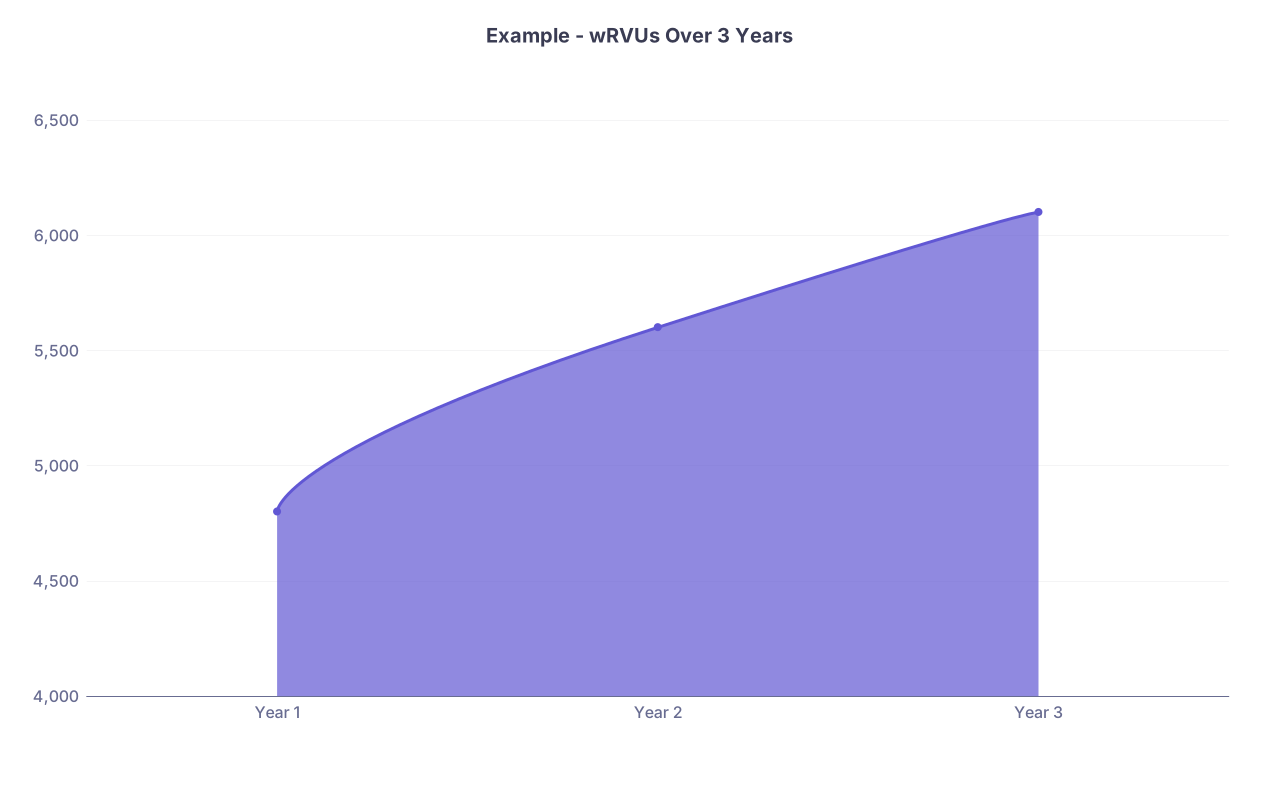
- Graph or table of your wRVUs over time
- Summary of call burden, leadership roles, non-clinical work
| Category | Value |
|---|---|
| Year 1 | 4800 |
| Year 2 | 5600 |
| Year 3 | 6100 |
Print it. Bring a few copies. PDF it and email it afterward.
This is not about theatrics. It is about making it very easy for decision-makers to justify saying yes to you in their own internal meetings.
Step 5: Run the Actual Conversation (Script Included)
This is where most attendings fall apart. They either get defensive or apologetic. You are going to do neither.
You will:
- State your case clearly
- Stay calm
- Anchor with data
- Ask a direct question
5.1 How to Open the Meeting
You sit down, they say some pleasantries. You respond, then pivot quickly.
Example script:
“Thank you for meeting with me. I wanted to review my current compensation in light of my productivity over the past year and current market benchmarks for our specialty and region. I have put together a short summary.”
Hand them the packet. Let them look for 15–30 seconds.
Then:
“As you can see, my annual wRVUs over the past 12 months are approximately 6,100, which is about 127% of the MGMA median for our specialty. My current total compensation is around the 50th percentile. Based on this, I believe an adjustment into the 75th percentile range is appropriate.”
Pause. Let the silence work for you.
5.2 Anchor Your Ask
Do not say “I was hoping.” You are not hoping. You are proposing.
Example:
“Specifically, I am requesting that my base salary be adjusted from $260,000 to $310,000, with my bonus threshold aligned with MGMA median wRVUs. I also think an adjustment to call pay of $500 per 24-hour call would more accurately reflect the volume and responsibility of our current call schedule.”
You can modify the structure. But keep the clarity.
5.3 Expect Their First Move: Delay, Deflect, or Minimize
Common responses and how to handle them:
“We pay everyone fairly and use a standard formula.”
Response:
“I appreciate the effort to keep things standardized. My concern is that the current formula does not reflect my level of productivity or call burden. I am open to adjustments within your framework, but I would like my compensation to be aligned with my 127% of median productivity. How can we address that within the current system?”
“We do not have the budget for raises right now.”
Response:
“I understand budget constraints. My productivity already generates significantly above-median value for the group. If a full adjustment is not possible immediately, I would like to discuss a phased plan over the next 12–18 months, tied to continued productivity. What would be a realistic target we can commit to now?”
“Everyone is underpaid; we have to be fair to the group.”
Response:
“If the entire group is misaligned with market data, that is a broader issue. My request is specifically tied to my productivity and call burden, which are substantially above median. I am asking to be brought closer to market-consistent compensation for that level of work. What steps can we take to start that adjustment?”
“We can revisit this next year.” (The brush-off)
Response:
“I am willing to work with a timeline, but I would like a specific plan rather than a general promise. Can we agree today on target numbers or a formula that will be implemented by [date], contingent on my productivity remaining at this level?”
You are always politely pulling them back to: numbers, plan, timeline.
Step 6: Use Leverage Without Empty Threats
You do not need to say, “I will leave if I do not get this.” Often you should not.
But you do need to quietly know your outside options.
6.1 Test the Market Before You Walk In
Do this before you negotiate:
- Update your CV.
- Reach out to 2–3 recruiters in your specialty.
- Submit interest to 2–3 appealing jobs (even if just to gauge).
- Take at least one serious exploratory call.
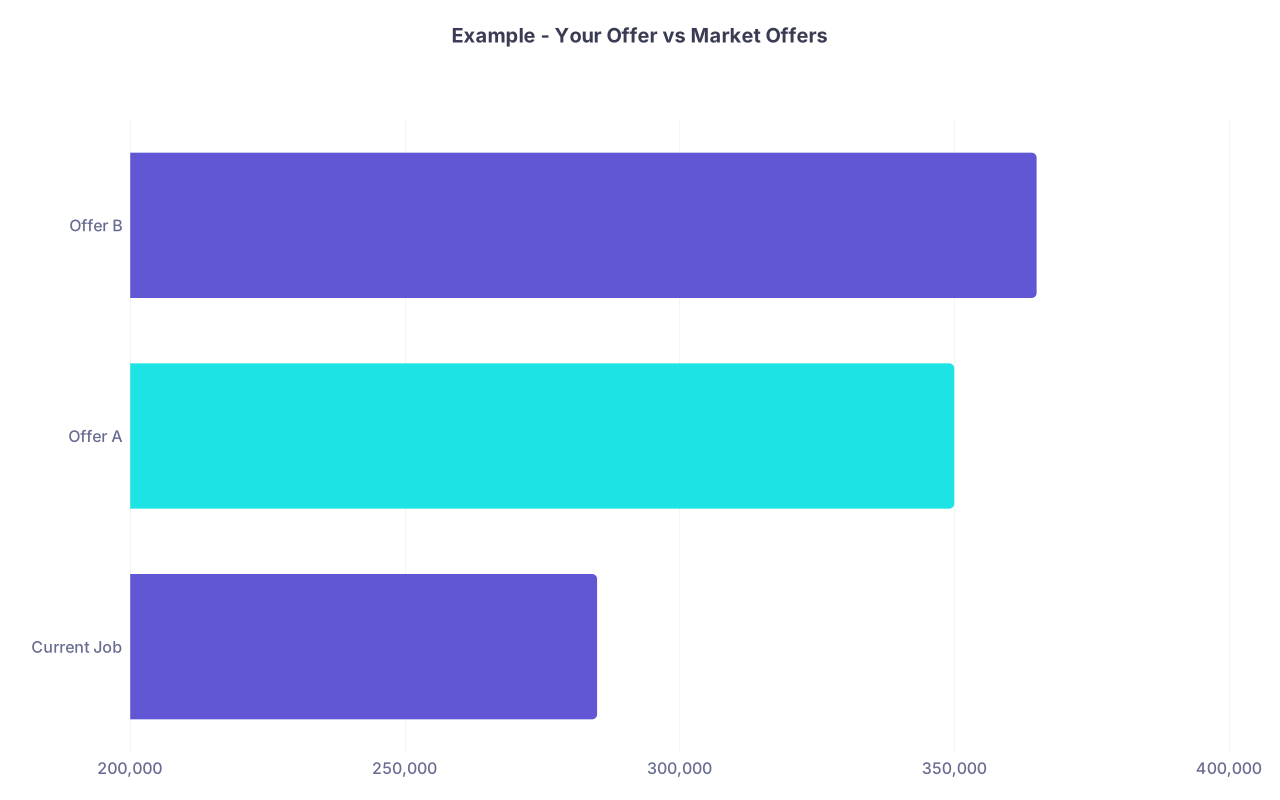
You want real numbers like:
- “Group X is offering $350,000 base plus $20/wRVU over threshold, with $3,000 per call weekend.”
You are not going to wave that in their face. But you need to know what you would be turning down.
This does two things:
- Gives you internal confidence. You are not stuck.
- Tells you if your ask is truly reasonable or actually below market.
| Category | Value |
|---|---|
| Current Job | 285000 |
| Offer A | 350000 |
| Offer B | 365000 |
6.2 When (and How) to Mention External Interest
You use this lightly, not as a club.
If they absolutely stonewall and you are genuinely ready to leave if needed, you can say:
“I want to be transparent that I have been approached by other groups that are aligned more closely with MGMA 75th–90th percentile compensation for my productivity level. My strong preference is to stay here, given my commitment to our patients and team, but I do need my compensation to be competitive and sustainable.”
Then ask:
“Is there a path you see to getting us materially closer to that range over the next contract period?”
This is not a tantrum. It is a business reality statement.
Step 7: Get Outcomes in Writing and Lock in a Follow-Up
The meeting ends in one of three ways:
- They agree in principle and will “run it up the chain.”
- They offer a partial or alternate solution.
- They refuse or give vague non-committal responses.
Handle each deliberately.
7.1 If They Seem Positive
You say:
“Thank you, I appreciate your willingness to look at this. To make sure we are on the same page, my understanding is that you will propose increasing my base to $X and adjusting my bonus structure as discussed, with a target effective date of [date]. Is that accurate?”
Then immediately after the meeting, send a brief recap email:
“Thank you again for meeting today to discuss my compensation. As summarized, my current productivity is approximately 6,100 wRVUs annually (127% of MGMA median), and we discussed adjusting my base salary to $X with bonus threshold aligned to MGMA median, effective [date], pending approval. I look forward to hearing the outcome of your discussions.”
This creates a paper trail. It also jogs their memory when they forget in two weeks.
7.2 If They Offer Less Than You Asked
Do not reflexively accept. Ask questions.
For example, they say, “We can do $15,000 more, but not $50,000.”
You can respond:
“I appreciate the movement and I understand there are constraints. Given that I am at 127% of median productivity, can we structure an additional productivity-based component that would allow me to reach closer to 75th percentile total compensation if I maintain or exceed my current volume?”
Push toward:
- Higher wRVU conversion factor
- Lower thresholds
- Better call pay
- Clear schedule / FTE protections
You might accept a stepped plan:
- $15,000 now
- Another $15,000 in 12 months if you maintain volume
- Adjusted bonus formula written into the contract
If you accept, again, get it in writing and tied to your contract or an official amendment.
7.3 If They Stonewall or Gaslight You
You will see some version of:
- “Be grateful, you are well paid.”
- “Everyone else is fine with this.”
- “If you are unhappy, maybe this is not the right place for you.”
That tells you all you need to know about your long-term future there.
Stay calm:
“I hear your position. From my perspective, being compensated at 50th percentile while producing at 127% of median is not sustainable in the long term. My preference is to work together to find a solution that reflects my contribution here. If that is not possible, then I may need to consider other options.”
At that point, the “conversation” has shifted to exit planning, not negotiation.
You do not threaten. You just stop pretending.
Step 8: Decide Your Next Move Like a Business Owner, Not an Employee
After the meeting and follow-up, you will likely end in one of three states:
- You got what you asked for or close to it.
- You got a partial win.
- You hit a brick wall.
8.1 If You Got It (or Close Enough)
Good. You are not done.
- Verify the contract amendment actually reflects what was agreed upon.
- Confirm:
- Base salary
- Bonus formula details (wRVU thresholds, conversion rate)
- Call pay
- Start dates
- Watch your first few paychecks after the change. HR errors are common.
Set a calendar reminder 12 months out: Comp review. You do not wait another five years.
8.2 If You Got a Partial Win
Ask yourself:
- Does this move me clearly closer to fair market value?
- Is there a documented pathway for further adjustments?
- Do I still feel resentment, or does this feel like progress?
If it is a step in the right direction and you like other aspects of the job (colleagues, schedule, location), you might accept, but keep your external options warm.
Agree on a specific review date and metrics.
Example:
“If I maintain at least 6,000 wRVUs over the next 12 months, will we agree now to move my compensation closer to the 75th percentile at that time?”
Again, get this in an email at least, contract if possible.
8.3 If You Hit a Brick Wall
Now you do serious math and serious soul-searching.
- Compare:
- Your current comp vs external offers (not hypothetical, actual numbers)
- Non-financial pros and cons (school for kids, spouse job, community)
- Long-term burnout risk of staying undervalued
If you stay, you are making a conscious trade: money and fairness for stability or personal reasons. Fine. But do not stay and complain for three more years without changing anything.
If you leave:
- Review your non-compete with an actual attorney.
- Time your exit to:
- Contract notice requirements
- Bonus/retention payment schedules
- Loan forgiveness or vesting cliffs
Then treat the job change itself as another negotiation. You are not going to repeat the same mistake.
Quick Reality Checks That Physicians Hate But Need
- If you have never asked for a raise or renegotiation since starting, you are almost certainly underpaid.
- If your employer becomes angry or punitive when you raise data-based concerns, you are in a bad system. Not a family.
- If your productivity has climbed year after year without any corresponding change in comp or schedule, they already know they are getting a bargain. They will not change out of kindness.
Renegotiation is not about being greedy. It is about being a rational professional in a system that treats you like a cost center unless you push back.
The Core Moves You Cannot Skip
Three points to keep in your head:
- You must bring data. Market benchmarks, your wRVUs, your call burden. Feelings do not move compensation committees. Numbers do.
- You must make a clear, specific ask. “I would like to be adjusted from $X to $Y based on my 127% of median productivity, with the following changes to my bonus and call structure…”
- You must be willing to act on your options. Quietly test the market so you are negotiating from strength, not from fear.
Do those three consistently, and you stop being the chronically underpaid attending waiting for someone to rescue you. You start acting like the person who actually generates the revenue in this system—because you are.