
How to Build Non-Clinical Income Streams Without Burning Out Clinically
You finish another 12‑hour day in clinic. Two no‑shows, three add‑ons, an inbox that looks like a denial factory, and someone just told you “Well, I read on Google…” for the 20th time.
On the drive home you think, “I need another income stream. Something that does not depend on RVUs and call schedules.”
Then your next thought hits: “If I add anything else, I will break.”
That tension—wanting non-clinical income but already running at 110%—is exactly what you are dealing with. You are not lazy. You are capacity‑maxed. The solution is not “hustle harder.” The solution is to build non‑clinical income deliberately, with rules that protect your clinical sanity.
Here is how you actually do that.
Step 1: Get Honest About Your Capacity and Risk Tolerance
Most physicians skip this and jump straight to “What side gig pays the most?” That is how you end up signing a consulting contract at midnight after 9 straight clinic hours and hating your life.
You start with constraints, not opportunities.
A. Define your weekly non-clinical budget
You need a hard cap. Not a vibe.
- Take your current schedule. Look at a real week, not an idealized one.
- Count:
- Clinical hours (in room / OR / on the floor)
- Charting / admin at home
- Call / post‑call zombification time
- Then ask: “How many hours per week can I add for 12 months without resenting my life?”
For most full‑time attendings:
- 3–5 hours/week is sustainable
- 5–8 hours/week is aggressive but doable for 6–12 months
8 hours/week long term = you are probably kidding yourself
Pick a number and write it down. That is your non‑clinical time budget.
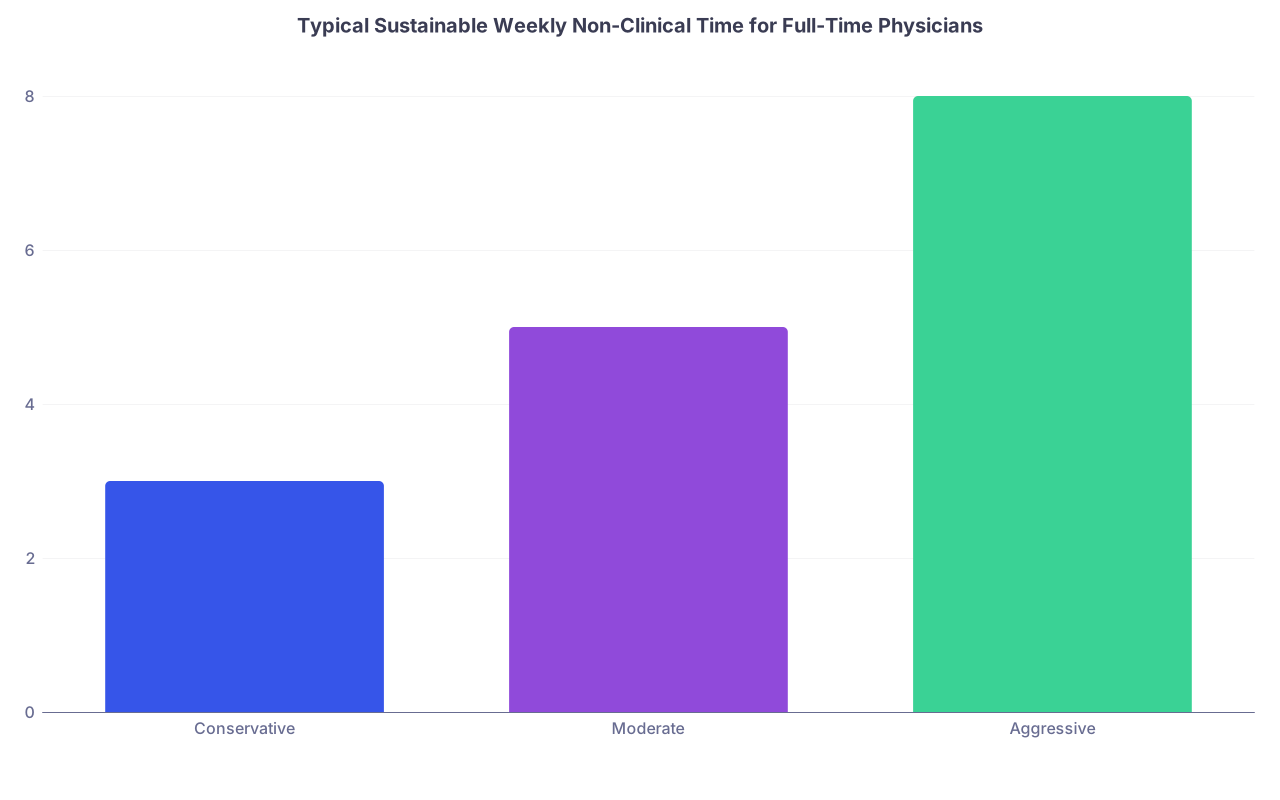
| Category | Value |
|---|---|
| Conservative | 3 |
| Moderate | 5 |
| Aggressive | 8 |
If you are already drowning in charting, your first “non‑clinical project” might actually be: fix documentation workflow, use scribes, or negotiate schedule changes. You build non-clinical income on top of a stable base, not on top of chaos.
B. Clarify your risk tolerance
Different income streams have different:
- Time to first dollar
- Upfront cost
- Legal/contract risk
- Reputation risk
Be blunt with yourself:
- “Am I comfortable putting $20–50k into something that may take 3–5 years to pay off?” (real estate, private practice ownership, startups)
- “Can I tolerate my name on something public? (podcast, Substack, YouTube)”
- “How much do I need to protect my current employer relationship?”
Write down:
- Max cash you are willing to invest in year 1
- Max time you are willing to invest weekly (already set)
- Whether you are okay being public or must stay low‑profile
That becomes your filter. Anything that blows past those limits is out—for now.
Step 2: Choose the Right Type of Non-Clinical Income for Your Situation
You do not need 10 income streams. You need 1–3 that fit your life, training, risk profile, and contract.
Split options into two big buckets:
- Active non-clinical income – you trade time for money outside patient care
- Semi-passive / asset-based income – you trade capital, IP, or systems for money
You will likely start with active. Faster path to cash, lower capital risk.
A. Common active non-clinical income streams for physicians
Here are realistic, physician‑compatible options:
| Option | Time to First Dollar | Typical Pay Range |
|---|---|---|
| Expert witness work | 1–6 months | $300–$800/hr |
| Utilization review | 1–3 months | $125–$200/hr |
| Chart review/IME | 1–4 months | $150–$400/hr |
| Telehealth consulting | 1–2 months | $80–$200/hr or per visit |
| Content creation (paid) | 3–12 months | Wide, $50–$3000+/piece |
Let me be clear: not all of these are good for you. Some will destroy your schedule. Some will be politically risky at your hospital. You pick based on leverage.
High‑leverage active options (best time:money ratio for most physicians):
Expert witness / medicolegal consulting
- Pros: Very high hourly rate, flexible, intellectually interesting
- Cons: Emotional load, must handle cross‑examination, conflict with colleagues possible
- Good for: Mid‑career physicians with strong CV, board certification, clear niche
Utilization review / insurance medical director
- Pros: Remote, structured hours, uses your clinical brain differently
- Cons: Some colleagues will think you “work for the dark side”; can be monotonous
- Good for: Physicians who like guidelines, systems, and policy
Chart review / independent medical exams (IMEs)
- Pros: Defined tasks, predictable deliverables
- Cons: Boring documentation, need to be careful legally and ethically
If you are already cooked at the end of the day, high‑leverage work you can batch on one non‑clinical afternoon will beat anything that requires daily low‑pay effort.
B. Semi-passive and asset-based options
These are slower to start but can eventually decouple your time from money:
- Real estate investing (direct ownership, syndications, funds)
- Digital products (online courses, ebooks, templates)
- Equity in startups (advising a health tech company)
- Niche subscription communities or newsletters
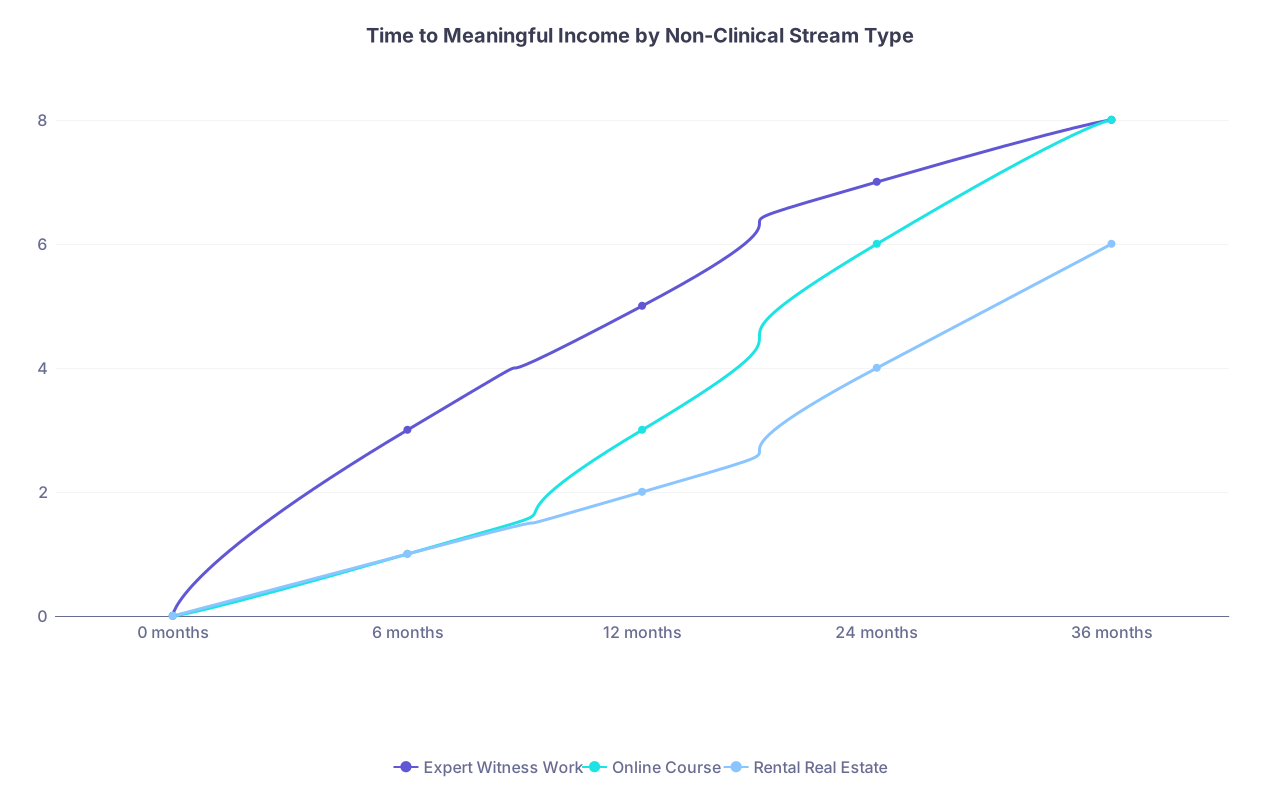
| Category | Expert Witness Work | Online Course | Rental Real Estate |
|---|---|---|---|
| 0 months | 0 | 0 | 0 |
| 6 months | 3 | 1 | 1 |
| 12 months | 5 | 3 | 2 |
| 24 months | 7 | 6 | 4 |
| 36 months | 8 | 8 | 6 |
Scores above are relative income scale (not dollars): the point is trend. Legal work can ramp fairly fast. Courses and real estate take longer but mature well.
For burnout protection, do one of each:
- 1 active, high‑pay, flexible stream
- 1 long‑term, asset‑building project (that you do slowly, without fantasy timelines)
Step 3: Protect Yourself Legally and Contractually Before You Start
This is where physicians get burned. You absolutely must handle the boring stuff upfront so your side income does not explode your clinical job, license, or marriage.
A. Check your employment contract for:
Non-compete clauses
- Some contracts define “practice of medicine” so broadly that telehealth, consulting, or even health‑related writing could theoretically trigger issues.
- Look for:
- Geographic radius
- Time period after leaving
- Scope (direct patient care only, or broader?)
Outside work / “moonlighting” policies
- Many hospitals require written approval for:
- Any paid work using your professional credentials
- Use of your title or affiliation
- Some explicitly mention:
- Expert witness work
- Pharmaceutical consulting
- Speaking engagements
- Many hospitals require written approval for:
-
- Some large systems claim ownership over anything you create “related to your work” or using their resources.
- If you are building an online course, app, or protocol, you want this clarified.
If your contract is vague or aggressive, pay for one hour with a physician‑savvy healthcare attorney. Not your cousin who does real estate closings.
B. Decide on business structure
For most physicians starting non-clinical income:
- Start as a sole proprietor if:
- You are doing low‑risk consulting, writing, or expert work
- Just testing the waters
- Form an LLC if:
- You know you will continue and grow
- You are taking on more legal exposure (real estate, courses with lots of customers, etc.)
- You want cleaner separation of finances and easier contracts
Do not let “I need the perfect entity structure” delay you for a year. But at minimum:
- Separate business checking account
- Separate credit card
- Track income and expenses from day 1 (even if it is $200)
C. Get appropriate coverage
Depending on your stream:
- Professional liability / E&O for:
- Expert witness work
- Consulting that includes clinical guidance or guideline interpretation
- Tail coverage questions:
- If you leave your clinical job and do part‑time clinical plus consulting, how is your tail covered?
- Disability insurance:
- If your non‑clinical income grows, you may want coverage that includes “own occupation” and recognizes that you can work non‑clinically while being disabled from clinical care
You want to be in a position where if something goes sideways, it is a business problem, not a “lose your house and license” problem.
Step 4: Design Your Non-Clinical Work So It Does Not Cannibalize Your Clinical Life
This is where most physicians fail. They try to cram side work into random scraps of time and end up half‑doing both.
You will build guardrails.
A. Use a fixed, recurring time block
Decide:
- 1–2 fixed time blocks per week that are sacred for non‑clinical work. Examples:
- Tuesday 7–9 pm
- Saturday 9 am–noon
- Post‑call afternoon (if safe and not brain‑dead)
- No squeezing it “wherever it fits.” That is how charting and email eat everything.
During those blocks:
- Phone on Do Not Disturb
- No EMR open
- No clinic inbox
- Only non‑clinical income project work
If you cannot protect 3–5 hours of focused time a week, you are not ready to add income streams. Fix workflow first.
B. Batch similar tasks
Context switching is what exhausts you, not total hours alone.
For example, suppose your non‑clinical stream is expert witness work:
- Batch 1: Case intake and contract review
- Batch 2: Case document review and note‑taking
- Batch 3: Opinion drafting
- Batch 4: Meeting with attorneys / depo prep
You do not half‑scroll through PDFs between patient rooms. That is how stuff gets missed and how you expose yourself to errors.
Same if you are building a course or writing:
- One block for outlining
- One for content creation
- One for editing / responding to feedback
Single‑tasking is a burnout prevention tool, not a productivity fad.
Step 5: Pick One Concrete Starting Path and Execute
Let me give you three specific starter “plays” that actually work for busy, full‑time physicians, with a step‑by‑step plan.
Path 1: Become an Expert Witness (High Pay, Moderate Time, Medium Emotional Load)
Best for: Board‑certified physicians with at least 3–5 years in practice, clean record, and comfortable explaining medicine to laypeople.
Steps (over 3–6 months)
Clarify your niche
- Example: “Board‑certified OB/GYN, 10 years in academic setting, high‑risk obstetrics focus”
- The narrower and clearer, the better.
Create a short, professional CV specifically for legal work
- 2–3 pages max, highlight:
- Training and board certification
- Clinical roles
- Teaching / leadership roles
- Publications or guideline work
- 2–3 pages max, highlight:
Set your policies and rates upfront
- Decide:
- Hourly rate for review (e.g., $400–$700+ depending on specialty and experience)
- Retainer amount (e.g., 5–10 hours paid upfront)
- Minimum charge for deposition / court (often 4‑hour minimum)
- Cancellation policy
- Put this in a simple terms sheet.
- Decide:
Get yourself listed
- Join 2–3 reputable expert witness directories (not the scammy, race‑to‑the‑bottom ones).
- Network quietly:
- Ask defense attorneys who work with your hospital
- Ask colleagues who already do this
Build a simple professional presence
- One‑page website or LinkedIn profile explicitly stating:
- Your specialty
- Types of cases you review
- Contact method
- Keep hospital affiliation separate.
- One‑page website or LinkedIn profile explicitly stating:
Create templates
- Engagement letter template
- Invoice template
- Case intake checklist
- Standard report structure
Do that once and you will reuse it 100+ times.
Path 2: Utilization Review or Insurance Medical Director (Stable, Remote, Less Emotional)
Best for: Physicians who like guidelines, policies, and “big picture” care systems.
Steps (over 1–3 months)
Update your CV to highlight
- Committee work (QA, peer review, credentialing)
- Guideline implementation
- Any admin titles (medical director, lead, etc.)
Set your non‑clinical schedule expectation
- Example: “I am available 8 hours per week, 1 full day or 2 half days”
- Companies like predictable blocks more than random hours.
Apply where this work lives
- National payers (United, Aetna, Cigna, BCBS plans)
- Utilization management companies (Evicore, etc.)
- Regional insurers or Medicaid MCOs
In interviews, be clear
- You want:
- Remote work
- Fixed blocks of time
- No 24/7 on‑call nonsense
- You want:
Clarify conflict of interest
- Confirm with your employer that this is allowed
- You may need to avoid reviewing cases from your own hospital/system
Once established, this can give you steady, controllable hours with no nights/weekends.
Path 3: Build a Lean Digital Product (Longer Horizon, Asset‑Building)
Best for: Physicians with a specific expertise or framework that solves a common problem.
Forget the fantasy of a giant course making $500k in 6 weeks. You start small and controlled.
Steps (over 6–12 months)
Define a painful, narrow problem
- Example:
- “Helping new grad NPs in cardiology interpret basic echo reports confidently”
- “Teaching anesthesia residents how to manage OB call safely in their first year”
- If your problem statement includes “everyone” or “anyone,” it is too vague.
- Example:
Test demand cheaply
- Host a 60–90 minute live Zoom workshop on the topic
- Charge something ($49–$99). Free “interest” is worthless; payment is proof.
- Record it.
Turn the recording into a starter product
- Light editing
- Add a simple PDF checklist or guide
- Host on a course platform (Teachable, Kajabi, etc.)
Systematize your promotion in 1–2 channels
- LinkedIn posts for professionals
- Email list you start from people who attended your workshop
- Professional Facebook groups (if allowed)
Iterate slowly
- Every 1–2 months, run another version of the workshop:
- Improve slides based on questions
- Refine your framework
- After 3–4 runs, you will know:
- If there is real demand
- How to structure a deeper course (if warranted)
- Every 1–2 months, run another version of the workshop:
This is slow burn but can eventually produce “money while you sleep” without destroying you.
Step 6: Build a Simple System to Track Money, Time, and Burnout
If you do not track, you will drift. Drift leads to resentment and overwork.
You only need three basic dashboards: money, time, and how fried you feel.
A. Money: is this actually worth it?
Track monthly:
- Gross income from each stream
- Direct expenses (software, professional services, CME, travel, etc.)
- Time spent (from your time budget)
Then calculate effective hourly rate:
Effective hourly rate = (Gross income – direct expenses) / hours spent
| Activity | Monthly Income | Hours/Month | Effective Hourly Rate |
|---|---|---|---|
| Extra clinic sessions | $4,000 | 20 | $200/hr |
| Expert witness work | $6,000 | 10 | $600/hr |
| Digital product | $1,000 | 4 | $250/hr |
If your non‑clinical work pays less per hour than picking up one extra clinic half‑day—and you hate it more—stop. Or raise rates.
B. Time: are you respecting the budget?
Every Sunday, look at:
- Did you respect the 3–5 hour weekly non‑clinical limit?
- If you exceeded it:
- Was it a one‑off (trial, launch, etc.)?
- Or is the system broken?
If you are consistently exceeding your budget, you must:
- Cut clinical hours
- Or reduce non‑clinical commitments
- Or systematize/delegate (more on this next)
C. Burnout: is this making life better or worse?
Quick subjective check monthly. Scale 1–5:
- Clinical burnout last month
- Non‑clinical stress last month
- Sense of progress toward financial goals
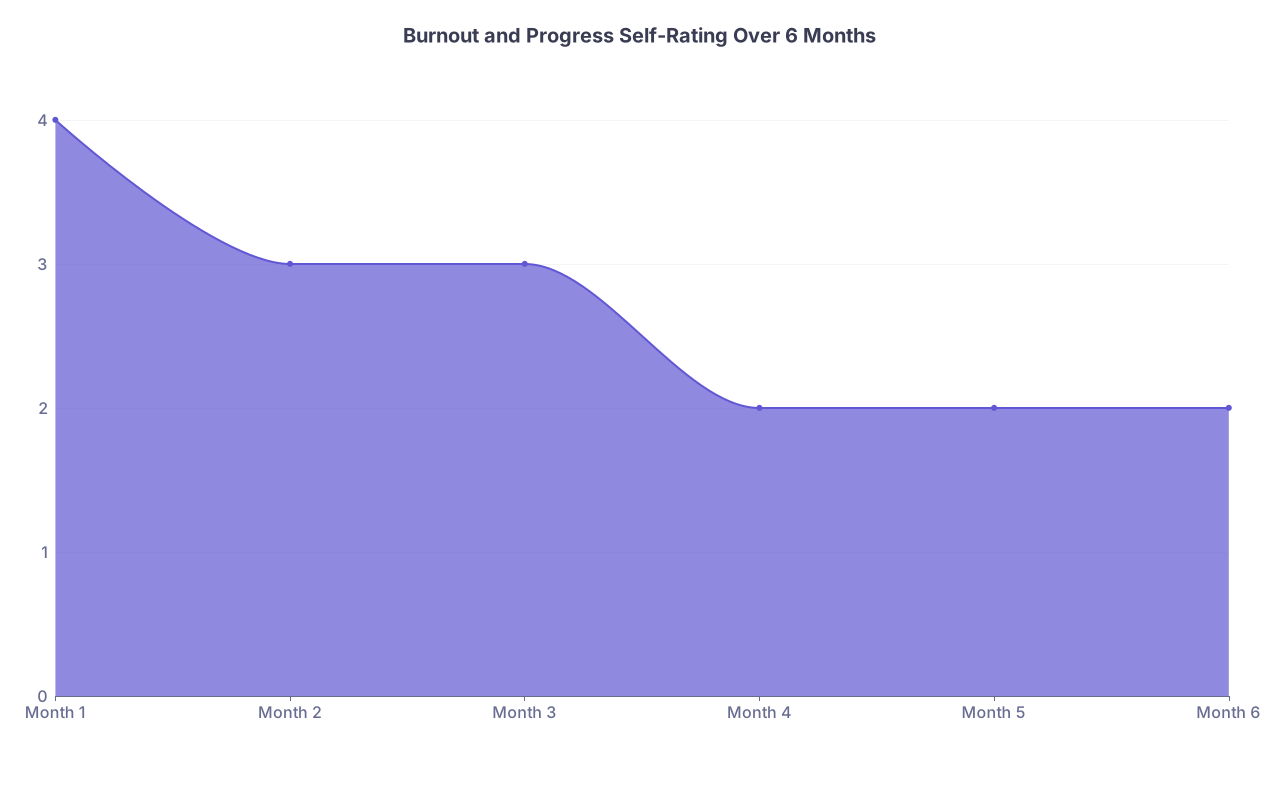
| Category | Value |
|---|---|
| Month 1 | 4 |
| Month 2 | 3 |
| Month 3 | 3 |
| Month 4 | 2 |
| Month 5 | 2 |
| Month 6 | 2 |
(Example: lower is better burnout score.)
If non‑clinical work is raising your overall burnout score after 3–6 months, you adjust or exit. The whole point is to create options and reduce dependence on clinical grind, not add another grind.
Step 7: Use Leverage: Systems, Delegation, and Saying “No”
The most underused skill among physicians: saying “No” to low‑value work. You are trained to default to “Yes.” That must change if you are going to add non‑clinical income without imploding.
A. Systemize repetitive tasks early
Anything you do more than twice needs a mini‑system:
- Email template for:
- New client inquiries
- Rate discussions
- Scheduling
- Checklists for:
- Case review prep
- Travel and speaking
- Workshop setup
Write them once. Stop reinventing them.
B. Delegate administrative noise as soon as there is cash flow
As your side income grows, buy back your time:
- Virtual assistant for:
- Email triage
- Scheduling
- Invoicing and payment chase
- Bookkeeper for:
- Monthly reconciliation
- Quarterly estimates
- Editor or designer for:
- Slide decks
- Simple marketing materials
If you are billing $300–$600+/hr and spending your time manually formatting invoices, that is just bad math.
C. Ruthlessly say “No” to bad‑fit offers
You will get:
- Invites to “collaborate” that pay in “exposure”
- Lowball consulting offers from companies that want a physician stamp for peanuts
- Requests to join advisory boards “in exchange for future equity” that never materializes
Your default response:
“This does not fit my current priorities, but thank you for thinking of me.”
This is not arrogance. It is survival. Guarding your limited non‑clinical hours is the only way to prevent side work from becoming another source of resentment.
Step 8: Plan the Long Game: From “Extra Income” to Real Optionality
The end goal here is not $1,000/month “fun money.” It is optionality:
- The option to cut clinical FTE without panicking
- The option to leave a toxic job
- The option to practice medicine on your own terms
Think in phases:
Year 1: Exploration and proof of concept
- One active stream
- One slow asset‑building project
- Learn what you like and what pays
Years 2–3: Focus and scaling
- Double down on the 1–2 streams with the best time/$$/joy ratio
- Systematize and delegate
- Begin shifting clinical FTE slightly if desired (0.1–0.2 changes)
Years 4–5: Optionality
- Non‑clinical income covers 25–50%+ of your living expenses
- Clinical work becomes more negotiable
- You can say “No” to bad contracts because you are not financially desperate
The physicians I have seen pull this off did not chase every new idea. They chose one lane, worked it steadily for years, and guarded their energy.
Your Next Step Today
Do not try to build a complete non‑clinical empire in your head tonight. That is how you overwhelm yourself and do nothing.
Do this instead:
- Open your calendar for the next 4 weeks.
- Block one recurring 2‑hour slot per week labeled “Non-clinical / future income.”
- In the first block, answer three questions in writing:
- How many hours per week can I realistically commit for 12 months?
- What is my maximum cash I am willing to invest in year 1?
- Which one path feels most aligned right now: expert witness, utilization review, or a starter digital product?
That is it. No website. No LLC. No 40‑page business plan.
Protect those 2 hours. Use them to make one concrete decision and take the first small step—updating your CV, emailing one colleague who does expert work, or outlining a 60‑minute workshop.
You build non‑clinical income the same way you built clinical skill: specific, repeatable actions, done consistently, with a clear sense of what you will not do.