
You are in the physician lounge at 2:17 a.m. The ED just paged you for the third consult in an hour. Your partner is on vacation, your “backup” is covering two hospitals, and tomorrow you are supposed to be in clinic at 8:00 a.m. You open your paycheck app between cases and do the math.
You are getting exactly $0 extra for this night.
Or you are getting $250 for 24 hours of q30min pages, ICU admits, and zero sleep. Which works out to less than your nurse’s overtime rate.
Here is the truth: hospitals and groups almost never “volunteer” to pay more for call. They respond to pressure, data, and risk. You will not get paid better call rates because you are a “team player”. You will get paid when (a) you know the market, (b) you speak their language (coverage, risk, throughput, revenue), and (c) you use tight, rehearsed scripts that make it easier to say yes than no.
Let me walk you through how to do that.
Step 1: Get Your Ammunition – Real Numbers, Not Vibes
You cannot negotiate call pay from a feeling. You negotiate from data and leverage.
You need three categories of numbers: market, your coverage, and hospital impact.
1. Market Data: What Others Get Paid
Your goal is to come in with external benchmarks that make your ask look reasonable, not greedy.
Use:
- MGMA / AMGA / SullivanCotter call pay data (if your group has access, or your specialty society).
- Local intel from colleagues at:
- Competing hospitals in your city
- Same specialty at hospitals 1–2 hours away
- Recruiter data from job postings and emails.
Make a simple comparison table so you can reference it in one sentence during negotiation.
| Source | Weeknight Call | Weekend 24-hr Call |
|---|---|---|
| Hospital A (same city) | $600 | $1,200 |
| Hospital B (regional) | $750 | $1,500 |
| MGMA 50th percentile | $650 | $1,400 |
| Your current hospital | $0–$200 | $400 |
You want to walk in knowing:
“For my specialty and market, typical 24-hour in-house call is $1,000–$1,500. We get $400.”
That gap is your leverage.
2. Your Coverage Reality: How Bad Is It… On Paper?
You are used to the chaos, so you underestimate it. Do a two-week hard count:
- Number of calls / pages per shift
- Number of admissions / consults
- Average in-house time after midnight
- Post-call clinic still expected? (yes/no)
- Any “fracture” of call (two hospitals, multiple floors, etc.)
You do this for one reason: to turn “call is heavy” into “here is what a typical call day looks like.”
Script-friendly summary example:
“On a typical 24-hour call, I handle 15–20 pages, 4–6 new consults, and I am physically in the hospital 6–10 hours, often past midnight. Then I am expected to cover full clinic the following day.”
That sounds very different from “I am pretty busy on call.”
3. Hospital Impact: Why Your Call Matters to Them
Administrators do not care that you are tired. They care about:
- EMTALA coverage
- Surgical or procedural block utilization
- ED throughput times
- Transfers accepted or lost
- ICU coverage and length of stay
- On-call obligations in service line agreements
You want a few concrete impact lines. Things like:
- “Without neurology call, 80% of our ED stroke cases would transfer out.”
- “We accepted 14 transfers last month during my call weekends.”
- “If we drop OB coverage, L&D essentially shuts down after 5 p.m.”
If you do not know the numbers, get rough ones from:
- ED director
- Service line director (cardiology/orthopedics/neuro/etc.)
- Hospitalist or ICU director
They usually know.
Step 2: Decide Your Strategy – Solo Ask vs. Group Move
Do not walk in blind. Decide which scenario you are actually in.

A. Employed Physician, Solo Ask
You are hospital-employed or large system-employed. Your leverage is:
- Reputational risk if you refuse call
- Recruitment cost if you leave
- EMTALA or service line risk if you reduce coverage
You need:
- Clean data
- Reasonable ask (anchored high, but not ridiculous)
- A clear alternative (you will reduce call, or you will leave, if they stonewall indefinitely)
B. Private Group Contracted With Hospital
You and your partners provide coverage for the hospital and bill your own professional fees.
You have more leverage because you can change your call contract. But you need internal alignment.
Minimum steps:
- Get internal vote: what will your group ask for?
- Decide your walk-away: no more 24-hour in-house, or no unassigned call, etc.
- Put a simple written proposal together (1–2 pages max).
C. “Orphan Specialist” / Small Group With Scarce Skills
You are one of three pulmonologists in town. Or the only neurosurgery group. Or you do niche procedures others do not.
Your scarcity is leverage. Hospitals know that replacing you is 12–18 months + $100k–$400k in recruitment costs.
In this case, your strategy is:
- Very clear market database
- Demonstrated recent recruitment difficulty in your region
- Quiet but firm mention that other systems have approached you
You do not need to threaten. You just need them to understand the replacement cost.
Step 3: Build Your Core Script – What You Actually Say
You want a short, repeatable core script that you can adapt to email, a meeting, or a phone call.
Here is a structure that works consistently:
- Open with alignment.
- Describe reality factually.
- Present market and risk.
- Make a concrete proposal.
- Give them a path to yes.
Core Script – Employed Physician, First Conversation
Use this for a sit-down with your department chair or service line director.
“I want to talk about our call structure, because the way it is set up now is not sustainable for me long-term. I am committed to keeping high-quality coverage for the hospital, but we need to realign how call is compensated.
“Right now, a typical 24-hour call for me includes 15–20 pages, 4–6 new consults, and 6–10 hours in-house, often past midnight, followed by a full clinic day. For that, I receive $400 in call pay.
“I looked at benchmarks. Comparable hospitals in our region are paying $1,000–$1,500 per 24-hour in-house call for my specialty. MGMA data shows a median of about $1,400. So we are significantly below market.
“This has two effects: it makes retention difficult, and it makes us less competitive for new hires. We have already seen candidates reject us for this reason. If we lose coverage, the hospital is at risk for EMTALA violations and transfer losses.
“Here is what I am asking:
- Increase 24-hour in-house call to $1,200 per shift;
- Increase weeknight from home to $400.
“I am open to phasing this in over 6–12 months if budget is tight, but we need a clear, written plan with specific rates and start dates.
“What is the best way to move this forward – should we set up a meeting with HR and finance, or is there a standard process you prefer?”
Key points:
- You state the ask in dollars, not “more pay”.
- You anchor with market data.
- You connect it directly to recruitment/retention and risk.
- You give them an easy next step instead of forcing an immediate yes.
Script – If They Say “We Do Not Pay for Call Here”
You will hear this. A lot. Often from legacy systems.
Reply with calm, no edge:
“I understand that has been the historical approach. The challenge is that the market has shifted. Most competing hospitals in our area are now paying for call, especially in higher-intensity specialties.
“When call volume was light, that approach might have worked. But our call now includes [insert your real numbers – pages, consults, in-house hours]. That is no longer incidental. It is a separate workload.
“If we want to recruit and retain physicians to cover this, we need to move toward market norms. I am not asking to be above market. I am asking that we align with what is standard regionally.
“If your concern is budget timing, I am willing to discuss a phased or partial solution. For example, starting with weekend call pay this fiscal year, then adding weekdays next year. But staying at zero call pay is not something I can commit to long-term.”
You do not accept “we do not pay for call” as a permanent rule. You treat it as a starting position.
Step 4: Specific Scripts for Common Pushbacks
Here is where most people fold. The administrator says something that sounds final, and the physician backs down.
Do not. You prepare responses.
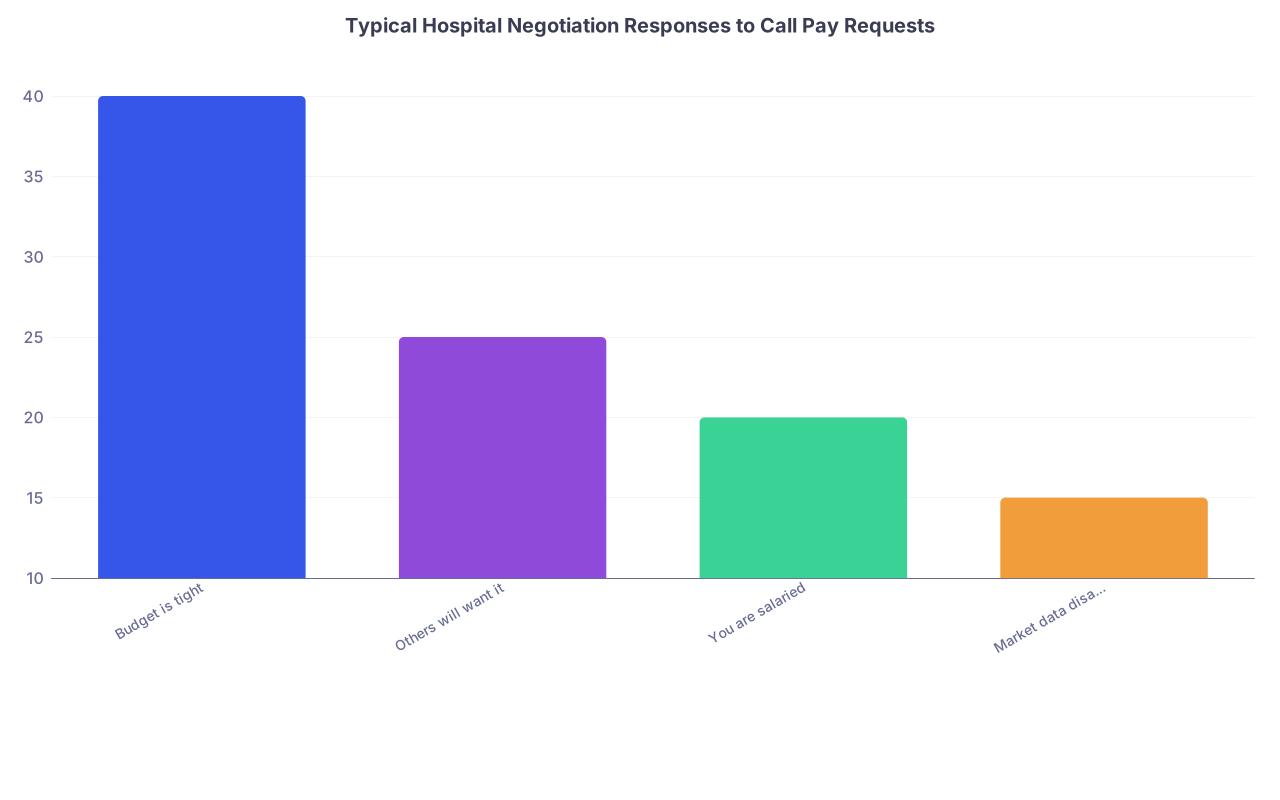
| Category | Value |
|---|---|
| Budget is tight | 40 |
| Others will want it | 25 |
| You are salaried | 20 |
| Market data disagreement | 15 |
Pushback 1: “The Budget Is Already Set”
Translation: “I do not want to deal with this.”
Response:
“I understand the current fiscal year is tight. I am not asking you to rewrite last month’s budget. I am asking that we acknowledge the gap and put a plan in writing.
“Two options that might work:
- Start with weekend and holiday call pay now, which is a smaller line item;
- Or, commit in writing to new call rates effective at the start of next fiscal year.
“In the meantime, I need to be clear that at the current compensation level, I cannot keep doing the same volume and frequency of call indefinitely. I want to avoid getting to a point where coverage is disrupted. That is why I am raising this now, not in crisis mode.”
You are polite but explicit: the status quo is not sustainable.
Pushback 2: “If We Pay You, Everyone Will Want It”
Yes. That is how markets work.
Response:
“If other services are providing similar intensity call, they should be compensated at a market rate as well. That is a fairness and recruitment issue across the hospital.
“The question is not whether people want call pay. The question is whether this hospital can reliably maintain call coverage. We are already seeing how difficult that is.
“If we pretend call is free, we will continue to have vacancies, burnout, and coverage gaps. Paying for call is the cost of doing business in 2026. Other systems have recognized this and budgeted for it.”
You pivot from “everyone wants it” to “this is the cost of coverage”.
Pushback 3: “You Are Already Well-Compensated. Call Is Included.”
This one tries to put you on the defensive. Do not debate your base salary.
Response:
“My base compensation covers scheduled clinical work – clinic hours, OR block, procedures. Call is fundamentally different: it is unpredictable, nights and weekends, and it directly affects safety and burnout.
“The market treats significant call as a separate component. That is why MGMA and SullivanCotter have distinct call pay benchmarks. The issue here is not whether my base salary is fair. The issue is whether our call expectations and compensation match what is standard in our region.
“Right now they do not. I want to keep providing this service, but I need the structure to align with how call is handled elsewhere.”
You separate “overall pay” from “call structure”. Do not get dragged into a global comp discussion unless you want one.
Pushback 4: “The Market Data You Have Is Wrong”
Sometimes they will attack your data source.
Response:
“If you have more accurate or more recent data, I am very open to seeing it. Everything I have seen – MGMA, local colleagues, and recruiter offers – points in the same direction: we are significantly below typical call pay for this specialty.
“Rather than debating exact percentiles, I would suggest we agree on a process. Let us have HR or finance pull the data they trust, review it with us, and then adjust call rates to land in a reasonable range.
“My bottom line is that the current arrangement is not sustainable. We need to move it closer to market, whether that is at the 40th or 60th percentile is less important to me than actually moving in the right direction.”
You invite their data and keep the focus on movement, not minutiae.
Pushback 5: “We Will Look Into It” (Then Silence)
Classic stall tactic.
Your script:
“Thank you for being open to reviewing this. To keep things on track, can we set a specific follow-up date now?
“For example, if you need a month to look at numbers, let us put a 30-minute check-in on the calendar four weeks from today. That way we have a clear time to revisit it and avoid this getting buried under other priorities.”
Then, in your follow-up email:
“Thanks again for discussing call pay today. Per our conversation, I am looking forward to reconnecting on [date] after you have had a chance to review the data with HR/finance.
“To summarize my understanding:
- Current: $400 per 24-hour call, no weekday call pay
- Ask: $1,200 per 24-hour call, $400 weekday from home
- Next step: You will review internal and external benchmarks and we will discuss concrete options on [date].”
You create a written trail and a calendar anchor.
Step 5: Escalation – When Talking Nicely Is Not Enough
Sometimes polite scripts do not move the needle. Then you switch to structured escalation.

| Step | Description |
|---|---|
| Step 1 | Clarify your data |
| Step 2 | Initial ask with chair |
| Step 3 | Follow up meeting set |
| Step 4 | Negotiate details and timeline |
| Step 5 | Involve group or service line |
| Step 6 | Present unified proposal |
| Step 7 | Reduce call / adjust coverage |
| Step 8 | Consider external offers |
| Step 9 | Progress? |
| Step 10 | Still blocked? |
Stage 1: Internal Alignment
If you are in a group:
- Get everyone to agree not to undercut each other.
- Decide minimal acceptable call rates.
- Put that in writing internally.
Simple line for your partners:
“Look, we can either all be underpaid together, or we can fix it together. But if one of us keeps saying ‘I am fine taking extra call for free,’ we will never get better rates.”
Stage 2: Formal Proposal to Administration
1–2 pages. Clear. No rambling.
Include:
- Short description of current state (coverage, volume, current pay).
- Market data summary (2–3 bullet points).
- Specific proposed rates for:
- Weeknight from home
- Weekend 24-hour from home
- In-house call
- Holidays
- Implementation options:
- “Full implementation on [date]”
- or phased approach (weekends first, then weekdays)
Send with:
“We are submitting this proposal to formally align call pay with market norms and ensure sustainable coverage for the hospital. We are available to meet to discuss within the next two weeks.”
Stage 3: Controlled Reduction of Call (Not a Wild Strike)
If you never draw a line, they never believe you have one.
This is not about abandoning patients. It is about adjusting what you promise.
Legally and ethically, you must:
- Respect contract terms (do not just walk off).
- Give reasonable notice if you intend not to renew or to modify coverage.
- Maintain EMTALA compliance until formal changes happen.
What you can do:
- Decline additional voluntary call beyond your contracted share.
- Stop “bailing out” holes for free (those late add-on calls that could be staffed with locums).
- When your contract is up, state clearly:
“We are willing to continue providing call coverage under the updated compensation terms in our proposal. We are not willing to renew under the previous call structure.”
Hospitals will suddenly discover “flexibility” right around the time they realize they might need locums at triple the price.
Step 6: Legal and Compliance Guardrails
Call pay is not just about money; it touches Stark, anti-kickback, and fair market value (FMV) rules.
You need to know the basic boundaries.
| Issue | What It Means for You |
|---|---|
| Fair Market Value | Call pay must be roughly in line with market data |
| Commercial Reasonableness | Payment must make sense without referral volume |
| Stark/AKS | Cannot tie call pay to volume/value of referrals |
| Documentation | Hospital will want written justification |
Your Practical Role
You are not the lawyer here. But you can:
- Anchor your ask to FMV data (MGMA, SullivanCotter, etc.).
- Avoid any language tying call pay to “you send us more cases”.
- Emphasize coverage, recruitment, retention, and risk, not referrals.
Script when they raise “compliance” as a scare tactic:
“I definitely want this structured in a fully compliant way. That is why I am basing my ask on published call pay benchmarks and what comparable hospitals are paying.
“If compliance has specific concerns, I am happy to have them propose a rate within fair market value that still reflects the actual intensity and frequency of our call. The underlying issue is that our current arrangement is far below what is typical for this level of responsibility.”
If you are about to sign or materially change a contract, having a healthcare attorney review it is smart. Not optional if the stakes are high.
Step 7: Optimize the Structure, Not Just the Dollar Amount
Sometimes they will not give you $1,200 per call. But you can still win by fixing structure.
Levers you can pull:
Differential Rates by Intensity
- In-house 24-hour: higher rate.
- From-home low-call: lower rate.
- High-holiday (Christmas, Thanksgiving): premium.
Cap the Abuse
- No more clinic the day after in-house call.
- Limit number of calls per month per physician.
- Require locums coverage if volume exceeds agreed thresholds.
Separate Stipends
- Medical director stipend for call coordination.
- Extra pay for backup call or “second call” when you are double-covered.
You can script this as:
“If we cannot get all the way to $1,200 per 24-hour call this year, there are two structural changes that would still make this sustainable:
- Protecting the post-call day for in-house call; and
- Setting a cap of [X] calls per month per physician, with locums filling anything above that.
“These changes, plus moving weekend call to $900 for now with a scheduled review next fiscal year, would make this workable.”
You give them a menu of solutions. They will often pick some rather than none.
Step 8: Stop Selling Yourself as “Unlimited Call” in Job Negotiations
One last fix. Many physicians ruin their own leverage on day one.
- Do not say: “I am fine with call; I will do whatever you need.”
- Do not sign vague language like “call as assigned” with no cap, no rate.
Instead, say:
“I am willing to participate fully in the call schedule, but I need clarity up front:
- How many calls per month on average?
- What is the current call pay structure and rates?
- Is there protection for post-call days on heavy in-house nights?
“I would like the contract to specify:
- Maximum of [X] primary calls per month;
- Call pay of [$amount] per 24-hour call;
- A review of call pay structure after 12 months, with reference to market benchmarks.”
If they absolutely “cannot” put numbers into the contract, that is code for “we can and will increase your call later for free.”
Your Next Step Today
Do not start with a meeting. Start with one page of reality.
Tonight, or on your next post-call afternoon, do this:
- Pull your last four call shifts.
- For each, write:
- Start/end times
- Number of pages
- Number of admits/consults
- Total in-hospital hours after 5 p.m.
- Then, add your current call pay for each shift (even if it is zero).
- At the bottom, write one sentence:
- “I am paid $___ for a typical 24-hour call that includes ___ pages, ___ consults, and ___ hours in-house.”
That one page is the backbone of your script. Once you see those numbers in black and white, you will stop telling yourself “it is not that bad” and start treating your call as what it really is:
A service line the hospital needs.
And a service line they can – and should – pay real money for.