
The way most physicians think about “side hustles” is completely wrong if you have a chronic illness.
The usual advice—start a busy clinic, do more shifts, open a med spa—just means burning the same candle from both ends. If your body is already rationing energy, you cannot afford income that depends on you feeling good on command.
You need energy-conserving income streams. Money that doesn’t collapse every time your joints flare, your POTS hits, your migraines spike, or fatigue pins you to the couch.
This is how to think about it, and what to actually do.
Step 1: Get Very Honest About Your Energy and Triggers
You cannot design good income streams without a brutally accurate “energy budget.”
Do this like a physician, not like a wishful patient.
Take 2–3 weeks and log:
- Wake-up time, sleep quality, and any night wakings
- Pain, fatigue, brain fog scores (0–10) at least 3 times a day
- What you actually did: clinical work, admin, family tasks, exercise, nothing
- Flare triggers: long standing, bright lights, computer time, stress spikes, etc.
Pattern you’re looking for: when are you consistently functional enough for 1–2 hours of focused work? When are you totally useless? When do you think you’ll have energy but crash instead?
Once you see your pattern, design rules. For example:
- “I never commit to live work before 11 am.”
- “I do not schedule anything on post-call days.”
- “I cap total ‘people time’ (patients/calls/meetings) to 3 hours/day.”
- “I assume one useless day per week and plan around it.”
If you skip this step, every side project will quietly blow up your health. I’ve watched too many physicians do this: they say “it’s just a small consulting thing” and three months later their rheumatologist is increasing meds and they’re wondering why.
Write down your rules. They will drive which income streams are actually safe for you.
Step 2: Understand the Types of “Energy-Conserving” Income
You’re not chasing “passive income.” For physicians with chronic illness, that phrase is a lie. Everything has a startup cost or maintenance overhead.
What you want is low-variability, low-obligation income. That means:
- It doesn’t require you to show up at a specific time consistently.
- Flare days do not tank your reputation or breach contracts.
- You can batch work on good days and coast on bad days.
- Your physical presence and appearance are irrelevant or minimal.
Quick structure to think about:
| Side Hustle Type | Energy Demand | Schedule Control | Flare Tolerance |
|---|---|---|---|
| Extra clinical shifts | Very High | Low | Very Low |
| Med spa / in-person biz | High | Low–Medium | Low |
| Telehealth shifts | Medium | Medium | Medium |
| Expert witness work | Low–Medium | Medium | Medium–High |
| Asynchronous consulting | Low | High | High |
You’re going to bias toward the bottom half of that table.
Step 3: Telehealth, But On Your Terms
Telehealth can be either a lifesaver or a trap if you’re sick.
The trap: full scheduled clinic days on video, with expectations exactly like in-person but with worse ergonomics and more screen fatigue.
The lifesaver: carefully selected, low-intensity, mostly asynchronous or drop-in work where you can adjust shifts or step away on bad days.
What to look for:
- Short shifts (2–4 hours) you can stack or drop, not 8–10 hour marathons
- Asynchronous components (chart reviews, messaging, e-consults)
- No or minimal video requirements, or at least audio-only options
- Ability to pick up shifts week-to-week, not months in advance
Think specific:
- Behavioral health follow-ups where you do 30-minute visits, 2–3 hours at a time
- Asynchronous dermatology or radiology reads (if applicable)
- E-consults for PCPs: reviewing cases and sending back guidance
- Rural tele-urgent care with low volume and clear triage protocols
Do not:
- Sign up for “full panel virtual PCP” work if your illness flares unpredictably. You’ll be on the hook for continuity and responsiveness you can’t guarantee.
- Take on tele-ED coverage where missing a shift = disaster for a whole hospital.
Practical move: test a small telehealth gig for 4–6 weeks with your new energy log in mind. If you’re wrecked every telehealth day and lose the next day too, it’s not energy-conserving, it’s just less walking.
Step 4: Asynchronous Expert Roles (High Leverage, Low Flare Risk)
This is where chronic illness + MD training can be a real advantage.
Roles where your thinking is valued, not your ability to stand for 12 hours or speed through 26 patient encounters.
Good categories:
Expert witness work
- Chart reviews, written reports, occasional deposition.
- You can do a large chunk of the work on your own schedule.
- Court dates are fixed, but usually scheduled ahead; you can limit to cases that fit your capacity.
- Heavier cognitive work, but often in 2–3 hour blocks that you control.
Clinical guideline or content review
- Reviewing patient education materials, clinical pathways, medical content for apps or health-tech companies.
- Usually project-based: “review X documents by Y date.” Perfect for good/bad day cycling.
- Extremely easy to do reclining, lying down, with breaks.
Medical-legal case reviews without testimony
- Some attorneys only want case viability screening; no courtroom.
- Even more schedule-flexible. Tell them clearly you do “records review and written opinion only.”
Where to start:
- Local or state medical-legal societies
- LinkedIn: search “medical expert witness,” “clinical guideline consultant,” “medical content reviewer”
- Your specialty society’s committees (many pay stipends or open doors to paid work later)
Energy rules here:
- Only commit to deadlines you can hit even if you lose 3–4 days/month to flares.
- Build in your “useless day” when you set your timeline for completion.
- Ask for a sample case to time yourself before quoting rates, so you don’t end up undercharging and overworking.
Step 5: Build Something Once, Get Paid Repeatedly (Digital Assets)
This is where most physicians either over-romanticize or completely ignore the opportunity.
No, you’re not going to throw up a random online course and make $300k in your sleep. But as someone who’s watched chronically ill physicians do this well, I’ll tell you: a modest, focused digital asset can eventually replace a clinic day or two per week with far less strain.
Key point: this is not passive at the beginning. It’s a 3–6 month project where you’re trading bursts of effort now for leverage later.
Strong options:
A tightly focused online course (CME or patient-facing)
Examples:- “Practical ECG for Non-Cardiologist Hospitalists”
- “Real-World Migraine Management for Primary Care”
- “Living with [Your Condition]: A Physician’s Guide to Pacing and Flares”
You record it once, update periodically, and sell via: - Your own site
- Established platforms that host CME or patient courses
Premium templates or toolkits
Think:- Discharge instruction bundles in plain language
- Shared decision-making tools for a specific disease
- A consultation framework (checklists, scripts, patient letters) for a niche area you know cold
Paid newsletters or membership communities
Lower energy if done right:- One solid piece of content weekly or twice a month
- Occasional Q&A that you can cancel or reschedule if flaring
It must be niche: “Clinician strategies for managing long COVID clinics” beats “wellness newsletter.”
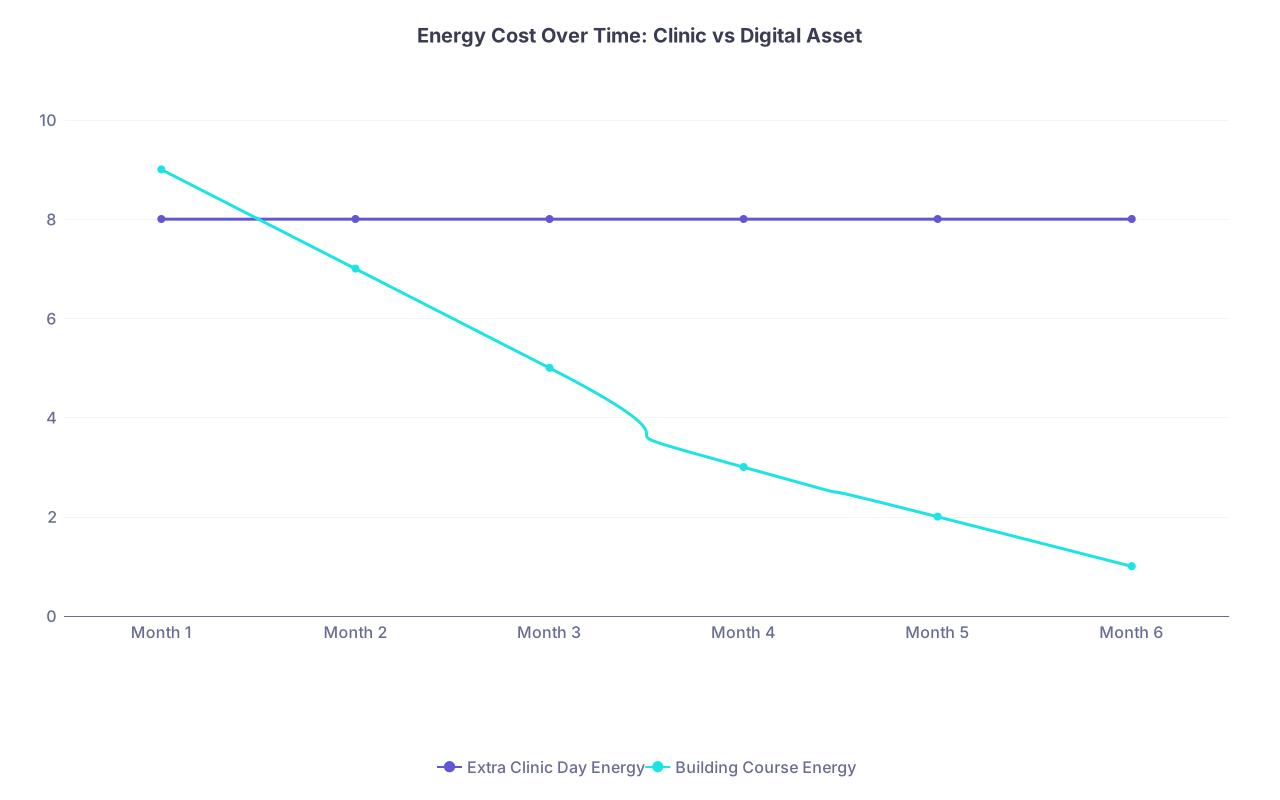
| Category | Extra Clinic Day Energy | Building Course Energy |
|---|---|---|
| Month 1 | 8 | 9 |
| Month 2 | 8 | 7 |
| Month 3 | 8 | 5 |
| Month 4 | 8 | 3 |
| Month 5 | 8 | 2 |
| Month 6 | 8 | 1 |
Practical guardrails:
- Use your energy log to set a hard weekly cap: “I’ll spend 3 hours/week on asset building. No more.”
- Batch video recordings on your best time of day, even if that’s 7–9 pm lying on the couch with a decent mic.
- Aim small: a focused 60–90 minute course can be far more profitable and manageable than a 12-hour “everything I know” monster.
Step 6: Low-Interaction Consulting That Respects Flares
Typical consulting is meeting-heavy and ego-flattering but energy-expensive.
You want consulting that looks more like:
- “Do a deep dive on this clinical process and send us recommendations.”
- “Audit our policies for X and write a report.”
- “Review our app’s clinical logic and flag risks.”
The key is to steer away from:
- Weekly standing calls
- Travel-dependent advisory board work, unless truly low frequency
- On-call style consulting (“we might need you to jump on a call any time”)
- Say upfront: “Because of a chronic health condition, I do my best work asynchronously. I’m happy to do 1–2 live calls/month and then focus on rigorous written feedback.”
- Put deliverables in writing: “2 calls/month, 1 written summary/month” etc.
- Quote a project fee, not an hourly one, or you’ll find your limited good hours evaporating faster than the invoice value justifies.
Do not shy away from disclosing your constraints in a professional way. Most modern health-tech and quality improvement outfits do not care that you can’t sit in a windowless boardroom for 8 hours. They care that your brain can prevent them from doing something clinically stupid.
Step 7: Adapt Your Environment Like It’s a Medical Device
Energy-conserving income is not just about what you do; it’s about how physically expensive the work is.
You’re a physician—treat your workspace like an intervention.
Consider:
- Fully reclining or zero-gravity chair with laptop stand if sitting upright is exhausting
- External keyboard, vertical mouse, and big monitor to reduce strain
- Blue-light filters, adjustable brightness, or colored lenses if migraines or light sensitivity are an issue
- Voice dictation for charting, writing, and email replies
- Pre-set templates and macros for reports, standard replies, and invoices

Also: watch your cognitive load. Deep reasoning work is energy-intensive even if you’re physically still.
Practical adjustments:
- Work in 25–45 minute blocks with planned breaks, not “go until I crash.”
- On days you feel “weirdly good,” cap your output anyway. Overdoing on a good day and paying for it with two bad days is a net loss.
Step 8: Legal and Disability Considerations (Do Not Skip)
If you’re considering disability or already on it, you have to treat side income like a medication with a narrow therapeutic window.
You need to know:
- SSDI or private disability definitions of “gainful activity”
- Income caps or work-hour expectations
- Reporting requirements if you start doing consulting, telehealth, or course sales
This is where you pay a disability-savvy attorney or accountant. Not Reddit. Not a Facebook group.
Questions to bring them:
- “If I do X type of consulting, does that threaten my disability status?”
- “How much can I earn from royalties or digital product sales before there’s an issue?”
- “Is LLC vs S-corp vs sole proprietor better given my situation?”
I’ve seen people lose crucial benefits because they casually took on extra income without understanding how their insurer or SSDI would reinterpret their capacity. Do not let “a few thousand extra dollars” cost you long-term security.
Step 9: Emotional Reality Check — Grieve, Then Strategize
Being a physician with chronic illness is not a mindset problem. It’s a physiological limit intersecting with a profession that worships over-functioning.
You’re not weak for needing different income structures. You’re realistic.
There’s a grief piece here:
- You may never again be the high-volume surgeon, the always-on hospitalist, the heroic ED doc who picks up every shift.
- Your colleagues may not understand why you “won’t just push through”—especially if your illness is invisible.
You are allowed to miss that version of your career. But you’re also responsible for not sacrificing your future health trying to cosplay your past capacity.
The physicians I’ve seen do best with chronic illness financially have one thing in common: they stop chasing the identity of “full-tilt clinician” and start acting like senior advisors to their own life. They trade ego hits for sustainability.
That trade hurts. And it frees you.
Step 10: A Concrete 3-Month Shift Plan
Here’s what 3 months of building energy-conserving income could reasonably look like if you’re currently clinical but struggling:
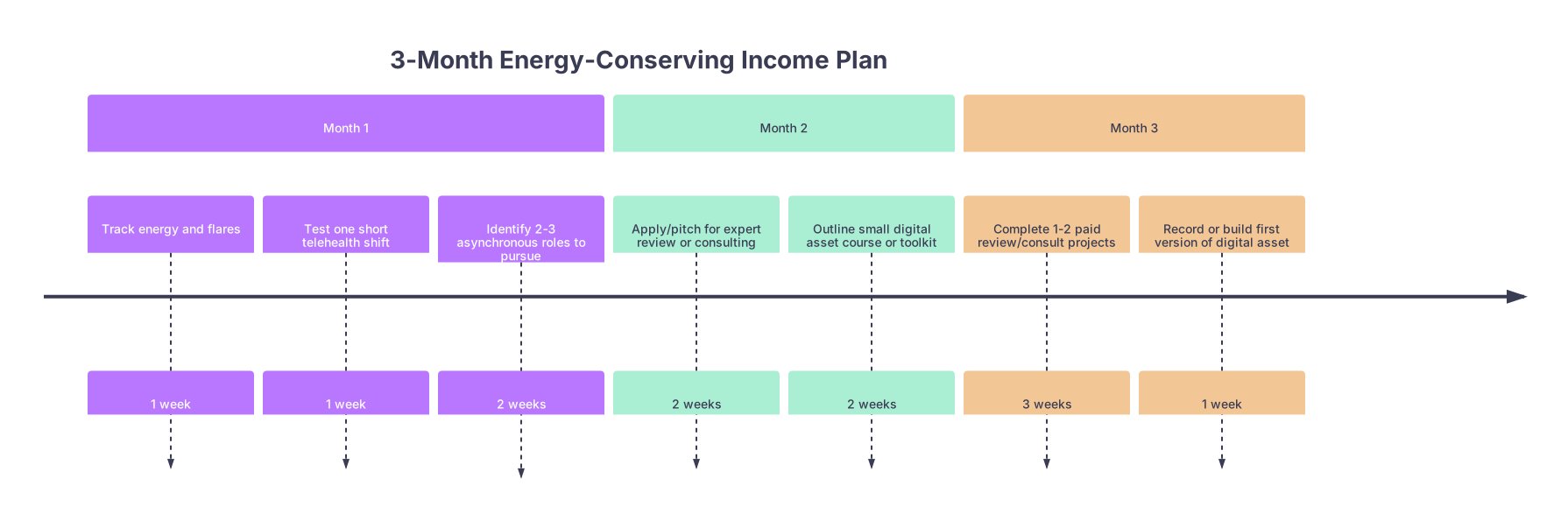
| Period | Event |
|---|---|
| Month 1 - Track energy and flares | 1 week |
| Month 1 - Test one short telehealth shift | 1 week |
| Month 1 - Identify 2-3 asynchronous roles to pursue | 2 weeks |
| Month 2 - Apply/pitch for expert review or consulting | 2 weeks |
| Month 2 - Outline small digital asset course or toolkit | 2 weeks |
| Month 3 - Complete 1-2 paid review/consult projects | 3 weeks |
| Month 3 - Record or build first version of digital asset | 1 week |
During this, your rules:
- No project that needs more than 5 hours/week from you.
- No locked weekly commitments you can’t skip or move at least 20% of the time.
- Every new commitment is tested for 4–6 weeks before you rely on it financially.
The Bottom Line
If you’re a physician with chronic illness, you do not need more hustle. You need better leverage.
Your training is still valuable. Your experience is still needed. But your body has changed the terms of service, and pretending otherwise is self-harm disguised as professionalism.
The right income streams for you:
- Respect unpredictable flares
- Let you batch work on good days
- Value your brain more than your physical stamina
- Can keep paying you even when you’re horizontal for a week
Today’s action:
Set a 15-minute timer and write down:
- Your three biggest energy triggers at work
- Your two most reliable “good” hours in a typical day
- One income idea from this article that doesn’t depend on you feeling well at a specific time
Then pick that one idea and define the smallest possible experiment you can do in the next 7 days—email a contact, fill out an application, outline a tiny course, or book a consult with a disability-savvy accountant.
Do that one thing. Your future self—with the same chronic illness but less financial fear—will thank you.


