
The default advice about mentioning your side hustle in interviews is lazy and often wrong.
You should not automatically hide it. And you definitely should not automatically lead with it. You need a decision rule: when it helps, when it hurts, and how to talk about it so you look ambitious, not distracted.
Let’s walk through that like adults, not like a career office pamphlet.
The Core Answer: Yes, But Only If It Passes Three Tests
Here’s the blunt version: you can talk about your side hustle in interviews if it clearly:
- Signals professionalism and judgment
- Supports your primary role as a physician (or future physician)
- Won’t raise red flags about time, ethics, or priorities
If it fails even one of those, you either keep it very brief or keep it off the table.
Use this quick screen:
| Question | Green Flag Answer |
|---|---|
| Is it legal and ethically clean? | Yes |
| Would a conservative program director care? | No or very unlikely |
| Can I link it to skills that help my job? | Yes, clearly and concretely |
If you cannot confidently answer “green flag” to all three, you either do not bring it up, or you mention it as a minor hobby, not a “business.”
When Your Side Hustle HELPS You in Interviews
Some side hustles actually make you look stronger. I’ve seen candidates get noticeably more engaged interviewers when they discuss these, because they stand out from the identical “research + volunteer + leadership” pile.
1. It Demonstrates Directly Relevant Skills
If you’re applying for:
- A clinical job with leadership responsibilities
- An academic role
- An administrative/operations role
- Anything involving innovation, digital health, or entrepreneurship
Then side hustles that clearly map to these are assets.
Good examples:
- You built a small telemedicine practice or niche clinic service (fully compliant with licensing and billing)
- You run a successful health-education YouTube channel or newsletter with actual metrics (subscribers, open rates, engagements)
- You created a CME course, online curriculum, or exam prep program
- You developed a medical app, scheduling tool, or QI dashboard being used by others
Those translate immediately to: initiative, follow-through, systems thinking, communication, and sometimes leadership and financial literacy. Hiring committees like those. Especially in 2026 and beyond, where medicine is clearly tied to tech, content, and patient engagement.
2. It Shows You Understand the Business of Medicine
Most physicians are shockingly naive about contracts, reimbursement, and basic business. If your side hustle means you can say:
- “I’ve negotiated vendor contracts.”
- “I’ve grown revenue and tracked profit/loss.”
- “I’ve managed a small team and a budget.”
you just separated yourself from 90% of your peers.
For example: a hospitalist who runs a small, compliant consulting company for clinical workflow optimization can talk about:
- Scoping projects
- Delivering measurable outcomes (reduced LOS, fewer readmissions)
- Working with admin, IT, and frontline staff
That screams “future medical director” more than “person who might leave for their startup.”
3. It Fits the Narrative of Who You Are as a Physician
If your side hustle ties directly into your specialty or values, it often lands well.
Sports med doc with a side business advising local teams on injury prevention? Great.
Psychiatrist who built a mindfulness app with evidence-based content? Strong.
EM physician who teaches prehospital providers via paid online courses? Logical.
What interviewers want is coherence. “This side thing makes sense for you” is the feeling you’re aiming for.
When Your Side Hustle HURTS You
Now the part nobody likes hearing: some side hustles look bad in interviews. Not because side hustles are bad, but because they raise the wrong questions in the mind of a risk-averse program director or hiring group.
Here are the common landmines.
1. It Looks Like a Time Suck Competing With Your Primary Job
Any side hustle that screams “this takes 20+ hours a week” will trigger worry. Interviewers are not thinking, “Cool, entrepreneur.” They’re thinking, “So when will this blow up my call schedule?”
- Dropshipping, Amazon FBA, heavy e-commerce operations
- Running multiple Airbnb properties yourself
- Full-scale coaching programs requiring frequent 1:1 sessions
- Large content engines with daily posting, editing, and community management
Can you do these and still be great clinically? Maybe. Will interviewers believe that? Usually not.
If your side hustle is time-heavy and you are early in training (student, resident, new attending), don’t make it the star of your interview. Mention only if there’s no way around it (e.g., big gap in your CV) and frame it as:
- Past, now scaled back or delegated
- Passive or minimally active during training
- Secondary to your clinical work with clear boundaries
2. It Smells Ethically Messy
This is an instant “no” for many interviewers, even if it’s technically allowed.
Problem areas:
- MLMs or anything with downlines and recruitment
- Dubious supplement or “biohacking” sales pitched directly to patients
- Financial products you’re selling to colleagues
- Anything flirting with scope creep or practicing outside license/geography rules
Even if you’re convinced it’s fine, a cautious administrator might not want to deal with the reputational risk. If you bring this up at all, keep it short, emphasize compliance, and do not sound defensive.
3. It Looks Like You’re Trying to Escape Medicine
If you come across like your real dream is to leave medicine ASAP and your side hustle is your exit ramp, you will lose offers. People are hiring for stability, not flight risk.
Phrases that scare interviewers:
- “My goal is to be financially independent and cut back my hours as soon as possible.”
- “Medicine is just my safety net while I build this.”
- “Long term I see myself more as an entrepreneur than a clinician.”
You might feel that way. Do not say it in a traditional clinical job or residency interview. In a startup/industry interview, maybe. In a residency or hospital-employed role, that’s self-sabotage.
How To Decide: Should I Mention My Side Hustle At All?
Use this simple decision flow:

| Step | Description |
|---|---|
| Step 1 | Have a side hustle |
| Step 2 | Do not mention |
| Step 3 | Consider highlighting with clear benefits |
| Step 4 | Mention briefly only if asked |
| Step 5 | Mention as hobby, not focus |
| Step 6 | Is it clearly legal and ethical |
| Step 7 | Related to medicine or transferable skills |
| Step 8 | Large time commitment |
If it’s:
- Clean
- Relevant
- Modest in time demands
then it can be one of your differentiating features.
If it’s:
- Clean
- Not really relevant
- But small in time
then it can be a brief “fun fact” or hobby if it shows something positive (discipline, creativity, organization).
If it’s:
- Ethically grey
- Or clearly huge in time
then either don’t bring it up or frame it as “past/paused” and not central to your identity right now.
How To Talk About Your Side Hustle Without Shooting Yourself in the Foot
Assume your interviewer is mildly skeptical. Your job is to:
- Make it sound structured, not chaotic
- Show that it benefits your medical work
- Reassure them you know your primary role comes first
Here’s a simple structure to use when answering:
- One-sentence description (what it is)
- What skills you developed that matter for this role
- Boundaries: how you keep it from interfering with medicine
- Future: how you see it fitting into your career (without overshadowing medicine)
Example for a resident applicant with a small education business:
“I run a small board-prep course for pre-clinical students; I started it as a way to teach and simplify tough concepts. Building it forced me to get very organized about curriculum design, feedback collection, and tracking outcomes. During clinical years I limit it to one evening a week and batch content ahead of time, so it never interferes with rotations. Long term I see it as a side project that keeps me sharp as an educator, not something that competes with my clinical work.”
That hits all four elements cleanly.
Red Flag Phrases vs Green Flag Phrases
If you say the wrong thing, you can make an otherwise fine side hustle sound like a threat.
| Red Flag Phrase | Better Version |
|---|---|
| “It’s taking off so fast right now.” | “I’ve intentionally kept it small and focused.” |
| “I work on it every night and weekends.” | “I batch work so it fits into my off-time.” |
| “My goal is to replace my clinical income.” | “It complements my clinical work long term.” |
| “I hate relying on hospital admin.” | “It taught me how systems and finances work.” |
You are selling judgment as much as achievements. Sound measured, not obsessed.
Special Cases: Content Creation, Coaching, and Investing
Three common categories physicians ask about: content, coaching, and investing.
Content Creation (YouTube, TikTok, Substack, podcasts)
Green flags:
- Focused on patient education, student education, or professional development
- Clear attention to confidentiality and professionalism
- You can cite real metrics (engagement, growth, impact)
Risks:
- Unprofessional posts, ranting about patients/colleagues, political flame-throwing
- Sponsored content that looks sketchy or conflicts with your employer
In interviews, emphasize:
- Communication skills
- Health literacy
- Professional standards and boundaries
Coaching / Consulting
If you coach:
- Students on applications
- Physicians on productivity or burnout
- Organizations on workflow / QI
you must be careful about conflict of interest and time.
Interview framing:
- Focus on outcomes and skills (listening, structuring problems, implementing solutions)
- Make it clear it’s low volume and scheduled around your main role
- Avoid sounding like you’re preying on desperate students or colleagues
Real Estate / Investing
Most of this doesn’t need to be discussed unless:
- It’s on your CV (e.g., you founded an investment group)
- It’s massive and obvious (public speaking, courses, company)
If you do mention it, keep it simple:
“I manage a small portfolio of rental properties with a partner; the main things I’ve gained are understanding contracts, risk, and long-term planning. Day to day, it’s largely handled by a property manager, so it doesn’t touch my clinical work.”
No need for cap rate lectures. Focus on judgment and systems thinking.
Future of Medicine: Why Side Hustles Will Keep Coming Up
Medicine is shifting. Physicians are building:
- Startups
- Creator brands
- Niche practices
- Tech products
Healthcare systems are slowly waking up to the fact that these people are valuable—if they’re aligned.
Over the next decade, you’ll see more roles that explicitly want:
- Clinician-innovators
- Physician-content leads
- MDs in product teams
For those, your side hustle is not a liability. It’s the point. In those interviews, you may actually lead with the side hustle and show how it proves you can ship real things.
But for traditional residency slots, hospital-employed jobs, and conservative groups? Assume they still prioritize stability and availability. Same you, different framing.
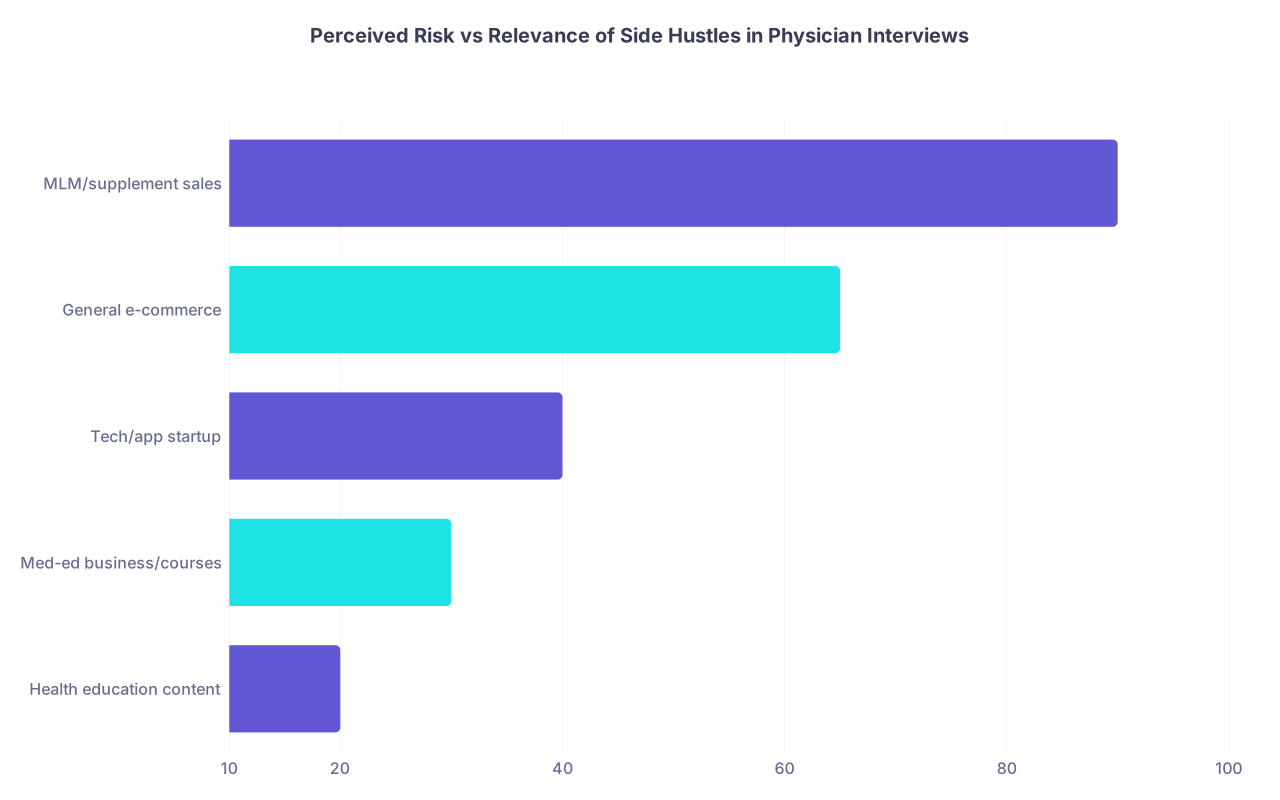
| Category | Value |
|---|---|
| Health education content | 20 |
| Med-ed business/courses | 30 |
| Tech/app startup | 40 |
| General e-commerce | 65 |
| MLM/supplement sales | 90 |
(Interpretation: the higher the number, the more likely interviewers see it as risky or distracting. You want to live on the left side of that chart, not the right.)
FAQ: Talking About Side Hustles in Interviews
1. Should I put my side hustle on my CV or only mention it if asked?
If it’s clean, relevant, and you’re proud of it, put it on the CV under “Other Professional Activities,” “Entrepreneurial Experience,” or “Education Projects.” If it’s marginally relevant or might trigger bias, leave it off and only discuss it briefly if it comes up naturally. Rule of thumb: if you’d be happy defending it to a somewhat skeptical chair, it can go on the page.
2. What if my program/employer doesn’t know I have this side hustle yet?
Then you need to think carefully. If disclosing it in an interview would blindside them later or conflict with moonlighting/non-compete policies, sort that out first. In many cases, you should either (a) keep it clearly hobby-level and non-monetized during training, or (b) get explicit permission and boundaries in writing. Don’t create a “they felt misled” narrative.
3. Can I talk about a failed side hustle?
Yes, and it can be powerful—if you frame it as a learning experience, not a victim story. “I launched X, it didn’t work because Y, so I learned A, B, and C about execution and focus” is mature. Avoid blaming others, ranting about the system, or sounding bitter. Interviewers love candidates who can fail, extract lessons, and move forward.
4. How do I answer if someone bluntly asks, “So what’s more important to you, this business or medicine?”
Do not get cute. “Medicine” is the answer. Then back it up: “My clinical work is my primary career and obligation. The business is structured to fit around that—limited scope, delegated where possible, and always secondary to patient care and call responsibilities.” You can privately have more nuance, but that’s not the time for it.
5. Is it safer to just never mention my side hustle in any medical interview?
Safer? Sometimes. Smarter? Not always. If your side hustle is one of the few things that truly differentiates you and is aligned with the job, hiding it can make you look more generic and less interesting. The trick is not “mention or hide.” It’s “position it so it solves the employer’s problem rather than creating one.”
6. What’s one concrete way to prepare before my next interview?
Write a 3–4 sentence “side hustle script” using the structure above: 1) what it is, 2) skills you gained that matter for this job, 3) how you keep it from interfering with clinical work, 4) how it fits into your long-term physician identity. Say it out loud three times. Then, before your next interview, decide: will you volunteer it as a strength, or keep it in your back pocket in case they ask?
Now, open a blank document and draft that 4-sentence script for your side hustle. If you cannot frame it confidently without triggering obvious red flags, your answer is clear: refine the side hustle—or keep it out of the interview.