
The fear that patients will find your side hustle and judge you isn’t paranoid. It’s rational.
You’re not crazy for worrying that one awkward Google search, one nosy family member, or one bored patient sitting in the waiting room with your full name on their clinic printout could blow up your carefully protected “professional” image.
Let me just say the quiet part out loud: medicine absolutely judges. Colleagues judge. Patients judge. Program directors judge. And the internet never forgets.
But here’s the other side that no one tells you when you’re spiraling at 1 a.m.: you have way more control over this than it feels like when your brain is running disaster simulations.
Let’s pick this apart like someone who’s already stalking themselves on Google every couple months.
The nightmare scenarios your brain keeps replaying
You know these scenes. Because your brain plays them on a loop.
Patient sitting in the exam room, scrolling. They type your name into Google because it’s on their after-visit summary. Up pops:
- Your YouTube channel about money and burnout
- Your Etsy art shop with your full name on it
- Your Instagram account where you sometimes rant about residency
- Your coaching website with you smiling in non-clinical clothes
Or worse, a single out-of-context clip where you’re joking, venting, or talking about controversial stuff like prior auths, obesity, mental health, or vaccine refusal.
Your brain supplies the rest:
“Wow, my doctor just wants money.”
“I don’t trust doctors who do TikTok.”
“This is unprofessional.”
“I’m going to leave a bad review.”
“I’ll complain to the hospital.”
Then it escalates.
They tell another doctor. That doctor tells your program director. Someone sends a screenshot to GME. Then suddenly your side hustle is being discussed by a committee of people who never talked to you when you were drowning on night float but now have a lot of opinions about your “professionalism.”
That’s the fear, right? It’s not just “what if a patient sees?” It’s “what if a patient seeing this becomes the match that lights everything else on fire?”
You’re not wrong to consider that. I’ve seen people get called into offices for far, far less.
But let’s untangle what’s actually likely, what’s manageable, and what’s truly career-threatening.
What actually matters to patients vs what we think will destroy us
Most physicians massively overestimate how much patients care about their lives outside work, and wildly underestimate which parts actually flip that “I don’t trust you” switch.
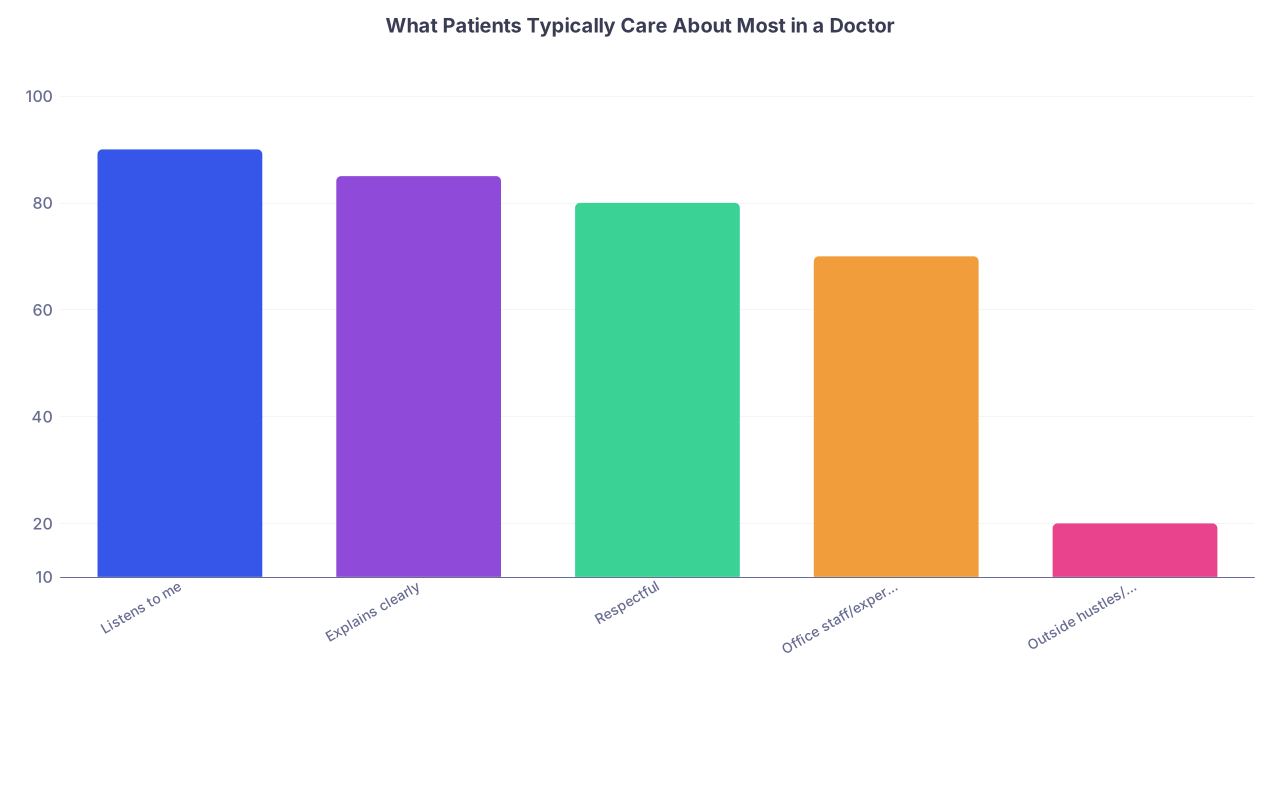
| Category | Value |
|---|---|
| Listens to me | 90 |
| Explains clearly | 85 |
| Respectful | 80 |
| Office staff/experience | 70 |
| Outside hustles/side projects | 20 |
Here’s the uncomfortable truth:
Patients care about side hustles mainly when they feel:
- You’re distracted or rushed
- You’re selling to them in the room
- Your content contradicts how you practice with them
- Your online persona is cruel, mocking, or dismissive of people like them
What doesn’t usually trigger nuclear-level responses?
- “My doctor also writes a blog.”
- “My doctor has a podcast.”
- “My doctor sells study notes.”
- “My doctor teaches other doctors about money.”
- “My doctor has an art shop.”
They may find it weird. Or interesting. Or they might not care at all. Most are too busy dealing with their own lives.
What they do care about—and what actually puts your reputation at risk—is:
- Do you look like you’re mocking patients? (even if it was meant as “dark humor for clinicians”)
- Do you show PHI or anything that smells like “this might be me”?
- Do you post political or cultural content that directly clashes with your patient base, and in a harsh, contemptuous tone?
- Are you pushing products/treatments that seem profit-first instead of patient-first?
The vast majority of online disasters physicians get dragged for fall into those buckets.
So your fear isn’t baseless. It’s just mis-aimed sometimes. The problem usually isn’t “I have a side hustle.” It’s “I didn’t design this side hustle as if my patients and my boss would absolutely see everything.”
How exposed are you really? A quick (slightly painful) check
Let’s be blunt: if your real first and last name is tied to your NPI, your hospital bio, and your LinkedIn, and that same name is on your YouTube, TikTok, Instagram, or coaching website… you’ve basically merged your professional and side-hustle identities.
That’s not automatically bad. But it means you don’t get to fantasize about “keeping them separate.” They’re already not.
Do this:
Google your full legal name plus “MD” or “DO” or “medical student” or “resident.” Open an incognito window. Don’t be logged in anywhere.
Then see:
- What’s on page 1?
- Can your side hustle be reached in 1–2 clicks from your name?
- Does your profile photo match across platforms (even if the usernames differ)?
- Does your institution show up alongside your personal content?
If you’re early in training, this can actually be good news. This is your chance to decide how connected or separate you want these worlds.
But if you’re like most of us, you’ll see some mildly horrifying stuff and think, “Oh my god, I’m dead.”
You’re not. It just means you have work to do on boundaries and framing.
Okay but what if a patient does find it?
Let’s walk through the worst-case interaction that’s living rent-free in your head.
Patient: “I saw your YouTube channel. I didn’t know you were telling people how much doctors can make. I thought doctors were supposed to care about patients, not money.”
Cue internal meltdown.
This is fixable if you’ve thought ahead. You need one or two calm, honest, non-defensive lines ready. Not a speech. Just a frame.
Something like:
“Outside of clinical work I create educational content for trainees about handling debt and burnout, because a lot of doctors struggle silently with that. I keep it separate from patient care, and I never share anything about my patients.”
Or:
“I do have a channel where I talk about medicine broadly, but my commitment to you in this room is the same: to give you my full attention, explain clearly, and do what’s best for your health.”
If it’s something more lifestyle-y:
“I paint and sell prints on the side. It’s one way I manage stress so I can show up better for my patients.”
Notice what you are not doing:
You’re not oversharing.
You’re not apologizing for having a life.
You’re not spiraling into justification.
You’re signaling: I’m still your doctor. I’m allowed to be a full human.
If they push and clearly don’t like it? That’s uncomfortable. But every patient doesn’t have to like everything about you for you to take good care of them. Worst case, they ask for a different doctor. That stings, but it’s not career death.
The real harm usually happens when we panic, get defensive, lie, or contradict what’s visible online. That’s when people feel weirdly betrayed and escalate.
Concrete ways to protect your reputation before something blows up
This is where you get power back. You can design your side hustle like someone who assumes patients, colleagues, PDs, and state boards might see it.
Think of it as “front-page safe.”
1. Decide your identity strategy on purpose
You basically have three options:
| Approach | Name Usage | Risk Level | Flexibility |
|---|---|---|---|
| Fully Public | Real name, MD/DO | Higher | High |
| Semi-Separate | First name/alias | Medium | Medium |
| Fully Pseudonym | Pen name only | Lower | Lower |
If your audience is other physicians/trainees (coaching, financial education, study resources), using your real name may actually help your credibility. But then you must behave like that’s permanently your brand.
If your content is borderline, venting, or spicy? That’s where a pen name or partial name is your friend. Not perfect protection—people can still connect dots—but at least you’re not hand-delivering it.
2. Set hard content rules for yourself
Not “vibes.” Actual rules. For example:
- No discussing individual patients, even de-identified, on public platforms
- No screenshots of EHR, hospital badges, work schedules, or inside patient areas
- No mocking patient groups you also treat
- No “doctor reacts to” videos that punch down at vulnerable people
- No medication or supplement recommendations linked to your affiliate codes for things you prescribe
If this sounds strict, that’s because the consequences can be ugly. I’ve seen residents dragged into professionalism hearings over a single “dark humor” meme that landed wrong with the wrong person.
You can still be real, honest, and a little edgy. You just can’t be cruel, careless, or lazy with privacy.
3. Put a clear boundary statement somewhere visible
This sounds corny but actually helps.
On your site or profile:
“I never share identifiable patient information. My content is for education and general information, not personal medical advice. My views are my own and don’t represent my employer.”
Does it legally shield you from everything? No. But it signals intention and professionalism to anyone casually browsing, including patients.
When the fear is really about colleagues and programs, not patients
Let’s be honest. Sometimes “what if patients find it?” is code for “what if my PD, chair, or future employer finds it and thinks I’m not serious enough or too money-focused?”
Because medicine has a weird, almost religious hang-up about physicians making money outside the traditional system. Side hustles get labeled as “distracted,” “less committed,” “not a team player.” Especially in training.
So yeah, you might not just be imagining that. People do talk.
Where you actually get in trouble though is usually here:
- You’re visibly hustling while your clinical duties are slipping
- You’re late on notes and everyone knows you’re posting daily on TikTok
- Your side hustle content trashes your own program, staff, or colleagues
- You’re clearly using institutional resources (clinic rooms, logos, work time) for side work
If your clinical work is solid, your professionalism on the job is unquestioned, and your side hustle doesn’t actively undermine your employer… most people might roll their eyes, maybe gossip a little, and then move on.
So a very blunt rule:
Don’t let your side hustle performance outshine your clinical performance in the eyes of the people who evaluate you.
Crushing it online but constantly behind on charts is the fastest way to confirm every stereotype in your PD’s mind.
The future: this is going to be normal, whether the old guard likes it or not
Right now, it feels like you’re sneaking around. Hiding second jobs. Hoping no one asks about the microphone in your Zoom background.
But look at what’s already happening:
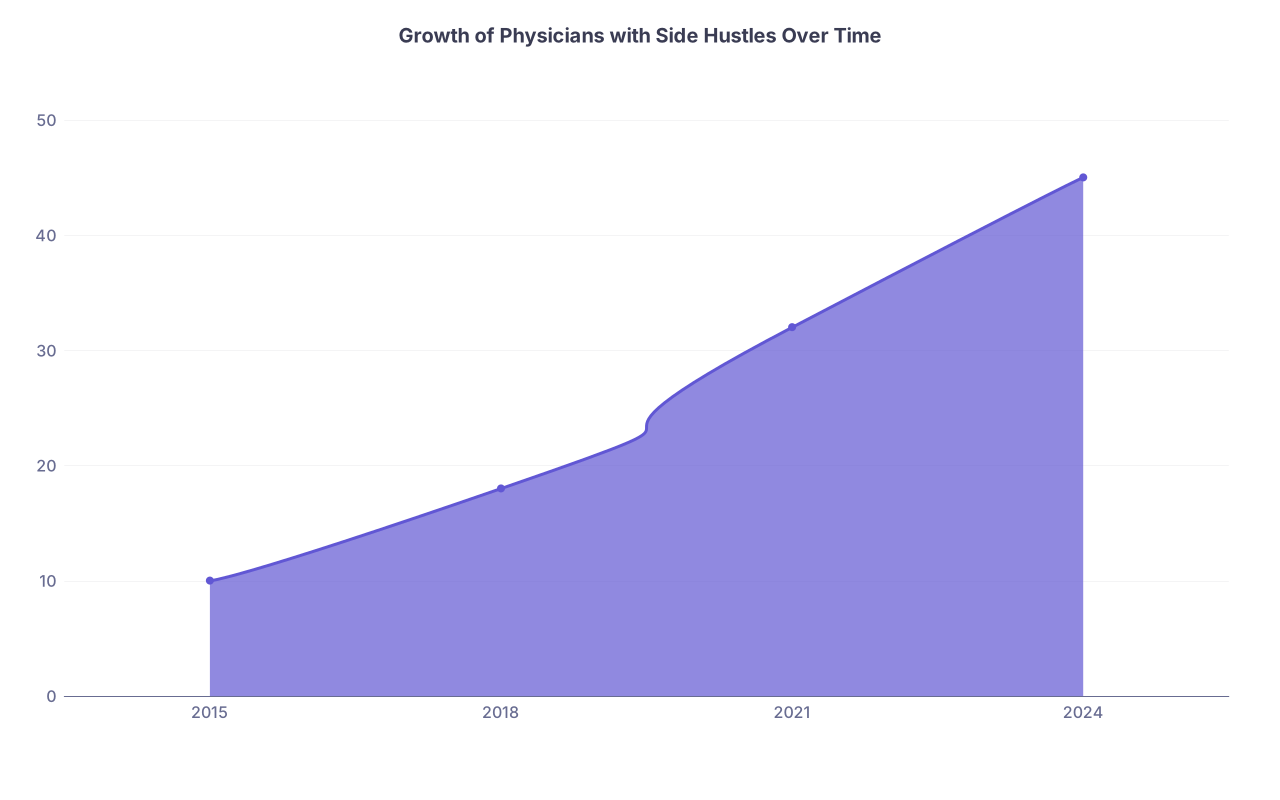
| Category | Value |
|---|---|
| 2015 | 10 |
| 2018 | 18 |
| 2021 | 32 |
| 2024 | 45 |
More physicians are building:
- Online courses for step/board studying
- Newsletters about burnout and leaving medicine
- Health tech startups
- Medical-legal consulting businesses
- Social media platforms around specific niches
You are not some weird outlier. You’re just slightly early in a profession that moves glacially slow.
In 10–15 years, nobody will blink at a doctor who also has an online brand or product—just like no one blinks at doctors doing medicolegal work or pharma consulting now. The taboo is already cracking.
But that doesn’t help much if you’re applying to residency this year, or you’re in a conservative program now.
So your job in this transitional era is to:
- Be more careful than your content peers in non-medical fields
- Build like you’re going to have to defend this in front of a committee
- Document that your clinical work is solid (evaluations, feedback, timely work)
And remember this: you can always choose to scale your side hustle up later. You don’t have to go all-in while you’re still the most vulnerable to institutional judgment.
A simple, low-anxiety way to move forward
If your brain is screaming “shut it all down” and “but I need this outlet/income,” that’s the tension.
You don’t actually have to choose between “do nothing ever” and “recklessly post everything.”
Here’s a saner middle ground for right now:
- Audit your online presence this week. Remove anything that feels borderline even to you on a bad day. If you’re hesitating, that’s your answer.
- Decide your identity: real name, semi-separate, or pseudonym. Don’t half-commit.
- Write a 1–2 sentence “If a patient finds this” response and practice saying it out loud until it doesn’t make you sweat.
- Pick one side hustle thing you can do that’s low visibility but builds skills/income (freelance writing under a pen name, curriculum building, behind-the-scenes consulting).
- Keep receipts that your clinical work is strong. You want evals and comments that say “professional,” “dependable,” “excellent with patients” in your back pocket.
You’re not weak or overly anxious for worrying about this. The rules are blurry, the risks are real, and medicine doesn’t exactly give clear, healthy guidance on “how to be a human with multiple interests and also a doctor.”
But you’re also not powerless. You can build smart, quiet, and safe now—so that if and when a patient or colleague stumbles onto your side hustle, you don’t have to panic-quit everything you’ve created.
Open an incognito browser window today, Google yourself, and take one protective action—change a name, delete a post, add a disclaimer, or map out a response line. Don’t just sit with the fear. Give it something concrete to work with.
FAQ (exactly 5 questions)
1. Should I hide my side hustle completely during residency and just wait until I’m attending?
Not necessarily. Total hiding sounds safe but it also delays years of growth, experience, and potential income. The key is scale and visibility. Keeping things small, low-key, and clearly non-competing with your program is usually safer than trying to build a massive public brand while you’re still being evaluated constantly. If you’re doing something like tutoring, writing, or behind-the-scenes consulting under a pen name, the actual risk is low as long as your clinical work is clearly solid.
2. Is it “unprofessional” for a doctor to talk about money, side hustles, or business publicly?
Old-school medicine tends to act like it is, but that doesn’t mean they’re right. A lot of physicians are quietly grateful for people who talk honestly about debt, burnout, and financial survival. The real professionalism issues appear when the content looks greedy, exploitative, or sneering at patients (“I learned to bill more, now I make bank” with no nuance). Talking about money with humility, context, and an educational tone is worlds different from flexing or bragging.
3. Can a patient complaint about my social media or side hustle actually get me fired or kicked out of residency?
In extreme cases—yes. If your content breaches privacy (anything that could reasonably be linked to a real patient), is openly discriminatory, endorses dangerous medical misinformation, or blatantly contradicts your institution’s policies, you’re exposed. For garden-variety “I don’t like my doctor doing TikTok” complaints, institutions usually start with a conversation, warning, or guidelines. That’s still stressful, but it’s rarely instant death if you respond maturely and adjust.
4. Should I tell my program director or employer about my side hustle upfront?
This depends on what you’re doing and how visible it is. If your real name plus “MD/DO” is on a public website offering coaching, consulting, or courses, your PD could easily find it anyway. Being proactive with a concise, professional heads-up sometimes builds trust: “I run a small educational project for students on my own time. It doesn’t involve patients or hospital branding.” But if your side work is more personal, anonymous, or small-scale, loudly announcing it can create drama where none needed to exist. Use common sense and know your program’s culture.
5. What if a future employer Googles me and doesn’t like that I have a brand or business?
That might happen. Some groups want a “pure clinician” who only lives and breathes RVUs. Others actually like entrepreneurial, visible physicians who can attract patients, build programs, or lead education. Having a thoughtful, mature narrative about your side work (“I built this to solve X problem and learned Y skills”) is your defense. If a practice is completely turned off by the idea that you have a brain and identity outside their walls, that’s probably not a great long-term fit for you anyway—even if right now it feels like you can’t afford to be picky.