

Utilization review is not “easy money for bored doctors.” It is a structured, algorithm-driven gatekeeping job that rewards pattern recognition, guideline literacy, and tolerance for repetition more than “clinical genius.”
If you understand that, you are already ahead of most physicians who ask me about it.
Let me break this down specifically.
1. What Utilization Review Actually Is (Not the Fantasy Version)
At its core, utilization review (UR) is this: you are paid to decide whether a payer should spend money on a specific service, at a specific level of care, for a specific time period.
That’s it. Not glamorous. But highly system-critical.
You are functioning as a “physician advisor” to an insurer, health plan, or health system. You look at a chart, compare the clinical data to pre-defined criteria, and decide:
- Does this meet criteria for this level of care?
- For how long?
- If not, is there any defensible reason to make an exception?
And you have to document that decision in a way that stands up to audits, regulators, and occasionally a screaming hospital CFO.
The fantasy version many residents have:
“Sitting at home in sweatpants, casually clicking ‘approve’ for a few hours, making $200/hr.”
Reality is closer to:
“Sitting at home in sweatpants, clicking through 25–40 cases per shift, applying criteria rigorously, explaining denials in carefully worded language, occasionally on the phone with an irate surgeon who insists this should be in-house ICU, not step-down.”
Both realities can coexist. But do not confuse them.
2. Types of Utilization Review Work Available to Physicians
UR is not one monolithic job. There are different niches, and they feel very different day to day.
2.1 Basic taxonomy of UR roles
Here is the practical breakdown most physicians will actually encounter:
| Role Type | Primary Employer | Typical Focus |
|---|---|---|
| Concurrent/Medical Necessity Reviewer | Insurance company or health plan | Inpatient admissions, length of stay |
| Prior Authorization Physician | Insurance company, PBM, or specialty plan | Outpatient tests, meds, procedures |
| Appeals/Peer-to-Peer Physician | Insurer or delegated group | Denials, appeals, peer discussions |
| Hospital Physician Advisor | Hospital/health system | Status (inpatient vs obs), internal appeals |
| UM/CM Leadership | Payers or large systems | Oversight, policy, audits |
For “side hustle” purposes, most doctors land in one of these buckets:
- Concurrent inpatient utilization review / medical necessity review
- Prior authorization / pre-service review
- Appeals and peer-to-peer calls
- Physician advisor for a hospital, part-time or per diem
Each has a different stress pattern and cognitive load.
3. How a Case Actually Flows Through Utilization Review
You need to understand workflow, or you will overestimate both the autonomy and the drama.
Let’s walk through a typical inpatient utilization review pathway from the moment the patient hits the hospital.

| Step | Description |
|---|---|
| Step 1 | Patient admitted |
| Step 2 | UR nurse review |
| Step 3 | Auto approve |
| Step 4 | Send to physician reviewer |
| Step 5 | Physician decision |
| Step 6 | Authorized at current level |
| Step 7 | Notification and appeal options |
| Step 8 | Peer to peer or formal appeal |
| Step 9 | Meets criteria? |
3.1 Step 1: UR nurse review
Most UR work does not come to a physician first. UR nurses are the front line.
They:
- Collect clinical data from the chart.
- Map it to an internal guideline system (InterQual, MCG, proprietary criteria).
- Decide: clear yes, clear no, or “gray zone / needs MD.”
Clear yes = approved at nurse level. You never see it.
Gray or no = routed to you, the physician reviewer.
3.2 Step 2: The case lands in your queue
On your screen, in a web-based portal, you will usually see:
- Member demographics (age, sex, insurance product).
- Facility type (acute care, LTACH, SNF, rehab).
- Reason for review (initial admission, continued stay, pre-auth).
- Clinical summary pulled by RN: vitals, labs, imaging, consult notes, progress notes.
- UR nurse’s recommendation or notes.
Your job is not to re-document the case. Your job is to evaluate:
- Does this clinical picture meet criteria for:
- This level of care (inpatient vs obs vs SNF vs home)?
- This intensity/duration?
- Are there risk factors or extenuating circumstances that push it over the line?
You are not the treating physician. You are the payer’s (or hospital’s) medical reviewer.
3.3 Step 3: Criteria application
This is the part that separates good UR physicians from frustrated ones.
You are not “going with your gut.” You are anchoring your decision in:
- Standardized criteria systems (e.g., InterQual, MCG).
- Plan-specific medical policies (e.g., “Lumbar spinal fusion criteria v3.2”).
- CMS rules and state regulations.
- Contracted terms between payer and facility.
So you might do something like:
- Check if the patient meets “Sepsis – Inpatient” criteria (hemodynamic instability, lactate, refractory hypotension, organ dysfunction).
- Look at what is actually being done: pressors, continuous monitoring, interventions requiring inpatient-level resources.
- Cross-check against LOS (length of stay) norms.
If they meet clear inpatient criteria, you approve.
If they only meet observation-level criteria and the hospital billed inpatient, you may recommend downgrade or denial.
3.4 Step 4: Document your decision
You cannot just write “denied—does not meet criteria.” That will get you shredded in audits.
A defensible UR note usually:
- States the service requested and date range.
- States which criteria or guidelines you used.
- Lists the key clinical facts that support your conclusion.
- States your determination (approve, deny, modify), in clear language.
For example:
“Review of 1/5–1/6 inpatient stay for 67-year-old male with community-acquired pneumonia. MCG guideline ‘Pneumonia – Adult, Inpatient and Obs’ applied. Vitals stable (BP 128/70, HR 86, RR 18, SpO2 95% RA), afebrile, WBC downtrending, no need for continuous monitoring or frequent interventions. IV antibiotics transitioned to oral. Criteria for ongoing inpatient stay not met; observation level appropriate after 1/5. Authorization limited to obs through 1/5; inpatient 1/6 denied as not medically necessary.”
That level of specificity is standard, not “going above and beyond.”
3.5 Step 5: Appeals and peer-to-peer
If the treating physician or facility disagrees, they can:
- Request a peer-to-peer conversation.
- File a formal appeal (member or provider appeal).
In those cases you might:
- Speak directly with the treating physician.
- Re-review the case with any new information.
- Either uphold or reverse your prior decision.
- Re-document in more detail, often with regulatory language.
This is where you need both clinical credibility and diplomatic skills.
4. What Your Actual Workday Looks Like (As a Side Gig)
Let’s get concrete. Here is what a typical part-time UR physician schedule might look like.
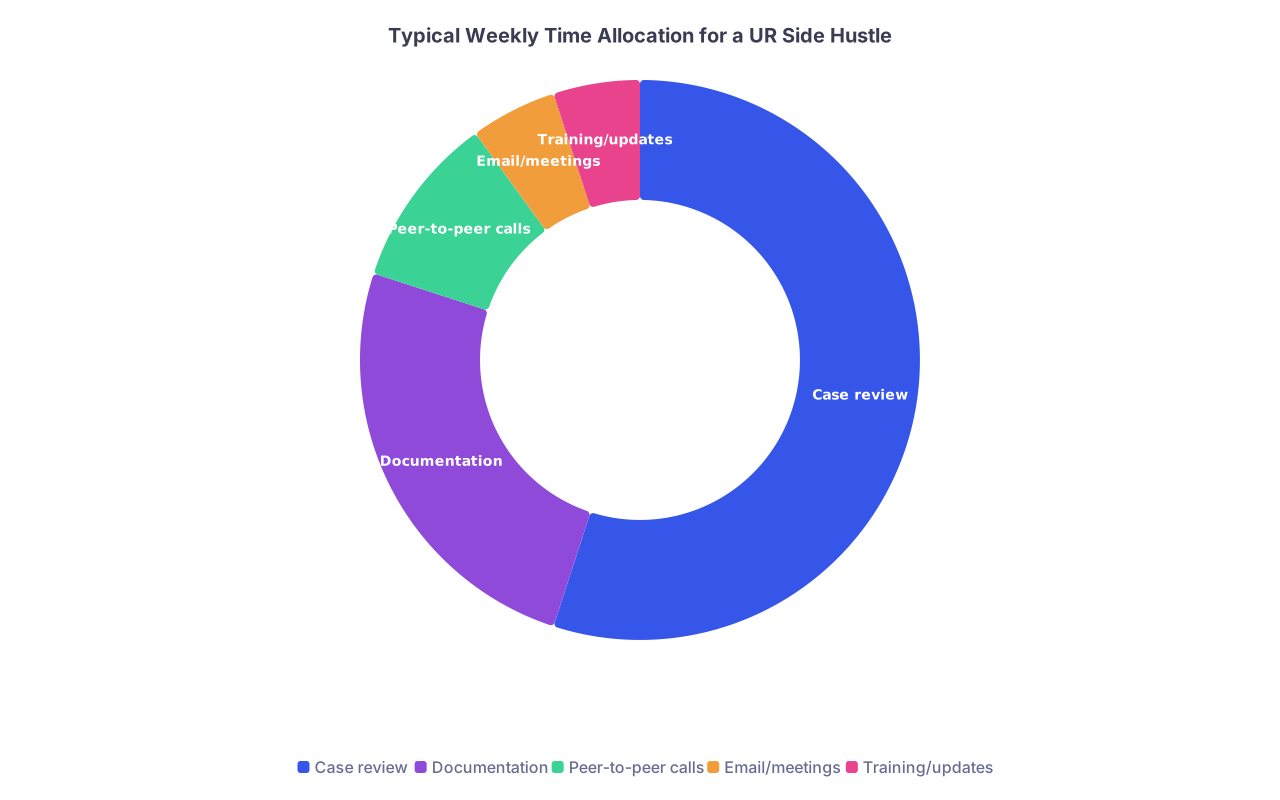
| Category | Value |
|---|---|
| Case review | 55 |
| Documentation | 25 |
| Peer-to-peer calls | 10 |
| Email/meetings | 5 |
| Training/updates | 5 |
4.1 Case volume and pace
For a side hustle, common ranges:
- 8–16 hours per week.
- 10–25 cases per shift for complex inpatient work.
- 25–40+ cases per shift for more straightforward outpatient or brief reviews.
Some pay models are per-hour; others are per-case. For side hustles, hourly is more common and saner.
Typical expectations:
- Log in at set times (e.g., 8–12 on Tuesday/Thursday) or have a flexible daily window.
- Clear your assigned queue.
- Answer time-sensitive peer-to-peer calls during your shift if that is part of your role.
4.2 Environment and workflow setup
You need:
- A reasonably quiet home office.
- Dual monitors help a lot: one for chart, one for criteria/guidelines.
- Secure VPN or portal access; typically the company supplies or secures software access.
- Sometimes they will send you a dedicated encrypted laptop; other times you install their software on your device (I prefer the former).
What you do not need:
- Stethoscope.
- Scrubs.
- “Clinic flow.”
You are reading, thinking, comparing to guidelines, documenting. All day.
4.3 Cognitive load and fatigue
UR is cognitively lighter than performing complex procedures, but it is not nothing.
Real fatigue points:
- Repetitive borderline cases (e.g., “Is this shoulder MRI really necessary?” 30 times).
- Constant toggling between different medical policies.
- Keeping track of different state regulations and product types (Medicare Advantage, Medicaid, commercial PPO, etc.).
People underestimate how drained they feel after 4 hours of decision-making without the variability of direct patient interaction.
5. Who Hires You, And What They Look For
This is where the fantasy often hits reality.
5.1 Common employers
Your paycheck usually comes from one of these:
- National insurers (UnitedHealthcare, Aetna, Cigna, etc.).
- Regional health plans (Blue plans, Medicaid managed care, integrated systems).
- PBMs and specialty benefit managers (for meds and high-tech imaging).
- Hospital systems (for internal physician advisor roles).
- Third-party UM vendors (e.g., companies contracted by payers or employers).
Each has its own training, metrics, and bureaucracy.
5.2 Typical physician requirements
There is a loose hierarchy:
- Board-certified in a relevant specialty.
- Active, unrestricted license in at least one U.S. state.
- 3+ years of post-residency clinical experience preferred.
- No major sanctions, OIG flags, or malpractice disasters.
For true side hustle (not leadership):
- Internal medicine, family medicine, EM, and pediatrics are the most versatile.
- For specialty review (e.g., oncology, cardiology, ortho), they want board certification in that specialty.
You do not have to be fellowship-trained for most roles, but for high-cost, high-stakes niches (oncology, transplant) they often prefer or require it.
5.3 Hiring process
Expect:
- Traditional CV and application.
- 1–2 interviews, often with a medical director and a nurse manager.
- Sometimes a “sample case” to walk through your reasoning.
They are not testing your ability to diagnose zebras. They are testing:
- Can you follow policy?
- Can you make a decision and support it?
- Can you communicate that decision professionally?
6. Money, Contracts, and How You Actually Get Paid
Let’s cut to what everyone really wants to know: is this financially worth it?
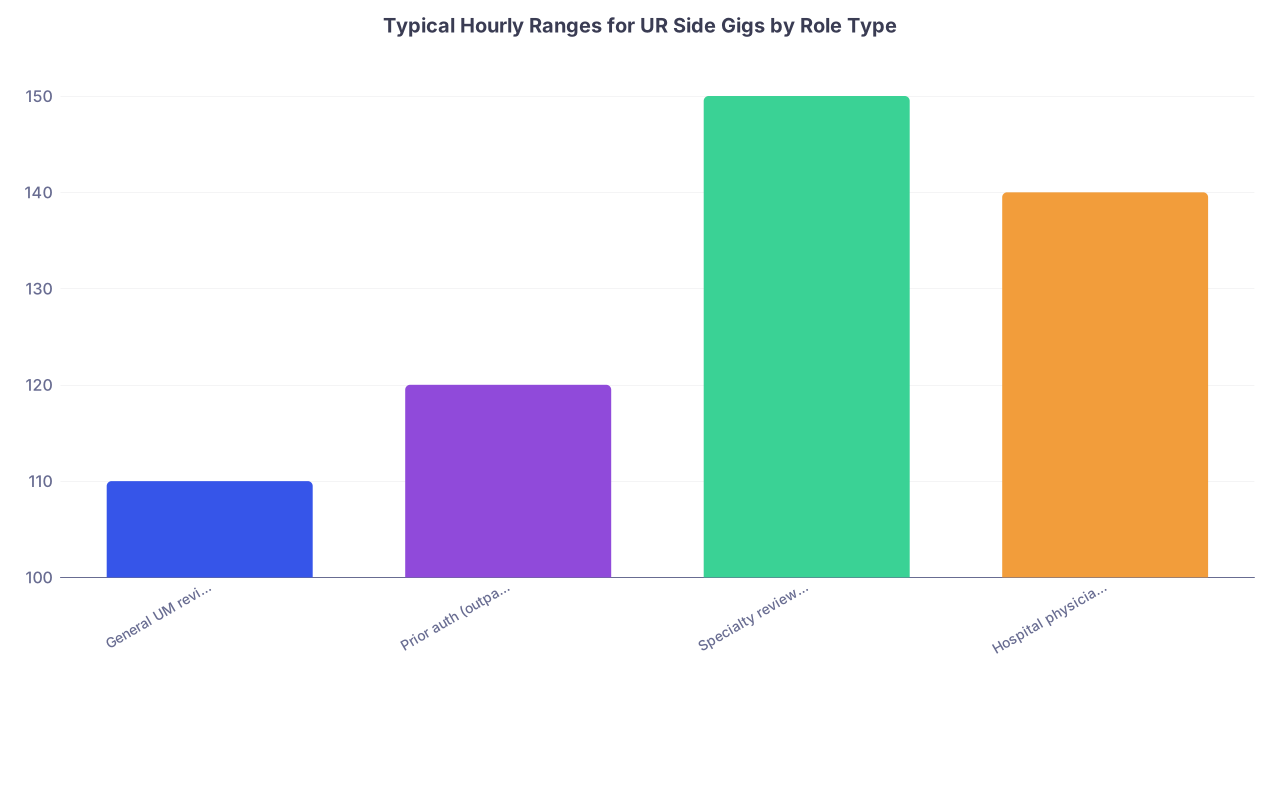
| Category | Value |
|---|---|
| General UM reviewer | 110 |
| Prior auth (outpatient) | 120 |
| Specialty reviewer (onc/ortho) | 150 |
| Hospital physician advisor (part-time) | 140 |
These are realistic ballparks for U.S.-based, part-time remote roles as of the last few years. Outliers exist, but if someone promises you $300/hr for UR, question it.
6.1 Pay structures
You will typically see:
- Hourly 1099 contractor (most common for side work).
- Hourly W-2 PRN or part-time employee.
- Rarely, per-case pay (which I do not recommend unless you really trust their volumes and definitions).
Hourly ranges:
- Generalist UR (IM/FM/EM): ~$100–$150/hr.
- Specialty UR (oncology, cardiology, ortho): ~$130–$180/hr.
- High-level physician advisor or leadership: higher, but usually salaried, not side hustle.
Non-clinical UR pays less than high-end locums or private practice, but the lifestyle tradeoff is huge:
- No nights (for many roles).
- No weekends (for many roles).
- No malpractice tail; often malpractice is not even required because you are not practicing medicine, you are rendering utilization review opinions.
6.2 Volume and consistency
This is where physicians get burned if they do not ask upfront.
Key questions:
- Is there a minimum number of hours I must commit weekly?
- Is there a maximum / cap on hours?
- Are hours guaranteed, or “as cases are available”?
- Will I be paid for time blocked and available, or strictly for cases completed?
I have seen people offered “minimum 10 hours per week,” but then cases dry up and they are sitting there refreshing the portal. Do not assume. Ask for it in writing.
7. How “Approvals” and “Denials” Really Work
A lot of moral anxiety around UR comes from not understanding how narrow your lane actually is.
7.1 You do not “deny care”; you deny payment at a given level
This distinction is both real and legally important.
As a UR physician, you are not forbidding a surgeon from operating or a hospital from admitting. You are saying:
- “We will/will not pay for this service at this level under this plan and policy.”
The patient and provider can still proceed, but financial responsibility shifts.
Ethically, yes, this matters. But it is not the same as walking into a room and saying, “You cannot have this medication.”
7.2 Your decisions are constrained
You operate within:
- Statutory rules (CMS, state Medicaid regulations).
- Contracted terms between payer and facility.
- Published medical policies and guidelines.
You are not free-styling based on your personal preference. If your denial or approval deviates from policy, that is a liability for the company and for you.
In practice this means:
- You will sometimes approve care you personally find questionable, because it meets policy criteria.
- You will sometimes deny or downgrade care that clinically “could go either way” but does not meet the policy threshold.
If that tension makes you deeply uncomfortable, UR is the wrong side hustle.
8. Documentation, Compliance, and Why Auditors Care About Your Notes
UR is brutally audited. Internal, external, regulatory.
Your notes must:
- Support the determination clearly.
- Use consistent terminology (medically necessary, experimental, cosmetic, etc.).
- Distinguish between what is fact (from the chart) and what is interpretation (your application of policy).
Common mistakes I see new UR physicians make:
- Copying large blocks of clinical data without synthesis.
- Failing to explicitly reference the guideline or policy used.
- Using ambiguous language: “probably not needed,” “seems OK.”
- Writing like a progress note instead of a coverage determination.
UR documentation is more legal-administrative than clinical. Think structured, concise, and policy-anchored.
9. Training Curve: How Long Until You Are Useful (and Comfortable)?
You are not instantly valuable on day one. You are a liability until you understand their systems.
Typical onboarding:
- 1–2 weeks of structured training:
- Systems navigation.
- Overview of applicable guidelines (InterQual, MCG, internal policies).
- Shadowing a senior reviewer.
- 2–4 weeks of supervised review:
- Your decisions double-checked.
- Feedback on documentation and consistency.
Realistically:
- Expect 4–8 weeks before you feel reasonably fluent.
- Expect 3–6 months before you are fast and efficient.
Do not expect full productivity (and full comfort) in week two. That’s not how this works.
10. Pros, Cons, and Who Actually Thrives in UR
Let’s be blunt.
10.1 Who is a good fit
UR side work fits:
- Physicians who like structure more than chaos.
- People comfortable applying rules consistently, even if they disagree occasionally with individual outcomes.
- Those who can read quickly and synthesize data without needing direct interaction.
- Those burned out by clinical risk and malpractice anxiety, looking for a lower-intensity alternative.
If you are the type who loves guidelines, checklists, and policy manuals, you will probably be fine.
10.2 Who is a bad fit
You will hate UR if:
- You need patient interaction to feel satisfied.
- You are highly conflict-avoidant with colleagues; peer-to-peer calls will paralyze you.
- You find insurance rules morally intolerable across the board.
- You cannot stand repetitive decision-making.
Also, if you are already clinically overwhelmed at 1.0 FTE with no time boundaries, slapping UR work on top simply increases your exhaustion.
11. How to Break In: A Practical Playbook
Here’s the part people always want: “How do I actually get one of these jobs?”
11.1 Targeted search
Stop just typing “remote physician jobs” into Google.
Look specifically for:
- “Physician reviewer”
- “Medical director – utilization management” (sometimes they over-title part-time roles)
- “Physician advisor”
- “Utilization review physician”
- “Prior authorization physician”
Search on:
- Indeed, LinkedIn, Glassdoor.
- Direct insurer and PBM career pages.
- Hospital system job boards (for physician advisor roles).
11.2 Position yourself correctly
Emphasize in your CV and cover letter:
- Prior committee or administrative experience (even if small: QA, peer review, pathway development).
- Experience with guidelines: UpToDate, NCCN, ACC/AHA, etc.
- Any chart review, coding, CDI, or quality work.
- Comfort with EHRs, remote work, and large amounts of reading.
They are not impressed by your rare procedures. They are impressed by your ability to be systematic.
11.3 Start smaller if you must
A common pathway:
- Start as a part-time physician advisor at your own hospital.
- Work closely with case management and UR nurses.
- Learn status determinations (inpatient vs observation).
- Use that experience to move to a remote payer role.
Hospitals are often desperate for physician advisors because most doctors do not want that job. Use that to your advantage.
12. Future of UR: Why This Side Hustle Is Not Going Away
If you are worried UR will be automated away in five years, relax. It will not. It will just change shape.
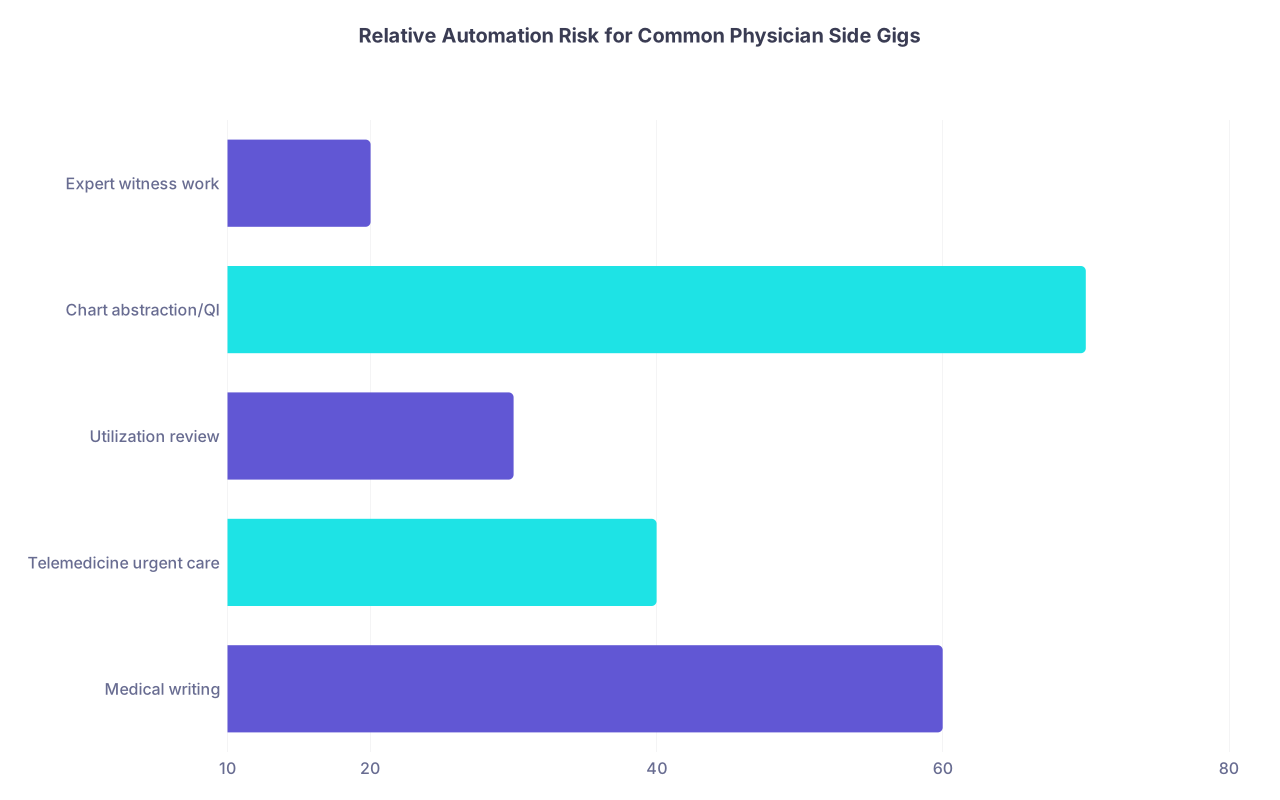
| Category | Value |
|---|---|
| Medical writing | 60 |
| Telemedicine urgent care | 40 |
| Utilization review | 30 |
| Chart abstraction/QI | 70 |
| Expert witness work | 20 |
Higher value = more likely to be automated substantially. UR is lower than many people think.
Here is why UR has staying power:
- Regulators and plans demand a human physician signature on certain determinations.
- Policy interpretation and exceptions require judgment, not just checkboxes.
- Peer-to-peer conversations are not going to be outsourced to a chatbot for a long time; the liability is enormous.
What will happen:
- First-line nurse and algorithm screening will become more sophisticated.
- Fewer cases will reach you, but the ones that do will be more complex and contentious.
- Documentation standards will tighten under regulatory scrutiny.
So you will see fewer straightforward rubber-stamp approvals and more “borderline, needs human oversight” cases.
That is actually good for job security.
13. Ethical Tension: You Work For The Payer, Not The Patient
You cannot ignore this piece.
UR puts you in a different alignment:
- As a clinician, your primary obligation is to the patient in front of you.
- As a UR reviewer for a payer, your obligation is to apply coverage rules fairly and consistently for the plan population and the integrity of the benefit.
You can:
- Advocate internally for better policies.
- Push back when criteria are clearly out of date.
- Apply policies in the most generous defensible way.
You cannot:
- Ignore policy entirely “because this patient seems nice.”
- Routinely override guidelines just because you clinically would have done something differently.
If you go into UR pretending you are still in the same role you have in clinic or on the ward, you will feel constant dissonance.
Some doctors cannot tolerate that shift. Others compartmentalize it and see themselves as part of a necessary system imposing some rationality on runaway healthcare spending.
You have to decide where you land.
14. Quick Reality Check: Is This Actually a Good Side Hustle?
If you want:
- Remote, predictable, bounded work.
- Use of your clinical brain without the acute pressure.
- A pathway to non-clinical leadership roles (medical director, CMO of a plan).
UR is solid.
If you want:
- Big money fast.
- High variety and intellectual stimulation.
- Minimal bureaucracy and policy.
UR will frustrate you.
FAQ (Exactly 4 Questions)
1. Do I need malpractice coverage for utilization review work?
Usually no, at least not traditional clinical malpractice. Many payers classify UR work as administrative rather than clinical practice, and you operate under the company’s own errors and omissions or corporate coverage. However, you should confirm in writing whether you are covered under their policy and whether any additional coverage is expected from you as a 1099 contractor.
2. Can I do utilization review while still working full-time clinically?
Yes, many physicians start UR as a 4–10 hour per week side gig. The limiting factor is your mental bandwidth and scheduling flexibility. You must be able to log in reliably for your committed hours and potentially take peer-to-peer calls during that time. If your current clinical job is chaotic with no protected time, you will need to be very disciplined to avoid burnout from stacking UR on top.
3. Does utilization review experience help if I want to leave clinical medicine entirely later?
Absolutely. UR is one of the more respected on-ramps into non-clinical roles. It exposes you to payer operations, policy development, and quality/utilization data. Physicians often move from UR reviewer roles into medical director positions, health plan leadership, provider relations, or broader population health and value-based care roles.
4. How long does it usually take from applying to actually starting a UR side job?
You should expect 2–3 months, sometimes longer. The hiring process itself can be a few weeks, but credentialing, licensing checks, background checks, and system setup take time. After that, onboarding and training may take several weeks before you are fully live. If you need immediate supplementary income next month, UR is not the fastest option; it is better seen as a medium-term pivot or complement to your current work.


