
You are here
It’s 11:47 pm. You’re still in scrubs. Your MyFedLoan / MOHELA / Nelnet tab is open on one screen, ERAS or EHR notes on the other, and in the middle is a half-finished Google doc titled “Business Idea.”
Your debt number is disgusting. $280k. $410k. Maybe more. It feels fake when you say it out loud.
You keep hearing people talk about “multiple income streams,” “locum gigs,” “niche telemed startups,” or “building something outside of medicine.” And a part of you really wants that. Not just for the money, but for sanity. Control. A backup plan if medicine keeps getting worse.
But the other voice in your brain is loud:
“What if I screw this up and end up in an even deeper financial hole?”
“Is starting a side business with this much student debt just… irresponsible?”
“What if I lose focus, tank my performance, and hurt my career?”
Let’s walk straight into that anxiety instead of pretending it’s not there.
Because yes, there are real risks. But they’re not always the ones you think they are.
First: What “too risky” actually means when you have massive loans
Everyone throws around “risky” like it’s obvious. It’s not. With six-figure loans, your risk profile is weirdly specific.
There are really four different kinds of risk here:
- Cash flow risk – Can you still make loan payments and basic living expenses if the business eats cash or fails?
- Career risk – Could your side hustle hurt your residency / attending job / fellowship prospects?
- Legal / compliance risk – Could what you’re doing get you into trouble with your hospital, board, or state medical board?
- Psychological risk – Will this wreck your sleep, relationships, or mental health on top of everything else?
Most people obsess about #1. That’s valid. But for physicians and trainees, #2 and #3 are often the bigger landmines.
Let me be blunt:
If your side business puts your license or training status at risk, it’s too risky. I don’t care how good the idea is.
If it “only” risks a few thousand dollars and some pride? That’s actually pretty tame in the context of $300k+ of student debt.
The ugly math: how much does a failed business really hurt?
You’re probably catastrophizing it like this:
“If I start something and it fails, I’ll end up bankrupt, homeless, and defaulting on loans.”
Let’s put numbers to it, because anxiety hates specifics.
Say you:
- Have $350k in loans at ~6–7%
- Are a resident or early attending
- Try a small online or consulting-type business
You “fail” and lose:
- $1,500 on software, design, maybe some legal help
- 200–300 hours over 6–12 months
In real life, the money loss is annoying, not fatal. That amount is a rounding error compared to your loan principal and what you’ll earn over your career.
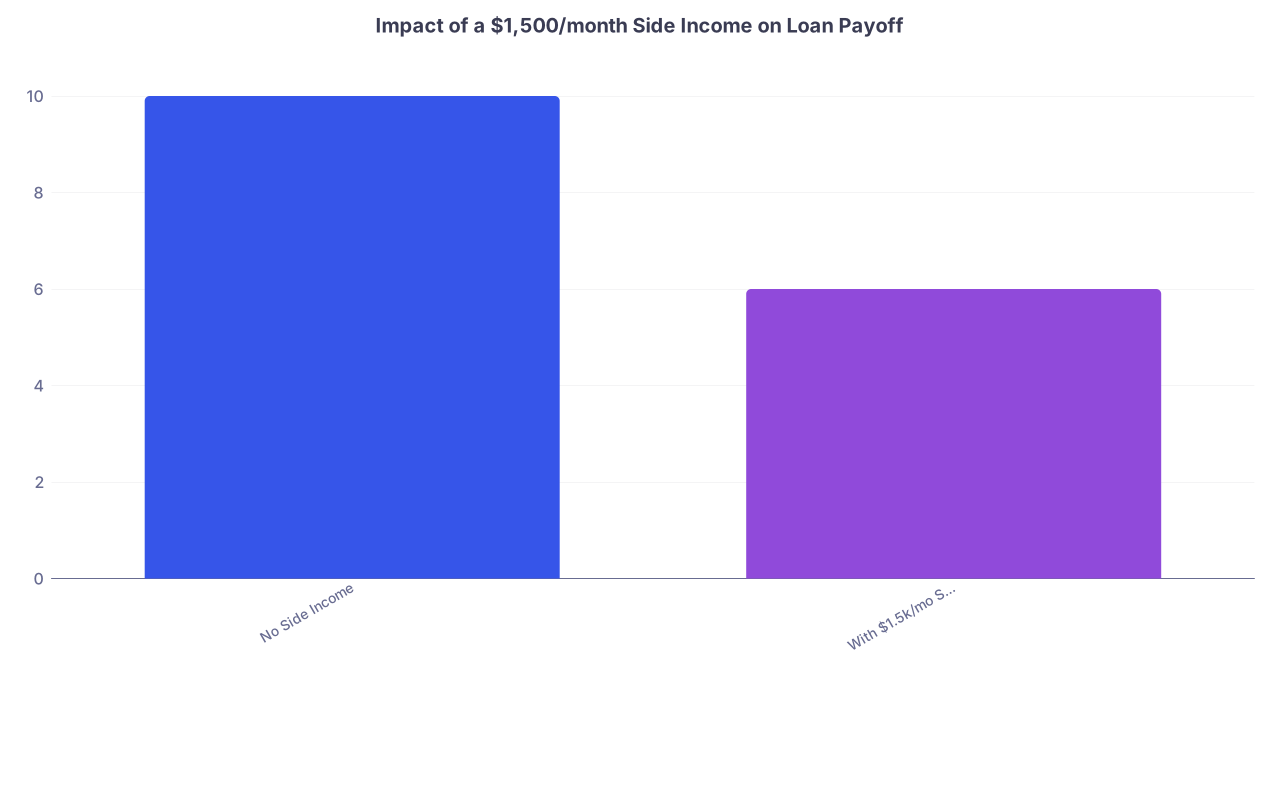
Here’s what changes if you add a modest side business that actually works for you as an early attending:
| Category | Value |
|---|---|
| No Side Income | 10 |
| With $1.5k/mo Side Income | 6 |
Years to pay off aggressive extra payments:
- No side income: ~10 years
- With $1.5k/month extra: ~6 years
Is this exact? No. But the direction is right: small, sustainable side income can shave years off.
The actual catastrophic scenario is not “I tried something and lost $1,500.”
It’s “I never built any financial margin and stayed trapped in a single income stream that I hate.”
But. That doesn’t give you a blank check to go all-in on some sketchy med spa with borrowed money.
So where’s the line?
How to know if your side business idea is too risky for your situation
This is the part you actually care about: “Is my idea a terrible idea with this much debt?”
Let’s do a quick gut-check framework. Be honest with yourself.
| Factor | Low Risk Example | High Risk Example |
|---|---|---|
| Upfront cash required | <$1,000 | >$25,000 (especially borrowed) |
| Ties to medical license | None | Direct patient care business |
| Time per week | 3–5 hrs | 15–25+ hrs |
| Legal/contract complexity | Simple (online, content, tutoring) | Multi-partner, brick-and-mortar |
| Funding source | Cash flow / savings | Credit cards / personal loans |
If your plan looks like:
- Signing a multi-year lease on a clinic space
- Buying equipment on credit
- Hiring staff before you have a single paying client
…while you’re in residency or just starting as an attending with $300k+ in loans?
That’s not “bold.” That’s reckless.
On the other hand, if your plan looks like:
- A low-cost online course
- A small niche consulting service
- A cash-based second-opinion tele-advice with proper legal structure
- A non-medical side hustle (writing, content, coaching, software, etc.)
…and the startup costs are under $1–2k, and you don’t take on new debt?
That’s usually not “too risky” from a financial perspective. The bigger question is whether it drains your time and mental health.
The real constraints: your time, your brain, and your training
You already know this but I’ll say it: residency and early attending life are brutal. Starting a side business on top of that isn’t just about money. It’s about bandwidth.
Here’s the truth I’ve seen play out over and over:
- The danger isn’t “your business will fail”
- The danger is “you will half-do both and feel like a failure in everything”
During residency/fellowship:
- You’re sleep-deprived
- Your learning curve is steep
- You’re under constant evaluation
- You’re already sacrificing relationships and hobbies
Layer a side business on top and you risk:
- Missing key learning because you’re exhausted
- Being that resident who always seems “distracted”
- Letting your business bleed into work hours (massive red flag)
I’ve watched residents get quietly blacklisted by faculty because they “seemed more interested in their side projects than being here.” People actually say that in meetings.
So if you’re in training, I’d be conservative:
- Aim for 3–5 hours/week max, not 15+
- Keep it asynchronous (no mandatory calls, no fixed client hours)
- Start with experiments, not LLCs and logos
Once you’re an attending with a stable job, different story. You’ve got more leverage and more control. But even then, don’t underestimate cognitive load. It’s still your sleep, your partner, your kids, your sanity on the line.
The legal / contract trap nobody warns you about
Here’s the part that can really blow up your life if you’re not careful.
You can absolutely ruin your career faster with a sloppy side business than with a missed RVU target.
Watch for:
Non-compete clauses / moonlighting rules
Your employment contract may restrict:- Practicing within X miles in the same specialty
- Doing telehealth on the side
- Owning or working in a competing clinic
- Any “outside employment” without written approval
Hospital policies
Many systems require disclosure of any side work that:- Involves your medical expertise
- Uses hospital patients, data, or referrals
- Might be perceived as endorsement by the institution
Compliance / Stark / kickback issues
If your business touches referrals, DME, labs, imaging, or anything that could involve self-referral or kickbacks? You need real legal advice, not Reddit.Telemedicine regulations
Crossing state lines, prescribing, documenting, malpractice coverage, corporate practice of medicine laws. It’s not “just Zoom visits.”
If there’s even a chance your side hustle touches patient care or referrals, factor in:
- Entity formation (usually LLC or professional entity)
- Written agreements
- Malpractice coverage
- Compliance review
Is that overkill for, say, a blog about physician burnout with affiliate links? No. For a side cash-pay clinic? Absolutely necessary.
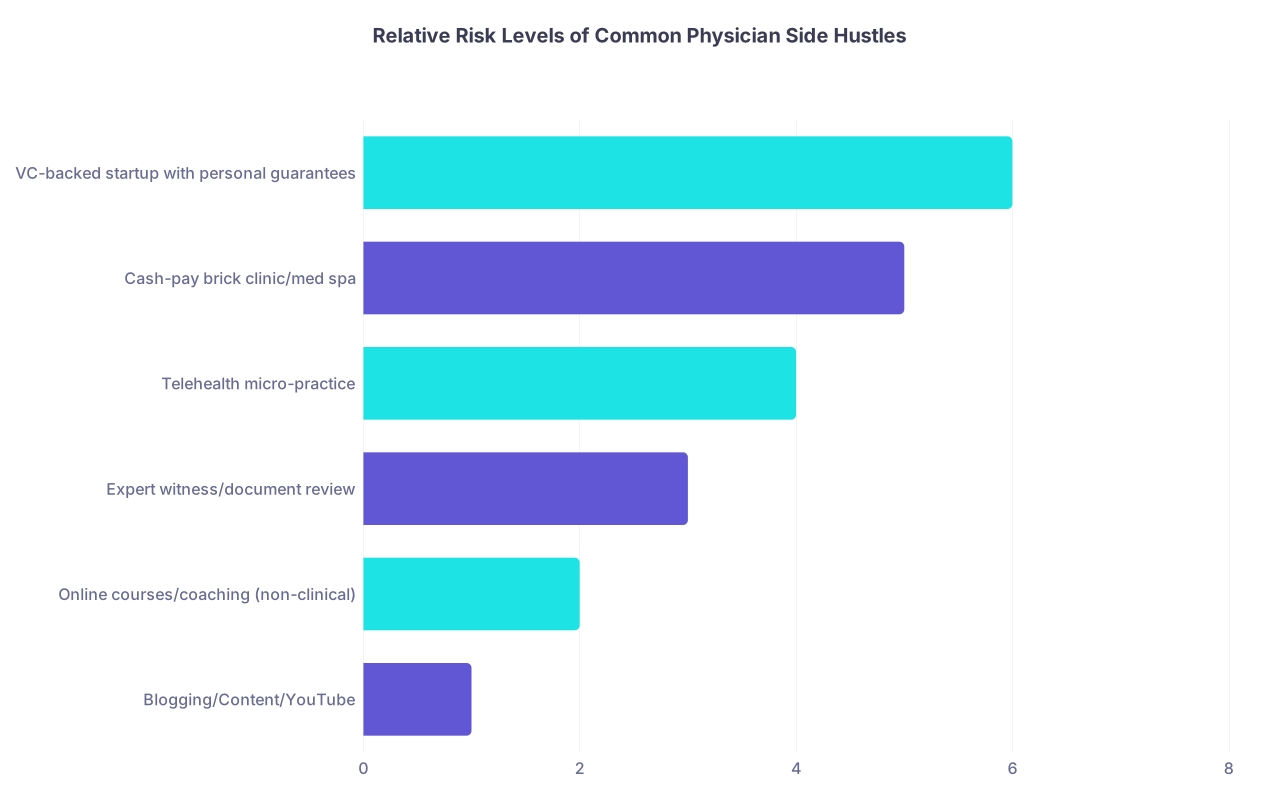
Safer vs. scarier physician side hustles when you have big loans
Let’s categorize this the way your anxious brain actually sees it.
| Category | Value |
|---|---|
| Blogging/Content/YouTube | 1 |
| Online courses/coaching (non-clinical) | 2 |
| Expert witness/document review | 3 |
| Telehealth micro-practice | 4 |
| Cash-pay brick clinic/med spa | 5 |
| VC-backed startup with personal guarantees | 6 |
1 = relatively low overall risk, 6 = high overall risk (for someone with large loans and no big savings)
Lower-risk (for debt-heavy physicians):
- Educational content (blog, YouTube, newsletter)
- Non-clinical coaching (test prep, productivity, premed, etc.)
- Public speaking, writing, consulting where you’re paid for expertise, not prescribing
- Simple digital products (guides, templates, small courses)
Why lower risk?
Low capital. No extra debt. Usually no malpractice exposure if you’re not giving individual medical advice. Can be shut down at any time with minimal fallout.
Medium-risk:
- Expert witness work
- Chart review / utilization review side gigs
- Very small, limited-scope telemedicine services under a tight legal framework
Money can be good. But legal exposure, time pressure, and burnout risk go up.
High-risk (with massive loans and little savings):
- Brick-and-mortar clinics or med spas you personally finance
- Startups where you sign personal guarantees or use credit cards to float expenses
- Anything that would tank you financially if it closed in 12 months
With a huge loan burden and no real savings cushion, I’m not a fan of the last category. Not as a first play. Not while you’re still stabilizing your primary career.
How to make a side business less terrifying when you’re drowning in loans
You’re not going to magically stop worrying. That’s fine. Use the anxiety as a design constraint.
Here’s how I’d structure it if I were in your shoes and couldn’t shake the urge to build something:
No new debt. Zero.
If your business can’t start lean, it’s the wrong business for this phase of your life.
If you need $50k before you make $1, that’s a hard pass for now.Cap your loss up front.
Decide: “I’m willing to risk $X and Y hours over 6 months.”
Example: “$1,000 and 5 hours/week for 6 months. If there’s no meaningful traction, I pause.”
Now the worst-case is bounded, not infinite.Protect your core job like it’s sacred.
No business calls during clinic. No scheduling that threatens your shift coverage. No skipping conferences or required events because of your side hustle. People notice.Separate identity from outcome.
Your first idea probably won’t hit. That doesn’t mean you’re bad at business. It means you did reps. If it fails cheaply, that’s actually a win in the long game.Start embarrassingly small and manual.
Before websites and logos and “launches,” ask:- Can I sell this 1:1 to three people?
- Can I run this as a test for 30 days with duct-taped systems?
If not, it’s probably too big or too vague right now.
What actually happens if it “fails”?
Let’s run your worst-case story all the way through instead of leaving it as a vague dread cloud.
You:
- Spend $1–2k on tools, design, maybe an accountant
- Put in evenings and weekends for 6–9 months
- Make almost no money
- Feel stupid and embarrassed
Then:
- You stop.
- Your loans are… exactly where they were.
- You’re a bit more tired and a bit more educated about marketing, contracts, and customers.
- Literally nobody outside a tiny circle even remembers you tried this.
And you can try again, smarter, later. As an attending. With more savings. More leverage. More clarity about what you actually want.
I’ve seen people drag a dead business idea for 3 years because their ego wouldn’t let them call it. That’s the real risk. Not failing—refusing to declare the failure and free yourself.
When you probably should wait
Even as someone who thinks physicians need more economic power and optionality, there are situations where I’d tell you to hold off:
- You’re on the verge of remediation / probation
- Your mental health is already shaky (burnout, depression, panic attacks)
- You’re applying for highly competitive fellowships and need strong letters
- You’re in PGY-1 and barely keeping your head above water
- You’re in a toxic program where any “distraction” will be weaponized against you
In those cases, your “side hustle” might be better as:
- Reading about business and finance
- Shadowing or talking to physicians who’ve built businesses
- Taking one basic course in entrepreneurship or personal finance
- Slowly building an audience or network without monetizing yet
Delayed doesn’t mean denied. It means you’re not using the most fragile phase of your career as the testing ground for your riskiest ideas.
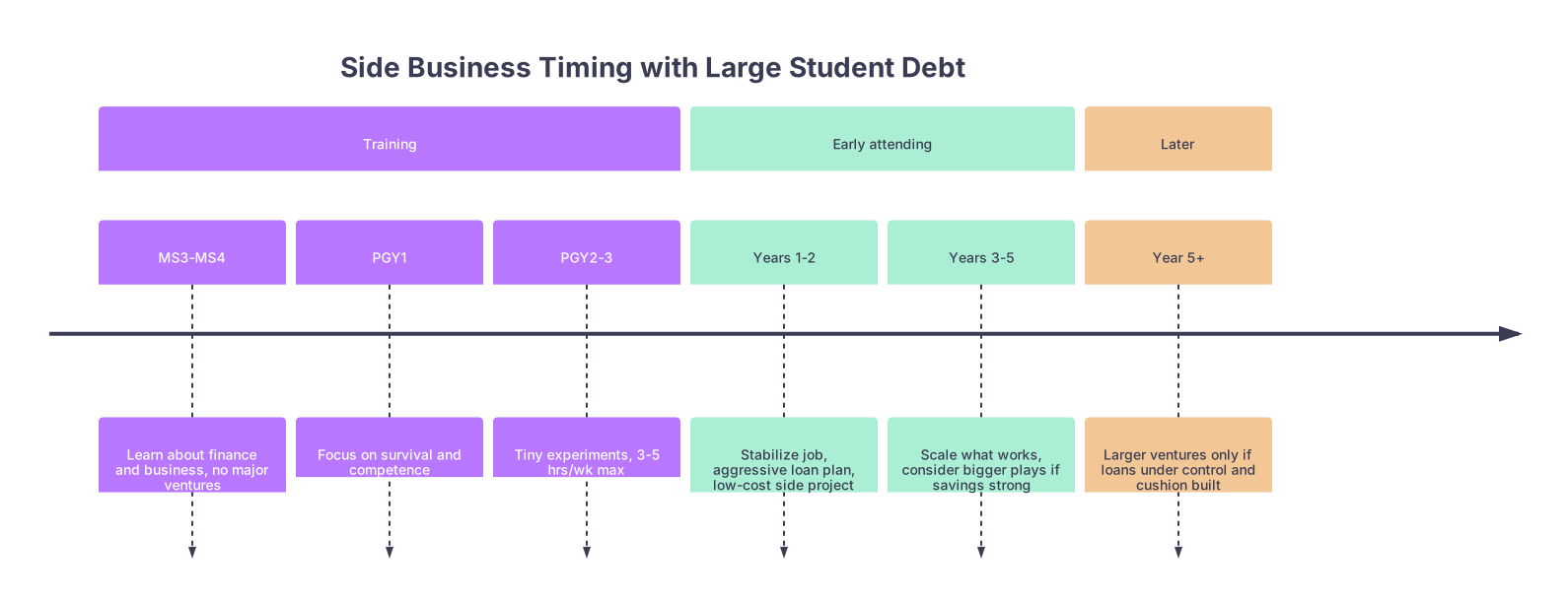
A sanity check timeline: when to layer what
Here’s a rough sketch for how people successfully stack this without imploding.
| Period | Event |
|---|---|
| Training - MS3-MS4 | Learn about finance and business, no major ventures |
| Training - PGY1 | Focus on survival and competence |
| Training - PGY2-3 | Tiny experiments, 3-5 hrs/wk max |
| Early attending - Years 1-2 | Stabilize job, aggressive loan plan, low-cost side project |
| Early attending - Years 3-5 | Scale what works, consider bigger plays if savings strong |
| Later - Year 5+ | Larger ventures only if loans under control and cushion built |
This is not a law. But if you’re massively off from this—like opening a brick clinic in PGY-2 with $400k in loans—your risk is objectively high.
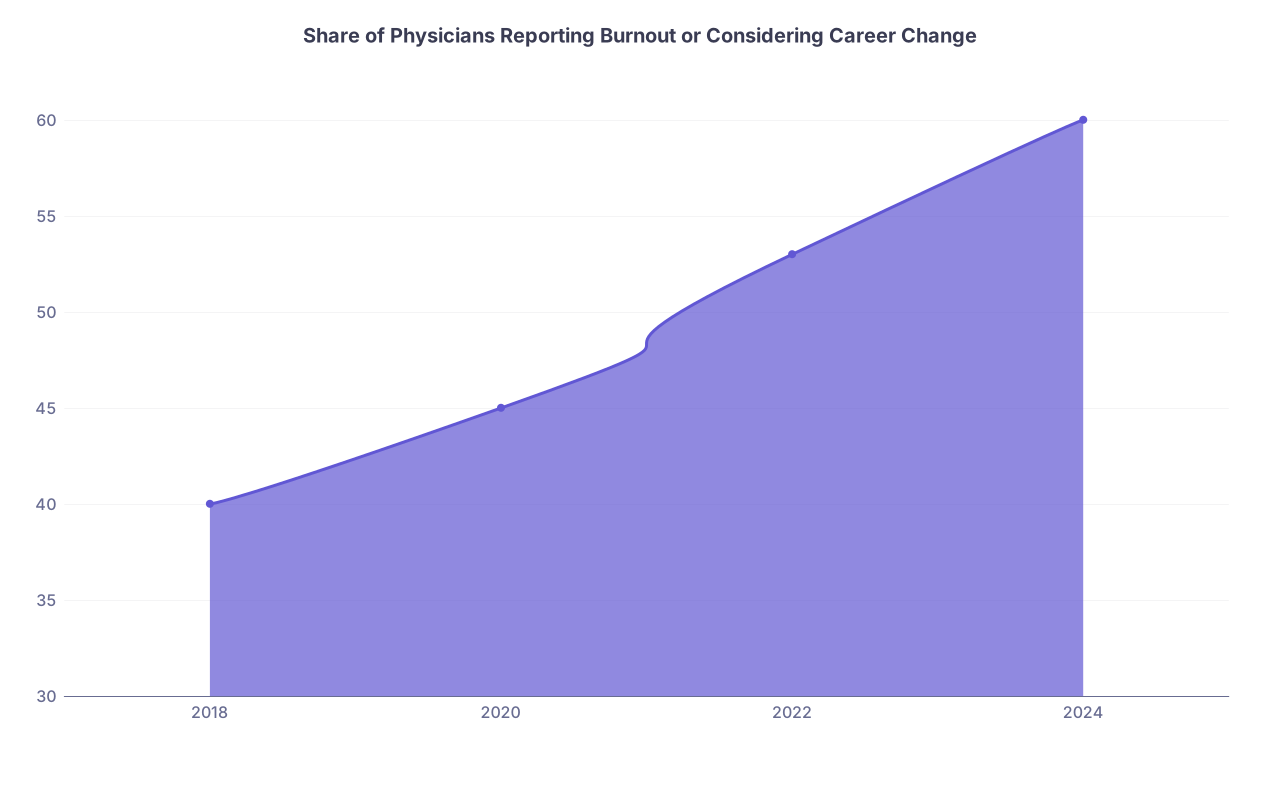
Quick reality check: The bigger risk might be doing nothing
I’m not going to pretend that every physician needs a side business. Some don’t. Some genuinely just want to practice and go home. That’s fine.
But the system you’re in is changing. Fast.
| Category | Value |
|---|---|
| 2018 | 40 |
| 2020 | 45 |
| 2022 | 53 |
| 2024 | 60 |
As more doctors talk openly about:
- Burnout
- Loss of autonomy
- Corporate consolidation
- RVU pressure and shrinking reimbursement
…having one employer as your only source of income starts to feel a little scarier.
So yes, starting a side business with massive loans has risk. But so does betting your entire financial and professional life on one institution that can change your schedule, pay structure, or job security with one policy email.
The trick is not eliminating risk. It’s choosing the form of risk you’re willing to live with, and capping the downside.
Years from now, you won’t remember the exact dollar amount you “wasted” trying something that didn’t work. You’ll remember whether you stayed paralyzed, or whether you let yourself take small, thoughtful bets on a future that felt more like yours.
FAQ (exactly 4 questions)
1. Should I pay off my loans first before starting any side business?
Not necessarily. If “side business” means low-cost, low-debt, evenings-and-weekends experiments that don’t touch your license, you don’t have to wait until you’re debt-free. What I wouldn’t do is delay all investing, all retirement saving, and all debt payoff just to pour money into a risky business. Loans and career stability come first; business experiments ride in the back seat, not the trunk.
2. Is it a bad sign to residency/fellowship programs if I talk about entrepreneurship?
It depends how you frame it. If you sound like you’re trying to escape medicine ASAP, some programs won’t love that. If you frame it as interest in systems, innovation, or improving care delivery, it can actually be a positive. The red flag isn’t “I’m interested in business.” The red flag is “I seem more invested in my startup than in learning to be a good physician.”
3. How much money should I be willing to lose on a first side business attempt?
With large loans and no major savings, I’d cap it at an amount that won’t change your life if it disappears—often $500–$2,000 total over 6–12 months. If losing that amount would derail loan payments, rent, or food, it’s too much right now. Your first goal is learning and proof-of-concept, not maximizing revenue.
4. What if I have zero business skills—should I even try?
Lack of business skills isn’t the real barrier; arrogance is. If you’re willing to admit you don’t know what you’re doing, read, take small courses, ask questions, and start tiny, you’re fine. Medicine already trained you to learn complex systems. Business is another system. You don’t need to be an MBA before you sell your first $50 service. You just need to keep the stakes low while you’re still clumsy.