
What if picking up another overnight shift is actually one of the least efficient ways to increase your income as a physician?
Most doctors default to the same answer: “I’ll just moonlight.” It feels obvious. Familiar EMR, billable hours, predictable RVUs. But if you look at the numbers—and I mean really look at income per hour of brain damage—traditional moonlighting is often a terrible deal compared with less obvious doctor gigs.
Let’s strip the romance out of “extra clinical work” and talk about what the data actually shows.
The Overrated Reality of Moonlighting
I am not anti-moonlighting. I am anti-myth.
The myth:
“If I want more money, I should pick up more clinical shifts. That’s the best ROI on my time.”
The reality:
Traditional moonlighting is:
- Highly taxed
- Physically draining
- Legally risky (malpractice, licensing, credentialing)
- Capped by your energy, not just available hours
And the pay is not nearly as magical as people pretend once you adjust for those things.
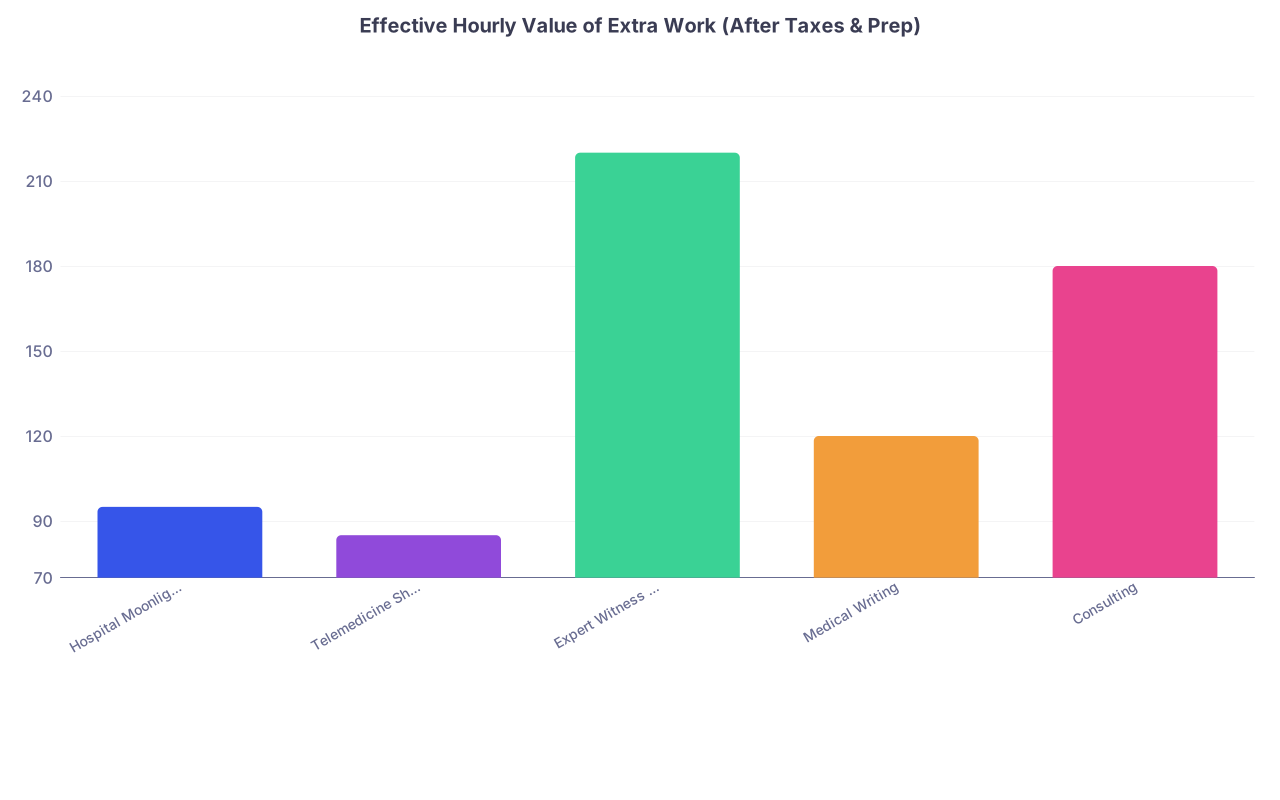
| Category | Value |
|---|---|
| Hospital Moonlighting | 95 |
| Telemedicine Shifts | 85 |
| Expert Witness Work | 220 |
| Medical Writing | 120 |
| Consulting | 180 |
That’s an illustrative but realistic spread from real ranges I’ve seen:
- Hospital moonlighting: $120–180/hr before tax → often <$100/hr effective after commuting, unpaid charting, and higher marginal tax rates
- Telemedicine: often $70–120/hr, sometimes volume-based, with major plateauing
- Expert witness work: $300–600/hr is common, more for some specialists
- Industry/consulting: $200–400/hr for many mid-career physicians
- Medical writing/review: $100–200/hr, often asynchronous and flexible
Doctors get hypnotized by the rate on paper and ignore:
- Time lost to commuting and sign-out
- Cognitive fatigue that bleeds into your main job
- Malpractice risk on top of your baseline exposure
- Marginal tax rate at 32–37% chipping away at “big money”
You know what’s underrated? Gigs where:
- You control timing
- You can say no without wrecking a schedule
- You can scale your rate over time
- Your risk is reputational, not malpractice and licensure
Let’s walk through side gigs where the numbers and the lifestyle actually beat “just one more shift.”
1. Expert Witness Work: The Pay Is Not a Rumor
Most residents have heard the whisper:
“I know a guy who makes 500 an hour doing legal stuff.”
That “legal stuff” is usually expert witness work. And no, it’s not just neurosurgeons in Manhattan.
Typical structure:
- Chart review rates: $300–600/hr (many start at $300–350/hr in non-elite specialties)
- Depositions: often higher, $400–800/hr, usually with minimum blocks (e.g., 4 hours)
- Trial testimony: same or higher than depo rates
- Retainer: some ask for a minimum (e.g., 5 or 10 hours prepaid)
Is it work? Yes. Is it adversarial? Sometimes. But you’re not getting called in every week. And you control your caseload.

Key myths that keep doctors away:
Myth: “I’ll get blacklisted if I testify for plaintiffs.”
Reality: Most credible experts do both plaintiff and defense work over time. Courts care more about honesty and consistency than who hired you. Boards are not hunting you for well-documented, defensible opinions.Myth: “I need special legal training first.”
Reality: You’re hired for your clinical expertise. You’ll pick up the legal side case by case. Plenty of experts start with no formal legal background.Myth: “It’s all malpractice cases.”
Reality: Not true. Product liability, disability determinations, personal injury, criminal cases, standards-of-care reviews—plenty of variety.
Why it beats moonlighting on an hourly basis:
- It’s deep-focus, bounded work. A 4-hour focused record review block can bring in more than an entire 12-hour hospital shift.
- Once you’re experienced and reachable, cases often come to you.
- Time is fully billable—no unpaid pre-charting, no “just finish these 4 extras” patients.
Downside: It’s not instant. You build this like any consulting business: website, CV, some outreach to attorneys, maybe listing with expert witness directories. But the income ceiling per hour is far higher than adding a nocturnist shift.
2. Industry & Consulting: Big Leverage, Low Visibility
When you hear “industry,” most doctors think: full-time pharma job, goodbye clinical skills, hello cubicle. That’s not what I’m talking about.
I’m talking about consulting and advisory work while still practicing:
- Advisory boards (pharma, med device, digital health)
- Clinical content and workflow consulting for health tech
- KOL (key opinion leader) roles—if you are actually, you know, an opinion leader
- Short-term projects: protocol review, product feedback, market input
Typical real numbers I’ve seen:
- Advisory boards: $250–500/hr or per-meeting stipends ($2,000–$5,000 for a half-day)
- Short-term consulting: $200–400/hr
- Ongoing retained advisory roles: $1,000–$5,000/month for a few hours
| Side Gig Type | Realistic Range ($/hr) | Scalability | Physical Fatigue |
|---|---|---|---|
| Hospital Moonlighting | 90–140 effective | Low | High |
| Telemedicine | 70–120 | Medium | Low–Medium |
| Expert Witness | 300–600 | Medium | Low |
| Industry Consulting | 200–400 | High | Low |
| Medical Writing | 100–200 | Medium | Low |
Why this path is so underutilized:
- It doesn’t show up on job boards with “$X/hr” highlighted. You have to ask, pitch, or network.
- Doctors underestimate how valuable their practical perspective is to non-clinicians building products.
- There’s no clear residency-to-consulting pipeline, so it feels nebulous—and doctors default to what’s obvious: more shifts.
But look at the leverage:
- You’re not seeing one patient at a time. You’re influencing workflows or products that touch thousands.
- Work is usually Zoom-based and scheduled, not 3 a.m. admissions with hostile staff and an exploding boarding queue.
- Once you’ve done solid work for one company, referrals happen. Quietly.
This isn’t fantasy. I’ve seen community internists doing $250/hr workflow consulting for EHR add-on vendors because they can speak human and understand cPT codes. Not just academic heavyweights.
3. Medical Writing, Editing, and Content: Unsexy but Efficient
Most doctors roll their eyes at “medical writing” because they think:
- $50/article content-mill garbage, or
- grinding out CME modules for pennies
Yes, that exists. That’s not what I’m talking about.
Realistic good-paying niches:
- CME content creation & peer review
- Guideline summaries for professional organizations
- Editing or writing for physician-facing education platforms
- High-end patient education for systems or insurers
- Regulatory and medical affairs content in pharma
Real-world rates I’ve seen and heard repeatedly:
- $100–200/hr for physicians with domain expertise
- Project-based fees that, when you do the math, land in that same band
- Sometimes more once you’re known and fast
This is one of the few side gigs where:
- You can do the work asynchronously around your call schedule
- You build a portfolio—after a year, you’re “the person who writes X”
- There’s no malpractice risk, and near-zero licensing drama
The catch: You need to be able to write clearly. Not beautifully. Just clearly. If your notes are readable and your co-residents asked you to proofread their personal statements, you’re probably fine.
What makes this superior to a lot of moonlighting?
- Zero commute
- Clear start and stop—you’re not hostage to “one last admit”
- Long-term relationships with content platforms can mean steady, low-friction work
No, you won’t bill $400/hr here. But a steady $150/hr, truly flexible, no-call, no-malpractice gig easily beats dragging yourself through another 10-hour shift after a full clinical week.
4. Telemedicine and Niche Clinical Work: Smarter, Not Just More
Telemedicine is the obvious “alternative,” but most people approach it badly.
The typical mistake: Sign up for a high-volume, low-complexity urgent care telehealth platform, race through 30 patients for $20–30 per visit, and then get depressed when your effective rate is barely $80/hr.
Better approach: Niche down.
- Specialty telemedicine (sleep, psych, endocrine, rheum)
- High-demand states where your license is scarce
- Asynchronous consults with well-defined questions and templates
- Direct-pay telehealth where you set your own rates
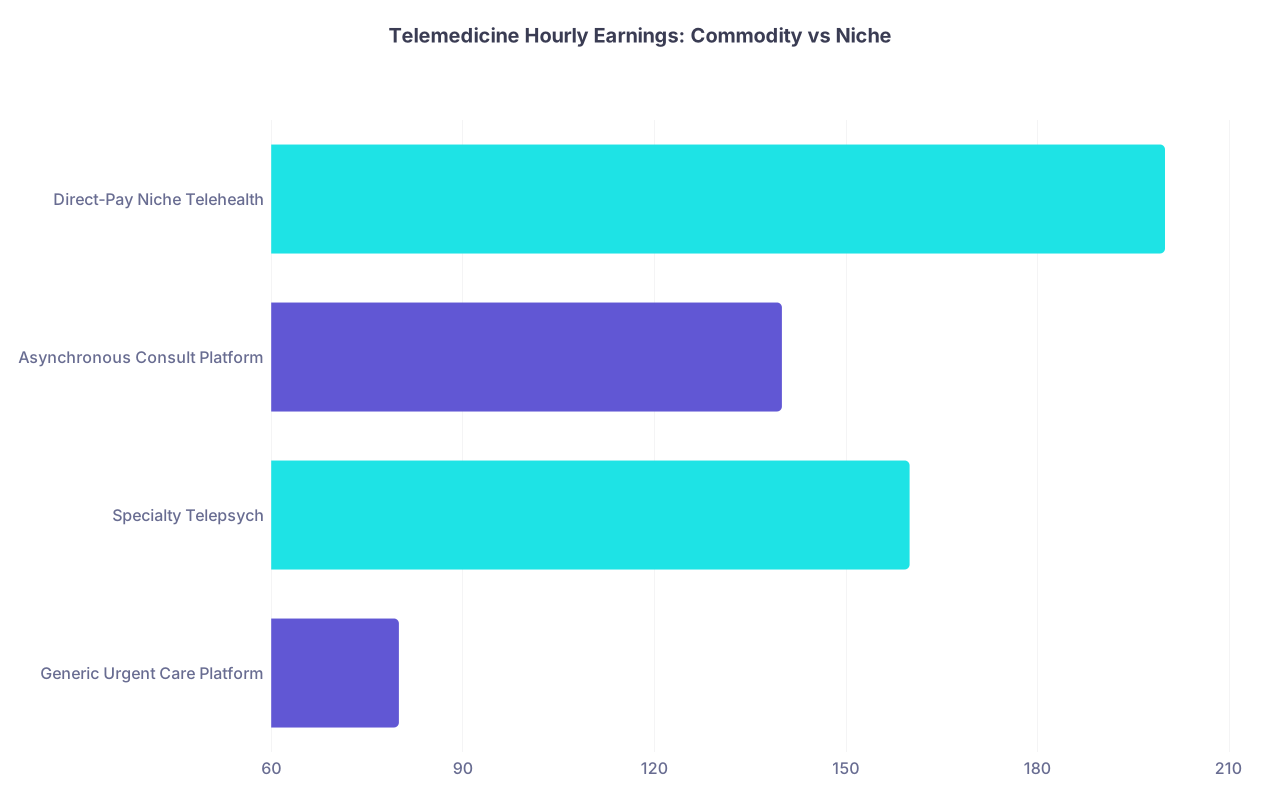
| Category | Value |
|---|---|
| Generic Urgent Care Platform | 80 |
| Specialty Telepsych | 160 |
| Asynchronous Consult Platform | 140 |
| Direct-Pay Niche Telehealth | 200 |
Numbers I’ve seen:
- Generic urgent care: $60–100/hr equivalent after you factor in unpaid time and low per-visit rates
- Specialty telepsych: $150–250/hr
- Asynchronous platform consults: $120–200/hr for focused, well-scoped cases
- Direct-pay niche: sky’s the limit, but $200/hr equivalent is not rare for people who do it intentionally
Is this still “clinical”? Yes. Does it beat traditional hospital moonlighting in risk and fatigue? For many, absolutely.
The trick is to stop thinking, “Any telemed is fine” and start thinking, “Where is my expertise rare and where can I avoid becoming a high-velocity note factory?”
5. The Hidden ROI Killers: Taxes, Fatigue, and Burnout
Let’s talk about the part nobody wants to think about when they see $150/hr: what you actually keep and what it actually costs you.
Three big killers:
Marginal tax rate
That extra moonlighting income stacks on top of your base salary. If you’re already solidly in a high bracket, a big chunk vanishes to taxes. You can blunt this with S-corps, solo 401(k)s, defined benefit plans, but most physicians do not. They just grind, pay, and complain.Burnout cost
Every extra shift isn’t just “more cash today.” Chronic overwork pushes people into reducing main-job FTE, missing out on bonuses, or even switching to lower-paying jobs to survive mentally. The “side income” can indirectly cost you far more.Opportunity cost
The time you spend learning an industry skill, building a tiny consulting brand, or developing an expert witness niche doesn’t pay immediately. But over 3–5 years, the payoff per hour dwarfs extra shifts. Most physicians never even start, because moonlighting gives instant gratification.
The data pattern I’ve seen over and over:
- Years 1–2 out of residency: moonlighting looks great; many doctors do it
- Years 3–7: fatigue sets in, and those who bothered to cultivate non-clinical or semi-clinical specialized gigs quietly exit the moonlighting game
- By mid-career: high earners with control often have 1–3 well-paying side lanes that are not just “more hospital work”
The ones who never left the shift treadmill? They’re the ones telling residents, “Medicine is broken” while going in for their 16th shift this month.
6. How to Pivot Without Blowing Up Your Life
You don’t jump from “no side gig” to “$400/hr expert witness” overnight. But you also don’t need a 5-year master plan. You need one deliberate move.
Pick one lane to test:
Curious about expert witness work?
Get your CV in shape, set up a simple site, register with 1–2 expert witness directories, and say yes to the first reasonable case that crosses your inbox. You’ll learn more from one real case than 20 hours of blog surfing.Interested in industry or consulting?
Go to one targeted conference where vendors actually build tech/products you care about. Have real conversations. Tell them what’s broken in their tool and how you’d fix it. Follow up. Companies remember the rare physician who speaks clearly and isn’t condescending.Thinking about medical writing?
Email three CME or medical education platforms with a short note, a sample piece (you can write one), and your CV. If your writing sample is clean and your credentials are legit, you’ll eventually get nibbles.Exploring niche telemedicine?
Look for platforms or small practices that match your subspecialty. Ask directly about pay structures and visit expectations, and walk away from hamster-wheel models.
You’re not trying to replace your salary. You’re trying to:
- Buy back future freedom
- Reduce dependence on a single employer or health system
- Build at least one income stream where your brain, not your body, does most of the work
The Bottom Line: Stop Automatically Choosing More Shifts
If you strip away habit and fear, and look at raw numbers plus risk, three things become obvious:
Traditional moonlighting is not the only option—and often not the best one. Expert witness work, consulting, and high-quality medical writing routinely beat extra shifts on an effective hourly basis with less physical and legal stress.
The best-paying gigs require a bit of front-loaded effort, not more endurance. You build relationships, credibility, and a small brand once, and then reap the benefits repeatedly, instead of selling every spare night and weekend.
If you keep autopiloting into more clinical hours, you’re capping your long-term leverage. The physicians with the most optionality later are the ones who experimented early with at least one non-obvious, non-moonlighting income stream.
You can keep trading sleep for dollars. Or you can start trading expertise, judgment, and perspective—the things no night shift will ever fully pay you for.