
The biggest money in “side hustle” medicine isn’t in moonlighting. It’s in industry consulting deals that nobody teaches you how to handle.
Let me walk you through what actually happens behind closed doors—how pharma, med device, digital health, and startups size you up, how they structure deals, and what physicians who understand the unspoken rules quietly do to triple their rates while everyone else is just happy for a free dinner and a “key opinion leader” slide.
This is the stuff program directors gossip about and compliance officers worry you’ll never learn. You’re going to learn it anyway.
1. How You Really Get Picked For Consulting (It’s Not Just Your CV)
The public story is: “We value your expertise.”
The real story: they’re buying a combination of influence, access, and plausible deniability.
Here’s what industry folks actually look at when they’re scouting physicians:
- Can you move behavior?
- Can they put you on a slide deck as a “Key Opinion Leader” to convince their internal people or investors?
- Do you have credibility with the specific audience they care about (hospital P&T committee, surgeons in a region, certain subspecialty listserv, social media following)?
I’ve sat in meetings where the medical affairs director literally said: “I don’t care if they have 10 papers or 100. Do people actually listen to them?”
The hierarchy in their heads looks more like this:
| Rank | Attribute |
|---|---|
| 1 | Ability to influence peers |
| 2 | Institutional titles/roles |
| 3 | Niche expertise in a product area |
| 4 | Social media / public presence |
| 5 | Raw academic metrics (papers, h-index) |
Notice what’s missing: “being a good clinician” by itself. They assume you’re competent. That’s the baseline to even get in the door.
So how do you actually get picked?
You don’t “apply.” You get noticed.
Ways people get on the radar:
- Someone in your department is already consulting and drops your name when they’re overcommitted.
- You’ve been vocal or visible around a certain disease area, guideline committee, or clinical protocol.
- Your name shows up in all the same journals and conferences in a specific niche they care about.
- A rep mentions you upward because you’re “reasonable, thoughtful, and not a jerk” in clinic.
The quiet truth: the first small consult offer—“can you join a 60-minute advisory board?”—is almost always them testing whether you’re easy, cheap, and compliant. Most physicians fail that test by saying yes too fast, for too little, while acting overly grateful.
The ones who understand the game treat that first ask like the opening move in a negotiation, not a prize.
2. The Real Money: Structures They Use And What They Won’t Tell You
Consulting deals for physicians come in a few predictable flavors. Each has unspoken rules and traps. I’ve seen people leave tens of thousands on the table because they treated them all the same.
Flat-fee advisory work
This is the classic: “We’d love your input on X. It’ll be a 60–90 minute advisory board, $500 honorarium.”
Translation:
“We’re going to pack 8–12 physicians into a Zoom, pay everyone the same low-ish rate, collect 6–12 months of strategic market intelligence for pocket change, and your opinion is now ours to use.”
The unspoken rule: They expect you to negotiate. They budget for it.
If they open at $500/hour, it’s very common they’re prepared to go to $750–$1,000 for someone with the same CV who simply asks:
“I typically do consulting at $X/hour. Is there flexibility in your budget for this session?”
The people who never ask… never find out.
Ongoing advisory roles and “boards”
The shiny object: Advisory Board Member, Medical Advisory Board, Clinical Council.
This can be legitimate or total theater. Industry likes to put your face and title on slides for investors or internal teams. I’ve seen companies whose “advisory board” meets maybe twice a year for 90 minutes, and the rest is slideware.
Unspoken rules:
- If they’re using your face/name for fundraising or marketing decks, your fee should reflect reputational and branding value, not just “90 minutes of your time.”
- Equity is often offered here, but almost never explained well. Vesting, dilution, exit scenarios—physicians gloss over this and then complain later. Do not be that person.
- Good advisory roles: clear scope, clear meeting frequency, clear compensation (cash, equity, or both), and someone on the inside who actually follows up with you.
- Bad advisory roles: “We’ll touch base ad hoc”, “We’re still figuring out structure”, “We’d love to have you onboard early and grow together.”
Those phrases are code for “We don’t want to commit to paying you reliably.”
Speaking and educational programs
Most of the public thinks this is where physicians get rich. It’s usually not, unless you’re doing big volume.
For traditional pharma/device speaker programs, here’s the truth:
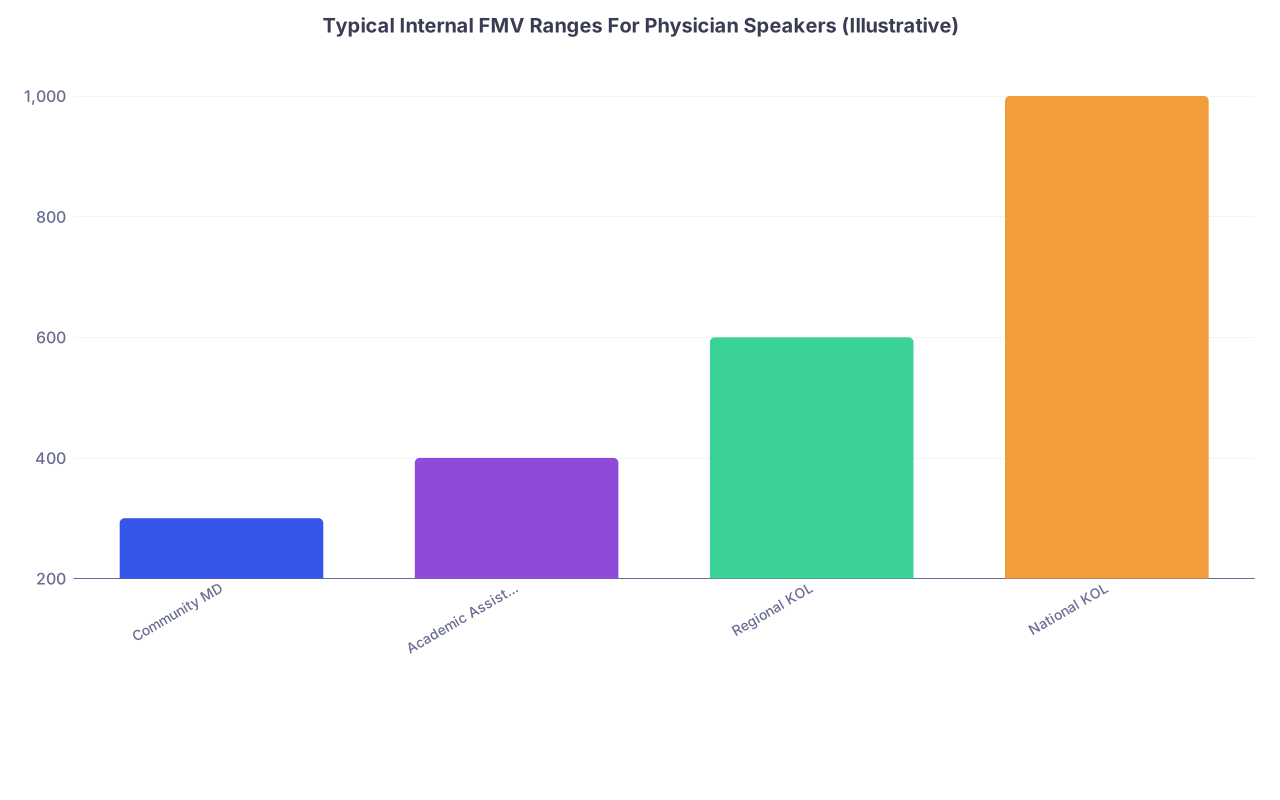
They have internal “fair market value” (FMV) tables that specify what they can pay per hour based on your credentials and geography.
You will not see those tables. But they exist. Something like:
| Category | Value |
|---|---|
| Community MD | 300 |
| Academic Assistant Prof | 400 |
| Regional KOL | 600 |
| National KOL | 1000 |
These are ballpark hourly ranges (USD) that I’ve heard quoted by people in medical affairs. They slide up or down by region and specialty.
Unspoken rules:
- They can’t blow through those FMV caps easily; legal/compliance won’t allow it. So you can negotiate within a band, but not infinitely.
- Where they have flexibility is travel time, prep time, and “follow-up calls.” Savvy physicians ask that those be included in paid hours.
- You’re expected to stay within their slides. Your independent “opinions” are welcomed only if they don’t contradict the core messaging. Pretending this is academically neutral is nonsense. Everyone in the room knows it.
Deep consulting / product development / protocol design
This is where the money gets serious and where most physicians are clueless.
If you’re deeply involved in:
- Shaping a product roadmap
- Helping design clinical protocols or pathways
- Iterating on device usability and safety
- Influencing trial design
You’re no longer just an “advisory call” resource. You’re contributing IP-adjacent value. That’s a bigger deal.
Unspoken rule: The moment your knowledge helps them actually avoid a regulatory pitfall, redesign a feature, or close a hospital system sale, your value is well beyond “$500/hour consultant.” They know this. Many of you don’t.
That’s when you should be thinking:
- Bigger retainer-style deals
- Defined scopes with multiple workstreams
- Equity (with real vesting schedules, not hand-wavy promises)
The physicians who end up on cap tables, not just vendor payment lists, are usually the ones who treat this level of consulting as co-creation, not casual advice.
3. The Pricing Game: What People Really Get Paid
Nobody will ever send you a PDF that says, “Here’s what everyone else is getting.” So you’ll keep underpricing yourself, grateful for crumbs.
Let me cut through it with real ranges I’ve seen repeatedly:
For U.S.-based physicians, typical hourly consulting ranges in industry (not grants, not academia) look like:
| Level | Common Range (USD/hour) |
|---|---|
| Early-career, no name | $200–$350 |
| Solid mid-career, local | $350–$600 |
| Regional KOL | $500–$800 |
| Nationally known KOL | $800–$1,500+ |
I’ve seen people with no formal academic title but large, respected social media platforms get $750/hour while an associate professor who never posts a thing settles for $300. Influence beats title.
Unspoken rules about pricing:
- They expect physicians to undervalue themselves. It’s built into how they budget.
- The first number you say becomes your anchor. If you respond, “Oh, I usually do consulting at $200/hour,” they will never magically volunteer $500.
- Many in-house folks are actually relieved when you state a clear rate. It saves them from awkward guesswork.
A simple, professional script that works:
“For this kind of strategic consulting, I typically work at $X/hour with a one-hour minimum per engagement. If that fits within your FMV and compliance parameters, I’m happy to move forward.”
That last sentence signals that you know they have internal rules and you’re not asking them to violate them. They appreciate that.
4. The Contract: Clauses That Quietly Screw You (And How To Fix Them)
Lawyers are going to hate me for this section.
When they send you a consulting agreement, you’ll skim until you see the dollar amount, mileage reimbursement, and maybe the date. Then you’ll sign.
That’s exactly what they’re counting on.
The real landmines sit in a few key zones: IP, confidentiality, conflict, and scope.
Intellectual Property (IP) landmines
Many standard consulting agreements have language that says (in plain English):
“Anything you think, say, or help create while working with us belongs to us.”
That can range from reasonable to insane depending on:
- Whether the IP is fully inside their product line
- Whether it touches your own independent projects
- Whether it’s broad enough to claim ideas you later use somewhere else
I saw one contract that essentially claimed the physician’s entire brain for the duration of the engagement. If they thought of a new digital health workflow while taking a shower, theoretically the company could argue it was theirs.
What savvy physicians do:
- Narrow the IP language to “work product specifically created for this project/company”
- Explicitly carve out your pre-existing ideas and ongoing independent projects
- Push back on language that suggests anything “related to the field” is automatically theirs
You don’t have to redline it yourself. You just have to know this is the section worth paying a lawyer to review.
Confidentiality and publication
They will give you a very broad NDA. That’s fine. But look for language that says you cannot:
- Work with any competitor for a certain period
- Publish anything in a “related” field without their permission
Some contracts basically attempt to gag your academic output. That’s where the academic physicians who don’t read the fine print get stuck.
Reasonable boundaries: You will not disclose their proprietary stuff. You will not share their internal docs. You will not present their confidential data as your own.
Unreasonable boundaries: You can’t ever talk or write about the disease space again.
Scope creep and “free work”
The most common unspoken rule: once you’re “on the team,” they’ll start adding “quick” calls, “short” email reviews, and “just glancing at this deck.”
Translation: unpaid hours.
If the agreement is vague—“The consultant will provide advisory services as needed”—you’ve basically signed up to be on-call for whatever volume they feel like sending.
The fix:
- Tie time to scope: “Up to X hours per month/quarter for defined advisory services.”
- Add a line: “Additional time beyond that will be billed at the standard hourly rate, with advance email approval.”
You’re not being difficult. You’re being a professional.
5. Conflict of Interest: What Actually Gets You In Trouble
Here’s the part everyone pretends is about “ethics” but is mostly about optics and paperwork.
What actually gets physicians in real trouble is not “doing industry consulting.” It’s:
- Hiding it
- Double-dipping
- Letting it distort clinical or academic decisions in obvious, traceable ways
Every institution is different, but the underlying expectations are similar:
- If you’re employed by a hospital/university, they usually want disclosure and sometimes pre-approval of outside consulting.
- If you’re using institution resources or patients in any way, things get much more regulated.
- If you sit on committees (formulary, guideline, device selection), your industry ties will be scrutinized.
I’ve heard more than one chief of staff say this exact sentence behind closed doors:
“I don’t care if they consult. Just don’t let me be surprised by something that ends up in the news.”
The quiet line in the sand is this:
Consulting is fine. Hidden influence that impacts patient care or purchasing decisions is not.
Where people screw up:
- Doing a lot of paid speaking for a drug, then aggressively pushing that drug on a formulary committee without disclosure.
- Using institution email, resources, or letterhead to advance a company’s agenda as if it’s official.
- Signing agreements that restrict your ability to publish or speak academically, then trying to ignore those clauses.
The other thing nobody tells you: your consulting income will show up in public databases (Open Payments in the U.S.). Your program director, department chair, jealous colleague, or journalist can (and do) look this up.
Assume everything is discoverable. Make decisions you can defend.
6. The Future: Where The Smart Money Is Moving
Traditional pharma/device speaker bureaus are losing some shine. Compliance is tighter. Audiences are more skeptical. Zoom fatigue is real.
The next decade of physician consulting money is moving in a few directions:
Digital health and AI companies
Everyone and their cousin is building an AI triage tool, documentation assistant, or chronic disease platform. They desperately need physicians who can:
- Tell them what’s clinically nonsense
- Define real-world workflows
- Translate “cool technology” into “something a tired internist would actually use at 4:30 pm”
These companies are often more flexible with equity, advisory titles, and creative deal structures. They’re also more volatile. You’re trading some fee certainty for upside.
Health systems and payor-facing analytics
Another big area: consulting around quality metrics, value-based care pathways, and risk stratification. Think: “Help us design a realistic, clinically acceptable pathway for X disease that also works in a value-based contract.”
Insider truth: these gigs often pay better per hour than pharma stuff, because they’re directly tied to cost savings and contract performance.
Content, media, and “physician brand” work
If you have a meaningful online presence—newsletter, YouTube channel, podcast, large LinkedIn following—industry will increasingly come to you not just for “advising” but for distribution and co-branding.
Then the economics shift.
You’re no longer just providing thought; you’re providing audience. That’s advertising, not just consulting. Different rules, higher prices.
The unspoken rule here: protect your voice. If your followers start seeing obviously sponsored nonsense, your influence decays. Industry folks will sometimes push you to “just read the script.” The smart ones say no, or charge a premium to say yes.
7. How To Stop Being The Cheap, Grateful Consultant
Let me be blunt.
Most physicians show up to industry deals like it’s an honor to be invited. Industry shows up like it’s Tuesday.
You need to reset that imbalance.
A few practical mindset shifts and behaviors:
Treat it like real business, not a side favor.
Have a rate. Say it calmly. Don’t apologize for wanting to be paid.Ask questions before you say yes.
Who’s the audience? What’s the scope? What’s the expected time? How will my input be used? Are you planning to list me publicly as an advisor?Push for written clarity.
Even if it’s a short email: “To confirm, this will be X hours, at $Y/hour, for Z deliverables.”Know what you’re protecting.
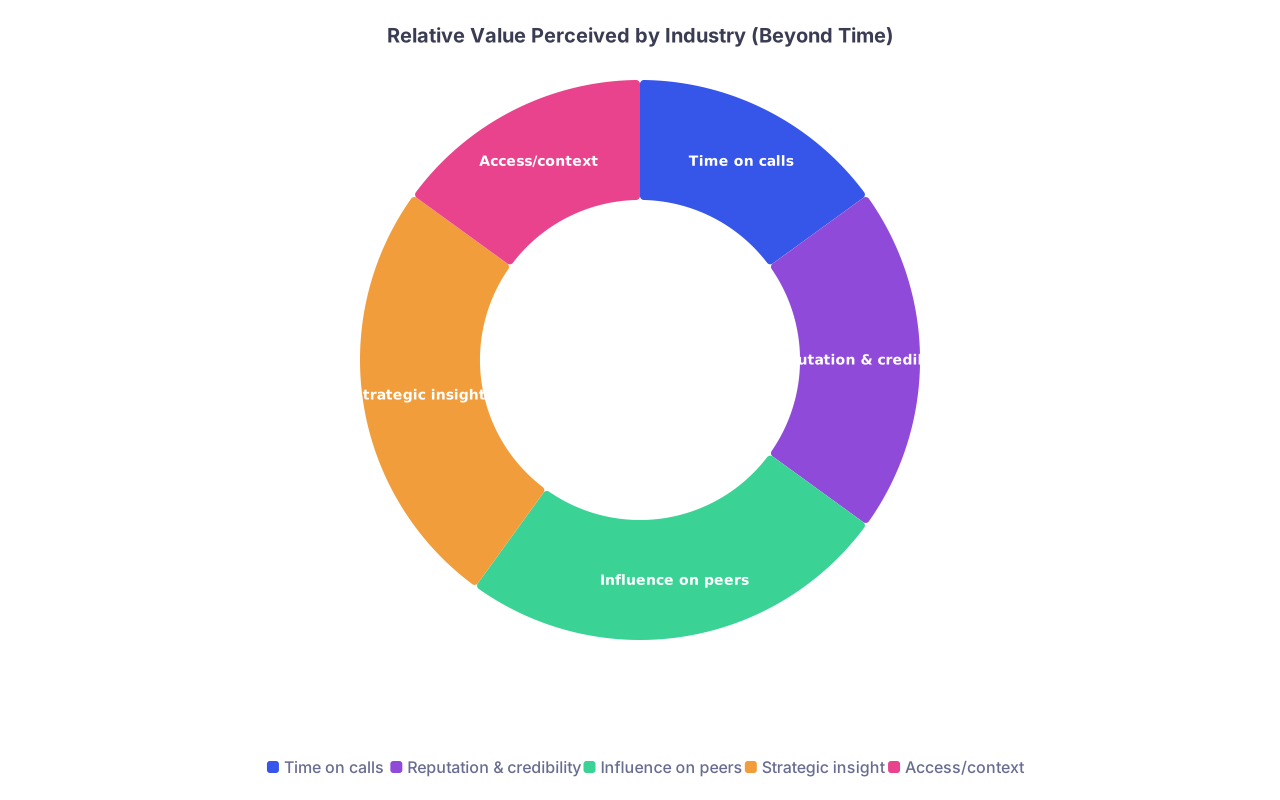
Your license. Your academic freedom. Your reputation with peers. Your own future projects or IP. Any clause that touches these should be examined closely.Remember they’re getting more than your minutes.
They’re buying your years of training, your pattern recognition, your credibility with other physicians. Don’t price yourself like a scribe.
| Category | Value |
|---|---|
| Time on calls | 15 |
| Reputation & credibility | 20 |
| Influence on peers | 25 |
| Strategic insight | 25 |
| Access/context | 15 |
You’re probably overvaluing the “time on calls” slice and ignoring the rest.

| Step | Description |
|---|---|
| Step 1 | Initial outreach email |
| Step 2 | Clarify scope and time |
| Step 3 | State rate and constraints |
| Step 4 | Receive draft contract |
| Step 5 | Review key clauses IP COI scope |
| Step 6 | Negotiate terms if needed |
| Step 7 | Sign and schedule work |
| Step 8 | Deliver consult with notes |
| Step 9 | Invoice and confirm payment |
That’s your playbook. Most physicians skip straight from A to G. Then wonder why they feel undervalued or burned later.
FAQ (Exactly 5 Questions)
1. Do I need a lawyer for every single consulting contract?
No. But you do need to know when a contract is “standard and small” versus “potentially career-impacting.” A one-off one-hour advisory call with a basic agreement and no IP claims? You can probably handle that with common sense and maybe a quick glance from someone familiar with these. Anything involving ongoing advisory work, IP language, equity, or restrictions on publishing or competing—that’s when it’s worth paying for legal review. Think of it as risk management, not paranoia.
2. How do I figure out my hourly consulting rate if I’ve never done this before?
Start with your clinical hourly value as a floor (your actual revenue per hour of patient care, not your salary divided by hours). Then adjust up for scarcity (are there 500 people like you or 5?), visibility (are you known in a niche?), and the type of work (strategic input should pay more than generic education). For most physicians in the U.S., starting somewhere in the $300–$500/hour range and adjusting based on demand and feedback is reasonable. If the first three companies say “no way,” you’re probably too high. If they all say yes instantly, you might be too low.
3. Is it safer to avoid industry consulting altogether early in my career?
Avoiding it completely is overkill. Doing it recklessly is dumb. Early career is actually a fine time to start, as long as you’re transparent with your institution, you stay away from anything that could bias your research or committee roles, and you keep the volume modest. A couple of well-chosen advisory sessions a year can teach you how the game works without painting you as “the industry shill” in your department.
4. What if they say they don’t have budget flexibility and can only pay a low rate?
Sometimes that’s true. Compliance and FMV caps are real. But often “no flexibility” means “we’d rather not go back to legal unless we have to.” You can respond with, “I understand if you’re capped by FMV. For this level of involvement I’d normally be at $X/hour, so if you’re ever doing a higher-touch project where that’s feasible, please keep me in mind.” Then decide whether to accept the lower rate for strategic reasons (experience, access, stepping-stone) or politely pass. You don’t have to take every deal.
5. How do I make sure my consulting doesn’t damage my reputation with colleagues?
Three things: be selective, be transparent, and be consistent. Selective: Choose companies and products you genuinely respect, and say no to anything you wouldn’t recommend to your own family. Transparent: Disclose your relationships when you’re in any setting where your opinion might sway decisions—talks, committees, papers. Consistent: Don’t change your clinical recommendations overnight just because someone’s paying you. Colleagues are very good at spotting that kind of shift. When your paid opinions line up with what you’ve already believed and practiced, most people are fine with you being compensated for your expertise.
If you remember nothing else:
- They’re not just buying your time. They’re buying your influence and credibility—price accordingly.
- The real traps live in the fine print: IP, scope creep, and hidden restrictions on your future.
- Treat every “opportunity” like a business deal, not a favor they’re doing for you, and you’ll be miles ahead of 90% of physicians wandering into industry consulting blind.