
The fastest way to blow up a promising consulting side gig is to ignore conflicts of interest. Not clinical mistakes. Not lack of expertise. Conflicts.
Most physicians stepping into consulting work are underprepared for this. You have strong medical judgment, but very few people have ever walked you through the legal, regulatory, and reputational landmines around conflicts of interest (COI). So you rely on “common sense.” That is how careers get burned.
Let me walk you through the traps I see physicians fall into over and over again—and how to avoid becoming the cautionary tale everyone whispers about at M&M.
The Biggest Myth: “If I Disclose It, I’m Safe”
This is the first mistake. And it is dangerous.
You are told in med school and residency: disclose conflicts. Sunshine Act. COI forms. Meeting slides with a tiny disclosures slide. You internalize a simple rule: as long as I disclose, I am fine.
Wrong.
Disclosure is necessary. It is not sufficient. In some situations, disclosing a conflict and then proceeding anyway is exactly what gets you in trouble, because:
- Regulators may see the underlying relationship as illegal or improper, disclosure or not.
- Your hospital may have policies that prohibit certain roles entirely.
- Patients and the public may interpret “disclosed” as “paid off,” not “safe.”
- Lawyers (plaintiff or government) can and will weaponize your disclosed relationships against you.
The real rule you must internalize:
Some conflicts are manageable with disclosure and structure. Some conflicts must be avoided entirely.
The hard part is knowing which is which.
The Hidden Conflict Sources You Keep Underestimating
Everyone worries about big pharma dinners and obvious device consulting. That is the amateur level. Let us talk about the subtle stuff that ambushes working physicians.
1. Overlapping Roles You Treat as “Separate Hats”
You think: “Clinic is clinic. My consulting is separate.” Regulators and plaintiffs do not see separate hats. They see one physician making decisions, influenced by financial ties.
Risky overlap patterns:
You consult for a device company and:
- You also sit on your hospital’s purchasing committee.
- You are the loudest voice pushing that device in emails and hallway conversations.
- You “informally” advise colleagues to adopt the company’s products.
You provide expert opinions for a payer or utilization management vendor and:
- You also see patients whose authorizations are decided by that same entity.
- You sit on your group’s quality committee that negotiates with that payer.
You consult for a digital health startup and:
- You pilot their app in your clinic without formal IRB or institutional approval.
- You blur lines between “try this tool I’m involved with” and actual standard of care.
None of that feels obviously criminal in the moment. But it is a conflict-of-interest minefield. Your defense of “I was just wearing a different hat” does not hold.
Avoid this mistake:
- Before taking any consulting role, write down every committee, leadership, and purchasing role you hold.
- Ask one question: Could my decisions in these roles directly or indirectly benefit this consulting client?
- If yes, you either:
- Step down from that internal role, or
- Decline or tightly restrict the consulting arrangement.
Do not tell yourself you will “be objective.” Objectivity is not your legal shield. Structure is.
2. “Educational” Work That is Actually Marketing
This one is everywhere. You get invited to:
- “Advisory boards” that are 90% one-way product messaging.
- “Speaking engagements” at fancy hotels with thinly disguised promotional content.
- “KOL opportunities” (you already know that stands for Key Opinion Leader, which is a marketing term, not a scientific one).
You rationalize: “I am just educating peers.” But you forget how this looks on paper:
- You are paid by a company.
- You talk to other prescribers or decision-makers.
- The talk directly promotes that company’s products, approaches, or devices.
If you also prescribe those products, or influence others to prescribe them, you are now firmly in conflict territory.
The worst variant: you sit on clinical guideline committees, formulary committees, or quality measure groups while doing this kind of work. That is how your name ends up in headlines.
Red flags you should not ignore:
- Slide decks prepared entirely by the company’s marketing team.
- Required “talking points” you are strongly encouraged not to deviate from.
- Pressure to downplay competitors’ products or safety issues.
- Contracts that explicitly label you as a “promotional” or “speaker bureau” resource.
Safer structure:
- If you do true education, insist on:
- Full control over the content.
- Transparent, non-product-specific materials.
- No off-label promotion.
- Clear CME provider oversight.
If you cannot get that? Do not try to “ethics your way” out of a fundamentally promotional role. Decline it.
3. Side Equity That Quietly Corrupts Your Clinical Decisions
Consulting for cash is one thing. Consulting for equity or options is far more dangerous.
Equity turns you into an owner. Which means:
- Every new hospital that adopts the platform increases your personal net worth.
- Every new patient you enroll in their trial/app/device moves the share price.
- Every positive result you publish feeds into valuation.
You may think you are being scientific and neutral. But from the outside, it is very easy to paint the story as: “Doctor pumped their own company.”
This becomes especially volatile when:
- You are first author or last author on papers about the product.
- You present at conferences without screaming your equity position across your slides.
- You implement the product at your own institution before rigorous external validation.
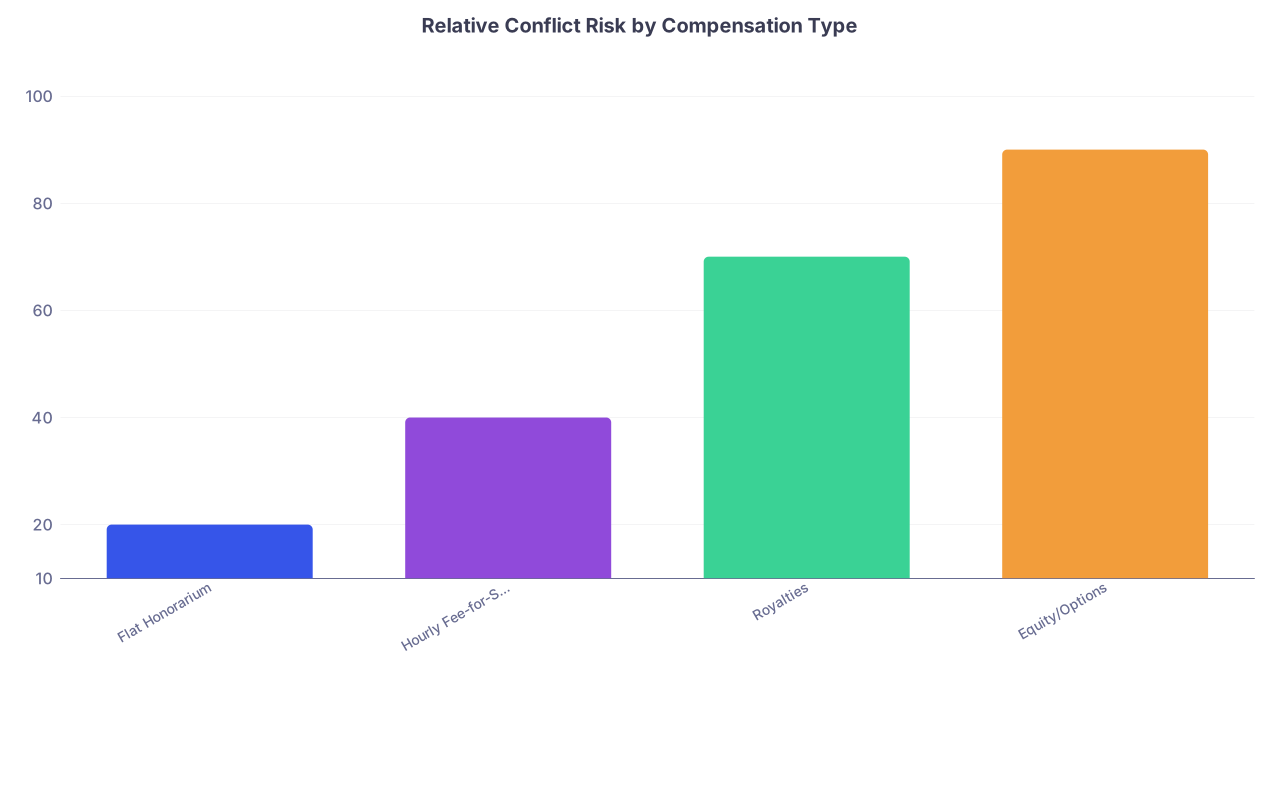
| Category | Value |
|---|---|
| Flat Honorarium | 20 |
| Hourly Fee-for-Service | 40 |
| Royalties | 70 |
| Equity/Options | 90 |
Practical guardrails:
If you hold equity in a company whose product you use on your own patients:
- Get formal institutional approval and document the review.
- Consider not being the primary decision-maker for that product’s use.
- Disclose, in writing, anywhere your judgment might be questioned later.
If you sit on a startup’s board and practice in their target market, assume every clinical or public comment you make about their space will be scrutinized.
Do not assume “everyone has equity in startups now” is a defense. It is not.
4. Hidden Employer and Institutional Conflicts
Many physicians wrongly assume moonlighting and consulting are “personal business.” They forget the contract they signed with their employer.
Common clauses you are probably underestimating:
- Exclusivity: Prohibiting paid work for competitors or overlapping clinical services.
- Intellectual property: Anything you create “related to the employer’s business” may belong to them.
- Conflict-of-interest policies: Banning certain relationships with vendors, device makers, or payers.
Here is where people get hurt:
- You design protocols, tools, or educational content on your own time, then license or sell them. Your health system claims ownership.
- You help a vendor “optimize” workflows for a competing hospital while on staff at your main institution.
- You negotiate with an industry partner as “consultant,” while your hospital is negotiating with the same partner for a major contract.
| Clause Type | Common Pitfall |
|---|---|
| Exclusivity | Consulting with direct competitor |
| IP Ownership | Selling tools built on work resources |
| COI / Vendor Policy | Paid by current vendor you evaluate |
| Outside Income Approval | Taking gigs without written clearance |
Avoid this mistake:
Pull your actual employment contract and read:
- “Outside activities” or “outside income” section
- “Intellectual property” section
- “Conflict of interest” or “Vendor relations” policies
Then ask compliance/legal in writing about your planned consulting relationship. Yes, writing. Verbal assurances vanish when there is an investigation.
If you are afraid to ask your institution about the work, that is a serious warning sign.
5. Expert Witness Work: The COI That Can Haunt You for Years
Expert witness work looks clean on the surface. You are paid for your opinion. You are not prescribing a product. There is no device or drug relationship.
But two conflict traps show up here:
- Becoming the “house expert” for one side
- Always for plaintiffs.
- Always for defense.
- Always for one particular insurer or health system.
Once you are financially tied to a recurring client, your future opinions about that same entity (or its competitors) are susceptible to conflict claims.
- Consulting for entities you may later review or critique
- You consult for a hospital system on quality metrics.
- A year later, you take an expert case involving that same system’s alleged negligence.
- Or worse, their direct competitor.
Technically, you might try to argue you can be “fair.” Realistically, opposing counsel will tear apart any perception of objectivity.
Safer habits:
- Maintain a record of every entity you consult for—names, dates, topic, compensation.
- Before accepting an expert case, cross-check it against that list. If there is significant overlap, you either:
- Disclose and likely decline, or
- Define and document strict boundaries with the attorneys.
Do not trust your memory. Five years and dozens of cases later, you will not remember every prior consulting conversation.
6. Social Media and Public Commentary That Conflicts With Your Contracts
Here is a modern problem: your online presence is now part of your professional footprint. Companies and hospitals care about what you post, like, and endorse.
Conflicts show up when:
- You are a paid consultant for a product and also post “independent-seeming” endorsements on Twitter, LinkedIn, or YouTube without clear (and prominent) disclosure.
- You publicly attack or downplay competitors of the company paying you.
- You write op-eds, blog posts, or do podcast appearances that align suspiciously tightly with your client’s messaging.
This can intersect with:
- FTC rules around disclosure of sponsored content.
- Medical board standards around misleading or biased public communication.
- Institutional social media policies you have never actually read.
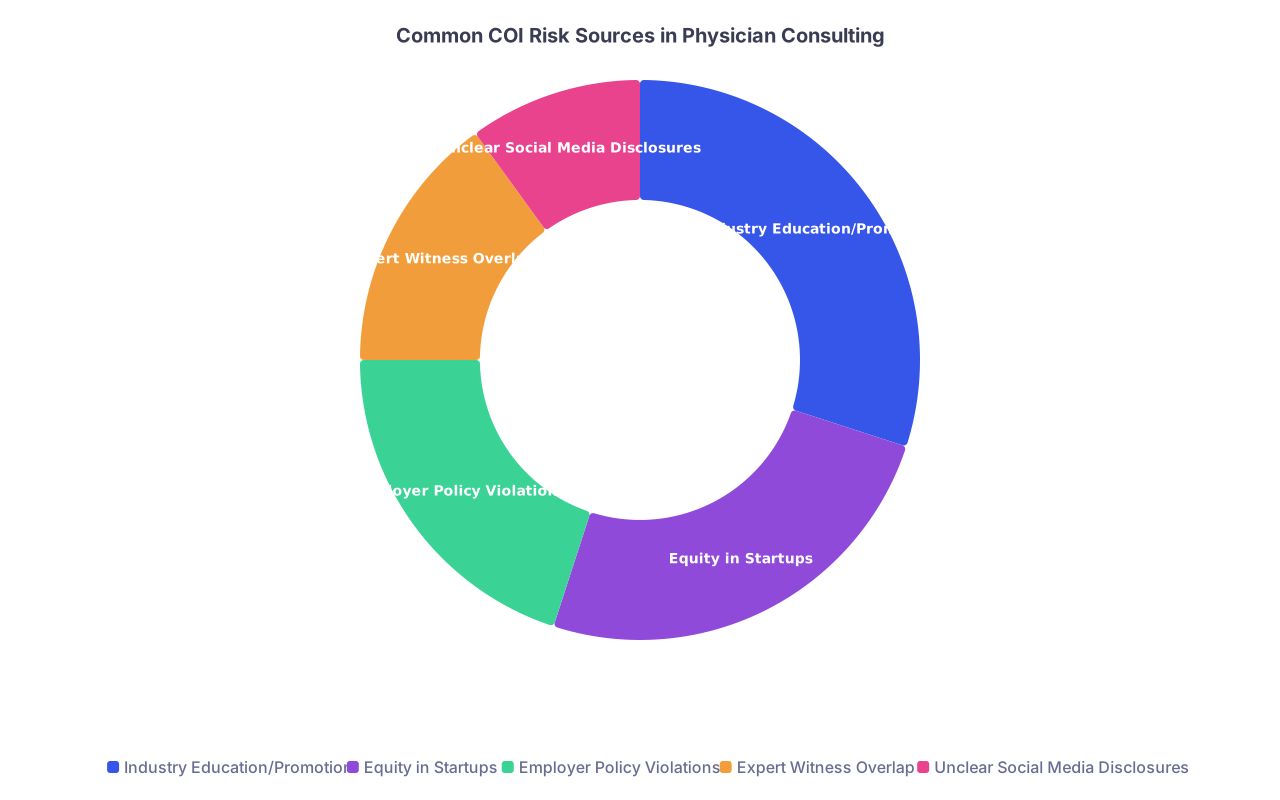
| Category | Value |
|---|---|
| Industry Education/Promotion | 30 |
| Equity in Startups | 25 |
| Employer Policy Violations | 20 |
| Expert Witness Overlap | 15 |
| Unclear Social Media Disclosures | 10 |
Practical rules:
- If you are paid by an entity and you publicly praise their product or service, assume it requires clear, up-front disclosure. Not buried in your bio.
- If your contract includes “confidentiality” or “non-disparagement,” be very careful publicly criticizing their competitors or broad categories that include their competitors.
If your social media brand is “unfiltered truth-teller,” you must be even stricter with your conflicts, not looser.
Regulatory and Legal Traps You Cannot Ignore
You may think: “This is just consulting, not billing. Stark and Anti-Kickback do not apply to me.”
Careful.
You can absolutely run into:
Anti-Kickback Statute (AKS) concerns if:
- Your consulting pay is tied, explicitly or implicitly, to your prescribing or referral volume.
- “Advisory boards” are thin cover for paying high prescribers.
- Compensation is not fair market value for your time and expertise.
False Claims Act angles if:
- Your biased consulting helps drive use of products that later end up in fraud cases.
- You participate in “clinical education” that pushes off-label use tied to federal program billing.
Regulators look for patterns like:
- Oversized honoraria for minimal work.
- Repeated “consulting” by the same high-prescribing physicians.
- Internally, emails like: “We need to bring Dr. X onto an advisory board; they are our top prescriber.”
You might not see those emails. Prosecutors will.
Protect yourself with structure:
- Ensure fees match credible hourly rates for your specialty and experience. If they feel “too good to be true,” ask why.
- Insist on detailed scopes of work: specific tasks, estimated time, clear deliverables.
- Avoid any language that ties compensation to sales performance, prescribing volume, or referral patterns.
If a company dodges fair-market-value discussions or refuses to put a real scope of work into the contract, walk away.
Overlooked Operational Mistakes That Expose Conflicts
Sometimes the conflict is not the relationship itself but how sloppily you manage it.
Key operational errors:
No separation of email/accounts
- Using your hospital email for consulting communication.
- Storing confidential client docs on hospital systems.
No documentation of time and work
- Being paid a flat fee with no tracked hours.
- Inconsistent or nonexistent records of what you actually did.
Missing or inconsistent COI disclosures
- Filling out institutional COI forms from memory and forgetting two or three relationships.
- Leaving old relationships on auto-pilot instead of updating annually.
Verbal side agreements
- “We will just agree informally to keep working together.”
- No updated contract when the scope expands into new areas (e.g., from advisory to clinical implementation).
These gaps become ammunition in litigation or internal investigations: “Doctor cannot even consistently disclose who pays them.”
Simple structural fixes:
- Separate consulting email and file storage from your clinical employer.
- Keep a live spreadsheet of: client, role, start/end dates, compensation, equity, and scope.
- Calendar reminders for quarterly COI review and updates.
- Demand updated written agreements whenever the nature of the work changes.
How to Vet a Consulting Opportunity for Hidden Conflicts (In 10 Minutes)
You do not need a law degree. You need a checklist and a bit of discipline.
Run every consulting offer through these questions:
Role and influence
- Do I prescribe, order, recommend, or evaluate this company’s product or service in my clinical or committee roles?
- Will this relationship influence—or appear to influence—my clinical or institutional decisions?
Employer relationship
- Does my hospital or group already do business with this company or its competitors?
- Does my contract restrict outside work with vendors or competitors?
Compensation structure
- Is the pay clearly tied to my time and expertise, or implicitly to volume, access, or influence?
- Would this compensation look reasonable if printed in a newspaper next to my name?
Equity and ownership
- Am I acquiring ownership or royalties tied to product adoption?
- If so, can I truly separate my financial interest from my clinical or institutional decisions?
Disclosure burden
- How many places will I need to disclose this relationship? (institution, journals, conferences, public bio, board applications)
- Will I remember to disclose it each time? Is it simple and clean, or messy and constant?
Reputational lens
- If an unhappy patient, investigative journalist, or regulator saw this relationship, would it look defensible or shady?
- Could this relationship reasonably appear as “doctor on the payroll” rather than “independent expert”?
If you feel any inner squirming while answering these, that is your early warning system. Respect it.
A Final Warning—and a Concrete Next Step
Conflicts of interest will not ruin your career in one dramatic explosion most of the time. They erode trust slowly, then suddenly:
- A bad outcome plus a disclosed payment.
- A lawsuit plus a conference talk with the wrong slide.
- A whistleblower plus your name in a payment database.
Do not make the lazy mistake of assuming, “Everyone does this, it must be fine.” Most physicians do not understand how quickly a harmless-seeming consulting role can be reframed as “kickback,” “undue influence,” or “biased expert.”
Your next step today is simple and non-negotiable:
Open your current CV or consulting folder and list every paid external relationship you have had in the last 3 years. Then, for each one, write down: (1) who paid you, (2) what you actually did, and (3) how it could possibly influence your clinical or institutional decisions.
Do that honestly, on paper. You will immediately see which relationships are clean, which need tighter structure and disclosure, and which you should probably end before they end you.