What happens when a recruiter, chief, or credentialing committee finds your “harmless” side account before they ever meet you?
You think you’re building income.
You might actually be burning your name.
If you’re a physician, the wrong social media side hustle doesn’t just fail. It follows you:
- Privileges reviews
- Licensing boards
- Credentialing packets
- Promotions
- Malpractice cases
I’ve watched good doctors get quietly cut from opportunities because of a TikTok channel, a “medfluencer” Instagram, or a little side coaching that looked shady to the wrong person.
Let me walk you through the traps you really do not want to step in.
The Silent Career Killers Lurking in Social Media
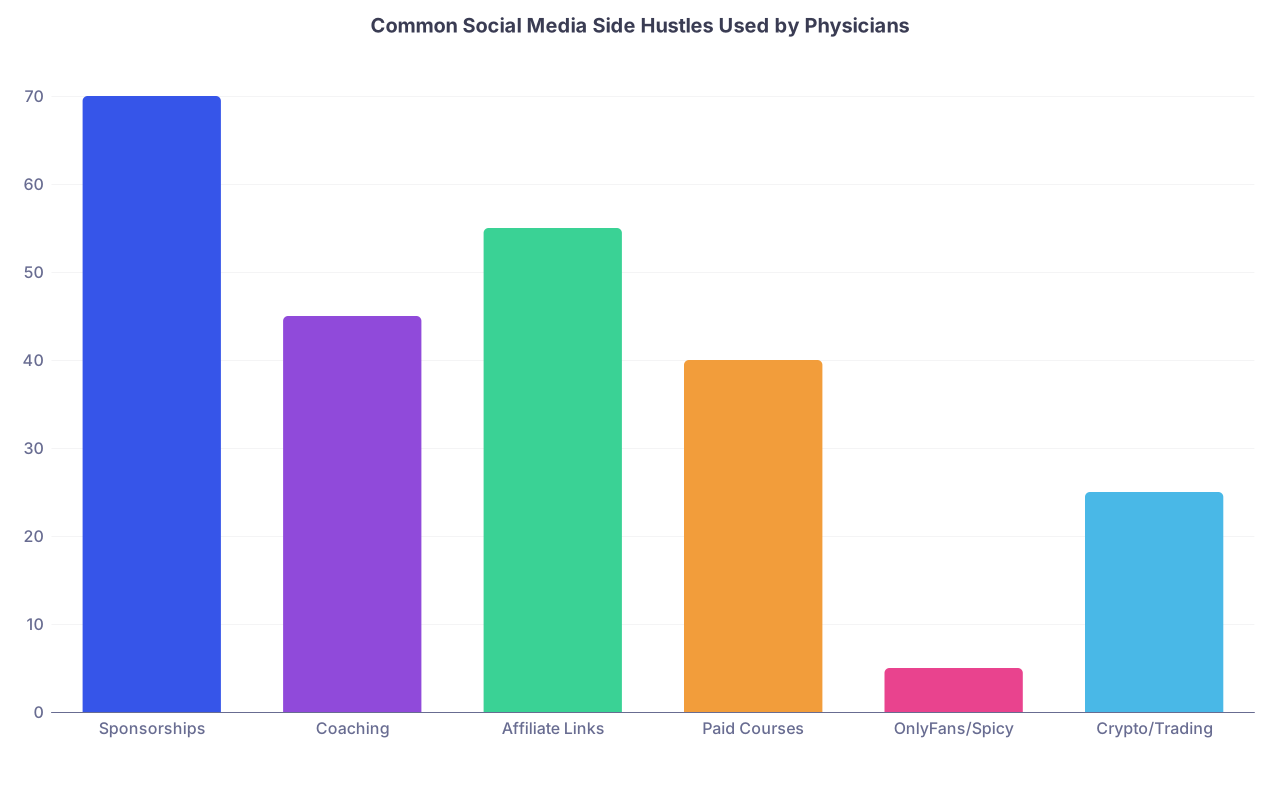
| Category | Value |
|---|---|
| Sponsorships | 70 |
| Coaching | 45 |
| Affiliate Links | 55 |
| Paid Courses | 40 |
| OnlyFans/Spicy | 5 |
| Crypto/Trading | 25 |
The big mistake is thinking: “If it’s legal and I’m off duty, it’s fine.”
That’s not how medicine works.
Medicine runs on trust + perception, not just rules. Credentialing committees don’t need to “prove” anything. They just decide you’re not worth the risk.
Here’s what I’ve seen silently wreck people:
- Unprofessional public persona
- Conflicts of interest that look exploitative
- Questionable medical advice in bite-size clips
- Blurring boundaries with patients and followers
- Association with scams or pseudoscience
You may think you’re “just educating” or “just sharing your journey.” Hospital leadership may see “liability” and “ethics problem.”
1. “Medfluencer” Accounts That Turn You Into a Liability

Let’s start with the big one: becoming a “medical content creator.”
Done right, it can be great.
Done wrong, it’s one of the fastest ways to erode professional respect.
Red Flags That Kill Credibility
These patterns scream “unprofessional” to colleagues and leadership:
- Dancing or trending audio in scrubs, in clinical spaces
- Jokes about “dumb” patients, even if de-identified
- Vague case descriptions that might be recognizable locally
- Emotional rant videos about your job, your patients, your admin
- “Hot take” medical opinions outside your actual expertise
- Oversimplified or clickbait medical advice clips
Your group chat may love it. Your CMO won’t.
Worst mistake: thinking, “But I never said where I work.”
HIPAA is not your only problem. Professional identity is.
If you’re visibly a physician (white coat, stethoscope, bio, or even just your name), your content is part of your professional footprint. That means:
- Opposing counsel can pull it in a lawsuit
- Boards can review it during investigations
- Hospitals can factor it into hiring or renewal decisions
I’ve seen a candidate tank an academic appointment because the search committee pulled up a channel full of “funny ER stories” and “day in the life” content with just enough detail to make everyone nervous.
How This Quietly Bites You Later
- Fewer leadership opportunities. Nobody tells you, “We didn’t pick you because of your TikTok,” but your file goes into the no pile.
- Private whispers. “Isn’t she that Instagram doctor who complains about patients all the time?”
- Ethics complaints. Even one colleague filing “concerns” about professionalism creates a shadow over your name.
If you’re going to create, fine. Just don’t confuse viral with respectable.
Avoid this mistake:
- Never film in clinical spaces. Ever.
- No scrub selfies or dances that trivialize your work
- No patient stories, even “heavily changed” ones, used for entertainment
- No venting about your job, your call, or your patients on public platforms
- Stay in your lane: talk about what you’re actually trained in, not everything that trends
2. Questionable Sponsorships and “Health” Brand Deals
Here’s where many doctors sell out without realizing it.
That DM from a supplement, telehealth start-up, “longevity clinic,” or fitness brand offering you:
- A few thousand dollars
- Affiliate codes
- “Medical advisor” titles
Seems low-risk. It is not.
Sponsorship Categories That Make You Look Bad
| Sponsorship Type | Risk Level | Why It Damages Reputation |
|---|---|---|
| Non‑evidence supplements | High | Conflicts with science-based practice |
| “Hormone optimization” | High | Borderline or outside guidelines |
| Weight loss shortcuts | High | Exploitative, oversimplified messaging |
| Crypto/forex “education” | Very High | Looks like a scam, not professional |
| Cosmetic quick fixes | Medium | Can look purely commercial and shallow |
These deals create two problems:
- Conflict of interest: Are you a doctor or a salesperson?
- Ethical optics: Are you exploiting your authority to sell questionable stuff?
I’ve sat in meetings where people literally said:
“Yeah, he’s smart, but he’s turned into a walking ad. I don’t want that associated with our department.”
Common Sponsorship Mistakes
- Promoting non–evidence-based supplements as if they’re clinically proven
- Using phrases like “I recommend this to my patients” when you really don’t
- Failing to disclose financial relationships clearly and consistently
- Letting marketing dictate messaging that bends the science
- Slapping “Doctor Approved” on something flimsy
You may think: “Everyone does it. FDA isn’t knocking on my door.”
True. But the people who matter—employers, peers, IRBs—are forming an opinion about your integrity.
Avoid this mistake:
Before accepting any partnership, ask:
- Would I be comfortable defending this product and wording in front of:
- My department chair
- A state medical board
- A plaintiff’s lawyer
- Is there actually high-quality evidence for what I’m implying?
- Am I blurring my role as physician vs influencer?
If the honest answer is “ehhh” — walk away. There are cleaner ways to earn.
3. Social Media “Medical Advice” That Crosses the Line Into Practicing Online

| Step | Description |
|---|---|
| Step 1 | General education posts |
| Step 2 | Condition-specific tips |
| Step 3 | Replying to individual symptoms |
| Step 4 | Making suggestions to specific users |
| Step 5 | Ongoing advice to same person |
| Step 6 | De facto treatment relationship |
This one’s subtle and dangerous.
You start with generic content:
- “3 signs you should see a doctor”
- “What chest pain might mean”
Then:
- You answer individual DMs about symptoms
- You comment “This sounds like X, ask your doctor about Y”
- You start following up with the same person
Now you’re in a gray zone between education and treatment.
If something goes wrong, that patient’s attorney will argue:
“There was a physician–patient relationship, established through repeated specific advice from a licensed doctor who held themselves out as an expert online.”
Will they win? Depends. But you will be dragged through that fight.
The Wrong Behaviors That Set You Up
- “DM me your symptoms” offers
- Free “quick consults” in DMs or comments
- Using phrases like “You don’t need to worry about this” to specific followers
- Reviewing labs or images sent via social media
- Giving medication opinions even theoretically to individuals
Also: local patients will recognize you. Patients will follow you. And some will view anything you say as personal advice, no matter what disclaimer you slapped in your bio.
“This is not medical advice” doesn’t magically erase the perception that you’re their doctor.
Avoid this mistake:
- Never give person-specific advice on public or private social media
- Use strict boundaries: “I can’t comment on individual cases. Please see a local physician or urgent care.”
- Disable or limit DMs if you keep getting symptom questions
- Don’t look at or comment on uploaded labs, photos, or scans
- Keep education high-level, not diagnostic
4. “Coaching” and Courses That Look Like Exploitation

Career coaching, step prep, residency advising, mindset coaching—huge space right now. Not all bad. But very easy to make yourself look predatory.
I see three big reputation destroyers here:
4.1 Overpromising Outcomes
“100% match rate.”
“Guaranteed score increase.”
“Double your income in 6 months.”
Any time you’re selling results you cannot control, you’re stepping into scam territory. Fellow physicians and trainees will drag you for it, and they’ll be right.
4.2 Charging Desperate People Premium Prices
Huge red flag:
- Charging IMGs or struggling applicants thousands for generic advice
- Selling high-priced group programs that are basically YouTube content
- Framing your services as “your last chance” or “only path” to success
You might make money. You will also earn a reputation as someone who preys on vulnerable peers. That sticks.
4.3 Blurring Physician vs Life Guru
The second you stamp “MD” on your coaching, people naturally assume:
- Your opinions carry medical authority
- Your frameworks are “evidence-based”
- You understand their specific clinical situation
Problem is: mindset/business/life strategies are usually not run through the same rigor. When you mix your MD halo with untested coaching theories, you risk being seen as another flavor of pseudoscience.
Avoid this mistake:
- No “guaranteed” outcomes. Ever.
- Be very clear what you are not doing: “This is not therapy / medical care / legal advice.”
- Price ethically. Ask yourself if you’d be proud explaining your fees to a residency program director.
- Do not pressure people with scarcity tactics (“only 2 spots left” every week). Looks like a gimmick, because it is.
5. “Spicy” or Overly Personal Content: It Follows You
Let me be blunt:
If you’re a physician considering anything like OnlyFans, explicit content, or even just heavily sexualized “thirst trap” content tied to your name or face — your medical career will pay a price.
Is it “fair”? You can debate ethics and personal freedom all day.
But I’m here to help you avoid landmines, not win philosophy arguments.
How This Comes Back to Haunt You
- Credentialing seeing explicit content linked to your name
- Patients or families recognizing you from non-medical content
- Colleagues quietly refusing to refer to you or work with you
- Committee members thinking, “We don’t want that PR risk”
Even if everything is legal and consensual, medicine is still conservative in many corners. Committees err on the side of “we don’t need this headache.”
Even milder versions can bite:
- Overly revealing photos in white coat / scrubs
- TikToks relying on sexual innuendo while wearing your badge
- Relationship/sex content obviously tied to your professional identity
If you insist on doing more adult or edgy content, at least separate it completely (and understand that “anonymous” on the internet is usually a fantasy).
But do not fool yourself: if someone wants to connect the dots, they probably can.
6. Financial Scams and “Get Rich” Schemes With an MD Stamp
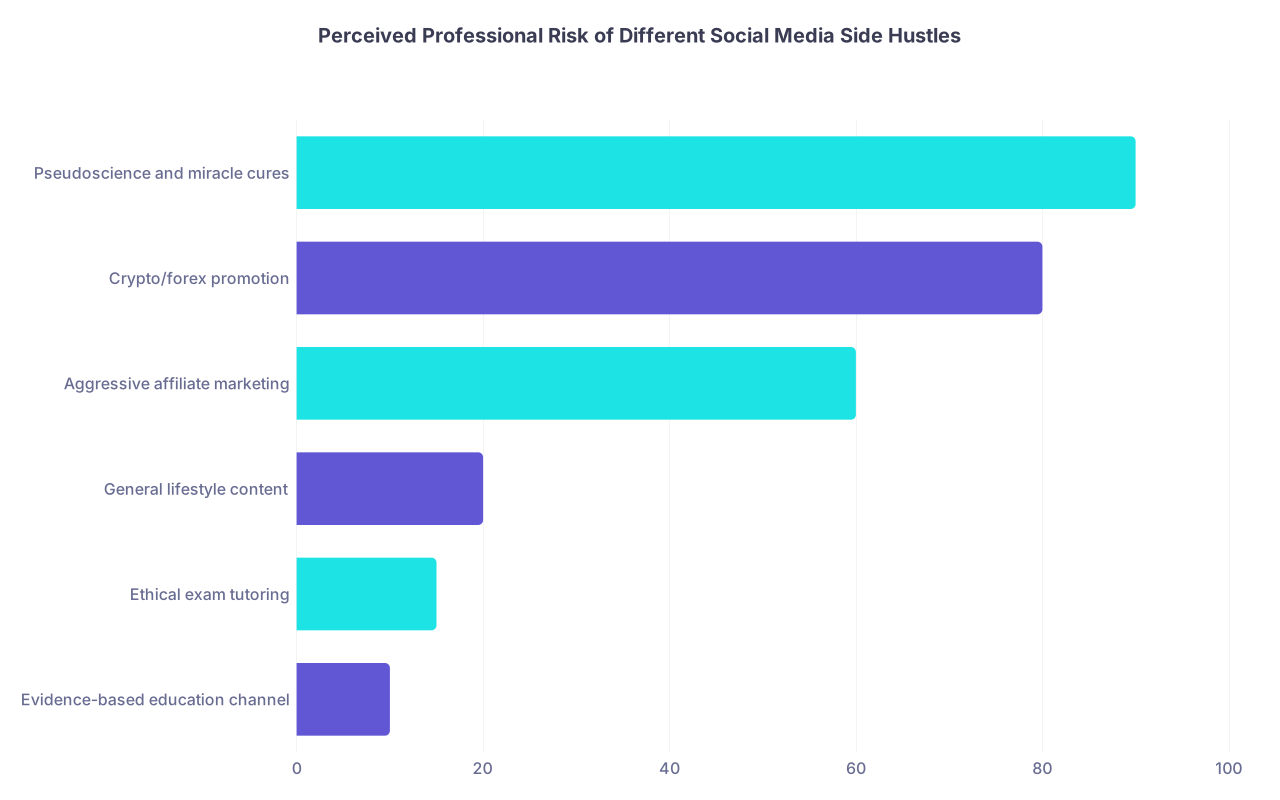
| Category | Value |
|---|---|
| Evidence-based education channel | 10 |
| Ethical exam tutoring | 15 |
| General lifestyle content | 20 |
| Aggressive affiliate marketing | 60 |
| Crypto/forex promotion | 80 |
| Pseudoscience and miracle cures | 90 |
Nothing tanks your reputation faster than being associated with:
- Crypto trading “signal groups”
- MLMs (multilevel marketing)
- “Passive income” trading bots
- High-ticket “investing academies” with no real substance
Slap “Doctor” or “MD” on those, and you look like a scam in a lab coat.
What Colleagues Think When They See This
They don’t think: “Wow, entrepreneurial.”
They think: “Why is this physician lending their credibility to this nonsense?”
You might tell yourself you’re just “diversifying income.” But:
- If the program is making money mainly by recruiting and upselling people, not through genuine value → it’s predatory
- If returns sound too good to be true, and you can’t understand the mechanism → you’re selling a fantasy
And again, no one has to prove you did anything illegal for your reputation to tank.
Avoid this mistake:
Before promoting any financial product or scheme, ask:
- Can I clearly explain how this makes money, without buzzwords?
- If my department chair got invited to this webinar, would I be proud or mortified?
- Would I still recommend this if my MD disappeared from my name tomorrow?
If you feel even a little slimy saying it out loud, you already have your answer.
7. The Hidden Risk: Leaving a Permanent, Searchable Paper Trail

The worst part about these side hustles?
They don’t disappear when you stop.
- Old usernames can be traced
- Archive sites exist
- People screenshot everything
- Internet sleuths on hiring committees are real
If there’s enough to identify you + your role as a physician, someone can dig it up when you least want it:
- Applying for a competitive fellowship
- Going for a leadership role
- Switching to a more conservative health system
- Facing a malpractice claim
Do a Self-Audit Before Someone Else Does
Search:
- Your full legal name
- Nicknames + “MD” or “doctor”
- Your handle/usernames
- Your email on data breach lookup sites
- Image search your profile photos
Ask: if a residency selection committee or promotions committee saw this, what story would they tell themselves about me?
If the story isn’t “serious, ethical, trustworthy physician,” you’ve got work to do.
8. Safer Alternatives: Social Media Side Hustles That Don’t Cook Your Career
Let’s be fair. You’re probably not reading this just to be scared. You want income options.
Social media isn’t evil. But for physicians, the bar is higher.
Better directions:
- De-identified, evidence-based education with strong boundaries
- B2B consulting (helping organizations, not vulnerable individuals)
- Paid talks or courses built on your real expertise with honest marketing
- Ghostwriting / behind-the-scenes advising where your name isn’t plastered everywhere
- Contributing to reputable platforms (journals, professional blogs, institutional channels)
High-level rule:
If your content and offers would look appropriate on LinkedIn and in a grant application, you’re probably fine.
If they’d look more at home in a late-night infomercial, don’t attach your MD to it.
FAQ (Exactly 4 Questions)
1. Can I have a personal social media account as a physician without risking my career?
Yes, but keep it genuinely personal and low-risk. That means: private account, limited followers (people you actually know), no identifiable patient content, no ranting about work, and no mixing of your physician role with controversial or explicit material. Assume screenshots can still escape. If you’d be ashamed to see it in a credentials committee packet, do not post it.
2. Are all brand deals and sponsorships automatically bad for my reputation?
No. The problems start when you promote products that are non–evidence-based, misleading, or heavily commercial in tone. Disclose clearly, stick to products that align with mainstream guidelines, and never allow a sponsor to script you into overpromising. A modest, transparent partnership with a reputable, evidence-aligned company is very different from hyping miracle supplements or sketchy financial products.
3. If I use disclaimers, am I protected when I share medical information online?
Disclaimers help, but they don’t magically shield you from all risk. If you repeatedly give specific advice to identifiable individuals, or people reasonably perceive a physician–patient relationship, you can still be scrutinized. Treat social media as education only: no individual case advice, no interpreting labs or images, no ongoing back-and-forth about personal health issues.
4. I already posted questionable content. What should I do now?
Don’t panic, but don’t ignore it. First, quietly archive or delete posts that cross professional lines (patient stories, rants, explicit material, sketchy promotions). Second, lock down or rebrand accounts if needed. Third, tighten your future standards—set clear personal rules for what you will and won’t post. If something particularly serious might already be on others’ radar (e.g., clear HIPAA issues), consider speaking with risk management or legal counsel rather than hoping it disappears.
Open your most active social media account right now and scroll the last 30 posts. For each one, ask: “Would I be comfortable with my department chair, a licensing board, and a plaintiff’s attorney reading this aloud in a room with my name on the door?” Anything that fails that test—take it down today.