
It is 10:45 p.m. You just finished sign‑out at your main hospital job, grabbed your bag, and are driving across town for your moonlighting shift. The locums recruiter told you the pay is “$220 an hour, very low acuity, fully covered malpractice.” You were tired when you signed the agreement. You did not read the entire PDF. You definitely did not send it to a lawyer.
On your third patient, something goes sideways. A bad outcome, a messy chart, three different EMRs involved. A week later you get an email: “Incident report filed – please provide a statement.” You forward it to your primary employer’s risk management and they write back with one line that drops your stomach into the floor:
“This activity is outside the scope of your coverage.”
That is the scenario I want to keep you out of.
Moonlighting is not the problem. Sloppy assumptions about liability are.
Let me walk you through the traps I have seen physicians fall into again and again, and how to avoid getting chewed up by a malpractice issue from a side gig that was supposed to be “easy money.”
1. The Single Biggest Mistake: Assuming “I’m Covered”
The most dangerous phrase I hear from moonlighting doctors is: “They said they cover malpractice.”
Who is “they”? Cover what exactly? Under what policy? Written where?
There are three different coverage assumptions that get people burned:
- “My main job’s malpractice covers me everywhere.”
- “The moonlighting site includes coverage, so I do not need my own.”
- “I have a personal tail / occurrence policy, so I am safe.”
All three can be wrong. Sometimes spectacularly.
Why your primary job’s coverage often does NOT follow you
Most hospital or group policies are role‑ and location‑specific. Common restrictions:
- You are only covered:
- When working at listed facilities
- For approved duties (e.g., hospitalist, ED only, not telemedicine or urgent care)
- During defined hours as an employee
If you moonlight at:
- A community ED not affiliated with your main hospital
- A private urgent care
- A telehealth company
- A surgery center unrelated to your group
…your employer’s policy is usually irrelevant. They will say, “That was your side gig. Not our problem.”
Do not assume. Get it in writing from your employer’s risk management if you think you are covered for outside work. Ninety percent of the time, the answer will be “no” or “only if we contract with that facility and list you.”
Why “the site covers you” is not enough
I have seen this exact conversation:
- Recruiter: “We provide malpractice, no need to worry.”
- Physician: “Is it claims‑made or occurrence?”
- Recruiter: “…uh, it is just standard coverage.”
Translation: they may not know. Or they are not going to volunteer the details.
You need to know:
- Policy type
- Limits
- Who is the named insured
- Who buys tail and when
- What activities are excluded
Or you are gambling your license and personal assets on someone else’s vague reassurance.
2. Claims‑Made vs Occurrence: Where People Get Crushed on Tail
If you remember nothing else from this article, remember this: tail coverage is where moonlighters get ambushed.
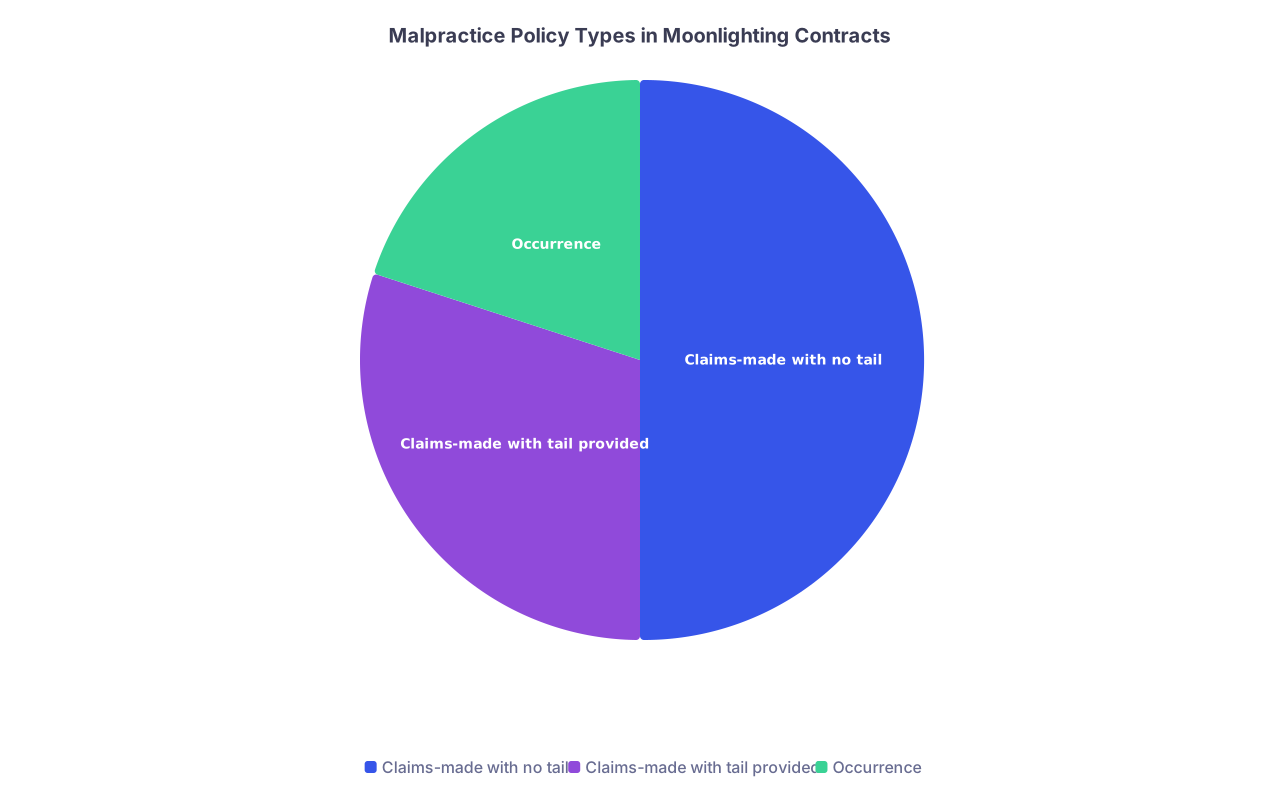
| Category | Value |
|---|---|
| Claims-made with no tail | 50 |
| Claims-made with tail provided | 30 |
| Occurrence | 20 |
Quick definitions (because most people fake understanding this)
Occurrence policy
Covers you for incidents that occurred during the policy period, no matter when the claim is filed. Finish the job, walk away. No tail needed.Claims‑made policy
Covers you for claims made and reported while the policy is active. When you leave, if a claim comes in later for care you gave during the job, you are not covered unless:- The next policy has prior acts coverage, or
- You or someone buys tail (an extended reporting endorsement).
Most moonlighting gigs are claims‑made. And many contracts deliberately dump tail risk on you.
The classic trap clause
Buried in the fine print:
“Physician shall be responsible for procuring and paying for any required tail coverage upon termination of this Agreement.”
You know when people learn about that language?
After they have left the job. After the group refuses to help. Then they call a broker and hear a number like $18,000 for tail.
For a part‑time moonlighting job that netted them maybe $25,000 over a year.
Non‑negotiable questions before you sign
Ask, and get written answers:
- Is the malpractice policy claims‑made or occurrence?
- If claims‑made:
- Who pays for tail—you or them?
- For how long is tail provided (1 year, 5 years, unlimited)?
- What are the limits (e.g., $1M/$3M, $2M/$4M)?
- Are prior acts included if you are stepping into ongoing coverage?
If their answer is vague or dodgy, assume:
- It is claims‑made.
- You will be responsible for tail.
- They will not volunteer that when recruiting you.
If you must take a claims‑made position where you pay tail, mentally add that cost to your “hourly rate.” Many physicians discover too late that, after tail, their “$200/hour” job was effectively $120.
3. Coverage Gaps Between Multiple Policies
The second big moonlighting mistake is believing “more policies = more safety.” Not always.
I have seen real cases where three different insurers pointed fingers at each other, each saying the other should defend the claim.
The “not it” game between insurers
Common scenarios:
- You have employer A’s policy for your day job.
- You have employer B’s policy for moonlighting.
- You also bought your own bare‑bones individual policy.
Then a marginal case shows up:
- Patient seen in telehealth (side gig) → then in ED (main job) → then in clinic (another moonlighting site).
- Poor documentation and fuzzy handoffs.
Each insurer says:
- “This was outside our scope.”
- “The primary liability lies with the other party.”
- “We are excess only.”
You do not care who pays. You just want a defense. But the delay and finger‑pointing alone can make your life miserable. Meanwhile, you are worrying about licensure reports, NPDB, hospital credentialing.
How to reduce “no one wants you” scenarios
List all your clinical roles for each insurer
Your broker should know:- Every job
- Every state
- Every practice type (ED, UC, telemed, aesthetics, etc.)
Eliminate unknown coverage territory
- If your main job forbids outside clinical work unless disclosed, and you hide it, do not be surprised when they wash their hands of you later.
- Some policies explicitly say they will not cover unapproved side work.
Align specialties and procedures
- If you are board‑certified in IM but moonlight doing high‑acuity ED work with procedures, check if either policy excludes those services.
- Some carriers quietly exclude:
- OB involvement
- Procedural sedation
- Cosmetics or cash‑pay procedures
You want no ambiguity about where each piece of your practice sits. If you are not sure? Ask the carrier. In writing.
4. Scope Creep: Doing More Than You Are Actually Covered For
Here is another overlooked trap:
Your moonlighting description says “low acuity urgent care,” but what you actually end up doing at midnight is closer to community EM.
The coverage, and your risk, follow what you actually do. Not the marketing.
Red flags I have personally seen in moonlighting gigs
Urgent care advertising “no appointment necessary, we handle emergencies”
Then you are first in line for:- Chest pain with no back‑up
- Active GI bleeds
- Peds respiratory distress
Telemedicine companies pushing:
- Off‑label prescribing
- Loose policies on controlled substances
- Minimal documentation requirements (“Keep the chart short, patients do not like long visits”)
Aesthetics or cash‑pay clinics
- Informal protocols
- “Template” consent forms
- No clear complication management pathways
All of these can put you outside what the policy underwriter thought they were covering.
The subtle trap: procedure scope vs credentialing
Ask yourself:
- Are the procedures you are doing:
- Credentialed by the facility?
- Documented in your privileging file?
- Specifically allowed under your malpractice policy?
If you are doing procedures:
- Central lines
- Joint injections
- Laceration repairs
- Cosmetic injections
- Telehealth prescribing
…confirm that:
- The facility has formally credentialed you for them.
- The insurer knows you do them and did not exclude them.
- Any “independent contractor” agreement does not say you “assume all risk” for your clinical judgment and procedures.
5. Independent Contractor Status: Tax Win, Liability Minefield
Moonlighting is increasingly offered as 1099 independent contractor work. Recruiters push the tax advantages. They talk about:
- Deducting expenses
- Flexibility
- Higher hourly rates
What they do not talk about is that independent contractor language is often used to offload malpractice and employment risk.

Where independent contractors get burned
You are not part of the group’s master policy.
You may:- Have a thin separate policy with lower limits.
- Be required to buy your own coverage entirely.
- Be forgotten on the policy renewal list.
The contract shifts all risk to you.
Common ugly clauses:- “Physician shall indemnify and hold harmless Group from and against any and all claims arising from Physician services.”
- “Physician is solely responsible for maintaining adequate malpractice coverage at Physician’s own expense.”
Indemnification + being an independent contractor = you can end up on the hook for:
- Settlement amounts
- Defense costs
- The group’s costs if they get dragged into your case
- No benefits from “institutional protection.”
As a contractor, you often:- Do not have union or staff council support.
- May not get the same level of risk‑management help.
- Are easier to cut loose if something goes wrong.
What to insist on as a contractor
At minimum:
- Named as an additional insured on the practice’s policy
- Clear statement that:
- The group provides malpractice insurance with specified limits.
- The group, not you, is responsible for tail, or you understand cost and have priced it in.
- No broad indemnification clauses that have you paying for the group’s negligence.
If they refuse to budge, treat it like a high‑risk financial instrument. Do not let the hourly rate blind you.
6. Telemedicine, Multi‑State Work, and Hidden Jurisdiction Problems
Telemed is the modern side hustle darling. Flexible, from home, stacked shifts. But jurisdiction and coverage issues get neglected constantly.
| Risk Area | Typical Problem | What To Check |
|---|---|---|
| State licenses | Practicing in unlicensed state | Exact list of states you will see patients in |
| Policy territory | Policy limited to one state | Written confirmation of multi‑state coverage |
| Standard of care | Different by state | Company clinical protocols by jurisdiction |
| Prescribing rules | Controlled substances, tele‑only | State‑specific telehealth prescribing laws |
How telemed multiplies your risk
- Patient is in State A, you are licensed there.
The company is based in State B.
The malpractice carrier is domiciled in State C.
Claim is filed in State A, but suit is brought in State B due to corporate location.
If your policy is:
- Only licensed in State A
- Or written with weird “territory” limits
…you might find yourself in a jurisdiction technically outside full coverage.
Questions you must get answered before clicking “Accept”
- Which states’ patients will I see?
- Am I personally required to be licensed in each state?
- Does the malpractice policy:
- Cover claims in all those states?
- Address choice of law and venue?
- Are there specific telehealth exclusions (e.g., no mental health, no controlled substances)?
Also, check your primary employer’s moonlighting policy. Many institutions now have:
- Explicit bans on telemedicine moonlighting
- Or requirements that you report it and get approval
If you ignore that, and a patient later files a high‑profile lawsuit where your hospital name appears in the complaint bio, good luck with the compliance and credentialing committees.
7. Documentation and EMR Access: Liability in the Shadows
Moonlighting usually means a different EMR, different passwords, different workflows. That alone creates risk.
The most common quiet mistake:
Poor or incomplete documentation that later looks like negligent care. Not because you were negligent, but because the chart is almost useless as a defense.
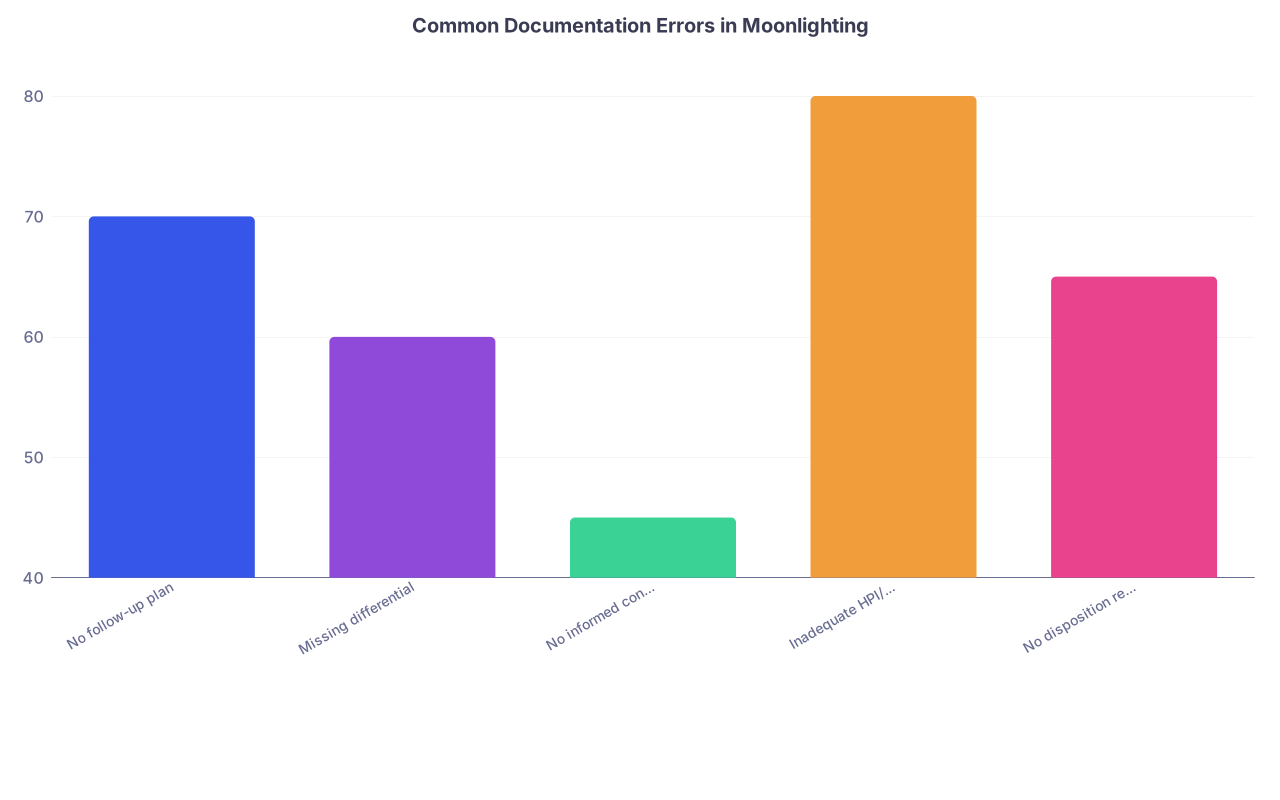
| Category | Value |
|---|---|
| No follow-up plan | 70 |
| Missing differential | 60 |
| No informed consent note | 45 |
| Inadequate HPI/ROS | 80 |
| No disposition reasoning | 65 |
EMR‑related traps
Temporary login, no clear link to your full name / NPI
Later, plaintiff experts argue:- “We cannot confirm who actually saw the patient.”
- “Audit trail incomplete.”
You are locked out after leaving the job
When litigation hits two years later, you cannot access the chart to refresh your memory. You are stuck with static PDFs someone else printed.Poor templates
The urgent care’s EMR has “fast chart” macros:- Normal exam auto‑populated.
- ROS all negative unless you manually change.
- Consent assumed, not documented.
In a busy shift, you click through. Then in trial, that lazy template makes you look like you lied.
How to protect yourself with documentation
Moonlighting charts need to be defensively strong, because:
- You know less about the system.
- You have less continuity with patients.
- You may never see them again.
Do not skip:
- Clear differential diagnosis
- Why you ruled out bad stuff, not just what you confirmed
- Explicit return precautions
- Specific follow‑up instructions and time frame
- For telemed: limitations of virtual exam, when you recommended in‑person care
You do not write for billing. You write for:
- The jury.
- The medical board.
- Your future self on the witness stand.
8. Contract Clauses That Quietly Destroy Your Protection
Nobody wants to read legalese after a 14‑hour shift. Which is exactly why bad clauses survive. The most dangerous are not obvious.
Here is what I tell physicians: before you sign any moonlighting agreement, control‑F these words in the contract:
- “Indemnify”
- “Hold harmless”
- “Tail”
- “Claims‑made”
- “Independent contractor”
- “Solely responsible”
- “At Physician’s expense”
- “Arising out of Physician services”

If the surrounding language looks like you are:
- Protecting them
- Paying for everything
- Accepting all risk
…do not assume “it will never matter.” It only has to matter once.
Clauses that should make you pause hard
Uncapped liability
No mention of any limits on what you could owe them.Tail entirely on you, with vague timing
“Physician shall obtain appropriate tail coverage as determined by Practice.”
They decide what is “appropriate.” You pay.
If you see this language and the hourly rate does not justify the potential disaster, walk away. There will be other gigs.
Practical Risk‑Reduction Checklist (Before You Say Yes)
Here is a blunt pre‑moonlighting checklist. If you cannot answer these, you are walking into preventable risk.

| Step | Description |
|---|---|
| Step 1 | Offered Moonlighting Gig |
| Step 2 | Ask for policy and contract |
| Step 3 | Recalculate true hourly rate |
| Step 4 | Confirm tail duration |
| Step 5 | Negotiate or walk away |
| Step 6 | Do not proceed |
| Step 7 | Confirm scope and procedures |
| Step 8 | Proceed with caution and strong documentation |
| Step 9 | Malpractice details in writing? |
| Step 10 | Claims made or occurrence? |
| Step 11 | Tail needed? |
| Step 12 | Who pays tail? |
| Step 13 | Any indemnity or hold harmless? |
| Step 14 | Employer policy allow moonlighting? |
FAQs
1. Do I really need my own personal malpractice policy if the moonlighting site says they cover me?
Not always, but you are making a bet every time you skip it. If:
- The site’s coverage is clearly documented,
- You are listed as an additional insured,
- Tail is guaranteed in writing,
- And the scope of work is narrow and well defined,
…you might reasonably rely on their policy. But if there is:
- Any ambiguity,
- Frequent job‑hopping,
- Or work in high‑risk areas (ED, OB, telemed psych, aesthetics),
then a personal policy that wraps around your various roles is cheap compared to one uncovered claim. At minimum, get a broker to review the moonlighting contract and tell you if there is a gap.
2. How big a deal is tail coverage for short‑term moonlighting (e.g., 6–12 months)?
Huge. Duration of employment does not matter. Claims can be filed years after the encounter, and plaintiffs’ attorneys love multi‑defendant suits. If your 8‑month urgent care stint generates one delayed diagnosis of cancer claim three years later, you either:
- Have tail and sleep at night, or
- Are scrambling to find coverage for a policy that no longer exists.
For any claims‑made role, assume tail is mandatory, regardless of how brief the job was. If the employer will not provide it, price the cost of tail into your decision. If the math looks bad, walk.
3. What if my primary employer forbids moonlighting but I do it anyway and a lawsuit happens?
Then you have created a perfect storm. Your primary employer’s insurer can deny any involvement. Your main hospital can:
- Discipline or terminate you for violating policy,
- Report you to the medical board,
- Make credentialing at future jobs harder.
Meanwhile, the moonlighting site’s insurer may fight harder, knowing you have no institutional back‑up. If your main job prohibits outside work, either:
- Get written approval for the moonlighting, or
- Accept that you are gambling your primary career for side‑gig income.
4. Is telemedicine really more legally risky than in‑person moonlighting?
Not inherently, but it is differently risky, and people underestimate that. Telemed multiplies:
- Jurisdiction issues,
- Licensing complexity,
- Ambiguity in standard of care when exams are limited.
When telemed goes wrong, it often looks like “you should have told them to go to the ED,” and plaintiff experts love that argument. If your telemed company:
- Pushes volume over thoroughness,
- Discourages referrals to in‑person care,
- Or operates in multiple states with fuzzy protocols,
you are accepting risk that might not be matched by the pay. Strong documentation and a conservative threshold for in‑person escalation are non‑negotiable if you do telemed moonlighting.
Key points to remember:
- Never assume “I am covered” without seeing the actual policy type, limits, and tail responsibility in writing.
- Independent contractor and telemedicine roles often hide the most dangerous liability shifts; read indemnity and tail language like your future depends on it—because it might.
- Every moonlighting chart you write should assume one day it may be read out loud in a courtroom; document accordingly or do not take the gig.