
You finish another clinic day. It is 6:45 p.m., the EMR inbox is still full, your last patient “quick question” turned into a 20‑minute detour, and you are staring at your schedule for next month. Double‑booked, squeezed, no end in sight.
You know you cannot keep doing 1.0 FTE of this forever. You want another income stream. Something you control. But every time you think “side gig,” you end up doom‑scrolling Twitter threads about real estate syndications, telemed, expert witness work, and random “doctor influencer” success stories.
And then… nothing changes.
Let me cut through the noise. You do not need a 2‑year plan. You need 90 days of focused, structured effort to get from “stuck in clinic” to “I have a real, operational side gig with my first paying client or first dollar of revenue.”
This is exactly what I am going to lay out: a realistic, clinic‑compatible 90‑day launch plan.
Step 0 (Week 0): Set the Rules of the Game
Before the 90 days even start, you need constraints. Otherwise you will drown in options.
Non‑negotiables
Write these down. Not in your head. On paper or in a notes app.
Time Budget
- How many hours per week can you realistically commit for 90 days?
- For full‑time clinicians, a sane range is 3–7 hours/week.
- Anything above 10 hours without dropping clinical time is fantasy.
Risk Tolerance
- Are you willing to:
- Sign a small contract (e.g., $2–5k/year software or platform costs)?
- Appear publicly under your real name?
- Talk to your employer about outside work (you probably should)?
- Are you willing to:
Financial Target for First 12 Months
- Not your “escape medicine” number. A starter target.
- Example: “I want this side gig to make $1,000/month by month 12.”
- That target will shape what is realistic.
Constraints from Your Employer
- Pull your employment agreement and look for:
- “Outside employment” or “moonlighting” clauses
- Non‑compete language (by geography/scope)
- Non‑solicitation (cannot take current patients)
- If it is vague, talk to HR or your chair. Get clarity now, not after a complaint email.
- Pull your employment agreement and look for:
| Clause Type | What To Look For |
|---|---|
| Non-compete | Radius, time limit, clinical scope |
| Outside employment | Need written approval? |
| Use of title | Limits on using hospital name/logo |
| Intellectual property | Who owns things you create? |
| Malpractice scope | Covers or excludes side activities |
Once these four are written, you are ready to start the 90 days.
Step 1 (Days 1–7): Pick a Side Gig That Actually Fits Physicians
If you are reading this, your time and cognitive load are already maxed. You need something that:
- Leverages your existing expertise.
- Does not require raising capital.
- Can produce your first dollar within 90 days if you execute.
Here are side gigs that pass that test for most physicians:
- Telemedicine niche practice (out‑of‑state hours, specific condition, asynchronous care)
- Consulting / advisory work (medtech, pharma, digital health, startups)
- Expert witness / chart review (med‑legal)
- High‑ticket 1:1 coaching or advising (e.g., weight loss, physician performance, burnout coaching, pre‑med/MCAT advisory)
- Clinical content creation for pay (CME content, industry education, ghostwriting, not random YouTube hoping for ad revenue)
Notice what is not here: starting a brick‑and‑mortar clinic, buying an apartment building, or launching a medical device company from scratch. Those are not 90‑day projects.
A Quick Decision Tool
Answer honestly:
Do you want to talk to patients in your side gig?
- Yes → Telemed / boutique clinical service.
- No → Consulting, expert witness, content.
Are you okay being highly visible (podcasts, LinkedIn, public brand)?
- Yes → Coaching/consulting with personal brand.
- No → Expert witness / back‑end consulting / ghostwriting.
Do you need this to be low legal exposure?
- Yes → Industry consulting, content, coaching outside diagnosis/treatment.
- No → Telemedicine okay; get proper coverage.
Pick a lane. One. Not three.
Write it as a simple sentence:
- “I will launch a telemedicine migraine care micro‑practice.”
- “I will launch a med‑legal side gig doing chart reviews and expert opinions.”
- “I will launch a 1:1 coaching offer for physicians who want to fix their time management.”
Once you write that, your 90‑day clock starts.
Step 2 (Days 8–21): Define the Offer and Who It Is For
Most physician side hustles die here. They stay vague:
- “I do consulting.”
- “I help people be healthier.”
- “I do telemedicine on the side.”
Vague offers do not sell. Specific ones do.
Craft a Narrow, Pain‑Focused Offer
Use this structure:
I help [specific type of person] who struggle with [specific painful problem] achieve [specific result] through [concise method].
Examples:
- Telemed weight loss:
- “I help busy professionals in Texas who struggle with yo‑yo dieting and prediabetes achieve consistent 1–2 lb/week weight loss and improved labs through evidence‑based medication + 15‑minute virtual check‑ins.”
- Med‑legal:
- “I help plaintiff and defense attorneys in OB cases who struggle with unclear standards of care get clear, defensible medical record analysis and testimony as a board‑certified OB/GYN with 12 years of practice.”
- Physician coaching:
- “I help early‑career hospitalists who struggle with overwhelm, inbox chaos, and staying late every day get to leaving on time 4 days/week through a 6‑week 1:1 systems and calendar reset.”
If your one‑sentence description would fit on every other doctor’s LinkedIn, it is not specific enough.
Decide Your First Paid Offer Format
Now structure something you can actually sell and deliver.
Options that work in the first 90 days:
- 1:1 Package
- 4–8 sessions over 4–8 weeks.
- Fixed fee (not hourly, not “we will see”).
- Single deep‑dive session + follow‑up
- 90‑minute intensive + 2 email check‑ins.
- Project‑based consulting
- Example: “EMR workflow review for your urgent care” → defined scope document.
- Telemed bundle
- Initial visit + 2 follow‑ups + messaging for X months.
Price it at a level that:
- Makes you care about doing a good job.
- Is not so high you never pitch it.
For most physicians starting out:
- Coaching/consulting: $600–$2,000 for a defined program.
- Expert witness: $350–$600/hour (and do not go lower; it signals inexperience).
- Telemed packages: whatever is standard in your niche + 10–20% if you are boutique.
You will refine this. Right now you just need “good enough to start.”
Step 3 (Days 22–30): Minimal Infrastructure – No Fancy Stuff
You do not need a full brand package or a glossy website. You need:
- A place where your offer is clearly described (1 page).
- A way for people to schedule time with you.
- A way to take payment.
- A way to deliver services securely and professionally.
Keep It Ruthlessly Simple
For your “website”:
- Use:
- A single‑page site on Carrd, Squarespace, or a basic WordPress template.
- Or even a polished LinkedIn “About” + featured document for the first 30 days.
Your 1‑pager must include:
- Who you help.
- What problem you solve.
- What your offer is (format + price or “contact for rates” for legal work).
- Two‑line bio with credentials.
- Single clear call to action: “Book a 15‑minute intro call.”
Scheduling and payments:
- Scheduling: Calendly, Acuity, or SimplePractice (if doing health‑related sessions).
- Payments:
- Stripe, Square, or PayPal business.
- For expert witness: old‑school is fine — invoice via QuickBooks or similar and accept ACH/check.
Delivery:
- Telemed: HIPAA‑compliant platform (Doxy.me, Zoom for Healthcare, Spruce, etc.) + malpractice coverage that explicitly covers your activity and states.
- Coaching/consulting: Zoom or Teams, no need for EMR.
- Expert witness: Secure email for sharing records, basic BAA if needed.
Do this step once, decently, then stop tinkering. The perfection loop kills more side gigs than anything else.
Step 4 (Days 31–45): Build a Tiny, Focused Presence
You are not trying to become an influencer. You are trying to be discoverable and credible to a very specific group who might pay you.
Choose One Primary Channel
Realistically, for your first 90 days, choose one from:
- LinkedIn – best for consulting, med‑legal, industry work, B2B services.
- Instagram – direct‑to‑consumer health services, coaching, niche education.
- Professional Facebook group presence – physician‑to‑physician services, especially coaching or niche telemed referrals.
Then:
- Update your profile headline and “About” section to match your offer.
- Put your booking link in your profile.
- Post 2–3 times per week with:
- Short case‑style stories (anonymized).
- Clear problem → insight → simple call to action.
Example for a hospitalist time‑management coach on LinkedIn:
- Post:
- “Yesterday a hospitalist told me, ‘My EMR inbox feels like it owns me.’ Here is the 10‑minute daily reset I had her implement… [description]. If you are a hospitalist leaving after 7 p.m. more than twice a week, I built a 6‑week 1:1 reset for you. Link in comments.”
Nothing viral. Just useful, concrete, and obviously coming from someone who knows what they are talking about.
Step 5 (Days 46–60): Direct Outreach – The Part Everyone Avoids
Here is where you actually get clients. Not from your pretty logo. From conversations.
You will do structured, tracked outreach. Not spam. Intentional, targeted, professional.
| Category | Value |
|---|---|
| Planning | 2 |
| Infrastructure | 3 |
| Content | 4 |
| Outreach | 5 |
| Delivery | 3 |
Build a 25–50 Person List
Who depends on your chosen niche:
- Telemed niche:
- Local PCPs, specialists who might refer.
- Health coaches, dietitians, therapists with overlapping clientele.
- Med‑legal:
- Plaintiff and defense attorneys who handle your type of cases.
- Med‑legal referral agencies.
- Consulting:
- Startup founders, medical directors, product managers in your domain.
- Physician coaching:
- Program directors, chiefs, physician Facebook/Slack communities.
Make a spreadsheet with:
- Name
- Role
- Organization
- Email / LinkedIn
- Last contact date
- Status (Not Contacted / Contacted / Call Scheduled / Client / Not Interested)
Send Simple, Honest Messages
No guru copywriting. Keep it straight.
For med‑legal, cold email:
Subject: OB/GYN expert support for your cases
Hi [Name],
I am a board‑certified OB/GYN in [State] with 12 years in [practice type]. I have started taking on a small number of med‑legal cases as an expert.
I focus on [specific case types, e.g., shoulder dystocia, delayed C‑section decisions, prenatal care]. My role is to provide clear, timely case review and, when appropriate, testimony.
If you ever need an OB/GYN to review a case, I would be glad to talk briefly about your typical needs and see if there is a fit.
Best,
[Your Name]
[Credentials]
[LinkedIn or 1‑page profile link]
For physician coaching, direct message in a group / email:
“Hi [Name], saw your post about feeling buried in notes and staying late. This is literally the problem I work on with early‑career hospitalists in a short 1:1 program.
I am not pitching you anything right now, but if you want, I can send you a brief outline of the 3 changes that usually move the needle fastest. If it resonates, we can talk more.”
You will feel salesy. You are not. You are offering help, with expertise most people do not have.
Your target for Days 46–60:
- 5–10 new outreach messages per week.
- Aim for 3–5 actual conversations (Zoom/phone) total in this window.
During these conversations, your goal is not to hard‑sell. It is to:
- Ask about their problems.
- Share your relevant experience.
- Offer your structured solution if it fits.
That is it.
Step 6 (Days 61–75): Run a “Beta” With Real People
By now, if you have done even 50% of the above, you should have at least:
- A couple of warm leads.
- One or two people clearly interested.
- Or, worst‑case, clear feedback that your initial offer/positioning is off.
It is time to stop “planning a side gig” and actually do the work for a few people.
Design a Low‑Friction Beta
A beta is:
- Time‑limited.
- With a small number of clients (2–5).
- Either slightly discounted or with clear “beta” framing in exchange for feedback.
You will:
- Clarify start and end dates.
- Define what is included.
- Ask for:
- Written feedback at the end.
- A testimonial if they are satisfied.
Example for coaching:
“For my initial 3 clients in this 6‑week program, I am offering 20% off in exchange for detailed feedback and a testimonial if you feel it is earned. Same full service, just asking for your help refining it.”
Example for telemed:
“For the first 10 patients in my new virtual migraine program, I am offering the full 3‑month package at [price] instead of [future price], in exchange for feedback about the process and a brief testimonial if it helps you.”
Then you onboard them. Even if it is messy. Especially then, because you will learn what actually breaks.
Step 7 (Days 76–90): Tighten, Systematize, and Decide
The last 2 weeks are about turning this from “random extra work” into “a repeatable side business that fits around clinic.”
Debrief Your Beta Honestly
After your first 2–5 clients or cases:
- What felt heavy and unsustainable?
- What felt easy and energizing?
- Where did you over‑deliver with no extra perceived value?
- Where did you under‑deliver or get confused questions?
Use this to refine:
- The scope of your offer.
- Your pricing.
- Your scheduling boundaries.
Build 3–5 Simple Systems
These do not need to be sophisticated. But they must be consistent.
Examples:
- Intake system
- A short Typeform/Google form or EMR‑based intake for new clients.
- Onboarding email template
- “Welcome, here is how we work together, expectations, links, cancellation policy.”
- Session/case template
- For coaching: a simple note template for each session.
- For med‑legal: a checklist for each case review.
- End‑of‑engagement process
- Request feedback and testimonial.
- Ask for referrals where appropriate.
- Weekly admin block
- A 60‑minute protected slot once per week to handle all side‑gig admin.
Then you decide: do you want to grow this?
If yes, your next 90‑day cycle is about:
- Increasing structured outreach.
- Optimizing your price.
- Streamlining operations.
- Potentially dropping a clinic session to expand.
If no, that is valuable data. You just learned what you do not want, which is far better than wondering for three more years.
A Sample 90‑Day Calendar (Clinic‑Compatible)
Here is a realistic cadence for a full‑time clinician:
| Timeframe | Primary Focus |
|---|---|
| Days 1–7 | Choose lane, define constraints |
| Days 8–21 | Nail offer + ideal client |
| Days 22–30 | Build minimal website + tools |
| Days 31–45 | Establish 1 main visibility channel |
| Days 46–60 | Direct outreach + conversations |
| Days 61–75 | Run paid beta with 2–5 clients |
| Days 76–90 | Refine, systematize, decide next |
And for weekly time allocation during the “build” phase:
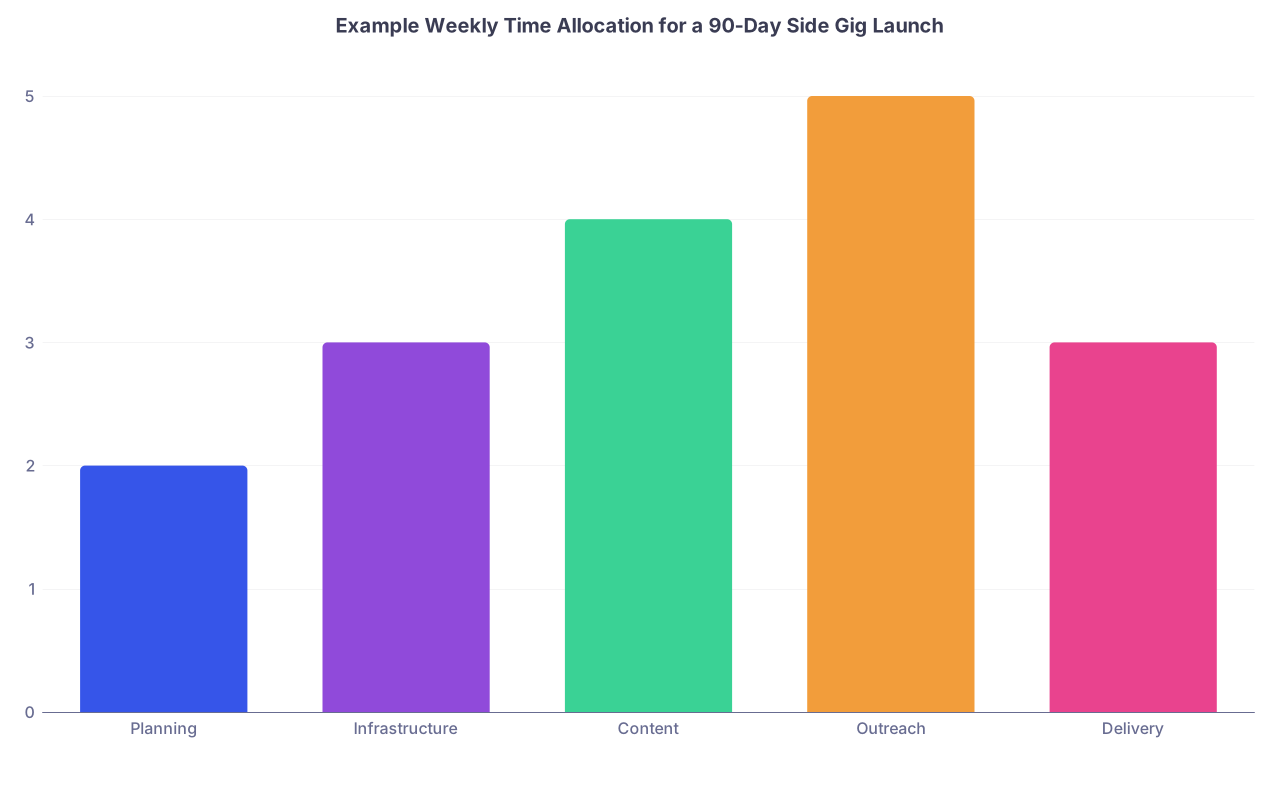
- 2 hours – content / small visibility actions.
- 2 hours – outreach and follow‑up.
- 1–3 hours – actual client work (once beta starts).
You can carve 5–7 hours/week out of your life if you are serious. It usually means:
- One evening (2–3 hours).
- One early morning (1–2 hours).
- One weekend block (2 hours).
If that feels impossible, you do not have a time problem; you have a priority problem. Solve that first.
Avoid These Common Physician Mistakes
I have watched dozens of physicians stall out. The pattern repeats.
1. Hiding Behind “Preparation”
Endless logo design, website tweaking, business card orders, reading books about entrepreneurship. All before having one actual conversation with a potential client.
Preparation is a socially acceptable form of procrastination. Cap it. Give yourself a maximum of 2 weeks for infrastructure and branding in this 90‑day window. Then move on.
2. Building for Other Doctors’ Praise
Designing your offer to impress colleagues on Twitter or at conferences instead of solving a real problem for a paying customer.
If your peers say, “Wow, that’s so innovative,” but nobody is pulling out a credit card, you built a vanity project. Side gigs pay rent, they do not just collect claps.
3. Underpricing Out of Guilt
You are a physician. Your expertise is not worth $50/hour freelance rates. Underpricing also attracts the worst clients – the most demanding and least committed.
Set a professional rate. Be clear. If you feel queasy, that is normal. Charge it anyway. You can always adjust upward after your beta.
4. Waiting for Organic Inbound
Posting on LinkedIn three times and then declaring “this does not work” because nobody reached out is nonsense. Early on, nearly all your traction will come from you initiating contact.
Inbound comes after months of consistent output, results, and word‑of‑mouth. Not in the first 90 days.
Where AI and the Future of Medicine Fit In
You asked for future‑oriented thinking. Here it is.
You are already seeing it: AI documentation tools, triage chatbots, decision support. A lot of clinical work you do now will be partially automated or delegated.
The leverage moves to:
- Being the human layer on top of AI outputs (interpretation, judgment, context).
- Designing and improving workflows where AI fits into real clinical life.
- Turning your domain expertise into scalable systems, curricula, protocols, and products.
| Category | Value |
|---|---|
| Scheduling | 1 |
| Invoicing | 1 |
| Note Templates | 1.5 |
| Email Responses | 0.5 |
You can build that right now into your side gig:
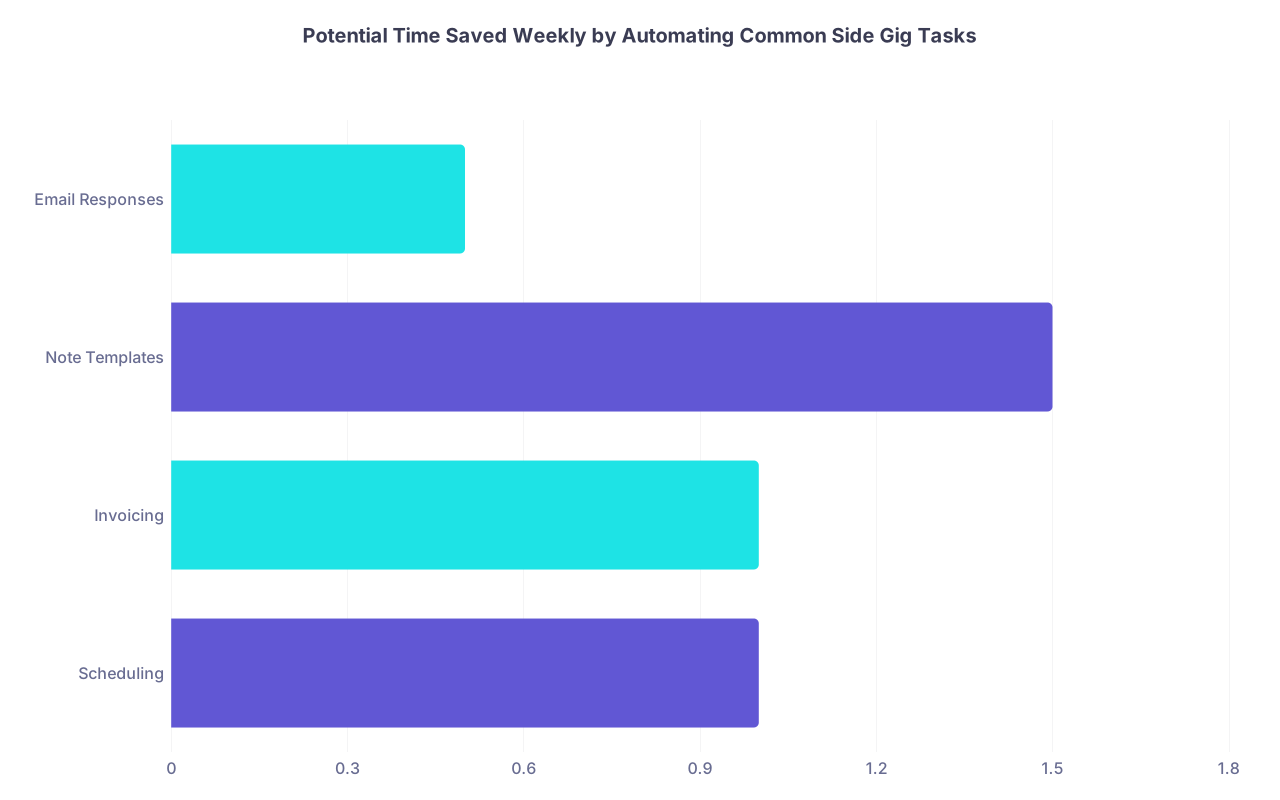
- Use AI tools for:
- Drafting content outlines.
- Generating first‑pass client summaries from handwritten notes.
- Automating scheduling, reminders, and simple email responses.
- Position yourself not as “random doctor,” but as:
- “The cardiologist who helps digital health companies avoid dangerous guideline violations.”
- “The psychiatrist who helps AI startups design ethically sound triage and escalation rules.”
- “The family medicine doc who builds turnkey telehealth protocols for employers.”
The physicians who win in the next decade will not be the ones who maximized RVUs. They will be the ones who:
- Built independent leverage.
- Learned how to package and sell their expertise.
- Used technology as force multipliers in businesses they control.
Your first small, imperfect side gig is your training ground for that future.
Bottom Line: Your 90-Day Playbook
You are not going to think your way into a side business while staring at your clinic schedule. You have to build it. In 90 focused days, your job is simple:
- Pick one clear lane and define a sharp offer for a specific group of people with a painful problem.
- Set up minimal infrastructure and start real conversations – outreach, not just posts.
- Run a small paid beta, then systematize what worked so it can run alongside clinic without wrecking you.
That is how you get unstuck from “maybe someday” and into “I have my own income stream” – without quitting medicine or burning yourself out in the process.