

The advice to “wait until you’re an attending before starting anything on the side” is not conservative. It’s lazy thinking disguised as prudence.
You’ll hear it from senior docs, program directors, even well-meaning co-residents: Focus on training now. Build businesses later. Sounds responsible. It’s also wildly out of touch with the actual economics of modern medicine and the data on physician burnout, debt, and career satisfaction.
Let me be clear: I’m not saying every MS2 needs an LLC or every PGY-1 should launch a startup. I am saying that the blanket rule — no side gig until attending — is wrong. For many people, waiting is the riskier move.
Let’s dismantle this myth properly.
The Old Model of Medicine Is Dead. The Side Gig Myth Is a Fossil from It.
The “wait until you’re an attending” crowd is operating off a script from 1995:
- Stable employment
- Predictable compensation
- Modest student loans
- Low administrative burden
- High autonomy
That world doesn’t exist anymore. You know it from your own life; the data just confirms it.
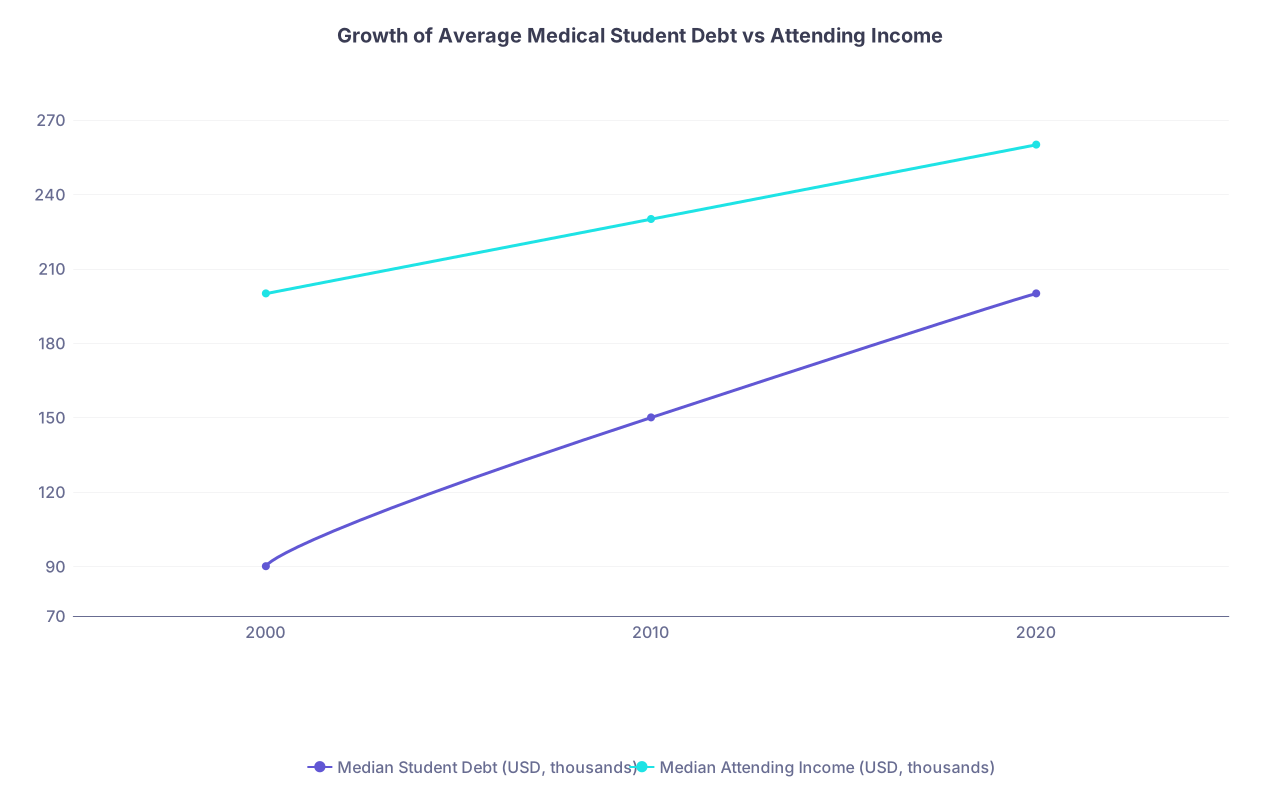
| Category | Median Student Debt (USD, thousands) | Median Attending Income (USD, thousands) |
|---|---|---|
| 2000 | 90 | 200 |
| 2010 | 150 | 230 |
| 2020 | 200 | 260 |
Debt has exploded. Income has crept. The math is brutal.
Most US MD grads now walk out with ~$200–250K in debt. Interest starts hitting immediately. Meanwhile, inflation and lifestyle creep eat into that mythical “attending money” you’re supposed to wait for before doing anything entrepreneurial.
So when someone tells you, “Just focus on training, you’ll be fine once you’re an attending,” what they’re really saying is, “I haven’t seriously looked at the numbers since before the iPhone.”
The future of medicine isn’t one job, one employer, one income stream. It’s portfolio careers, multiple revenue lines, and optionality. Early, small side gigs are not a distraction from that reality. They’re training wheels for it.
The Real Risks Are Not Where People Think They Are
The standard argument against early side gigs goes like this:
- You’ll be distracted
- Your performance will suffer
- You’ll burn out
- You’ll get in trouble with your program/employer
Some of that can be true if you’re reckless. But most people stop there and never ask the obvious follow-up: Compared to what?
Because the alternative — doing nothing but medicine for 7–10 straight years while debt compounds and autonomy shrinks — has its own risk profile. And it’s not pretty.
Burnout Is Higher for the “Medicine-Only” Path
Look at burnout data. The physicians most at risk? Those who:
- Feel a lack of control over their schedule and work
- Feel their work has become purely transactional
- Are financially trapped and unable to change jobs or reduce hours
A lot of those people did exactly what they were told. No “distractions.” No side gigs. Pure medicine for a decade, then straight into full-time clinical grind.
Contrast that with physicians who have a secondary professional identity — consulting, teaching, coaching, content, tech, entrepreneurship. Over and over, when you actually talk to them, you hear versions of the same thing:
“I can tolerate the EMR and admin garbage because I know it’s not my only life.”
Is that in randomized controlled trials? No. But the correlation between autonomy, multiple roles, and lower burnout shows up in survey data and in real conversations. I’ve sat in hospital lounges and listened to a 62-year-old cardiologist say, “I wish I’d started something else years ago. Now I feel stuck.”
Starting something small as a resident or fellow is often protective against burnout. Not causative. Protective. It gives you a sense of agency when the rest of your life is block schedules and rotation lotteries.
The “You Don’t Have Time” Argument Is Overstated
You do not have endless time in training. But you also do not have zero.
This is where people get intellectually lazy. They jump from “you are busy” to “therefore, no side project is possible without disaster.” That’s not analysis, that’s fear.
I’ve watched:
- An IM resident build a niche Step 2 tutoring business to $1–2K/month, strictly capped at 3–4 hours/week
- An EM resident write and self-publish a focused clinical handbook that now generates small but steady royalties
- A PGY-3 psychiatrist develop a digital course for med students on psych interviewing that later became a key part of their nonclinical pivot
None of those people were coasting in residency. They were solid residents. Because they approached the side work like adults: tight boundaries, small scope, slow growth.
Here’s what the tradeoff actually looks like when done sanely:
| Activity | No Side Gig | With Small Side Gig |
|---|---|---|
| Clinical + Required Duties | 60–70 hrs | 60–70 hrs |
| Social / Entertainment | 10–12 hrs | 6–8 hrs |
| Mindless Screen Time | 5–8 hrs | 2–3 hrs |
| Focused Side Gig Work | 0 hrs | 3–5 hrs |
Is there sacrifice? Yes. Are you giving up sleep and patient safety for your Etsy store? No — unless you’re reckless, in which case the problem isn’t the side gig, it’s your judgment.
If you can scroll Instagram for 45 minutes after call, you can outline a blog post, draft a client email, or watch a marketing video. The issue isn’t capacity. It’s clarity and boundaries.
The Real Constraints: Ethics, Contracts, and Competence
Now for the part that actually matters. There are real constraints during training. They’re just not the ones people usually yell about.
1. Your Contract and Moonlighting Rules
A lot of programs and employers bake in:
- Moonlighting restrictions
- Non-compete language
- “No other employment without approval” clauses
You can’t ignore those and call it “entrepreneurship.” That’s just asking to get fired.
The smart move is boring and unsexy:
- Read your contract like a lawyer
- Clarify what counts as “employment” vs “business” vs “hobby”
- Get written permission when there’s any ambiguity
Most nonclinical, nonmedical businesses (writing, digital products, tech projects, design, consulting outside your specialty) are fine when structured correctly. The attendings telling you “you can’t do that” often haven’t read their own HR manual since orientation.
2. Scope of Practice and Conflicts of Interest
You absolutely should not:
- Give medical advice online as “the resident doc” without proper structure, malpractice coverage, and understanding of telehealth regulations
- Sell products/services that overlap with your hospital’s offerings without disclosure and clearance
- Use patient data or cases in your content in a sloppy or identifiable way
But that doesn’t rule out the vast majority of smart side hustles. It just means you pick lanes that don’t violate scope or ethics.
You can teach MCAT. You can help premeds with personal statements. You can build physician scheduling software. You can run a simple SaaS tool that solves a problem in some other industry entirely. None of that conflicts with your duty to patients.
3. Don’t Suck at Your Day Job
This one is obvious but worth stating: if you’re struggling clinically — remediation, repeated professionalism issues, chronic lateness — you don’t earn the right to side projects. Fix the foundation first.
The point is not “ignore medicine, chase money.” The point is: once you’re doing your job competently, one does not preclude the other.
The Strategic Advantage of Starting Before You’re an Attending
Now let’s talk about why “waiting until attending” is strategically backwards.
The Learning Curve Is Long. You Want It Started Early.
Skill sets for most meaningful side gigs — marketing, sales, negotiation, tech, writing, leadership — are not innate. They’re learned. Slowly. Through mistakes.
If you start at 40, as a full-time attending with kids, a mortgage, and admin roles, your ability to tolerate slow, clumsy learning is much lower. You’re squeezed for time and patience.
Start as an MS3 with a tiny blog? As a PGY-2 with a tiny, ethical tutoring service? You’ve got:
- Lower financial pressure
- Lower expectations
- More tolerance for trial and error
You don’t need the income right away. You’re building competence, not cash. That’s a huge psychological advantage.
Early Side Gigs Buy You Future Flexibility
You are not just buying extra income. You’re buying options down the line:
- The option to drop to 0.8 FTE without panic
- The option to say no to a toxic job because you’re not 100% dependent on it
- The option to transition into nonclinical or hybrid work without starting from scratch
Look at the physicians who moved into:
- Medical education businesses
- Consulting for payers or pharma
- Tech roles (CMO, product, UX research)
- Coaching, content, and courses
Most of them didn’t wake up at 45 and suddenly “decide to pivot.” They had a 3–7 year runway of small, early side projects that later scaled.
That runway can start in residency. Or it can start when you’re already burned out and cornered. Your call.
Not All Side Gigs Are Created Equal — Choose Like an Adult
Let’s separate the garbage from the viable.
The bad side gig patterns in training usually look like:
- High time, low upside (random MLMs, generic dropshipping, anything that depends on you spamming your co-residents)
- Blatant conflict with your employer (telehealth from your call room, mining patient lists)
- Ego-driven stuff (starting a “brand” before you have any useful skills or experience)
The good ones share a different pattern:
They either leverage your existing strengths or build broadly useful skills, with tight time caps and low regulatory risk.
Common examples I’ve seen work during training:
- MCAT/USMLE tutoring with clear caps
- Structured essay/personal statement review
- Paid content writing for health/education companies
- Building small software tools or apps (even better if outside of healthcare)
- Design, video editing, or podcast production, if you already have talent there
- Very focused education products (e.g., a niche ebook/course)
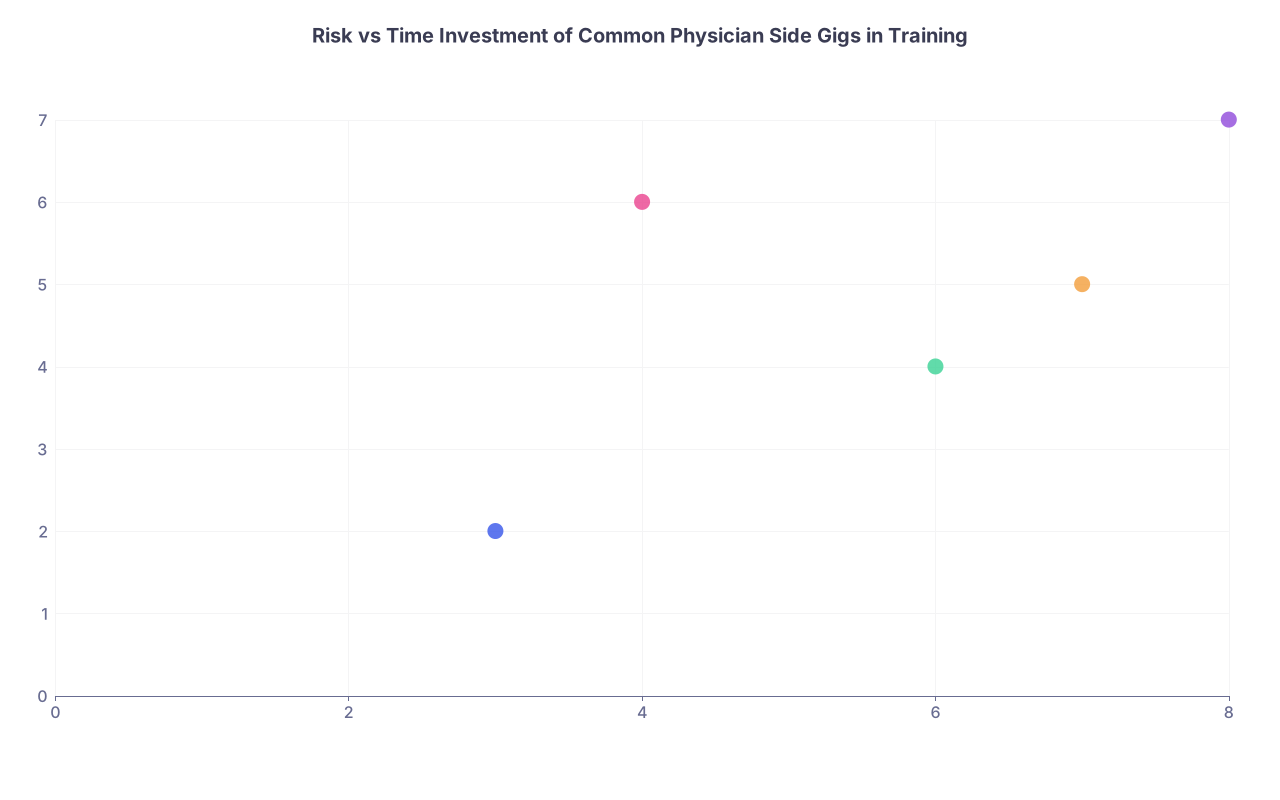
| Category | Value |
|---|---|
| USMLE Tutoring | 3,2 |
| Telehealth Clinic | 8,7 |
| Health Coaching Online | 6,4 |
| MLM Sales | 7,5 |
| Tech SaaS Tool | 4,6 |
(Interpretation: higher numbers = more of that quality. Telehealth clinic is high time, high regulatory risk; tutoring is moderate time, low regulatory risk.)
You don’t need to “build an empire.” You need something small, testable, and sustainable that either grows your income modestly or builds real-world skills.
“But No One in My Program Is Doing This…”
Yes. That’s exactly the point.
By definition, being early looks weird. The first residents who moonlighted, negotiated remote work, or demanded nonclinical time for research or innovation also looked weird. Now those things are normalized.
The culture in many programs is still: medicine is your entire life, side interests are “cute” at best and “concerning” at worst. That culture was built in an era of lower debt, less regulatory madness, and less commoditization of physician labor.
The future of medicine will favor physicians who can:
- Communicate clearly outside of charting
- Understand business models and incentives
- Use technology beyond the EMR
- Build and maintain networks outside of a single hospital system
Side gigs are not a fad. They’re how you practice those skills before you’re backed into a corner.
If you’re waiting for your attendings, who never had to face your version of medicine, to validate that, you’ll wait forever.
How to Be Aggressively Sensible About It
If you’re going to ignore the “wait until attending” myth — and you should — then do it with discipline:
- Set a hard weekly cap (3–5 hours) and a clinical performance standard. If either gets violated, you scale back.
- Stay out of gray-zone medicine online unless you actually understand telehealth regulations, licensing, and malpractice.
- Keep it simple. Early on, pick projects that don’t require employees, inventory, or complex legal structures.
- Under-promise at work and over-deliver. Your PD should see you as reliable, not distracted.
- Track the math. If your side gig is netting you $50/month for 30 hours of work, either pivot or call it a hobby. Don’t delude yourself.
You’re not too early. You’re early enough that your mistakes are cheap.
The Bottom Line
Three things to walk away with:
- The blanket advice to “wait until you’re an attending” before starting any side gig is outdated and often more dangerous than starting small, smart projects now.
- Done correctly — with clear boundaries, ethical lanes, and contract awareness — early side gigs can reduce burnout and dramatically increase your future options.
- You do not need permission from the old guard to build a life that is not 100% dependent on one employer, one specialty, and one income stream. You just need to be competent at your day job and disciplined about everything else.


