

The biggest mistake physicians make with clinical algorithms is giving away intellectual property every single day and calling it “the protocol” or “the order set.”
You are already designing algorithms: sepsis bundles, anticoagulation flows, telehealth triage scripts, EMR order sets, ICU weaning pathways. The problem is that you treat them like disposable checklists instead of assets that can be licensed, productized, and scaled.
Let me walk you through how to turn those protocols into actual IP and, yes, revenue.
1. What Counts as a “Clinical Algorithm” Worth Monetizing?
Forget the buzzwords. Start here: an algorithm is just a repeatable decision process that another clinician (or software system) can follow and get similar results.
Most physicians already create:
- Admission / discharge criteria
- Escalation pathways (“if lactate X, do Y”)
- Pharmacy dosing protocols
- Remote monitoring rules (“if HR > X and BP < Y, message MD”)
- Triage decision trees for nurse lines or telehealth
- Imaging or lab utilization rules
Those are algorithms.
The question is which ones are worth turning into IP. The sweet spot has three features:
High variability today
Places where different clinicians “just use judgment” and outcomes/costs are all over the place.High volume or high stakes
Either tons of patients (e.g., URIs in urgent care) or expensive events (ICU transfer, readmission, stroke).Measurable impact
You can plausibly move:- Costs (shorter LOS, fewer labs, lower drug waste)
- Revenue (more appropriate referrals, coding)
- Risk (fewer readmissions, safety events, malpractice exposure)
Typical fertile areas:
- Hospital: sepsis, VTE prophylaxis, transfusion thresholds, ICU sedation, delirium prevention, post-op pathways.
- Outpatient: chronic disease management (diabetes, CHF, COPD, anticoagulation), medication titration, referral criteria.
- Telehealth / urgent care: triage rules, antibiotic stewardship, imaging thresholds.
If your process is already running as a checklist, smart phrase, or shared PDF—but you keep getting pinged for “how do you handle X?”—you are staring at monetizable IP.
2. From “Clinic Protocol” to Structured Algorithm
Protocols written as narrative text are almost useless outside your own team. If you want IP, you need structure.
Step 1: Extract the decision logic
Take your loose protocol and force it into explicit decisions and actions. No hand-wavy “consider” or “use clinical judgment” everywhere.
Example: Outpatient diuretic titration protocol for CHF
Bad (typical note):
“Adjust diuretics based on weight, symptoms, and blood pressure. Reassess in 1–2 weeks.”
Good (algorithmic):
Input:
- Current med list (including ACE/ARB/ARNI, beta-blocker, MRA, SGLT2)
- Baseline weight, current weight (3-day trend)
- Symptoms (NYHA class, orthopnea, PND)
- Home BP and HR
- Last BMP (BUN/Cr, K, Na)
- Recent ED visits / admissions
Decision nodes (examples):
- If weight increase ≥ 2 kg in 3 days AND no hypotension (SBP ≥ 95) AND creatinine < 2.5: increase loop diuretic dose by 25–50%.
- If SBP < 90 with dizziness or presyncope: hold titration and flag for urgent review.
- If K > 5.5: auto-flag for MD review and suppress MRA up-titration recommendations.
Now you have conditional logic that a software engineer, nurse, or remote MA can follow without mind-reading.
Step 2: Define input and output explicitly
Think like an engineer for 10 minutes.
Answer two questions clearly for each algorithm:
What are the required inputs?
Not “labs”; say “BMP within last 7 days including Na, K, BUN, Cr” or “home BP readings, at least two in last 48 hours.”What are the outputs?
Not “adjust meds” but “recommendation string + discrete dose change + suggested interval for follow-up + alert severity flag.”
If an algorithm can be described as:
For given input X, Y, Z → output A, B, C
…it is far easier to convert into:
- A decision support module
- A triage script
- A remote monitoring rule set
- A rules engine within an app
Step 3: Clarify scope and exclusions
No one wants an algorithm that pretends to cover everything. You want something safely scoped, with clear “stop here and hand off” rules.
You write this plainly:
- Applies to:
- Adults ≥ 18 with diagnosis of chronic HFrEF (LVEF ≤ 40%), NYHA II–IV.
- Excludes:
- Pregnancy
- Advanced CKD with eGFR < 30
- Recent hospitalization (<7 days) for acute decompensated HF
- Significant valve disease requiring surgical or structural intervention
Then define explicit “stop conditions” where the algorithm says “escalate” rather than guessing:
- If systolic BP < 85 AND new confusion: trigger emergency escalation path.
- If eGFR drops > 30% from baseline within 7 days: send urgent provider alert, suppress further titration.
That boundary work is what makes it both safer clinically and more valuable commercially.
3. When Does This Become Intellectual Property?
Here is where physicians get fuzzy and leave money on the table.
Your “idea” that blood pressure should be controlled more tightly in CKD is not protectable. Everyone knows that.
What can contribute to protectable IP:
A specific arrangement and implementation of decision rules
The actual structure, thresholds, ordering of steps, and integration logic.A novel system or method for clinical decision-making
Especially if it uses a combination of data sources or steps that is not obvious.A software implementation of those rules
Code, databases, UI flows, parameterization that allows easy deployment across sites.Documentation, branding, and data model
Protocol manuals, content libraries, templates, and named frameworks.
| IP Type | What It Protects | Typical Use Case |
|---|---|---|
| Copyright | Exact text, flowcharts, software code | Protocol manuals, UI, documentation |
| Trade Secret | Internal rules, thresholds, methods | In-house triage logic, “secret sauce” |
| Patent | Novel, non-obvious methods/systems | Unique remote monitoring or scoring tool |
| Trademark | Branding/name of the algorithm/tool | Marketed pathways or SaaS product names |
Copyright
Easy win. Your written protocol, flowchart, GUI layout, and code are automatically copyrighted once created, as long as they are original expression.
That means if your hospital or another vendor lifts your exact manuals and sells them, you have some recourse (assuming you own it—huge caveat, more on that below).
Trade secret
If you build:
- A proprietary triage rubric
- A unique scoring system combining inputs from EMR + wearables + patient-reported data
- A set of thresholds and micro-rules that give your practice an edge
…and you keep the details internal (not publicly published), it can function as a trade secret. That often pairs with:
- NDAs for contractors
- Restricted access to full documentation
- Only a black-box implementation visible to customers
This is common in nurse triage call centers and proprietary care management companies.
Patent
Harder, slower, but can be very valuable in the right context.
You think about a patent when:
- The algorithm ties into a specific system or method, not just “do A then B.”
- There is a novel way of combining data sources, adjusting thresholds, or automating part of care.
- It would matter if competitors were legally barred from copying the method.
Classic low-value examples: “Method of adjusting metformin dose based on GFR” is almost certainly obvious and not patentable.
Higher-value example: “System and method for real-time medication titration for heart failure using combined EMR, wearable device, and patient-reported data with a dynamic safety boundary model.”
If you are even thinking about patents, you stop publishing full details publicly before filing and you talk to a qualified patent attorney early.
4. Ownership Nightmares: Employment, EMR, and Academic Traps
Here’s where most clinicians lose their leverage: they sign it away without reading.
Check your employment agreement
Three landmines:
“Work made for hire”
Anything you create “within the scope of employment” belongs to your employer.Broad IP assignment clauses
Language like: “All inventions, discoveries, developments, and innovations conceived in connection with employee’s service shall be the exclusive property of Employer.”Side-gig restrictions
Prohibitions on outside consulting, product development, or “competing activities.”
If you develop a clinical algorithm as part of a hospital QI initiative or academic project, odds are high the institution at least claims some ownership. Whether they will enforce that when you productize it is a separate, very real, negotiation question. I have seen both: complete apathy, and aggressive enforcement.
EMR / Vendor constraints
If your algorithm is tightly coupled to:
- Epic SmartSets
- Cerner MPages
- Proprietary CDS modules
- Remote monitoring vendor workflows
You may run into contract terms or technical dependence that make commercialization trickier.
Better approach:
Abstract the clinical logic from the implementation.
Maintain a vendor-neutral spec: JSON, decision tables, or plain structured text. That spec is your IP.Implement as:
- A standalone API or service
- A modular rules engine
- A library that can be integrated by others
You license access to the logic and methods, not to a particular EPIC build you did for your hospital.
5. Business Models: How Algorithms Turn into Actual Income
You do not get paid for a PDF of “your sepsis protocol.” You get paid for outcomes, scale, and integration.
Here are realistic paths I have seen physicians use.
1. Licensing content to a company
You create:
- A library of algorithms (e.g., urgent care triage trees, stewardship logic)
- Full documentation and structured specs
- Ongoing update support
You license these to:
- Digital health startups
- Remote patient monitoring companies
- Telehealth platforms
- Nurse triage vendors
Money flows as:
- One-time content fee (cheaper, weaker)
- Annual content licensing (better)
- Per-member-per-month (PMPM) content + oversight (best if you have leverage)
For early-stage startups, I have seen deals like:
- $10k–$50k for initial algorithm design + implementation spec
- Then $1–$2 PMPM for content use in defined modules (if you negotiate well and show outcome value)
You become the “clinical engine” under the hood.
2. Building your own digital product
Heavy lift, larger upside.
Common structures:
- A narrow SaaS tool (e.g., ECG triage, antibiotic selection, pre-op evaluation)
- An internal-use product for a large group, then sold outward
- A white-label care pathway engine
Revenue models:
- Subscription per clinician user
- Subscription per site
- Integration + maintenance contracts
Here your algorithm is core IP, but the software wrapper, integrations, and support matter just as much for what customers pay for.
3. Consulting + algorithm design
You might not want to own product risk. Fine. You can still get paid well as the architect.
Typical scenario:
- Health system wants to standardize CHF, sepsis, or perioperative pathways.
- Digital health startup wants to build a triage or dosing engine.
- RPM company wants disease-specific escalation algorithms.
You charge:
- Hourly ($300–$600+ for real subspecialty expertise, often undervalued)
- Project-based: e.g., $30k–$80k for end-to-end design and validation for a complex area.
- Retainers for ongoing improvement and regulatory documentation.
Income is less “passive” but faster to realize and far less risky.
4. Hybrid: equity + fees
Startup wants your algorithms but cannot pay full cash.
Reasonable model:
Discounted cash fee for initial work
(Example: 50% of your usual consulting rate)Equity grant tied to:
- Deliverables (algorithms delivered and implemented)
- Specific milestones (FDA 510(k) clearance, first 1000 users, Series A financing)
This is where you stop thinking like an employed clinician and start thinking like a founder. You are trading part of your IP and time for upside.
6. Validation: Without Data, Your Algorithm Is Just An Opinion
Companies, health systems, and regulators care about evidence. Your algorithm must earn its keep.
There are three levels you should think about.
Level 1: Expert consensus and guideline alignment
Baseline sanity:
- Map each rule to:
- Guideline (ACC/AHA, KDIGO, Surviving Sepsis, etc.)
- High-quality trials or meta-analyses
- Document deviations explicitly and justify them.
You maintain:
- A reference table linking each decision node to sources.
- A “clinical rationale” supplement that a skeptical CMO could read and sign off on.
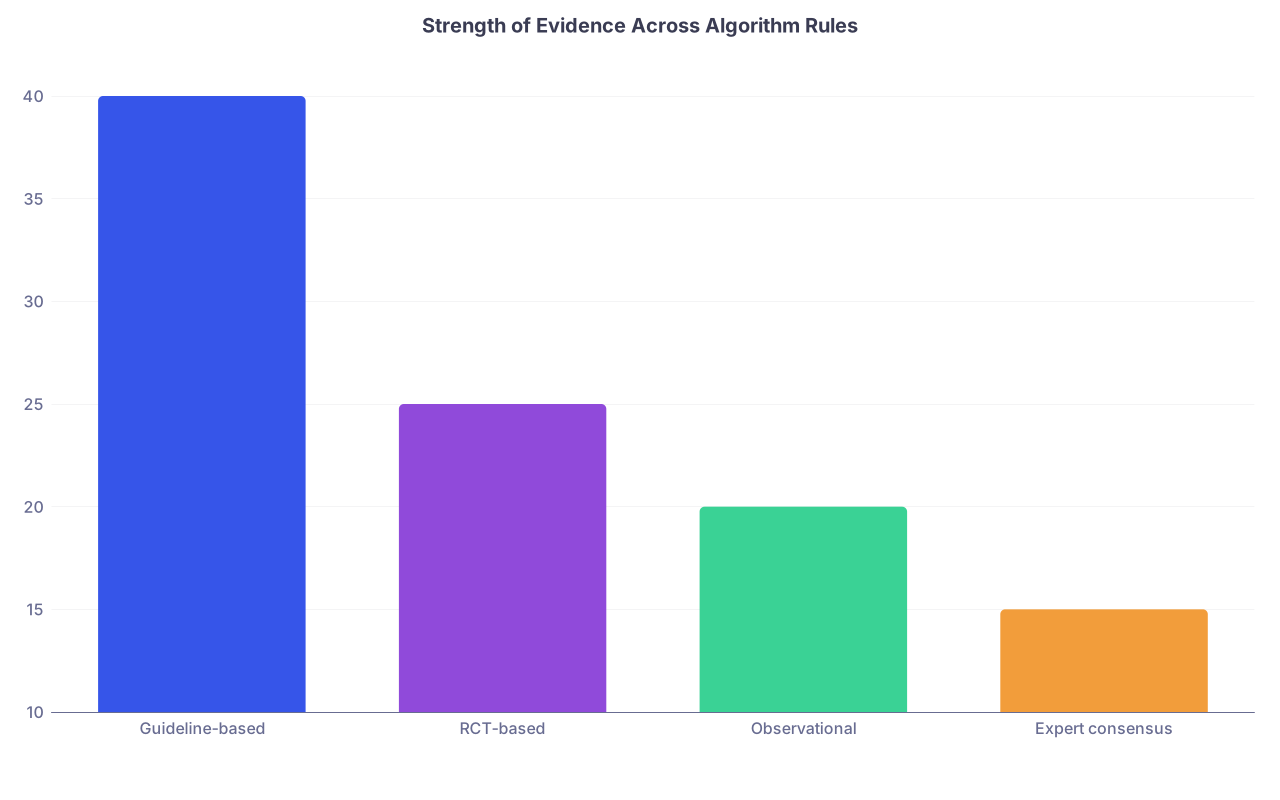
| Category | Value |
|---|---|
| Guideline-based | 40 |
| RCT-based | 25 |
| Observational | 20 |
| Expert consensus | 15 |
Level 2: Retrospective validation
Before any big rollout, you do:
- Retrospective chart review or EMR simulation.
- Feed historical patient data into your algorithm logic.
- Compare algorithm recommendations to:
- What actually happened
- Outcomes (readmissions, ED visits, time to escalation, cost metrics)
You quantify:
- Safety: Did it ever suggest something clearly dangerous?
- Sensitivity: How often did it catch events earlier?
- Efficiency: Fewer labs, imaging, visits?
This is not optional if you want to sell beyond one friendly buyer.
Level 3: Prospective or quasi-experimental evaluation
Serious products need prospective data at some point.
Options:
- Pilot in one clinic or unit vs. matched controls.
- Stepped-wedge rollout across sites.
- Before/after with proper statistical adjustment.
You measure:
- Clinical outcomes: admissions, complications, mortality where relevant.
- Operational: LOS, time to decision, clinician time saved.
- Financial: cost per patient, revenue lift (e.g., better coding, fewer penalties).
You do not need NEJM-level RCTs for many algorithms. But you do need something more than “my residents like it.”
7. Regulatory and Risk: Where Algorithms Cross Into Devices
If your algorithm is just a guideline summary, non-binding, and clearly “for educational purposes,” you are in a different world than if it is driving automated decisions.
The risk spectrum:
Low risk:
- Pure reference apps
- Checklists with no automated recommendations
- Tools that only format or display data
Medium risk:
- Clinical decision support that suggests next steps but requires clinician confirmation
- Remote monitoring alert thresholds that can be overridden
High risk:
- Algorithms that autonomously adjust therapy
- Tools that triage emergent vs. non-emergent care without human override
- Systems marketed as replacing specialist decision-making
High-risk categories can easily cross into “software as a medical device” territory. That can mean FDA, MDR (EU), and significant regulatory work.
You do not need to memorise regulations. But you do need:
- A regulatory-savvy partner or consultant.
- Clean documentation of:
- Intended use
- Risk analysis
- Validation and performance metrics
And strong disclaimers do not magically fix a genuinely dangerous design. You still owe a duty of care if you are holding yourself out as an expert behind the algorithm.
8. Practical Roadmap: From Clinic Brain to IP Asset
Let me strip this down to a realistic path for a working clinician.
Phase 1: Identify and structure
Pick one narrow problem
Example: “Nurse triage algorithm for outpatient chest pain in a cardiology practice.”Write your current protocol in structured form
- Inputs list
- Decision nodes (if/then)
- Actions
- Stop / handoff triggers
- Scope and exclusions
Create both:
- Human-readable flowchart
- Machine-consumable spec (simple JSON or table of rules)
Phase 2: Protect and clarify ownership
Check your current employment and IP agreements.
If needed, get a 1–2 hour consult with an IP/healthcare attorney. Worth every dollar.Decide your IP strategy:
- Keep as trade secret and license?
- Copyright the documentation?
- Explore patentability?
Keep development on your own time, using your own hardware, clearly outside employer scope if you want independent ownership. Document this.
Phase 3: Validate and package
Do a small retrospective analysis
Even 50–100 patients can show whether your logic is sane and what it might achieve.Create a clean “algorithm package”:
- Clinical rationale + references
- Technical spec
- Risk and exclusion statements
- Sample integration scenarios
Decide your business entry point:
- Sell design and validation as consulting?
- Approach a specific vendor to license content?
- Partner with a technical cofounder to build a product?
Phase 4: Sell intelligently
- When talking to potential partners:
Lead with:
- The problem you solve (e.g., “reduce unnecessary ED transfers from urgent care by X% while keeping misses near zero”)
- The evidence you have
- How easy it is to integrate your spec
Avoid leading with:
- “I have a protocol”
- “It is based on guidelines”
That is table stakes, not a differentiator.
- Structure deals that respect your contribution:
- Clear IP ownership clauses
- Royalties or licensing if your algorithm is core engine
- Attribution rights (if you want your name attached)
9. Where This Is Going: Algorithms as Core Physician Leverage
Let me be blunt. If you do not own your algorithms, someone else will.
The future of medicine is:
- Fewer clinicians making higher-level decisions
- More automation of low-level triage and titration
- Payers and systems obsessed with standardized pathways
That standardization will be built from algorithms. Some written by physicians, some by engineers, and frankly too many purely by MBAs trying to cut costs.
You have three choices:
Ignore it. Stay in the lane of manual cognitive labor and watch your leverage erode.
Let your employer and vendors absorb your algorithm design for free, while they build scalable products from your expertise.
Treat your protocols as the raw material of intellectual property and design a strategy—legal, technical, and business—to own a piece of that future.
The third path takes actual thought. And some discomfort. But it is the only one that preserves your clinical judgment as something more than a line-item cost.

| Step | Description |
|---|---|
| Step 1 | Identify High-Impact Protocol |
| Step 2 | Structure as Explicit Algorithm |
| Step 3 | Validate with Retrospective Data |
| Step 4 | Package IP and Documentation |
| Step 5 | Legal Review and Strategy |
| Step 6 | Design and Advisory |
| Step 7 | Content Licensing Deals |
| Step 8 | Build or Join Startup |
| Step 9 | Ownership Clear? |
| Step 10 | Business Model |

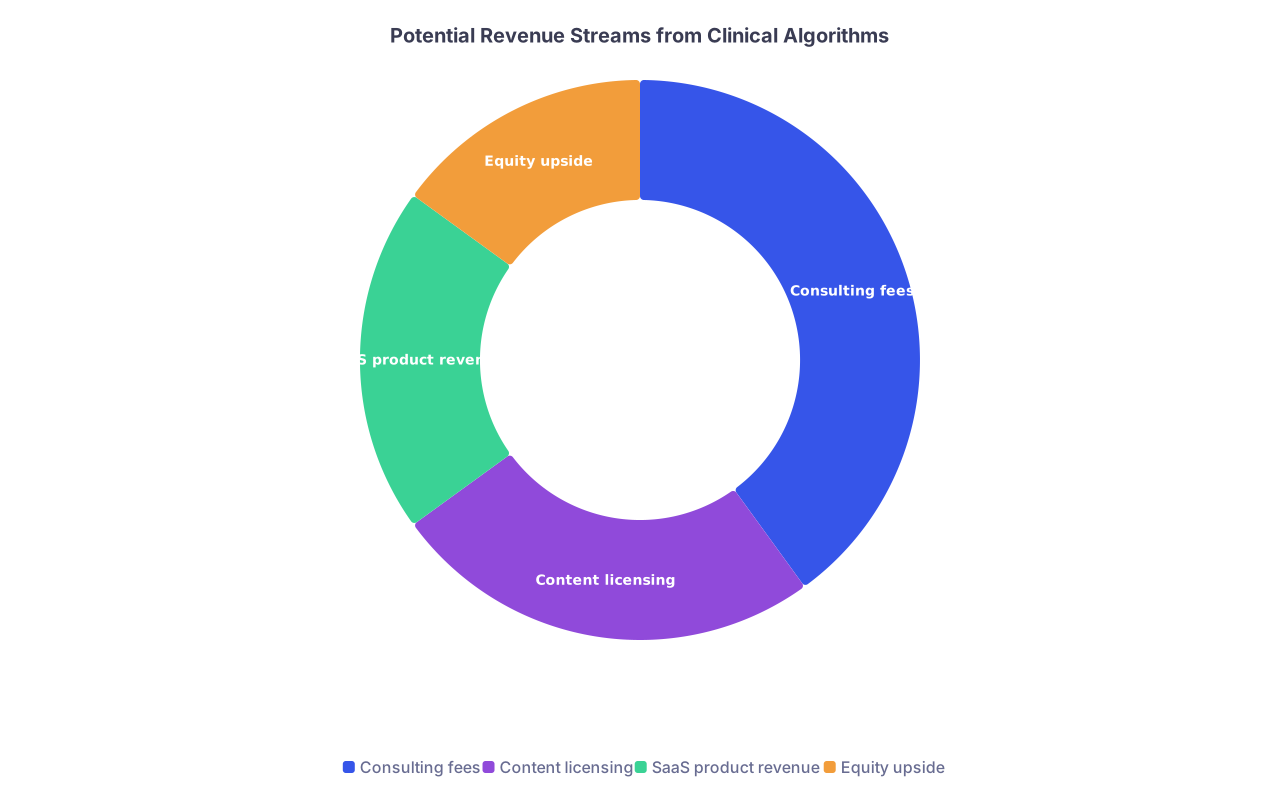
| Category | Value |
|---|---|
| Consulting fees | 40 |
| Content licensing | 25 |
| SaaS product revenue | 20 |
| Equity upside | 15 |

FAQ (4 Questions)
1. Can I really claim IP rights over a protocol based on public guidelines?
Yes, you can claim rights over your specific expression and implementation: how the rules are structured, combined, prioritized, and integrated into workflows or software. The underlying medical facts and general guideline recommendations are not protectable, but your unique arrangement, documentation, and code are. That is classic copyright and sometimes trade secret territory.
2. Do I need a patent for my clinical algorithm to monetize it?
No. Most monetizable clinical algorithms are commercialized through copyright, trade secrets, and contracts (licensing or consulting). Patents are useful when you have a truly novel system or method and plan to compete in a space where legal exclusivity is strategically important. They are expensive and slow; they are not a prerequisite for turning protocols into revenue.
3. How do I avoid conflicts with my employer when working on algorithms as a side hustle?
You start by reading your employment contract and IP clauses. Then you (1) pick projects clearly outside your job duties, (2) work on your own time and equipment, (3) document that separation, and (4) if needed, negotiate a carve-out or written permission. For anything substantial, a brief consultation with an attorney who understands healthcare IP is the most cost-effective move you can make.
4. I am not technical. How can I still build income from clinical algorithms?
You do not need to code. Your value is in structuring clinical logic, defining safe boundaries, and tying decisions to evidence. You partner with technical people—engineers, product teams, or vendors—who implement your spec. You earn through consulting fees, content licensing, and sometimes equity. Your deliverables are well-structured algorithms, documentation, validation plans, and ongoing clinical oversight, not software itself.
Key points to remember: your protocols are not just “good practice,” they are latent IP; structure and scope them like real algorithms; and do not casually give away ownership when that logic becomes the core of someone else’s product and profit.


