

You have just finished another 23-patient clinic day. Three no-shows. Two complex prior auth disasters. One “can you just refill my meds” that turned into a 40-minute train wreck. You are staring at your EMR inbox at 8:15 p.m. and thinking: there has to be a smarter way to use my license.
You are right. And the answer is not generic “telemedicine.” It is niche telemedicine.
Let me break this down specifically.
Why General Telemedicine Is A Race To The Bottom
The standard story: physician signs up for a big telemed platform, gets paid $25–$40 per visit to churn through viral URIs and UTIs with minimal continuity, minimal control, and maximal liability. That is not a side hustle. That is piecework.
The leverage appears only when you go narrow and specific.
Niche telemedicine means:
- You pick a specific problem.
- For a specific patient segment.
- Where your expertise is clearly differentiated.
- And the perceived value is high enough to justify real fees.
Think cash-pay ADHD management for tech workers. Menopause consults for mid-career executives. Second-opinion cardiology for high-risk athletes. Post-op bariatric nutrition coaching. Sleep medicine for shift workers. Not “I see adults with everything.”
Most physicians never escape “generic doc in a box” land. They complain telemedicine does not pay. They are right—at that level.
You are not going to build a high-yield side hustle doing $29 sinusitis visits on an overcrowded marketplace. You need a niche with:
- Asymmetric demand (patients care more than payers).
- Clear pain points.
- Measurable outcomes or tangible reassurance.
- Willingness to pay out-of-pocket or via concierge retainers.
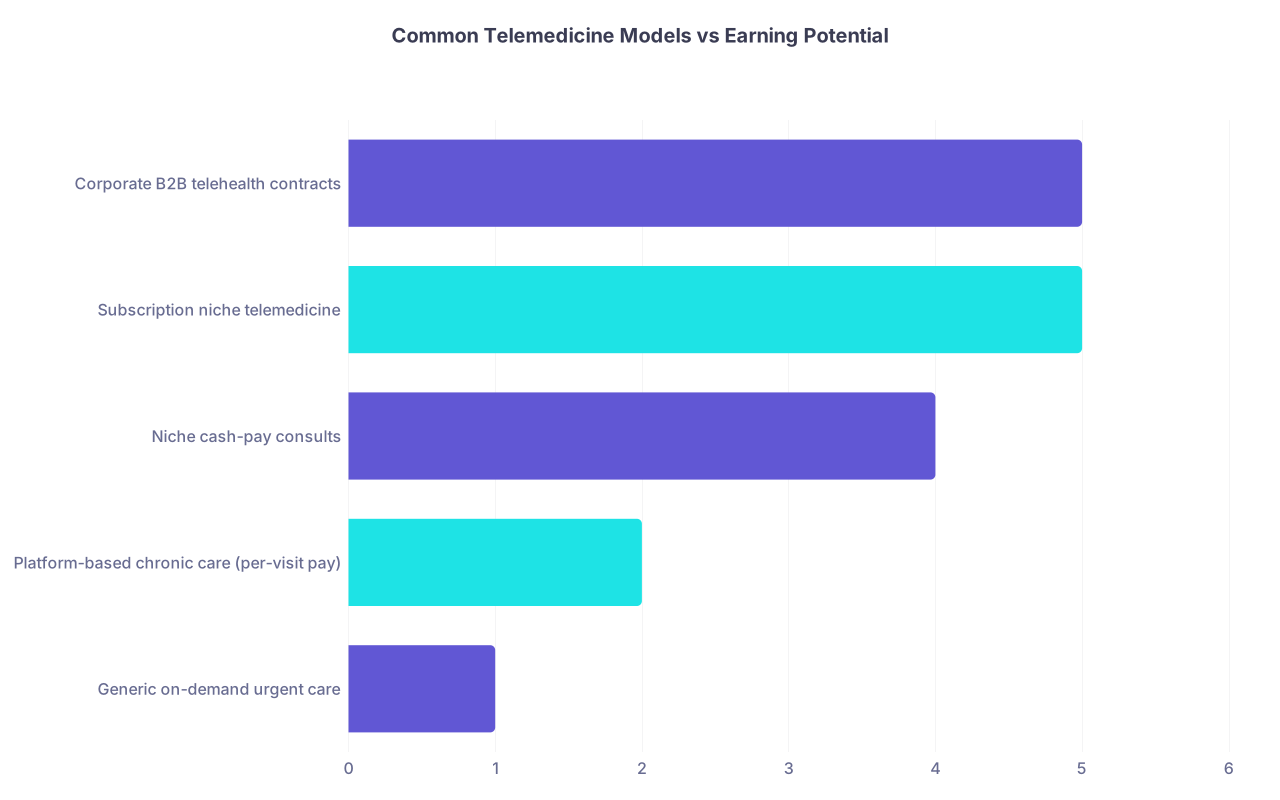
| Category | Value |
|---|---|
| Generic on-demand urgent care | 1 |
| Platform-based chronic care (per-visit pay) | 2 |
| Niche cash-pay consults | 4 |
| Subscription niche telemedicine | 5 |
| Corporate B2B telehealth contracts | 5 |
Scale of 1–5: earning potential and control. The money and autonomy are on the right side of that chart. Your job is to move there deliberately.
Step 1: Choose A Niche That Actually Prints Money
Do not start with “what sounds trendy.” Start with: Who would gladly pay $200–$500 for a 45–60 minute video visit that solves a meaningful problem and saves them time, stress, or future costs?
You need three overlapping circles:
- You are qualified and credible.
- The clinical problem fits telemedicine.
- The economics make sense.
Let me be concrete.
1. Clinical areas that lend themselves to high-yield telemedicine
These are categories I have seen work repeatedly.
High-anxiety decisions
People will pay to avoid a bad decision or a missed diagnosis. Examples:
– Second opinions on surgery (orthopedic, spine, gynecologic)
– Oncology treatment options review
– Cardiology risk and imaging review
These are not “ongoing primary care.” They are 1–3 deep-dive consults with heavy cognitive value.Chronic, high-friction conditions
Where the system fails at follow-up and behavior change, telemedicine can shine. Example niches:
– Obesity medicine with structured protocols
– PCOS management for young women
– Migraine management
– Long COVID symptom management (if you want pain)
– Peri-menopause and menopause hormone therapyLifestyle- and performance-adjacent services
People pay for optimization more than maintenance.
– Sleep medicine for professionals and shift workers
– Athletic performance cardiology or pulmonology
– ADHD management for adults in high-cognitive-demand jobs
– Physician mental performance consults (yes, niche within a niche)Procedure-driven specialties doing pre-/post- work
You cannot do the procedure on video. You can do all of the decision-making, risk counseling, and follow-up.
– Pre-op and second-opinion consults across surgery subspecialties
– Post-op complication triage and wound check guidance
– Bariatric surgery nutritional and behavioral follow-upHighly stigmatized or privacy-sensitive areas
Telemedicine + cash pay is ideal here.
– Sexual health, ED management, low testosterone (done ethically, not as a pill-mill)
– Disordered eating support (in collaboration with therapists, nutritionists)
– Gender-affirming care (if you have the training and the stomach for policy fights)
2. Filters that tell you “this is a good niche”
Use these hard filters:
- Can I practice safely and effectively via video + local labs/imaging?
- Does the condition rely more on history, counseling, and longitudinal decision-making than physical exam or procedures?
- Is there existing demand evidenced by:
- High search volume for “online [X] doctor”
- Telehealth startups already in that space (proof of concept, not a reason to avoid it)
- Can I productize this? Not just “visit,” but “package”:
- 90-day optimization program
- Pre-surgery second-opinion package
- 6-month migraine stabilization protocol
If you cannot see a 3–6 month program structure, you probably picked something too generic.
Step 2: Decide Your Business Model Before You Build Anything
The next mistake: building a beautiful telemedicine setup without a concrete revenue model. Do not do that. Pick your monetization structure first, then build backwards.
You have four main options that work in niche telemedicine.
| Model | Typical Pricing | Best For | Complexity |
|---|---|---|---|
| One-off cash consults | $200–$600 per visit | Second opinions, discrete questions | Low |
| Program / package model | $800–$3,000 per 3–6 months | Chronic conditions, behavior change | Medium |
| Subscription / membership | $100–$400 per month | Ongoing access, niche primary/specialty | Medium |
| B2B corporate telehealth | Contract-based | Wellness, risk management | High |
1. High-ticket, one-off consults
Simplest to start. Example: “Cardiac second opinion consult – 60 minutes + written summary for you and your local cardiologist, $450.”
Pros:
– No commitment from patients.
– High perceived value if marketed correctly.
– Low operational overhead.
Cons:
– Revenue is lumpy.
– Harder to predict income.
– You must be very good at front-end marketing.
Works nicely as a starting point while you build reputation and pipeline.
2. Structured programs or packages
You sell an outcome, not a visit.
Examples:
- “90-Day Migraine Reset Program” – initial 60-min consult + 2 follow-ups + messaging + protocol, $1,200.
- “6-Month Perimenopause Stabilization” – scheduled touchpoints, labs, titration of therapy, $2,000–$2,500.
This is where the money looks like an actual business.
Structure:
- Clear start and finish.
- Defined expectations: number of visits, access level, lab costs, etc.
- Named framework or protocol (yes, branding your approach matters).
3. Membership / subscription
Examples:
- $175 per month for ADHD management access (includes one visit per quarter plus messaging).
- $249 per month menopause concierge care.
This can become recurring, semi-passive revenue once your systems are clean. But do not jump to this without understanding your workload per patient. Or you will underprice and burn out.
4. B2B / employer contracts
Most physicians underestimate this path. You provide niche consults to:
- Mid-sized employers (e.g., tech companies needing ADHD, sleep, or mental health support for remote teams).
- Unions.
- Physician organizations (yes, meta).
You charge the organization, not the individual. Often per-member-per-month or flat retainer for defined access.
This is where five-figure monthly contracts live. It is not a phase one move. But it is where a successful niche practice can go.
Pick one primary model for now. If you are early, I recommend: high-value one-off consults + clearly defined 3–6 month programs.
Step 3: Licensing, Legal, and Platforms – The Unsexy Part You Cannot Ignore
This is where people cut corners. That is how you end up explaining yourself to a board.
1. Licensing and jurisdiction
Telemedicine is still state-based in the US. You practice where the patient sits, not where you are. So:
- Start with your home state, where your malpractice is cleanest.
- If you want multi-state, either:
- Use the Interstate Medical Licensure Compact (IMLC) if eligible.
- Or selectively add 2–3 high-yield states with big target markets (e.g., CA, TX, FL, NY – but check their telehealth quirks).
Do not collect random low-yield licenses just because they are “easy.” Every license is ongoing paperwork.
2. Malpractice coverage
You need a policy that explicitly covers:
- Telemedicine.
- Cash-pay or concierge models.
- The states where you practice.
Call your carrier. Spell it out. “Board-certified [specialty] doing telemedicine only, no in-office care, in [states], mostly [type of care].” Get a written confirmation.
If your carrier is confused, find one that is not. Med-mal markets have caught up; there are now products built for virtual-only practices.
3. Corporate structure
Keep it simple but separate.
Minimum viable setup:
- A single-member LLC (or PLLC if required) in your home state.
- An operating agreement.
- A business checking account.
You can layer S-corp taxation later if your profit justifies it; that is an accountant’s discussion, not a Reddit thread.
4. Platform and tech stack
Do not custom-code anything unless you enjoy lighting money on fire. Use:
- A telehealth-capable EHR with integrated video and e-prescribing (e.g., Charm, Elation + Zoom, SimplePractice, DrChrono, etc.).
- HIPAA-compliant video (built-in or Zoom for Healthcare).
- Payment processing (Stripe, Square, or your EHR’s built-in).
- A basic website with:
- What you do
- Who you help
- Pricing or at least pricing ranges
- Clear call to action to book
Your tech stack in month 1 should be boring. Reliable. Cheap-ish. Upgrade once you have revenue.

| Step | Description |
|---|---|
| Step 1 | Pick Niche and Model |
| Step 2 | Confirm Licensing and Malpractice |
| Step 3 | Form LLC and Bank Account |
| Step 4 | Choose Telehealth EHR |
| Step 5 | Build Simple Website |
| Step 6 | Set Pricing and Packages |
| Step 7 | Start Marketing to First 20 Patients |
Step 4: Design A “High-Yield” Clinical Workflow
You are not building an academic clinic. You are building a ruthlessly efficient, high-value consult service. That means:
1. Pre-visit intake does the heavy lifting
By the time you enter the video, you should already know:
- The core problem and duration.
- Prior workup (labs, imaging, prior consults).
- Medications and comorbidities.
- Patient goals and fears.
Solution: a structured intake form that is painful enough to filter tire-kickers but not so insane that no one completes it.
Example for a second-opinion cardiology niche:
- Upload most recent echo, stress test, cath report.
- Upload med list or allow EHR access.
- Describe in your own words: “What decision are you trying to make?”
- “What are you most worried will happen if you choose wrong?”
Now your visit addresses that. Not “tell me your story from the beginning” for 30 minutes.
2. Standardized visit structure
High-yield visits are scripted. Not robotic, but structured.
Typical 60-minute second-opinion:
- 5 min – Clarify agenda and goals (“I want you to leave with X, Y, Z”).
- 15–20 min – Focused history and targeted clarifications.
- 15–20 min – Screen-share review of imaging/labs and evidence explanation.
- 10–15 min – Recommendation tiering:
- What I would do if I were you.
- Acceptable alternative paths.
- What to watch out for / red flags.
- 5–10 min – Next steps + summary + check understanding.
You then send a 1–2 page written summary (templated, but personalized) that doubles as medicolegal documentation and a tangible deliverable for the patient.
3. Follow-up and messaging boundaries
If you are doing packages or programs, define:
- How many visits.
- What type of async access (portal messaging, not texting your personal phone).
- Response time guarantees (e.g., “responses within 2 business days”).
- What is urgent and must go to ER / local urgent care.
Clinical clarity + clear guardrails = you do not become a 24/7 helpline for $199 per month.
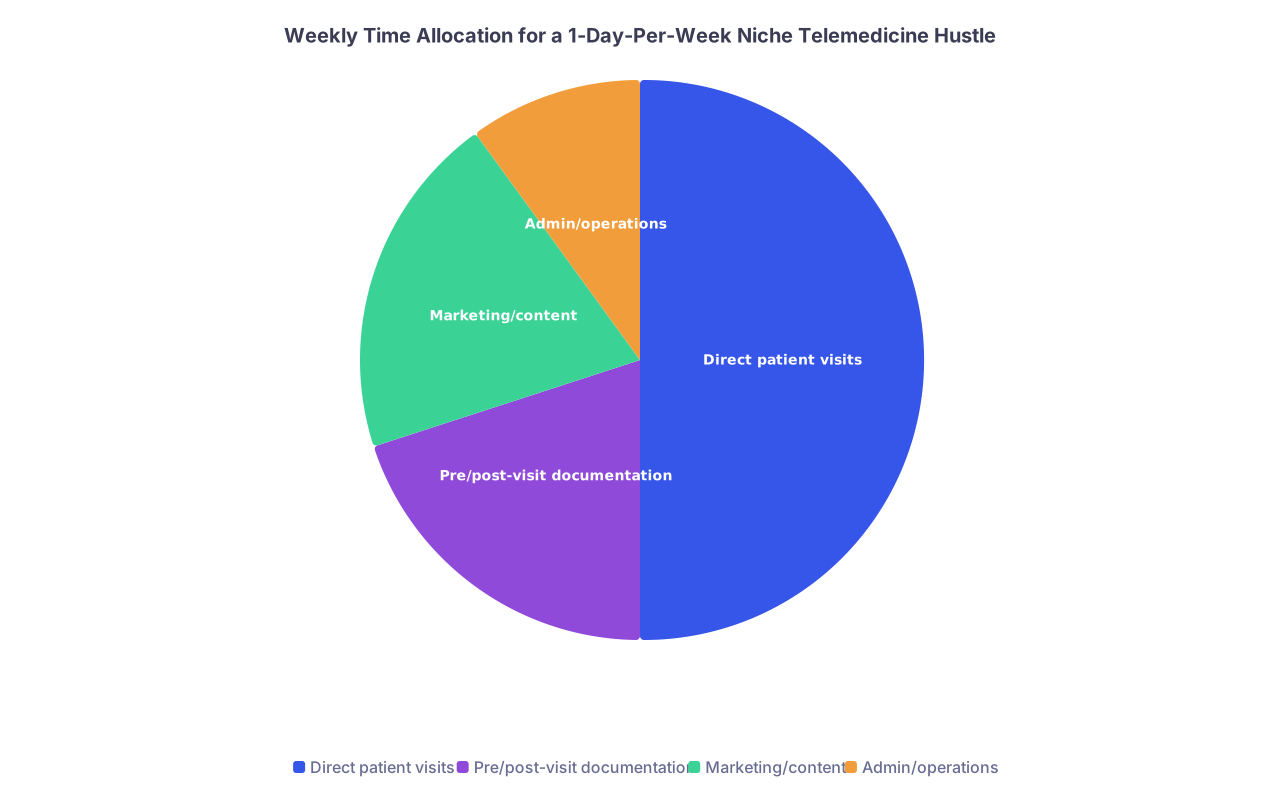
| Category | Value |
|---|---|
| Direct patient visits | 50 |
| Pre/post-visit documentation | 20 |
| Marketing/content | 20 |
| Admin/operations | 10 |
This is the ratio you should be aiming near. If admin creeps past 20–25 percent, your systems are sloppy.
Step 5: Patient Acquisition – The Part Most Doctors Hate
You are not opening a strip-mall clinic and waiting for foot traffic. This is precision marketing.
And yes, you have to do it. Or pay someone who understands both medicine and digital marketing—which is rare.
1. Define your avatar
No, not “any adult with migraines.” That is lazy.
Real niche telemedicine side hustles define something like:
- “Women 30–50, working in professional or tech roles, with 10+ years of migraines, frustrated with rushed neurology visits and polypharmacy, willing to pay cash for a structured plan that reduces attack frequency by at least 50 percent.”
Everything—your website copy, intake questions, pricing—speaks directly to that person.
2. Where do they already hang out?
- LinkedIn for high-income professionals and executives.
- Niche Facebook groups (e.g., “Women in Tech,” “Physician Moms,” “Long COVID support [city/state]”).
- Subreddits (careful with overt self-promotion).
- Patient advocacy organizations and non-profits.
You are not spamming. You are providing real value and then saying, “If you want a more in-depth, individualized consult, here is how to work with me.”
3. Authority-building content
You do not need to become a TikTok star. But you do need a few things:
- A clean, professional website with a simple blog or resources section.
- 3–5 “cornerstone” pieces of content that answer the most critical questions in your niche.
- Optional: a simple YouTube channel with 5–10 videos explaining key decisions.
Example cornerstone pieces for a spine surgery second-opinion telemed service:
- “How to tell if you actually need spine surgery vs more conservative management.”
- “What your MRI really means – a spine surgeon explains in plain English.”
- “Questions to ask your surgeon before agreeing to fusion.”
Your consult becomes the logical “next step” from those articles.
4. Referral flywheel
The highest-yield growth engine: thrilled patients sending you more patients.
You increase the odds by:
- Delivering a written summary that they can share with spouses, PCPs, other specialists.
- Making it trivially easy for them to refer (“Here’s a link you can share if anyone you know needs this kind of help”).
- Staying top of mind with a quarterly email newsletter (one page, no fluff) to past clients.
I have seen niche telemedicine practices hit 70–80 percent referral-based growth within 18–24 months. That is when marketing spend collapses and margins go up.
Step 6: Economics – Making It Actually “High-Yield”
Let us talk real numbers. Because if this does not move the needle financially, you are just collecting hobbies.
Assume you are doing niche telemedicine one full day per week (say, 8 clinical hours).
Conservative example:
- 4 one-hour high-value consults per day at $400 each = $1,600/day.
- You work 45 weeks per year on the side = $72,000 gross.
Now layer one program:
- 5 patients per quarter enrolled in a $1,500, 3-month structured program = $7,500/quarter → $30,000/year.
You are at roughly $100,000/year with one day per week, with a single niche plus one program. Not wild. Very doable with clean marketing and good execution.
Your main costs:
- Malpractice: $3k–$8k/year depending on specialty.
- Telehealth EHR and tech stack: $2k–$5k/year.
- Accounting/legal, etc.: $2k–$4k/year.
- Marketing/website: variable. Maybe $5k–$10k in the first year if you invest deliberately.
So maybe $15k–$25k in annual overhead. You still clear $75k–$85k pre-tax pretty comfortably.
You can push that much higher with:
- Higher pricing as your reputation builds.
- Group visits (in appropriate niches) to leverage your time.
- Adding a second day per week or coverage by a PA/NP under your protocols.
The Near Future: Where Niche Telemedicine Is Actually Headed
We are still early, despite the COVID boom and subsequent cooling.
Here is where things are realistically moving in the next 5–10 years—and how you position your side hustle to benefit rather than get crushed.
1. Fragmented, hyper-niche verticals
You are already seeing it: platform after platform focused narrowly.
- Companies doing only obesity telemed.
- Only ADHD.
- Only men’s health.
- Only hair loss.
Many are mediocre clinically, spectacular at marketing. That is the opportunity. You combine serious clinical chops with focused branding.
You as an individual physician can be “the” person for:
- Post-concussive syndrome in adult athletes.
- Pregnancy and cardiac risk counseling in women with structural heart disease.
- Complex autoimmune disease second opinions.
That level of specificity is not optional; it is where we are headed.
2. Integration with remote monitoring and AI
No, you do not need to become an AI engineer. But you should expect:
- Wearables and home devices feeding you structured data (sleep, HRV, BP, glucose, etc.).
- AI summarizing that data and maybe even the patient’s history for you.
What you offer—the actual value—is:
- Judgment.
- Prioritization.
- “What do we do next?” in the real world, with limited time and money.
The more commoditized data and generic advice become, the more a niche expert opinion stands out.
3. Cross-border telemedicine and regulatory loosening
Slow, painful trend, but it is real:
- More states joining compacts.
- More acceptance of telemedicine as standard of care in specific contexts.
- Occasional cross-border arrangements (e.g., US specialists consulting for overseas hospitals, or vice versa) under defined collaborations.
Your side hustle should be built flexibly enough that adding new jurisdictions is a configuration change, not a full rebuild.
4. Hybrid models: Telemedicine + local collaborators
High-functioning niche practices will not live in isolation.
Example: you run a telemedicine migraine program. You:
- Partner with local infusion centers for rescue therapy.
- Partner with physical therapists for vestibular rehab.
- Coordinate with PCPs for labs and imaging.
You are the brain and coordinator. Others provide local hands. This is exactly where specialists should be anyway.

How To Actually Start In The Next 30 Days
Let me give you a concrete, no-excuses roadmap for the first month. Not theory. Steps.
Week 1:
- Decide on 1–2 candidate niches that fit your training and interest.
- Sanity-check demand: look at search volume, existing telehealth competitors, and patient forums.
Week 2:
- Pick one niche.
- Draft your core offer: who you serve, what problem you solve, what your primary product is (consult or program), and your initial pricing.
- Call your malpractice carrier and verify telemed coverage in your home state.
Week 3:
- Form your LLC/PLLC and open a business bank account.
- Choose a telehealth-capable EHR and set up basic workflows (intake, consents, scheduling, payment).
- Register a simple domain and put up a one-page website with:
- Who you are (credibility).
- Who you help.
- What you offer and price range.
- A “Book a consult” button.
Week 4:
- Create a structured intake form.
- Reach out intentionally to:
- 3–5 colleagues (PCPs, therapists, other specialists) who have your target patients and explain your service.
- 2–3 relevant online communities where you can contribute value without spamming.
- Aim to book your first 3–5 patients, even if at a discounted “founding client” price in exchange for feedback and testimonials.
At that point, it stops being theoretical. You will know quickly if your niche and offer resonate or need adjusting.
The worst outcome is not that it “fails.” The worst outcome is that you spend another 3 years complaining about your main job, never testing whether a focused telemedicine practice could have bought you margin, money, and optionality.
You have the license. The training. The credibility. The missing pieces are niche selection, structure, and the willingness to be a little uncomfortable doing “business” things doctors are not trained for.
With those in place, you are not just doing a side gig. You are building a small, sharp, future-proof clinical asset that you fully control.
What you do with that asset later—scale it, sell it, or keep it as your personal autonomy engine—that is the next phase of the story.
FAQ: Niche Telemedicine Side Hustles
How many licenses do I realistically need to make this worthwhile?
For most physicians, starting with one state is entirely reasonable. If your home state has enough target patients (usually true for any decently populated state), you can hit six figures in revenue without ever adding licenses. Once your processes and demand are proven, add 1–2 strategically chosen states with high population and good alignment with your niche. Three to four states can sustain a very robust side or even full-time practice. Chasing ten licenses at the beginning is almost always a distraction.Should I take insurance or stay 100 percent cash-pay?
For a side hustle in a niche domain, I strongly favor cash-pay only, at least initially. Insurance contracts add administrative burden, prior auths, lower reimbursement, and loss of pricing control. The entire point of niche telemedicine is that you solve a specific, high-value problem people will pay for directly. If your model collapses without insurance, your niche or value proposition is probably not strong enough yet.How do I pick pricing without undercharging or scaring people away?
Anchor your pricing to: a) your local specialist rates, and b) the financial impact of the decision you are helping with. For a surgery second opinion that may avoid a $50,000 procedure and months of lost work, a $400–$600 consult is perfectly rational. Start at a level that makes you slightly uncomfortable but still feels defensible. Then reassess every 10–20 patients. If demand is strong and you are fully booked, raise prices by 10–20 percent and watch what happens.Can I do this as a resident or fellow, or do I need to be fully attending?
Residents and fellows are usually not in a good position to run independent telemedicine practices due to supervision requirements, board status, scheduling chaos, and often visa or institutional constraints. I would consider this an attending-level move. Use residency/fellowship to learn what problems patients keep getting poor care for, and note where you could later provide focused, high-value consults. That observational work now will save you months of trial and error later.What about competition from big telehealth startups in my area?
If a giant venture-backed telehealth company is doing “tele-ADHD for everyone” or “online weight loss clinic,” that is not a reason to avoid the space. It is proof there is demand. Your edge is specificity and quality. While they optimize funnels and churn through standardized protocols, you become the go-to expert for a defined subset: e.g., “ADHD management for attorneys,” or “obesity medicine for post-bariatric weight regain.” You cannot out-spend their marketing, but you can out-specialize their care.How do I avoid turning this into another burnout machine on top of my day job?
You prevent that in the design phase, not after the fact. Limit the number of clinic hours per week (e.g., one day or two half-days). Set hard boundaries on messaging and availability and bake them into your consent and onboarding documents. Choose a niche where the cognitive load is high but the emotional trauma is not constant (for instance, second-opinion work often has heavy responsibility but less daily chaos than, say, crisis psychiatry). Finally, commit to reviewing your schedule and pricing every quarter; if you are consistently oversubscribed, you either raise prices, cut hours, or both. The side hustle is supposed to buy your time back, not cannibalize it.
With these foundations, you are in a position to build a telemedicine side hustle that is narrow, profitable, and under your control. The next step is experimentation in the real world—talking to actual patients, refining your offer, and deciding just how big you want this to become.


