

You are post-call on a Tuesday afternoon. Notes are (mostly) done, inbox is screaming, and your phone buzzes with an email:
“Doctor, we’re developing an AI triage tool for headache. We need a 45-minute consult on red-flag symptom flows and risk stratification. Our budget is $800 for this call.”
That is micro-consulting. And physicians who know what they are doing are stacking enough of these to equal a clinic day. Without prior auth. Without RVUs.
Let me break this down specifically.
What Micro-Consulting Actually Is (For Physicians)
Micro-consulting is not a 6‑month advisory board, and it is not joining a startup as “Chief Medical Officer” for 0.1% equity and vibes.
Micro-consulting = highly focused, short-duration, high-value expertise sold in small units.
Typical patterns I see physicians using:
- 30–120 minute expert calls
- 1–3 hour document reviews
- Fixed-fee “micro projects” (e.g., “review this 20-page protocol and send tracked changes + 30-min debrief”)
- Asynchronous Q&A (paid access per question bundle, or via a platform)
The key: companies are not buying your time. They are buying your pattern recognition in a narrow problem space.
Examples:
- A heart failure cardiologist doing 60-minute calls with digital therapeutics startups on remote monitoring protocols.
- A pediatric allergist reviewing ingredient lists and claims language for a direct-to-consumer food startup.
- An interventional radiologist advising an imaging AI company on labeling, edge cases, and realistic workflow integration.
- A sleep medicine physician consulting with B2B wellness platforms on insomnia screening algorithms.
You stay in your lane. You do not “become a business strategist.” You monetize the weird, specific stuff you already know that everyone else wishes they knew.
Where Subspecialty Expertise Actually Gets Paid
There are five main buyer groups that consistently pay physicians for micro-consulting. Most doctors only see one of them (maybe pharma) and miss the rest.
| Client Type | Typical Call Rate Range | Common Call Length |
|---|---|---|
| Market Research | $200–$500/hr | 30–60 minutes |
| Startups | $250–$800/hr | 45–90 minutes |
| MedTech/AI | $300–$1,000/hr | 60–120 minutes |
| Legal / Expert | $400–$800/hr (micro) | 30–60 minutes |
| Employer / Payer | $250–$600/hr | 60–90 minutes |
1. Market Research and “KOL Lite”
These are the classic “expert network” gigs (think GLG, Guidepoint, Third Bridge, AlphaSights). They connect institutional investors, consulting firms, and industry with niche experts for rapid insight.
Example:
You are an epileptologist. A hedge fund wants to know how likely a pipeline drug is to displace current standard of care in refractory focal seizures. They pay $300–$500/hr for your honest, non-conflicted view.
What they ask:
- “How do you currently sequence Drug A, B, and C?”
- “What % of your patients might be eligible for this new therapy if approved?”
- “Biggest adoption barriers? Prior auth? Safety concerns?”
You are not giving patient advice. You are giving market reality.
Good fits: subspecialists with clear therapeutic niches, proceduralists using specialized tech, oncologists, cardiologists, neurologists, rheumatologists.
Weak fits: pure hospitalists with broad scope but no clear niche (unless they have specific system-level or utilization expertise).
2. Startups (Especially Digital Health and Niche Tech)
This is where most physicians leave money on the table. Why? Because founders often want:
- “Quick feedback” on clinical workflows
- Red-flag checks on risk, safety, regulatory landmines
- Help turning half-baked clinical ideas into something that would not be laughed out of a credentialing committee
This almost always starts as micro-consulting, even if later you take a deeper advisory role or equity.
Example patterns:
- 60-minute “product-clinical sanity check” call for a seed-stage startup.
- 2-hour session mapping real-world patient journeys vs. their fantasy app flow.
- 90-minute “clinical constraints” workshop with the product and engineering team.
Real example I have seen:
An endocrinologist charging $600 for a 90-minute session helping a CGM-focused app redesign its alert logic to match how actual clinicians think about hypoglycemia risk, especially in older adults. Followed by a 2-hour protocol review at $400/hr. No contract beyond a simple SOW. Paid within 7 days.
3. MedTech, Devices, AI, and Diagnostics
These groups have money and specific problems:
- How will this device change workflow in the OR/clinic?
- What real contraindications will clinicians care about?
- Which endpoints matter to you enough to change behavior?
- How do we design labeling and instructions to avoid misuse you already know is going to happen?
You come in as the person who has seen 1,000+ of whatever they are modeling.
Good subspecialties here:
- Interventional (cards, radiology, GI, pulm)
- Surgical subspecialties
- Imaging-heavy fields (neuro, MSK, breast, emergency radiology)
- Pathology (digital pathology, AI tools)
- ICU, ED, anesthesiology for monitoring and decision-support tech
4. Legal and Risk “Micro-Opinion” Work
Full-blown medico-legal consulting can be heavy. But there is a micro-consulting zone that is quick and valuable:
- Early case screening for plaintiff or defense firms (30–60 minute review + brief call)
- Risk analysis for insurers or self-insured employers on certain practices (“Is this standard? Is this risky?”)
- Policy language review for malpractice carriers or benefits plans.
You are not writing 50-page reports. You are being paid to say “this is wildly outside standard of care” or “this is common in tertiary centers.”
5. Employers, Payers, and Benefits Designers
They need real clinicians to keep them from building clinically absurd benefit designs or high-risk wellness “solutions.”
Examples:
- A sleep medicine doc reviewing a large employer’s vendor proposals for “digital insomnia solutions.” 90-minute vendor comparison call.
- A gastroenterologist advising on colon cancer screening benefit design—where stool tests fit, how to word reminders, when to escalate to colonoscopy.
- A child psychiatrist consulted about school-based mental health programs or telepsychiatry vendor selection.
The Core Asset: Your Subspecialty Positioning
You do not get good micro-consulting work by saying, “I am an internal medicine doctor. I can consult on anything.”
You get it by saying something like:
- “I am a fellowship-trained heart failure cardiologist at a large academic center, seeing ~700 patients/year, with specific expertise in advanced therapies and remote monitoring.”
- “I am a pediatric allergist-immunologist with a focus on food allergy and atopic disease, running a large oral immunotherapy program.”
- “I am a breast imaging radiologist interpreting ~10,000+ mammograms and several thousand MRIs annually, with experience integrating AI CAD tools.”
Your niche is a combination of:
- Disease space (heart failure, MS, IBD, severe asthma, etc.)
- Modality (imaging, procedures, telehealth, AI, digital therapeutics)
- Setting (academic tertiary center, community high-volume, rural safety net)
- Role (ordering physician, proceduralist, interpreting physician, program director)
If I cannot see within 15 seconds what unique perspective you bring, you are losing work.
How Physicians Actually Find Micro-Consulting Gigs
Here is where people fantasize about “I’ll just build a website.” No.
The real channels that actually produce work:
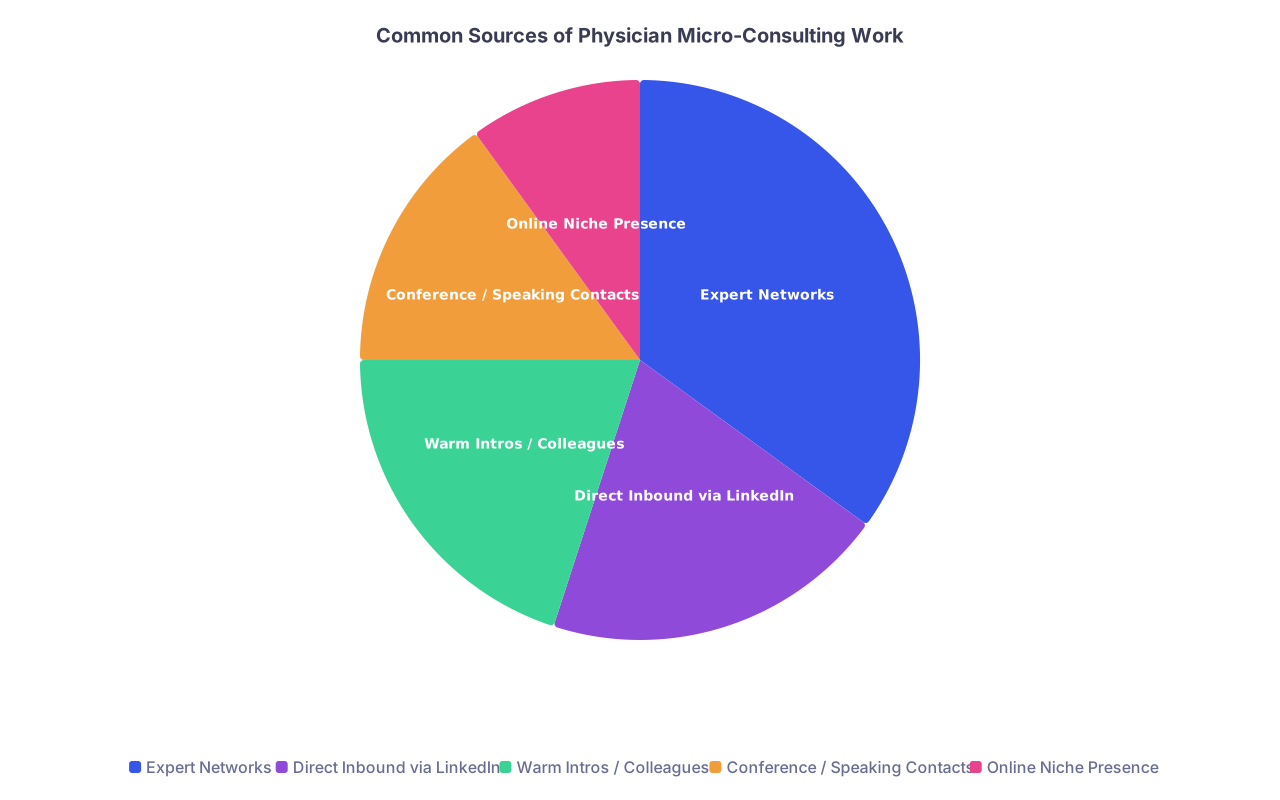
| Category | Value |
|---|---|
| Expert Networks | 35 |
| Direct Inbound via LinkedIn | 20 |
| Warm Intros / Colleagues | 20 |
| Conference / Speaking Contacts | 15 |
| Online Niche Presence | 10 |
1. Expert Networks (Fastest On-Ramp)
Registering with 2–3 major expert networks is the single fastest way to see what this world looks like.
Typical path:
- Create a profile: subspecialty, procedures, roles, practice setting.
- They send you “project invites” via email.
- You answer screening questions (5–10 min).
- If selected, you pick time slots → 30–60 min call → paid within 1–4 weeks.
Pros:
- No marketing.
- You see demand signals for your niche.
- Great training ground for learning what questions industry/investors actually care about.
Cons:
- They take a cut. Hefty.
- You do not set your own rates at first.
- It is transactional; you are a line item, not a “trusted advisor.”
Still, if you have never done micro-consulting, this is the training wheels phase I recommend. Do 5–10 calls. Learn the game.
2. LinkedIn (Optimized for Your Niche)
LinkedIn works when you stop treating it like a CV and start treating it like a high-signal landing page.
Key moves:
- Headline: “Pediatric Allergist | Food Allergy & OIT | Advisor to CPG and Digital Health” beats “Assistant Professor of Pediatrics.”
- About section: 3–5 concise paragraphs that answer: who you are, what patient population you know deeply, what systems you understand, and what types of questions you can help with.
- Featured section: 2–5 items—talks, brief posts, or even 1-pager PDFs that show your thinking in your niche.
Then:
- Accept connection requests from founders, product managers, health tech, consulting, and investor profiles in your space.
- Occasionally post short, tightly scoped insights. Example: “3 failure modes I see when digital asthma programs try to replace real follow-up.”
Warm inbound will eventually appear: “I saw your post on pediatric food allergy. Could we get your eyes on our label / algorithm / product idea?”
3. Warm Intros from Colleagues and Industry Contacts
Underused and extremely effective:
- Former fellows now in industry.
- The device rep who trusts you and knows you are the rational adult on the service.
- Academic collaborations that touch industry-sponsored research.
You explicitly say to trusted people:
“If you hear of projects where someone needs practical subspecialty input for a few hours, I do paid micro-consulting in [niche]. Happy to send a 1-page overview you can forward.”
You are not begging for work. You are helping them look competent when someone asks, “Do you know an actual clinician who knows this area?”
4. Conferences and Niche Communities
If you are already going to a subspecialty conference, you are walking into a micro-consulting market:
- Satellite symposia and product theaters
- Exhibit hall (yes, the dreaded exhibit hall)
- Small vendor booths for software, devices, diagnostics
Two behaviors that work:
- Structured curiosity: “Which clinicians do you usually tap for feedback on this?” → “If you ever need real-world input from someone seeing [X volume] of [Y patients], I do short paid advisory calls. Here is my card.”
- Follow-up afterward: LinkedIn message + a simple 1-pager summarizing the types of questions you can answer.
You are not asking them to “hire you.” You are offering risk-reducing expertise. Which they sorely need.
Pricing Micro-Consulting Like a Professional, Not a Resident Moonlighter
Most physicians undercharge, then feel resentful, then quit. Avoid that.
There are three main pricing models that make sense for micro-consulting:
1. Hourly (for Calls and Live Sessions)
For U.S.-based subspecialists with 3–10 years post-training, realistic starting bands:
- Generalist clinician with coherent niche: $200–$300/hr
- Fellowship-trained subspecialist: $300–$500/hr
- High-demand niche (oncology, cardiology, AI-heavy imaging, advanced procedures): $400–$800/hr
Yes, expert networks often list lower. They are arbitraging you. When you are working direct with a client, your floor should rarely be under $300/hr unless you choose to discount for a specific mission-driven project.
Tactical point:
Quote in project-level language, but internally think hourly. E.g.
- “For a 60-minute call plus up to 30 minutes of prep, my fee is $600.”
2. Fixed-Fee Micro Projects
Used when there is a deliverable:
- “Review this 10-slide deck + 60-min call”
- “Redline this protocol and send written feedback”
- “Audit our triage questions and provide recommendations”
You estimate total time (prep + call + follow-up) and price it as a package. Example:
- You expect 2 hours total → 2 × $400/hr = $800 → quote: “This will be $800 as a fixed fee.”
Fixed-fee is cleaner psychologically for clients. They are buying an outcome, not “hours.”
3. Short-Term Retainers (Lightweight)
This is when a startup or company needs predictable access but not full-scale advisory:
- Example: “Up to 3 hours/month of calls and document review for $1,500/month, minimum 3 months.”
You keep it simple. Low admin overhead. You track your hours enough to not be abused. Past that, do not obsess.
What You Actually Do on a Micro-Consulting Call
If you do this well, they will rebook you. Repeatedly.
A clean structure for a 60-minute call:

| Step | Description |
|---|---|
| Step 1 | Intro 5 min |
| Step 2 | Context from client 10 min |
| Step 3 | Your structured input 30 min |
| Step 4 | Clarifications and Q&A 10 min |
| Step 5 | Wrap and next steps 5 min |
Step 1: Frame the (Narrow) Problem
You begin with something like:
“Before we dive in—what exactly do you want to walk away with today? A sanity check on your concept? Specific feedback on this clinical flow? Prioritization of risk areas?”
You are forcing scope. If they want everything, you say:
“We have 60 minutes. I suggest we pick 1–2 areas where my experience is most valuable. For your product, that is [X] and [Y].”
Step 2: Translate Their Jargon into Your World
Founders and analysts often misuse clinical terms. Correct them quickly but tactfully:
“When you say ‘severe COPD’, what FEV1 cutoffs or exacerbation patterns are you actually targeting? In clinic we usually think in terms of GOLD stage and recent hospitalization history.”
You build a translation layer between:
- Their product / business language and
- Your decision-making and patient management language
That is the monetizable skill.
Step 3: Pattern Dump, Not Story Time
They do not want long case vignettes. They want the pattern behind 500 cases distilled.
You might say:
“In real practice, here is how this usually plays out in three steps…”
Or:
“If you deploy this into primary care, you will see three main failure modes…”
You give:
- Concrete cutoffs you actually use.
- Where guidelines completely fail in real humans.
- Workarounds your colleagues already use that their product could either support or break.
Step 4: Flag Risk and Reality
This is where you earn your money.
You say things like:
- “If you put this in front of ED docs, they will ignore it unless X and Y.”
- “No major center will adopt this if your sensitivity for [catastrophic thing] is below [number].”
- “This is going to create so many false positives that specialist clinics will hate you. Here is how to avoid that.”
You are not being a naysayer. You are derisking.
Step 5: Close with Clear Takeaways
You end with:
“Let me summarize three key points from my side, so your team has something actionable:”
1–3 bullets, max. Then:
“If you want, I can send a brief email summarizing these; that is included in today’s scope.”
That email (5–10 minutes) often triggers repeat work because suddenly the product manager forwards it around: “This was super helpful; we should get Dr. X back when we redesign the flow.”
Systems, Boundaries, and Compliance
This is where people get sloppy. Do not.
1. Keep It Non-Clinical and De-Identified
You are not treating their customers. You are not giving clinical advice to individuals.
- No PHI.
- No talking about specific patients that can be identified.
- You describe patterns, not people.
If they try to push you into “Can you just comment on this one user’s lab work?” you respond:
“I cannot provide clinical care or patient-specific advice in this context. What I can comment on is how a typical clinician would interpret labs like this in general terms.”
2. Conflict of Interest and Employer Policies
If you are employed by a hospital/academic system, you need to know:
- Do you need to disclose outside income above a certain threshold?
- Are there restrictions on consulting with certain industry categories you already have institutional relationships with?
- Do you need to route certain agreements through your institution? (Often yes for device companies and pharma if overlapping with your institutional role.)
You choose your battles. For simple, non-overlapping, non-competing startups, many institutions allow private consulting if you are off the clock, off their resources, and you disclose.
3. Minimal Legal Structure
Past a certain point, you should not be doing this as “checks to Dr. Smith, personal account.”
Lightweight, realistic setup:
- Register a simple professional LLC or PLLC in your state.
- Business bank account.
- Use basic contracts: a one-page consulting agreement and a one-page statement of work (SOW) per project.
You are not building a giant consulting firm. You are just separating liability and making bookkeeping cleaner.
Typical Income Patterns and Time Commitment
Let us be concrete. What does this look like over a year for someone who takes it seriously but is not trying to leave medicine?
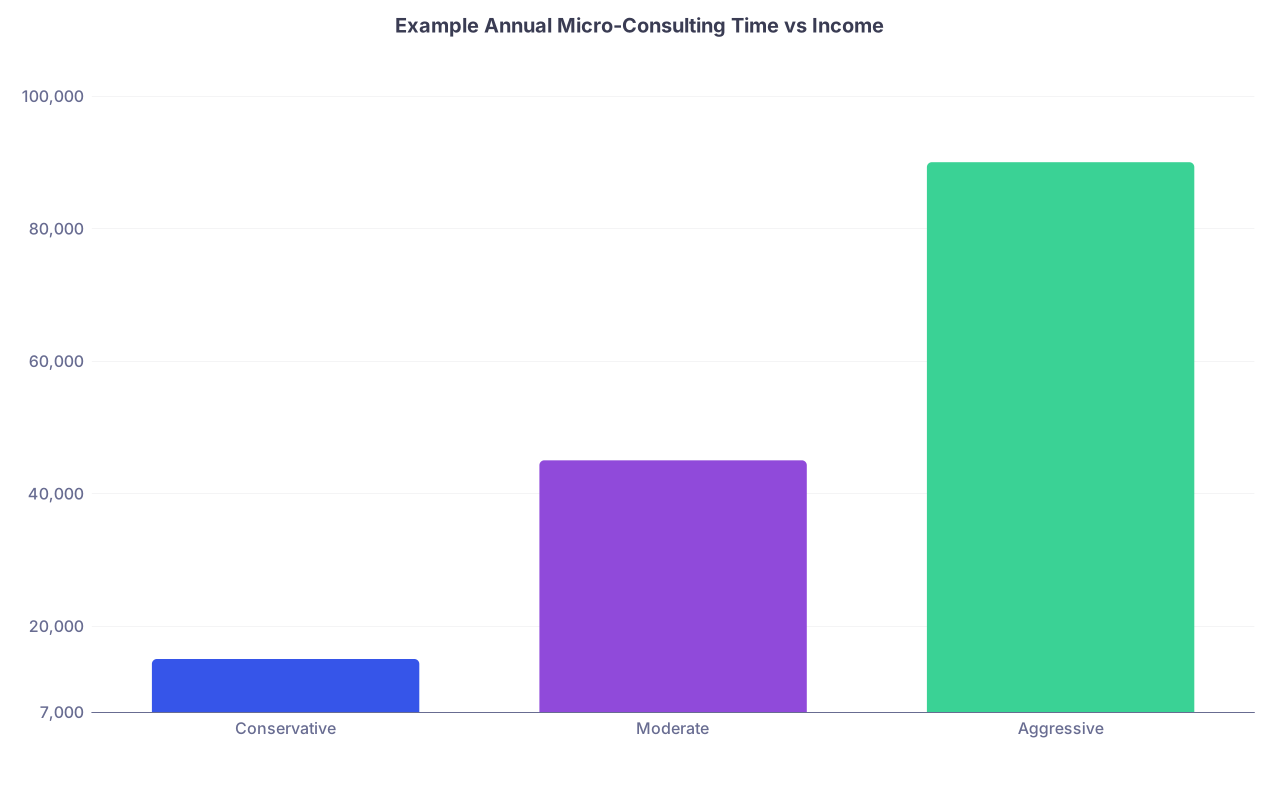
| Category | Value |
|---|---|
| Conservative | 15000 |
| Moderate | 45000 |
| Aggressive | 90000 |
Interpretation (approximate scenarios):
- Conservative: 1–2 hours/month, average effective rate $300/hr → ~$3,600–$7,200/year.
- Moderate: 3–5 hours/month, blended rate $350–$400/hr → ~$15,000–$25,000/year.
- Aggressive but still part-time: 8–10 hours/month, blended $400–$450/hr → $40,000–$60,000/year.
Most well-positioned subspecialists who lean in can land in the moderate range within 12–18 months.
How This Fits into the Future of Medicine
Micro-consulting is not just a “side hustle.” It is a preview of where physician work is going.
Several trends:
Unbundling of Physician Expertise
Hospitals buy your time in giant inefficient blocks: 8–12 hour shifts, half of which is wrangling EMRs. The market outside will increasingly buy your expertise in thin slices—single decisions, specific pattern recognition, narrow questions.Rise of Clinician–Technologist Hybrids
The physicians who can fluently operate between their subspecialty world and product/tech/regulation will hold disproportionate influence. Micro-consulting is how many of them start.New Career Safety Net
Burned out? Want to cut back clinical hours? Politics get ugly at your institution? A micro-consulting practice with 3–5 recurring clients gives you real optionality.Feedback Loop into Better Tools
If the people building AI, digital health products, and decision supports never talk to real clinicians except at sales demos, you get garbage tools. Micro-consulting is one of the few mechanisms where frontline pattern recognition actually shapes products.
You can complain about the direction of healthcare. Or you can charge $500/hr to shape it.
How to Start in the Next 30 Days (Concrete Plan)
If you want this to be real instead of aspirational, here is a blunt, minimal path:
Week 1–2:
- Draft a one-page positioning summary:
- Who you are (training, current role).
- Patient/disease volume.
- Systems you understand (telehealth, academic centers, community, rural, etc.).
- 5–10 “question types” you are uniquely good at answering.
- Optimize LinkedIn headline and About section around that.
Week 2–3:
- Register with 2–3 expert networks.
- Do not obsess over rates yet. Use this to learn.
- When you get your first request, over-prepare once—then build a template for yourself.
Week 3–4:
- Identify 5–10 people in your orbit already touching industry or tech (former fellows, rep you like, prior collaborators).
- Send each a short note: “I have started doing very targeted micro-consulting in [niche]. If anyone in your network ever needs [types of questions], feel free to pass along my 1-pager.”
Then keep showing up. 6–12 months of this, consistently, and it stops being theoretical.
With those foundations in place, you are in position not just to make side money, but to transition—if you choose—into higher-leverage roles where your subspecialty brain is finally priced closer to its actual value. How you parlay that into formal advisory boards, equity roles, or even your own company is the next chapter. But first, get paid for the next 60-minute call.


