

The worst kept secret in medicine is this: the people who actually write the content that runs the industry are not full‑time writers. They are clinicians with a side gig.
You want in on that? Then you need to understand niche medical writing, not the generic “blogging for health sites” nonsense. I am talking about regulatory documents, accredited CME content, and industry projects that quietly pay very well and actually value your MD/DO (or NP/PA/PhD).
Let me break this down specifically.
1. The Landscape: What “Niche Medical Writing” Really Means
Most physicians who say “I want to do medical writing” have 3 vague ideas in mind:
- Writing for a big public site (WebMD, Healthline, etc.).
- Starting a Substack.
- Maybe “some pharma stuff” if they can figure it out.
That is entry‑level, crowded, and usually underpaid.
Serious, higher‑value medical writing lives in three big buckets:
- Regulatory / clinical documentation – content tied to approvals, labeling, and safety.
- CME and education – content that grants credit to physicians, NPs, PAs, pharmacists.
- Industry / commercial projects – everything from slide decks to advisory materials.
They overlap, but they pay differently, have different gatekeepers, and require different proof that you are not making things up.
| Segment | Typical Client | Pay Basis | Complexity |
|---|---|---|---|
| Regulatory | Pharma / CRO | Hourly / per doc | Very high |
| CME | Med Ed Companies | Per project/module | High |
| Industry | Pharma, Devices | Per asset/package | Variable |
You do not need a fellowship in anything to start. But you do need to know exactly what each of these actually involves. Otherwise, you will keep sending unfocused “I’m interested in medical writing” emails that go straight to archive.
2. Regulatory Medical Writing: Where Your OCD Pays Off
Regulatory medical writing is the most misunderstood and the most structurally important.
Here is the blunt version: regulatory writers help companies talk to the FDA, EMA, and other agencies in a very constrained, highly technical language. When you hear “dossier,” “submission,” or “label update,” a regulatory writer was involved.
What You Actually Write
You are not writing ads. You are writing documents that get drugs, devices, and biologics approved, monitored, or updated. Common deliverables include:
- Clinical Study Reports (CSRs) – full narrative of a clinical trial: design, conduct, statistics, results, safety, and efficacy.
- Investigator’s Brochure (IB) – master document summarizing nonclinical + clinical data for investigators.
- Protocols and amendments – detailed plan for a clinical trial, including endpoints, safety, stats.
- Informed consent forms – patient‑facing explanation of study risks, benefits, logistics (often multiple reading levels).
- Regulatory summaries/overviews – e.g., clinical overview for an NDA/MAA, benefit–risk assessments.
- Safety documents – periodic safety update reports (PSURs), development safety update reports (DSURs), risk management plans.
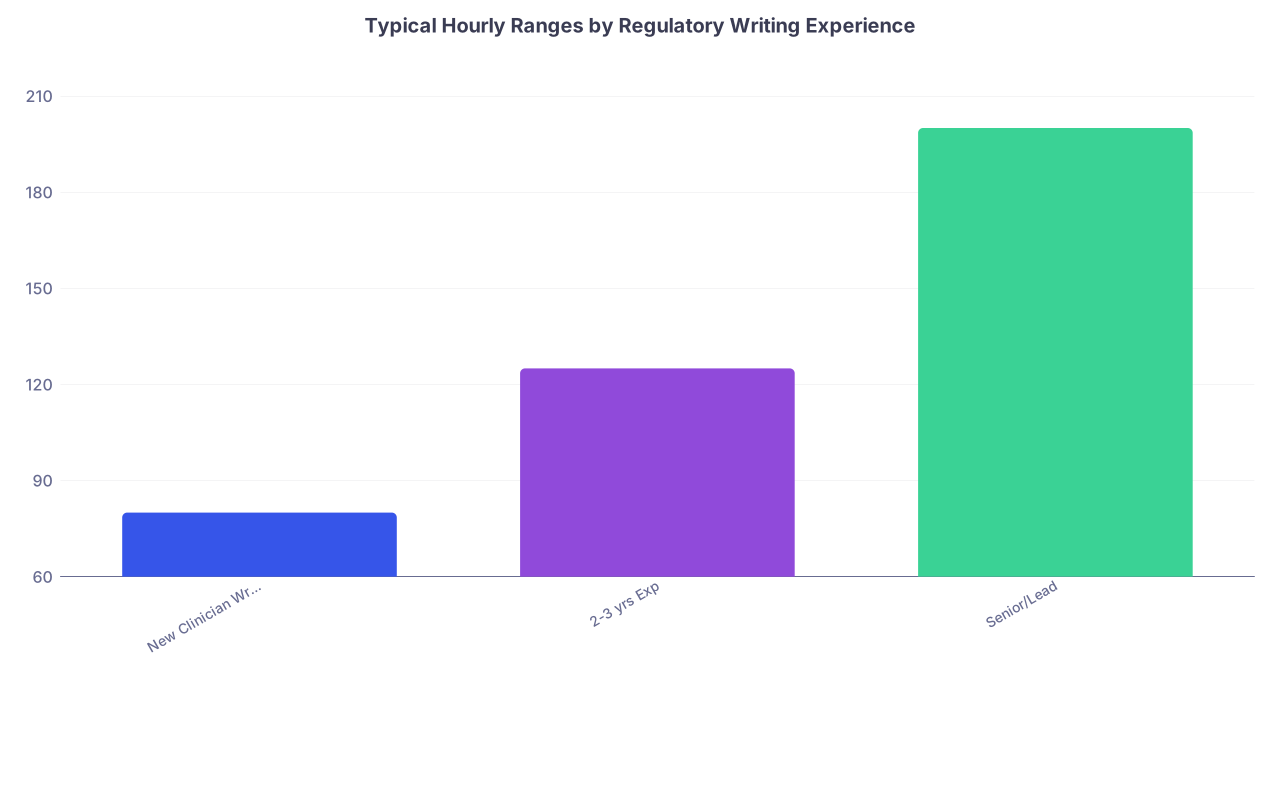
If you have ever thought, “Who writes those 200‑page documents?”—the answer is: people like you, working from home, billing $80–$200/hour, depending on experience and niche.
| Category | Value |
|---|---|
| New Clinician Writer | 80 |
| 2-3 yrs Exp | 125 |
| Senior/Lead | 200 |
Who Hires You
Three main players:
- Pharma / biotech companies – often through their clinical development or regulatory affairs departments.
- CROs (Contract Research Organizations) – execute trials on behalf of sponsors; they constantly need writers.
- Specialized regulatory consultancies – boutique firms that parachute into “fire” situations: delayed submissions, messy data, etc.
The reality: as a newcomer you are far more likely to get in through a CRO or med writing agency than directly with Pfizer or Novartis.
What Background Actually Helps
You do not need to be “boarded in regulatory.” That does not exist. But these help a lot:
- Real trial experience (PI, sub‑I, or coordinator).
- Comfort with statistics (not as a biostatistician, but enough to read analysis outputs without panicking).
- Experience with guidelines: ICH E3 (CSRs), E6 (GCP), E9 (stats principles), and relevant FDA/EMA guidance.
You can learn the format and conventions. Many regulatory writers started as clinicians who volunteered to write parts of CSRs or protocols on their own studies.
How the Work Feels Day‑to‑Day
Regulatory writing is:
- Highly structured. There are templates. There are expectations. This is not creative essay writing.
- Deadline‑driven. Submissions have hard dates. You work backward.
- Collaborative. You will work with statisticians, clinical leads, pharmacovigilance, and quality.
A typical CSR project:
- Kickoff meeting: timelines, responsibilities, data availability.
- Shell development: outline + mock tables/figures.
- Draft 1: built from shells + raw data outputs.
- Internal review: clinical/statistical lead revisions.
- Sponsor review(s): sometimes multiple cycles.
- Final QC + submission.
If you like precision, structure, and clear right/wrong answers, this work suits you. If you like storytelling freedom, not so much.
How to Break In (Realistically)
Three paths that actually work:
Leverage your clinical trial experience.
Put “authored sections of protocol / CSR for [trial name / NCT#]” on your CV. That line gets noticed.Do formal training targeted to regulatory writing.
Short, practical courses (e.g., via AMWA, EMWA) focused on CSRs, protocols, ICH guidelines—then build 1–2 “mock” documents for your portfolio.Enter through an agency as a contractor.
Agencies do not expect you to know everything on day one. They want discipline, reliability, and the ability to learn the formats quickly.
The mistake I see: clinicians applying to regulatory jobs with generic “I like to write” statements and zero mention of templates, ICH, or trial documentation. That screams “I have no idea what this is.”
3. CME Writing: You Are Not Just Making Slides
CME writing is where your ability to teach and simplify complex concepts becomes billable.
CME (Continuing Medical Education) content has one crucial constraint: it must be independent of commercial bias. If pharma is funding it, there are firewalls between promotion and education. Violating that gets providers in serious trouble with accreditors (ACCME, ANCC, etc.).
What You Actually Produce
CME content can look simple from the outside, but the backstage work is exacting. You might work on:
- Needs assessments – data‑driven analysis explaining what gaps exist in practice and why education is necessary.
- Learning objectives – those bullet points you normally ignore, but accreditors do not.
- Slide decks – for live events, webinars, enduring activities, or satellite symposia.
- Monographs and articles – stand‑alone CME pieces, often hosted on specialty society sites.
- Case‑based modules – interactive patient cases for online CME, with branching decisions and feedback.
- Pre/post tests and evaluations – assessment questions, outcomes measures, commitment‑to‑change prompts.
The bar is higher than “decent Grand Rounds.” Every claim must be supportable, referenced, and aligned with current guidelines.
Who Hires You
The key players are medical education companies (MedEd) that are accredited providers or work closely with them:
- Pure CME shops: e.g., Medscape Education, Pri-Med, Haymarket, Vindico, etc.
- Academic CME offices: large academic centers with in‑house CME teams.
- Specialty societies: ACC, ASCO, IDSA, etc., sometimes hire writers/consultants.
You are usually not hired directly by pharma for the CME content writing. The pharma grant funds the CME, but the accredited provider controls the content.
The Rules You Have To Respect
Three things CME clients care about deeply:
Fair balance.
If you mention Drug A, you must address alternatives and limitations. No “hero drug” narratives.Evidence hierarchy.
You cannot cherry‑pick small phase 2 data and pretend it rewrites guidelines. Systematic, referenced, and transparent.Commercial separation.
Your writing cannot be shaped by brand teams. You work with faculty and MedEd staff, not marketers.
If your CV screams “Brand Consultant” with 100 promotional decks and zero CME, some providers will hesitate. They live and die by compliance.
How the Work Actually Flows
Concrete example: a CME project on new HFpEF therapies.
You might:
- Help draft the grant application: gaps in current HFpEF treatment, data on poor outcomes, practice pattern deviations.
- Once funded, work with faculty KOLs to outline the activity.
- Draft slide content: pathophysiology, guideline‑directed medical therapy, clinical trial data, case vignettes.
- Integrate references (primary literature, guidelines, registries).
- Write pre‑ and post‑test questions that actually discriminate knowledge, not trivial pursuit.
- Do multiple revision cycles after faculty and internal medical reviewers weigh in.
You are the invisible hand that keeps everything coherent, accurate, and balanced.
Pay, Scope, and Time
Payment is usually per project:
- Short monograph (2,000–3,000 words): low four figures.
- 30–40 slide deck: similar range, sometimes higher if highly specialized.
- Full multi‑module curriculum: several thousand to five figures, but spaced over months.
You can realistically stack 1–3 CME projects alongside clinical work if you control your calendar.
4. Industry Projects: The “Everything Else” Bucket
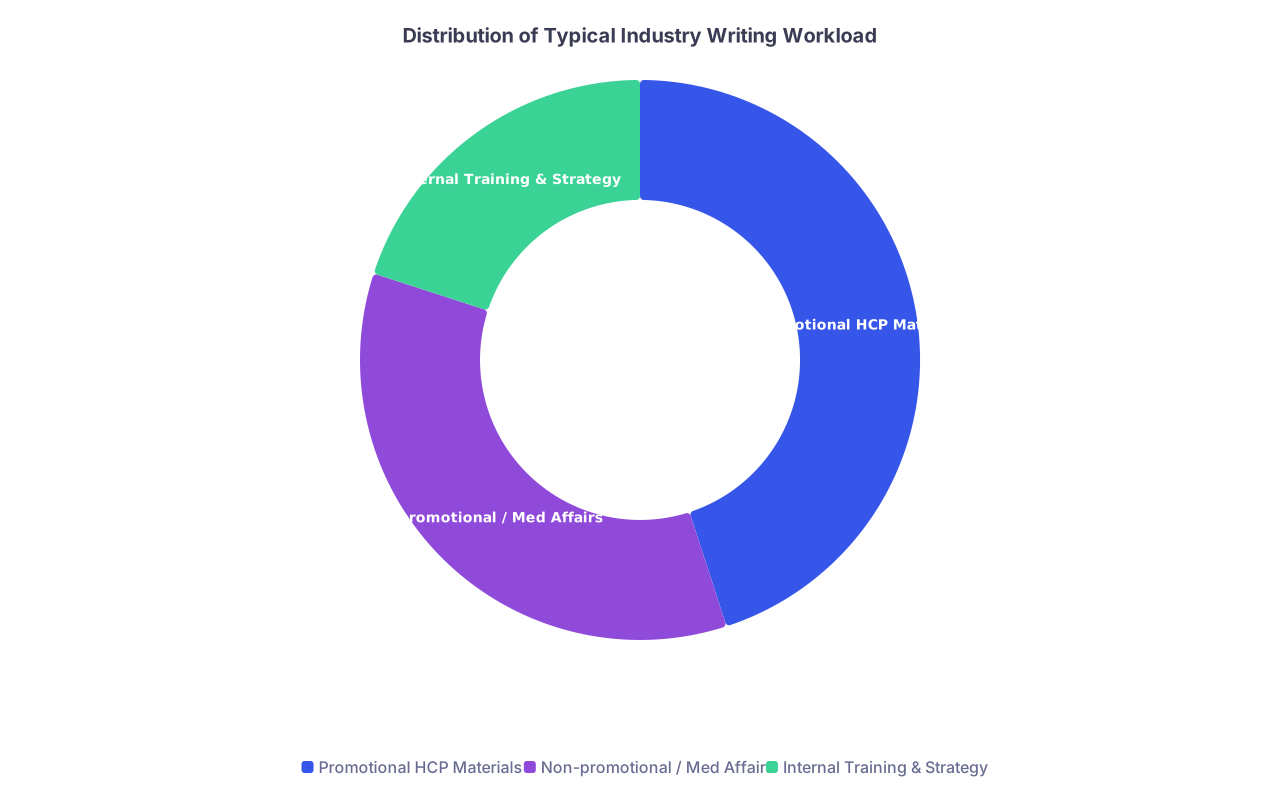
Industry medical writing is a catch‑all category that covers both promotional and non‑promotional materials. This is where a lot of side hustle money sits, because the volume is massive.
Promotional vs Non‑Promotional
Let’s be clear.
Promotional = content that directly or indirectly supports marketing or sales of a specific product, under strict regulatory/compliance review.
Non‑promotional = scientific and educational content that informs, but is not labeled as advertising or promotion.
Examples help.
Promotional projects:
- Branded slide decks for field reps to use with HCPs.
- Leave‑behind brochures and dosing guides.
- Email campaigns to HCPs about new indications.
- Speaker training decks for branded dinner talks.
- Brand‑specific web copy (product sites, MOA pages).
Non‑promotional projects:
- Scientific platforms and “unbranded disease state” decks.
- Advisory board backgrounders and read‑aheads.
- Medical affairs slide decks for MSLs.
- Publication planning support, data gap analysis.
- Conference materials (scientific booth content, summaries).
| Category | Value |
|---|---|
| Promotional HCP Materials | 45 |
| Non-promotional / Med Affairs | 35 |
| Internal Training & Strategy | 20 |
Who Hires You
Mostly:
- Medical communications agencies – these are the real engines of industry medical content.
- Internal medical affairs / marketing teams at pharma/biotech.
- Device companies – cardiology, ortho, neuro, etc.
For a side hustle, agencies are your best entry point. They already have established client work and need flexible capacity.
Concrete Deliverables You Might Work On
Let us get specific. Typical requests:
- “We need a 10‑slide disease overview on non‑metastatic CRPC for an internal training.”
- “We need speaker notes and annotated references for an HCP dinner program on SGLT2 inhibitors in HF.”
- “We have a new product coming; we need FAQ content for our MSLs, based on recent phase 3 data.”
- “We need patient‑friendly materials explaining a new biologic’s administration schedule.”
You might also end up ghostwriting:
- Conference abstracts and posters.
- Slide decks for KOL talks (where the KOL reviews and edits).
- White papers and internal decision documents.
Some people get precious about ghostwriting. Here is the reality: as long as authors approve, data are accurate, and journal guidelines are followed, it is standard.
Compliance Reality: You Cannot Say Whatever You Want
Two constraints dominate industry writing:
Label vs off‑label
You cannot make promotional claims outside the approved label. Even for HCP materials, anything off‑label is radioactive in promo contexts.Reference standards
Claims must be supported by credible, appropriate evidence. “A single poster from a small study” will not survive medical-legal-regulatory review if you use it aggressively.
Agencies run everything through MLR (medical–legal–regulatory) review. If you cannot handle redlines and “please remove this entire paragraph” feedback, this space will frustrate you.
5. How To Actually Get Hired For These Projects
Here is where most clinicians fumble. They assume “I have MD after my name, surely they will train me.”
Sometimes. Mostly not.
Clients want to see three things:
- You understand their world.
- You can deliver on time.
- You write clearly, accurately, and to spec.
Build a Focused, Not Fluffy, Portfolio
You do not need a 20‑piece portfolio. You need 3–5 relevant samples.
For regulatory:
- A de‑identified CSR excerpt (e.g., methods + results).
- A mock protocol synopsis for a trial in your specialty.
- A structured safety summary based on public data (e.g., from a published phase 3 trial).
For CME:
- A fully referenced slide deck on a guideline update (pick a real guideline).
- A 1,500–2,000 word needs assessment on a real clinical gap with stats and citations.
- Pre/post assessment questions with rationales.
For industry:
- A short, HCP‑facing disease‑state deck.
- A one‑pager FAQ based on a key trial publication.
- A patient leaflet written at 6th–8th grade level explaining a condition and treatment options.
Do not send journal articles as your primary “writing sample.” Academic style ≠ client‑ready writing. Clients care whether you can hit their formats and tone.
6. Time, Money, and Reality as a Side Hustle
Let us talk brass tacks.
You are not quitting medicine next week to write full time. You are trying to layer in high‑skill, high‑value projects without destroying your sanity.
Time Investment
Regulatory:
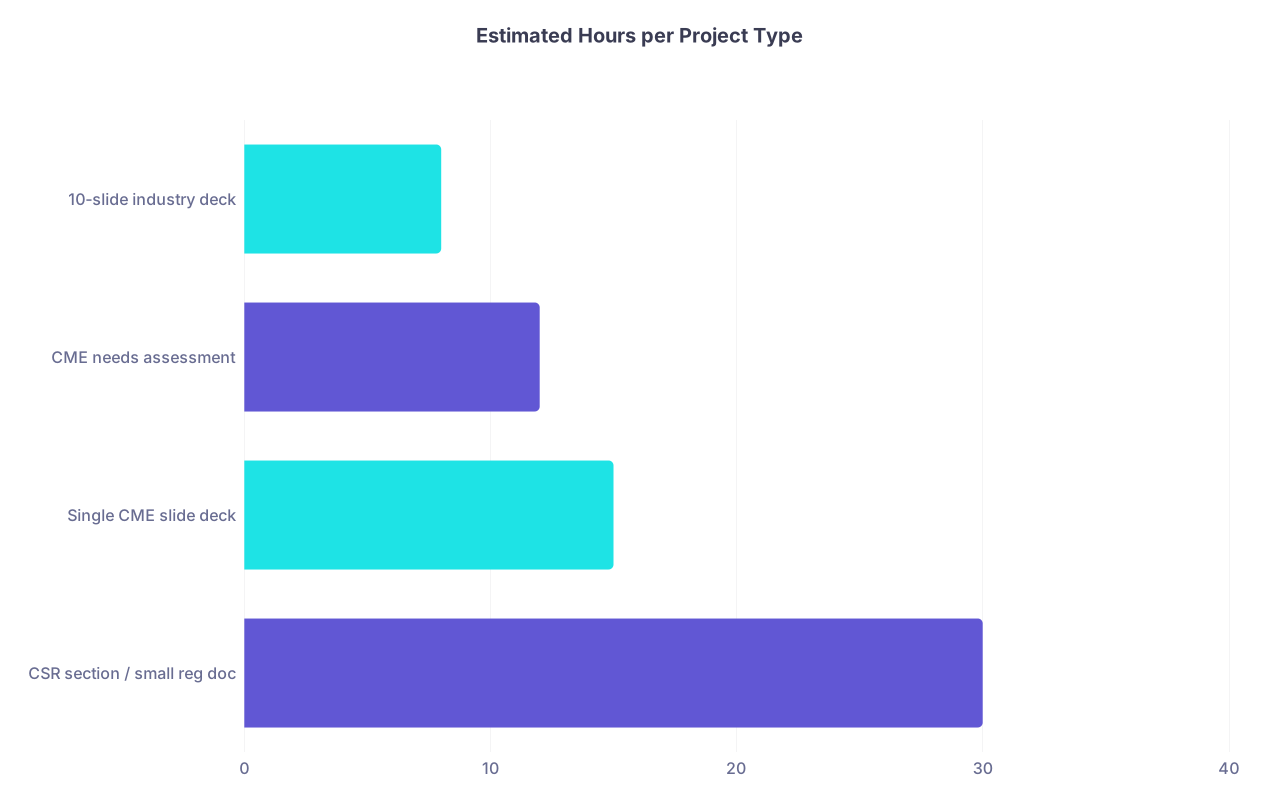
A full CSR can chew up 40–80+ hours depending on complexity and how clean the data package is. As a side hustler, you are more likely to work on sections or smaller documents (protocol synopsis, IB update, safety narratives).
CME:
A single 30–40 slide deck with references and test questions might take 10–20 hours spread over 2–4 weeks. A needs assessment: 8–15 hours.
Industry:
Smaller deliverables (5‑10 slides, 2–4 page briefs) may take 5–10 hours. Some agencies will expect fast turnaround once you know the product.
| Category | Value |
|---|---|
| CSR section / small reg doc | 30 |
| Single CME slide deck | 15 |
| CME needs assessment | 12 |
| 10-slide industry deck | 8 |
Typical Path For a Clinician
What I have seen work repeatedly:
- Start with CME or industry MedComms – lower barrier, more forgiving as you learn process and style.
- Once you know the language and workflow, pick up regulatory projects if the structure appeals to you.
- Over 1–2 years, build repeat clients and then raise rates or reduce clinical time if you want.
The physicians who fail at this usually:
- Treat writing as “whenever I get a spare hour,” then miss deadlines.
- Underprice themselves drastically, then burn out.
- Accept projects in a therapeutic area they know nothing about and drown.
Be selective early. It is better to become the “go‑to HF and CKD writer” for two agencies than dabble in eight random areas poorly.
7. How To Position Yourself to Agencies and Companies
Do not send emails like: “Hi, I’m a physician interested in medical writing, do you have any opportunities?”
That looks like spam. You want something like:
A concise 1–2 page CV focused on:
- Clinical background and specialties.
- Trial involvement.
- Any teaching/CME experience.
- Any prior writing (even internal hospital guidelines).
A 3–4 sentence summary that hits:
- Your specialty.
- Your primary writing interests (regulatory, CME, industry).
- 2–3 specific types of documents you can take on now.
- Your approximate availability per week.
Example:
I am a board‑certified internist with a focus in heart failure, with experience as a sub‑investigator on multicenter phase 3 HF trials. I am currently available 5–8 hours/week for freelance work. I am particularly interested in developing CME slide decks and needs assessments in cardiology and nephrology, as well as disease‑state and med affairs decks for industry. I have attached 3 writing samples: a de‑identified trial synopsis, a CME deck on SGLT2 inhibitors in HF, and a disease‑state overview on CKD progression.
That sounds like someone who understands the space. It invites a conversation.
8. The Future: Why This Side Hustle Is Not Going Away
Everyone wants to ask: “But what about AI? Will this all be automated?”
Here is the situation, right now and for the foreseeable future.
AI Can Draft. It Cannot Be Accountable.
Yes, large language models can spit out a summary of a trial or a draft slide deck. You know what they cannot be?
- Listed as a contributor on an FDA submission.
- Held responsible in a legal case.
- Trusted to not invent references without human checking.
Regulators, accreditors, and pharma compliance are conservative by design. Human medical writers are not going away. Their jobs are morphing: more reviewing, structuring, and higher‑level synthesis; less manual boilerplate.
The Side Hustle Angle Gets Better, Not Worse
You, as a clinician, sit in a sweet spot:
- You understand practice reality (e.g., why guidelines are impractical in clinic).
- You can smell nonsense in data interpretation.
- You can course‑correct AI‑drafted content quickly.
I am already seeing workflows like:
- AI generates a first‑pass structure or literature pull.
- Human writer (you) reorganizes, verifies, adds nuance, and makes compliance‑safe content.
- Reviewer reviews; you refine.
That compresses grunt work but increases demand for competent reviewers who know medicine and know what a “good” CSR/CME deck/industry slide actually looks like.
Where the Real Opportunity Lies
If you want to future‑proof this side hustle:
- Learn process and standards, not just “how to write a nice paragraph.”
- Get comfortable saying, “This claim is not supported by these data,” even if marketing loves it.
- Get faster at turning complex evidence into clear, structured teaching.
The people who can do that will stay booked.
9. Concrete First Steps (Next 30–60 Days)
If you are serious, here is a tightly focused action plan. Not vague “start networking” fluff.
Pick your primary lane to start
Regulatory, CME, or industry. You can expand later. Choose based on your temperament:- Love structure and details? Start with regulatory.
- Love teaching and guidelines? Start with CME.
- Love strategy and positioning? Start with industry MedComms.
Produce 2–3 targeted samples in that lane
Block off 2 weekends. Pretend you are already hired. Write deliverables that look like the real thing.Do one real course or workshop
Not a 1‑hour webinar. Something that forces you to produce work and get at least minimal feedback—AMWA/EMWA modules, credible online programs, or society‑run writing courses.Identify 10–15 potential clients
MedEd companies, MedComms agencies, CROs. Make a simple spreadsheet: name, contact, niche areas.Send focused outreach with your mini‑portfolio attached
Not begging. Not bragging. Just: here is who I am, what I can do, where I can help.
You will not get 15 yeses. You do not need 15. You need one or two clients who trust you and feed you steady, rationally scoped work.
Key Takeaways
- High‑value medical writing is not generic blogging; it is regulatory documents, CME content, and industry assets that run on strict standards and real money.
- Your clinical background is an advantage only if you pair it with domain‑specific skills: understanding templates, guidelines, compliance, and formats in one primary lane.
- A small, focused portfolio and targeted outreach to the right agencies beats years of vague “I’d like to do medical writing someday” talk.


