
The moment a resident starts making more from a side hustle than from residency, program directors notice—whether they admit it or not.
They may not say it in so many words, but I’ve sat in those offices, heard the offhand comments, watched how “concern about professionalism” mysteriously spikes right after someone’s LLC starts doing five figures. You think money is a personal thing. In training, it isn’t. It bleeds into evaluations, scheduling, and how much leash you’re given.
Let me walk you through how this actually plays out behind closed doors.
The First Whispers: “Did You See What She’s Doing on Instagram?”
Here’s how it usually starts.
It’s not a bank statement. It’s visibility.
The first time a resident starts making real money—let’s say $3–10K a month—from something outside medicine, it almost never comes to the program director via a disclosure form. It comes through gossip.
A chief resident shows a screenshot.
An attending says in the workroom, half amused, half annoyed:
“Did you see Dr. X’s ‘brand partnership’ post? She’s doing ads now?”
I’ve heard variations of:
- “He’s got a YouTube channel with 80,000 subscribers—does he have time for that?”
- “She’s selling a course to premeds. Is that even allowed while she’s a resident here?”
- “Why is his name on a real estate LLC? Is he flipping houses on nights?”
Program directors don’t care at first about the money figure. They care about three things:
- Is this going to blow back on the program?
- Is it cutting into clinical performance?
- Is there a professionalism or optics problem?
Once income becomes substantial, the tone changes. When it’s clear this isn’t “beer money” but rent-level or attending-level money, the old training culture reflex kicks in: Medicine should be your first, second, and third priority.
They won’t always say it bluntly. But that’s the operating belief.
The Unspoken Hierarchy of Side Hustles
Directors don’t react the same way to every source of extra income. There’s a quiet hierarchy of what’s “acceptable” vs “suspicious.”
| Side Hustle Type | Typical PD Reaction |
|---|---|
| Extra moonlighting | Generally positive |
| Medical education content | Mildly positive/mixed |
| Tutoring/consulting | Neutral to positive |
| Real estate investing | Wary, but tolerates |
| Social media brand deals | Wary to negative |
| Non-medical online biz | Suspicious/negative |
Moonlighting is the gold standard. It fits their worldview. You’re “working harder,” “getting more clinical exposure,” and generating clinical revenue. Directors may grumble if you’re exhausted, but philosophically they understand it.
Medical-education-related content? Usually tolerated, sometimes supported—until it gets too big or too polished. Once you’re doing sponsorships, courses, or have a serious following, it shifts from “nice academic adjunct” to “potential distraction and liability.”
Real estate, e-commerce, SaaS, or “I bought three Airbnbs” triggers a different reaction. In private, I’ve heard:
- “If he’s closing on properties, where is he finding the time?”
- “She told me she made $40K last year from that thing. That’s more than her PGY salary. Is she planning to stay in medicine long-term?”
They start asking: Is this resident still “all in” on medicine? Or halfway out the door?
And that’s where the real consequences begin.
The First Formal Reaction: “Let’s Talk About Your Outside Activities”
When your income crosses from hobby to “this could pay for childcare, a car, or an extra mortgage,” one of three things usually triggers a formal conversation:
- Your performance slips—even slightly
- Your public presence becomes noticeable
- Someone complains (jealous co-resident, annoyed attending, OR staff)
The program director then calls you in “just to touch base.” Here’s what that conversation really is: a risk assessment.
They’re thinking:
- Could this violate work-hour rules because you’re working “another job”?
- Could this conflict with institutional policies (logo use, patient images, hospital mentions)?
- Could this blow up on social media and drag the program into it?
- Is your clinical work—or your attitude—changing?
You’ll hear phrases like:
- “We fully support your interests, but…”
- “We just want to ensure this doesn’t interfere with your training.”
- “You have to be careful about appearances.”
And then the line that often gives it away:
“Do you mind explaining what exactly you’re doing and how much time this takes per week?”
That’s not curiosity. That’s triage. They’re trying to decide if this is manageable, or if you’re a future problem.
When You Start Making More Than Your Resident Salary
This is the threshold where directors’ behavior really shifts.
Let’s define “real money” as:
- Consistently >$4–5K/month
- OR any single payout that’s clearly bigger than a month of resident pay
I’ve watched PDs react very differently once they know a resident is making attending-adjacent money from something not involving a stethoscope.
Three specific changes tend to occur.
1. Your Commitment Gets Quietly Questioned
They rarely say, “You care more about your business than patients.” But they’ll frame it as “career alignment” or “focus.”
Comments I’ve heard in CCC (Clinical Competency Committee) meetings:
- “He’s very bright but I get the sense his priority may not be clinical medicine long-term.”
- “She’s got a lot of outside projects. I’m not sure she’s fully engaged on the wards.”
- “He talks a lot about passive income. I worry about his buy-in.”
Notice those aren’t about actual patient errors or missed notes. They’re about vibe. Perceived commitment. That soft, subjective stuff that magically shows up on your evaluations as “needs to demonstrate consistent engagement” or “could improve reliability.”
Those words matter for fellowships and letters.
2. Your Autonomy Gets Regulated
Residents with active, profitable side hustles suddenly find themselves:
- Blocked from extra elective time “for research” unless it’s tightly documented
- Denied schedule swaps that might help them attend a conference (for their business, not medicine)
- Under more scrutiny with duty hours and sign-outs
If there’s even a hint you’re leaving early to work on the business, they’ll clamp down fast.
I’ve seen a PD say directly to a chief:
“If he wants to run a business, he can do it after residency. Right now, I want him on the floor, not checking Shopify.”
Do they have proof? Usually not. Do they act on suspicion? Yes.
3. Your Future Path Is Filtered
When a side hustle is clearly successful, directors think ahead: “Is this person actually going to pursue a competitive fellowship, or are they going to go part-time/hospitalist/leave medicine?”
On fellowship calls, PDs do share impressions. I’ve heard:
“Very strong clinically, but he seems distracted with non-clinical pursuits,” coded into a lukewarm recommendation. Not a direct sabotage. But enough that the receiving program raises an eyebrow.
If you’re applying for something like derm, ortho, GI, heme/onc? The more competitive the pathway, the less tolerant they are of signs you are not 100% locked in.
The Old Guard vs The New Guard: Generational Split
Here’s a nuance most residents miss: not all PDs think the same way.
The response to you making real money often hinges on whether you’re dealing with “old guard” or “new guard” leadership.
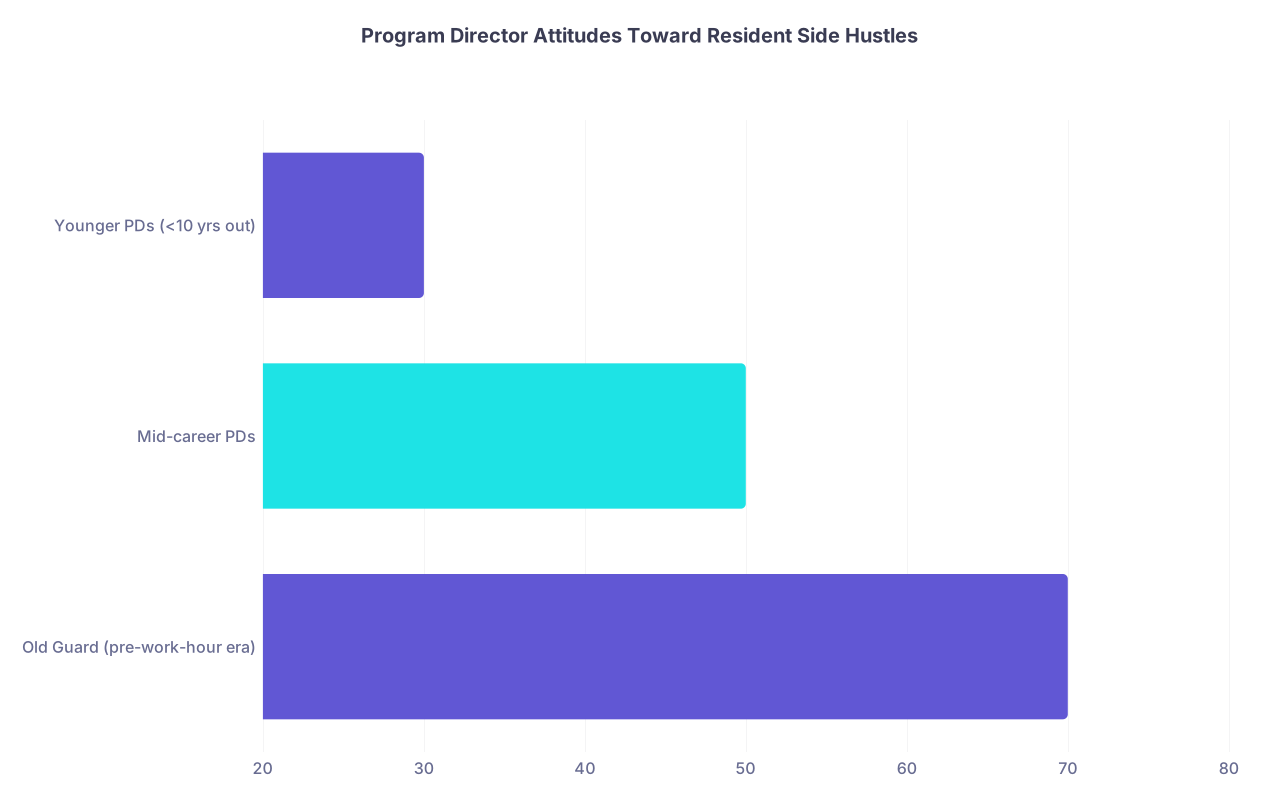
| Category | Value |
|---|---|
| Old Guard (pre-work-hour era) | 70 |
| Mid-career PDs | 50 |
| Younger PDs (<10 yrs out) | 30 |
(The values here represent percent likely to view side hustles negatively, in my experience—not official data, but pretty close to what you’ll feel on the ground.)
Old guard PDs (trained before 80-hour weeks) often see residency as a monastic commitment: if you have the energy to build a serious business, you’re “not working hard enough.” They came up in an era where money conversations were taboo and moonlighting was the only acceptable extra income.
Mid-career PDs are mixed. Some are fascinated—“How are you doing that?” Others are threatened by what they don’t understand. They might hedge: “I think it’s interesting, but it must not interfere.”
Younger PDs, especially those who have done QI projects, consulting, or had their own academic side incomes, are more pragmatic. They’ve seen the burnout data. They know resident salaries are ridiculous for the work. Some quietly respect you for building a cushion. But even they have limits. Once patient care is affected or the hospital’s name shows up somewhere inappropriate, they’ll still crack down.
The common thread across all ages: they like control. Any serious outside income is a form of independence. And independence in training makes administrators nervous.
The Real Flashpoint: Public Visibility Plus Money
You can sell an online course anonymously and a PD may never notice. You can quietly grow a rental portfolio and most programs won’t care.
What they react hardest to is the combination of:
- Your face
- Your credentials (MD, DO, PGY-3 at X)
- Your institutional affiliation
- And obvious monetization
Things that raise blood pressure in the PD office:
- Sponsored posts with you in hospital gear, tagging a brand
- Content complaining about call schedules or pay with your name and institution discoverable
- Coaching premeds/IMGs using your program’s name as a selling point
- A YouTube channel with “Resident at [Hospital Name]” in the title or bio, plus visible AdSense/sponsorship integrations
That’s when the emails start flying:
- “Can you ask her to remove the hospital logo from that?”
- “Does he have media clearance for this?”
- “We need to remind the residents about our social media policy.”
You might think, “I’m off duty, this is my life.” The institution does not agree. Anything with your name plus MD/DO attached is seen as semi-representative of them.
How It Shows Up in Your Evaluations (That No One Explains to You)
You’ll almost never see “too focused on making money” on an official form. It’s subtler.
Here are the phrases I’ve seen used as proxies when a resident’s business raises eyebrows:
- “Needs to demonstrate sustained commitment to clinical duties.”
- “Could improve timeliness of documentation.”
- “At times appears disengaged on rounds.”
- “Shows strong potential but must prioritize residency responsibilities.”
- “Professionalism is generally good but should be mindful of outside activities.”
That last one is a big red flag; it becomes a permanent part of your record.
The CCC reads these. Fellowship directors read them when they call your PD. Those phrases are how quiet skepticism about your “doctor identity” becomes baked into your professional paper trail.
And it’s rarely cleanly tied to a specific incident. It’s an accumulation of impressions—your side hustle conversations in the workroom, your Instagram, your “Yeah I made more from my real estate this month than this place pays me” comment that someone repeats.
The Residents Who Pull It Off Cleanly
Not everyone gets burned. There are residents making real money who glide through training with the PD’s full blessing—or at least with no serious sabotage.
What are they doing differently?
First, they control optics ruthlessly.
- They never brag about income numbers in front of co-residents.
- They keep business and clinical persona separate. Different emails, websites, branding.
- Their public content is either neutral or flattering to training and patient care.
- No complaining online about call, pay, or admin—at least not under their real name and role.
Second, they overperform clinically. On purpose.
I’ve seen this pattern again and again: the residents who can disappear for a weekend conference for their startup without drama are the same ones who are known for:
- Clean, on-time notes
- Reliable sign-outs
- Good relationships with nursing and staff
- Being “low maintenance” for chiefs
Program leadership will forgive a lot if you’re clinically solid and not a headache. They’re human. If they like you and you’re competent, they’ll rationalize your outside pursuits as “just entrepreneurial spirit.”
Third, they disclose just enough—but not too much.
The smart ones:
- Know the institution’s conflict-of-interest and outside employment policies cold
- Formally disclose if required, with clean documentation and clear separation from patient care
- Present their work as aligned with medicine (education, burnout prevention, systems improvement), even if the real engine is revenue
- Frame their business as “occasional work” rather than “I’m building my escape plan”
They don’t lie. But they curate the narrative.
What Directors Won’t Tell You, But Talk About Among Themselves
Let me pull back the curtain a little further. These are things I’ve heard in PD meetings, usually after the second or third coffee when people are a little too honest:
- “If he’s already making $80K a year on the side, he’s not going to be a 1.0 FTE academic doc. We’d be fools to count on him that way.”
- “I like her, but I’m not writing a glowing letter to derm if she’s clearly treating this like a part-time gig.”
- “We trained to sacrifice. This generation wants balance and money. I don’t know how to mentor that.”
- “If they’re out here telling the world residency is toxic, why would I put my name on their fellowship application?”
Programs are under pressure too—ACGME, hospital administration, reputation, recruitment. A resident with a big public platform and financial independence is a wild card. Some PDs are curious. Many are scared of what they can’t predict.
How This All Collides With the Future of Medicine
Here’s the irony.
The very reasons residents are building serious side hustles—burnout, stagnant pay, loss of autonomy, fear of the RVU treadmill—are the same systemic pressures PDs are dealing with from the other side. But the training culture hasn’t caught up with that reality.
You’re entering a world where:
- Physician employment is more corporate
- Autonomy is shrinking
- Financial literacy is rising
- Side gigs, locums, non-clinical work, and entrepreneurship are becoming normalized
But residency itself is still built on a 1990 mindset: total immersion, financial dependence, delayed gratification.
That’s the tension.
So when you suddenly break the script—when you prove you don’t have to wait 10 years to make attending money—that doesn’t just affect you. It implicitly questions the entire structure they’ve devoted their careers to.
Some PDs will adapt. Some already are, supporting residents doing startups, med-ed platforms, consulting. Future programs will recruit based on “we’ll help you build portfolio careers,” not just “we’ll make you great clinicians.”
Others will double down: “No distractions. Medicine first.” You’re going to feel that generational collision in real time.
If You’re Going to Make Real Money in Residency, Do It With Your Eyes Open
Let me be blunt: I’m not telling you not to build something. Honestly, I think more physicians should. The system is not going to protect you financially, and the days of one lifelong hospital job being safe are gone.
But do not be naïve about how leadership will react once your Stripe payouts or rent checks cross a certain point.
In practice, that means:
- Assume anything public with your name + MD is being watched.
- Protect your clinical reputation like it’s your best asset—because it is.
- Read your institution’s policies before—not after—you launch.
- Don’t flaunt your numbers. No one in the hospital is happy for you the way your entrepreneur friends are.
- Decide intentionally: are you optimizing for fellowship/academic prestige, or for independence? Those paths can overlap, but they often conflict.
The residents who do best are the ones who stop expecting the program to “get it” and instead treat their side hustle as something that must quietly coexist with training, not bulldoze through it.
One day you’ll be on the other side of the table, interviewing applicants who already have businesses, YouTube channels, and investment portfolios. You might catch yourself judging them the way your PDs judged you.
Try to remember what it felt like to be the one breaking the mold—making, for the first time, more from your own ideas than from the pager clipped to your waistband.
Years from now, you won’t remember the exact revenue numbers from your side hustle during PGY-2. You’ll remember whether you let that new money make you sloppy—or whether you used it to quietly buy back a piece of your future while still doing the job in front of you well.