
The way physicians get paid for CME talks is far less glamorous—and far more strategic—than most people think.
You see the polished one-hour presentation. I see the contract, the backchannel emails, the budget spreadsheet, the CME office, the med-ed vendor, the quietly involved pharma sponsor, and the faculty member who either negotiated well… or got completely underpaid.
If you want CME speaking as a real side hustle—panels, webinars, live conferences—you need to understand how the money actually flows. Not the brochure version. The real version that PDs, division chiefs, and medical education companies talk about when you’re not on the email chain.
Let me walk you through how it really works.
1. Follow the Money: Who’s Actually Paying You?
Most physicians think, “The conference pays me.” Technically true. Practically wrong.
In most CME situations, the check you eventually get is just the last stop in a much longer financial pipeline.
Here’s the usual stack behind a single “Dr. Smith, thanks for speaking today” CME talk:
- An industry sponsor (often pharma, med device, or occasionally diagnostics company) funds an unrestricted educational grant or a sponsored educational activity.
- That money goes to either:
- A CME-accredited provider (university CME office, specialty society, hospital system), or
- A medical education company (MedEd vendor) that partners with an accredited provider.
- The CME provider or vendor builds a budget. That budget includes:
- Faculty honoraria
- Slide development or content planning
- Platform fees (Zoom, webinar platform, CME portal)
- Marketing
- Travel and lodging if live
- From that budget, a pre-set rate (or range) is allocated for faculty.
Your name plugs into a box labeled “Speaker Honorarium: $X.”
You are not negotiating directly with pharma (and you shouldn’t be, under ACCME rules). You are getting paid by the CME provider or the med-ed vendor. That insulation is deliberate. Everyone in the system is pretending this is purely education and not influence. We both know it’s not that clean.
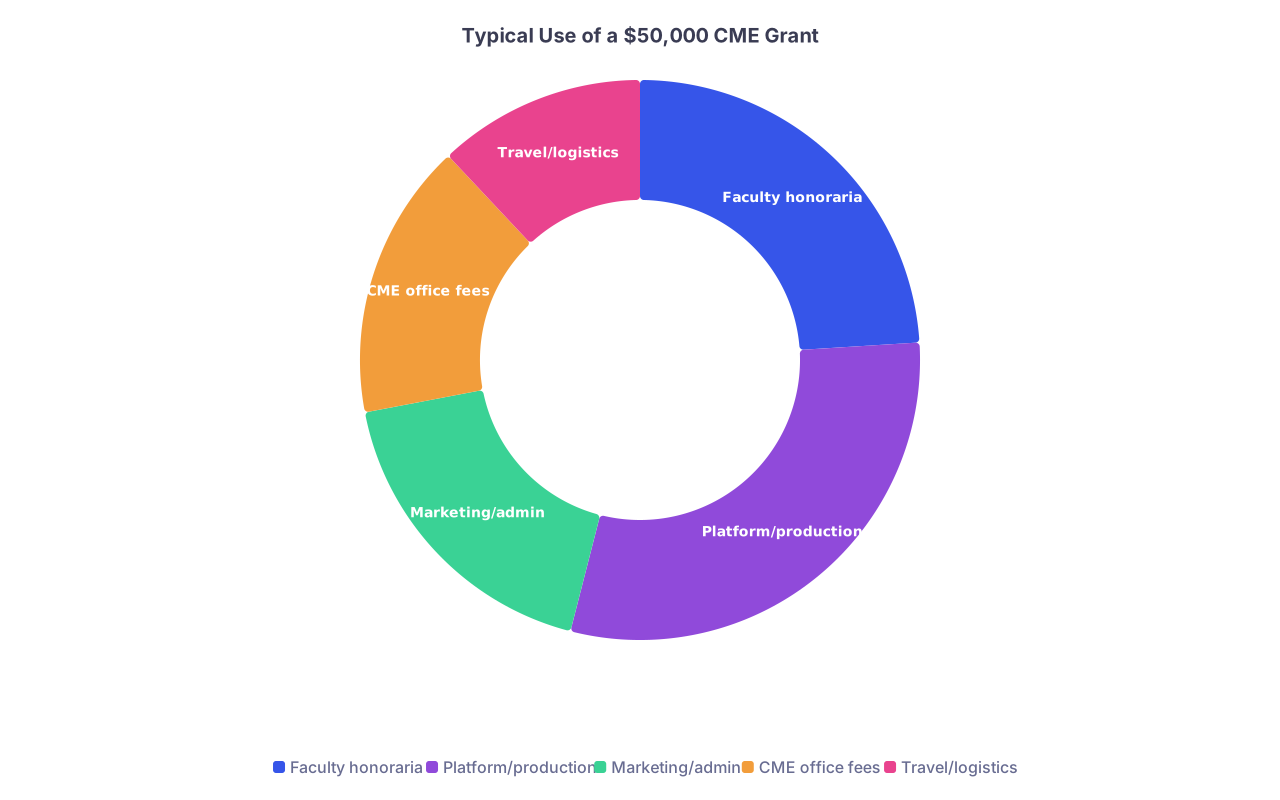
| Category | Value |
|---|---|
| Faculty honoraria | 12000 |
| Platform/production | 15000 |
| Marketing/admin | 9000 |
| CME office fees | 8000 |
| Travel/logistics | 6000 |
Behind the scenes, when a big grant comes in, the first thing people do is divide it into buckets like this. Your honorarium is just one sliver.
If you’re wondering why you got $750 for a polished national webinar while the event looked like a full production studio—this is why.
2. How Rates Are Really Set (And Why the Same Talk Pays $300 or $3,000)
Most physicians assume there’s some standard “going rate” for CME talks.
There isn’t.
I’ve sat in budget meetings where the exact same format—a 45–60 minute talk—was valued anywhere from $250 to $3,500 depending on five things nobody explains to junior faculty:
- Who is funding the activity
- What specialty and topic it is
- How scarce you are as an expert
- Who’s controlling the budget (university vs med-ed vendor vs society)
- How early you’re involved in the planning
Let’s break that down.
Industry-funded vs “organic” CME
Industry-supported CME (built on grant money) almost always pays more than purely institutional CME.
A regional academic CME series that your hospital runs to check compliance boxes? You might get:
- $0–$500 for a one-hour grand rounds, often just “Thank you and a parking voucher”
- Maybe a small stipend if you’re external
Take essentially the same talk, filtered through a national CME provider with a pharma-backed grant? That’s when you see:
- $750–$2,000 for a 45–60 minute webinar
- $1,500–$3,500 for a live national talk with Q&A
- $2,000–$5,000 total for being on a multi-event steering committee plus 1–2 talks
Same slides. Completely different pay, because the source of the money changed.
The quiet rate cards they never show you
Every serious CME vendor and many academic CME offices have internal “rate cards” for speakers. You never see them. You’re just told “Our honorarium for this activity is $X.”
Those internal ranges will look roughly like this for US settings (I’m aggregating what I’ve seen across multiple orgs):
| Activity Type | Common Range (US) |
|---|---|
| Local grand rounds (live) | $0 – $500 |
| Regional society talk (in-person) | $500 – $1,500 |
| National webinar (industry grant) | $750 – $2,000 |
| National in-person conference | $1,000 – $3,500 |
| Panelist (per panel) | $300 – $1,000 |
| Course director/steering (per proj) | $2,000 – $8,000 |
If you’ve ever wondered why one group lightly apologizes and says, “We can only offer $500,” and another—same length, same you—opens with $1,800, this is the hidden structure you’re feeling.
You’re not crazy. The market is that inconsistent.
3. How People Actually Get Invited (Not the Story You Hear at Faculty Orientation)
You’ve been lied to about how faculty get picked for CME talks.
The official story: “We review the literature, select content experts, ensure balance, and invite the best-qualified speakers.”
The actual story: “We invite people we already know, people other people trust, and people whose names will not cause the compliance office to have an aneurysm.”
Here’s what really drives CME invitations.
The five backdoor routes to CME work
The invisible “short list”
Every specialty society, every hospital CME office, every med-ed vendor has an internal list of names. These aren’t on the website. These are “people we’ve used before who didn’t screw it up and filled seats.”
Once you’re on that list, you get repeat work. That’s why you see the same faces on every webinar.Medical education companies’ databases
Med-ed vendors maintain databases of potential faculty with tags like “heart failure,” “women’s health,” “rural,” “Spanish-speaking,” “early adopter.”
Where do they get those names?- Recommendations from KOLs
- Prior speakers whose evals were good
- Faculty on papers or guidelines relevant to a funded topic
Getting into one of those databases is the single most powerful step you can take if you want CME as a side income.
Pharma MSL and medical affairs “suggestions”
ACCME rules say pharma can’t pick your CME speakers. That’s technically correct. But medical affairs and MSLs will casually mention, “Dr. X is a strong educator who’s done balanced talks,” and CME providers hear that loud and clear.
If MSLs in your region know you as a fair, non-ridiculous educator? You’re much more likely to be on the radar when a grant is written.Specialty society politics
Conference CME faculty are often just the same people already in leadership:- Committee chairs
- Guideline authors
- Section heads
- People who always “say yes” when deadlines are tight
If you’re not inside that network, you’re not even considered for the prime plenary talk. You’re maybe getting a breakout at 4:30 pm on Saturday.
Your own colleagues’ email recommendations
The most common behind-the-scenes thing I see:
“Hey, we need someone for a webinar on resistant hypertension with interest in CKD. Any names?”
That email goes to 5–10 senior faculty. They throw out names they know. If you haven’t done internal talks, haven’t made yourself visible, your name never comes up.
This is why the first few talks are the hardest. Once you’ve done three or four and not embarrassed anyone, you start showing up in these internal conversations. And it snowballs.
4. How Panels & Webinars Are Packaged (and Why the Pay Often Feels Off)
Panels, roundtables, and “expert discussions” are where a lot of physicians dip their toes into CME. They also tend to be where people get significantly underpaid and overused.
From the organizer’s perspective, a panel is a way to:
- Use multiple faculty for the price of one or two
- Stretch a single hour of recording into multiple CME modules
- Make the content feel more dynamic, which marketers love
From your perspective, panels are a trap if you don’t understand the math.
The panel math nobody explains
I’ve watched budgets for a 60-minute CME panel look like this:
- Total faculty honoraria budget: $3,000
- 1 moderator: $1,500
- 3 panelists: $500 each
You, as a panelist, prep just as much (sometimes more, because you’re nervous), show up, contribute good content, and get a third of the moderator’s pay. Why? Because the moderator was in early, maybe helped design the agenda, and probably negotiated.
You were invited late with: “We have a standard honorarium of $500 for panelists, hope that works.”
It usually can be negotiated up a bit, but not a lot. Because by the time they’re contacting you, the budget is already locked. The grant is written. The line item for “faculty honoraria” is capped. That’s why you want to be in the conversation when the activity is being built, not just when it’s being staffed.
5. Academic Credit vs Cash: The Uncomfortable Tradeoff
Let me be blunt: a lot of “prestigious” academic CME speaking pays embarrassingly little.
Big-name universities and major specialty meetings know this. They’re trading on their brand. The quiet assumption is:
“We’re paying you in prestige and line items on your CV, not in dollars.”
So here’s how it often shakes out:
Top-tier national society podium talk
- Travel covered, maybe hotel
- Honorarium: $0–$1,000
- Value: enormous for career visibility, weak as a business decision
Niche but well-funded CME webinar with industry grant
- Honorarium: $1,000–$2,000 for 60 minutes
- No prestige points beyond “look, I’m on this email blast”
- Value: strong cash, limited academic capital
Most serious side-hustlers in medicine eventually do this hybrid:
- Selectively say yes to high-prestige, low-pay meetings for academic currency
- Systematically build up a reliable stream of well-paying, lower-profile CME gigs for financial return
If you’re going to treat CME as a side hustle, you have to stop pretending every invite is equally valuable. It isn’t. Some you accept for your CV. Some you accept for your bank account. A few rare ones give you both.
6. The Part Nobody Talks About: Compliance, Conflicts, and Getting Blacklisted
You can absolutely get yourself quietly blacklisted from CME work. It doesn’t take much.
CME providers live and die by compliance—ACCME rules, institutional policies, conflict-of-interest management. They watch this stuff closely.
Here’s how faculty get themselves disinvited from the invisible short list:
Overt brand pushing
You name a single product 25 times in a “balanced” talk. Compliance flags it.
Next time there’s a planning call, someone says, “Let’s maybe not invite Dr. X again; too promotional.”Slides that don’t match references
You claim outcomes that aren’t actually in the paper. Or you show data from an industry slide deck that isn’t peer-reviewed.
CME offices hate this. If reviewers catch it once, they’ll watch you like a hawk. Twice? You disappear from invitations.Not disclosing relationships honestly
If you’re getting paid as a consultant, on speakers bureaus, or advisory boards, and you “forget” to list that on your disclosure form? Someone will notice. Too many relationships? Some CME providers will quietly stop using you, because it’s not worth the risk.Unreliable behavior
This is actually the most common killer:- Slides turned in late
- No-shows for tech checks
- Changing your content 30 minutes before the talk
- Blowing off pre-recording sessions
Organizers remember this. They have too many compliant, responsive faculty to choose from. You are replaced immediately.
On the flip side, if you:
- Turn things in early
- Hit your timing
- Avoid being a commercial
- Handle Q&A professionally
You get invited back. And referred. And suddenly you’re the person they think of first when a new grant hits.
7. How to Actually Turn CME Into a Real Side Hustle (Not Just Random $500 Checks)
You’re reading this as “physician side hustles,” not “how to be a good citizen academic.” So let’s be honest: you want to know how to turn this into consistent income, not just the occasional honorarium.
Here’s how I’ve seen people do it successfully.
Step 1: Build a recognizable niche
You need one or two topics where people can say your name and everyone nods:
- “She’s the CKD + diabetes person.”
- “He’s the early-sepsis-recognition guy.”
- “They’re all over long COVID in primary care.”
You don’t need 20 topics. You need 1–3 that you own. Publish a bit. Present locally. Run small workshops. Make it obvious this is your lane.
Step 2: Get visible to the right intermediaries
Your real customers are not “the audience.” They’re:
- CME office staff
- Med-ed company project managers
- Specialty society program committees
- Sometimes: medical affairs / MSLs who recommend names
You want these people to know:
- You exist
- What you’re good at
- That you show up and do not cause problems
That means:
- Saying yes to a few lower-paid early gigs where these folks are present
- Doing CME for your home institution flawlessly so your CME office feels safe recommending you externally
- Following up with a simple, non-cringy note: “If you’re planning more work in [topic], happy to help again.”
Step 3: Negotiate—lightly but firmly
Most physicians never say a word about money. They just accept whatever’s offered.
There’s a better line:
“Thanks for the invite; can you share the honorarium for this activity?”
If it’s low, and you have multiple things on your plate:
“I appreciate it. For this level of prep and a live session, I usually accept engagements in the $X–$Y range. Is there any flexibility in the budget?”
Sometimes the answer is no. That’s fine. You then decide if it’s worth it—for prestige, networking, or future doors. But at least you’ve signaled that your time has a value. That matters.
Step 4: Move upstream into planning and course direction
The people who actually make consistent money from CME aren’t doing 40 one-off talks a year. They’re:
- On steering committees
- Course directors for recurring programs
- Content leads for multi-module projects
Those roles:
- Pay more total
- Give you more control
- Put you in the room where future faculty are chosen
You don’t get those roles by asking for them up front. You get them by:
- Doing excellent work on smaller roles
- Being the person who can think beyond your own talk (“This series really needs a case-based session and a PCP-targeted module…”)
- Letting organizers know you enjoy planning and curriculum design, not just presenting
That’s when a med-ed vendor will say, “We’re applying for a new grant in your space. Would you be interested in being on the steering group?” That’s where the money and consistency live.
8. Future of CME Money: Where This Is Actually Going
People love to fantasize that AI or Zoom will kill this whole game. It won’t. It’ll just reshape it.
Here’s what I hear in planning meetings now:
- “Live, in-person attendance is sliding; we need hybrid.”
- “Enduring content (recorded, on-demand modules) is performing better for busy clinicians.”
- “We need more case-based, interactive content, not just didactic slide decks.”
Translation for your side hustle:
- Expect more webinars, fewer grand live podium moments unless it’s a big national conference.
- Expect more pre-recorded modules, sometimes with decent pay, especially if you’re willing to do short, tight 10–20 minute chunks.
- Expect pressure on honoraria from some academic CME offices—but steady or even higher rates in pharma-backed, outcomes-based projects where they need serious faculty.
The speakers who will still command high rates:
- Can teach well on camera
- Handle interactive chat/Q&A like pros
- Are seen as safe, balanced, and evidence-heavy in high-controversy topics (diabetes, obesity, autoimmune biologics, oncology)
FAQ (Exactly 4 Questions)
1. Is it realistic to make six figures a year from CME speaking alone?
For most physicians, no. For a tiny group of highly visible, niche experts who also sit on steering committees and course-direct complex national programs? Yes, it happens. But they’re not doing it from single $1,000 webinars; they’re stacking multiple roles—course director here, recurring national meeting there, enduring content projects, advisory-style planning.
2. Can employed physicians (hospital or academic) keep their CME honoraria personally?
Depends on your contract. Some academic centers require faculty to route all outside speaking income through the institution, especially if it’s during “work hours” or related to your official role. Others let you keep it as personal income if you disclose it and it doesn’t conflict with your job. Private practice docs usually keep it. Read your contract and ask quietly how others in your department handle it—people are often more candid off the record.
3. How many CME talks do I need before I start seeing consistent invitations?
Usually 3–5 visible, well-run events in a specific niche are enough to start the snowball. That might be:
- Two institutional talks
- One regional society event
- One webinar with a med-ed vendor
If you perform well and people in the backend (CME staff, project managers) like working with you, you’ll start getting “We’re doing another program and thought of you” emails.
4. What’s the single biggest mistake new CME speakers make about money?
Treating every invitation as if it has the same value. It doesn’t. New speakers either say yes to everything (burnout, resentment, low hourly rate) or say no to low-paying but strategically valuable gigs that would get them in front of the right people. The smart play: do a few underpaid but high-prestige or high-network events early, then become selective and prioritize either money, visibility, or stepping-stone roles—never “just because they asked.”
Key points: the money you see is the last stop in a much bigger funding pipeline, rates are wildly variable and quietly structured behind the scenes, and consistent CME income comes from being reliable, niche-focused, and upstream in planning—not just giving the occasional talk.