
The biggest tax risk for physicians with side hustles is not the IRS audit. It is the slow, silent pile‑up of avoidable mistakes that cost you tens of thousands of dollars over a decade.
You worked too hard for that money to donate it to the government by accident.
You start consulting. Maybe some expert witness work. A telemedicine gig. A small private practice on the side. A course or a Substack that suddenly starts bringing in actual money. Then one day, your “little side thing” is pulling in six figures.
And your tax situation? A mess.
Let me walk you through the mistakes I see again and again when physician side income finally takes off—and how to avoid becoming the cautionary tale your colleagues whisper about at grand rounds.
Mistake #1: Treating Side Income Like “Extra” Instead of a Business
The first mistake is mindset. If you think of your side work as “extra money,” you will almost certainly:
- Underpay taxes
- Miss legitimate deductions
- Invite penalties and interest
That 1099 income is not “just a little extra moonlighting.” It is self‑employment income from a business. The IRS views you as a business owner whether you embrace it or not.
Typical scenario I see:
- Year 1: You make $8,000 in casual consulting. You toss it on your 1040 as “other income” and move on.
- Year 2: You make $40,000. Still treat it casually. No estimated payments. Minimal tracking.
- Year 3: It jumps to $120,000. Now the IRS cares. A lot.
What you must do early:
Get a separate bank account.
The second you cross a few thousand dollars consistently, open a separate checking account just for side income and expenses. Commingling personal and business funds is how you lose deductions and create chaos.Use basic bookkeeping, not a shoebox.
Spreadsheet. Simple accounting software. Something. Do not rely on your memory and a pile of emails and statements in March.Accept that you are running a business.
That means: records, receipts, contracts, and some minimal structure. If you want “simple,” then stay employed on W‑2 only. Side income and simplicity do not coexist.
Mistake #2: Ignoring Self‑Employment Tax Until It Hurts
Physicians routinely underestimate the self‑employment tax hit. Then get blindsided.
Here is the part too many ignore:
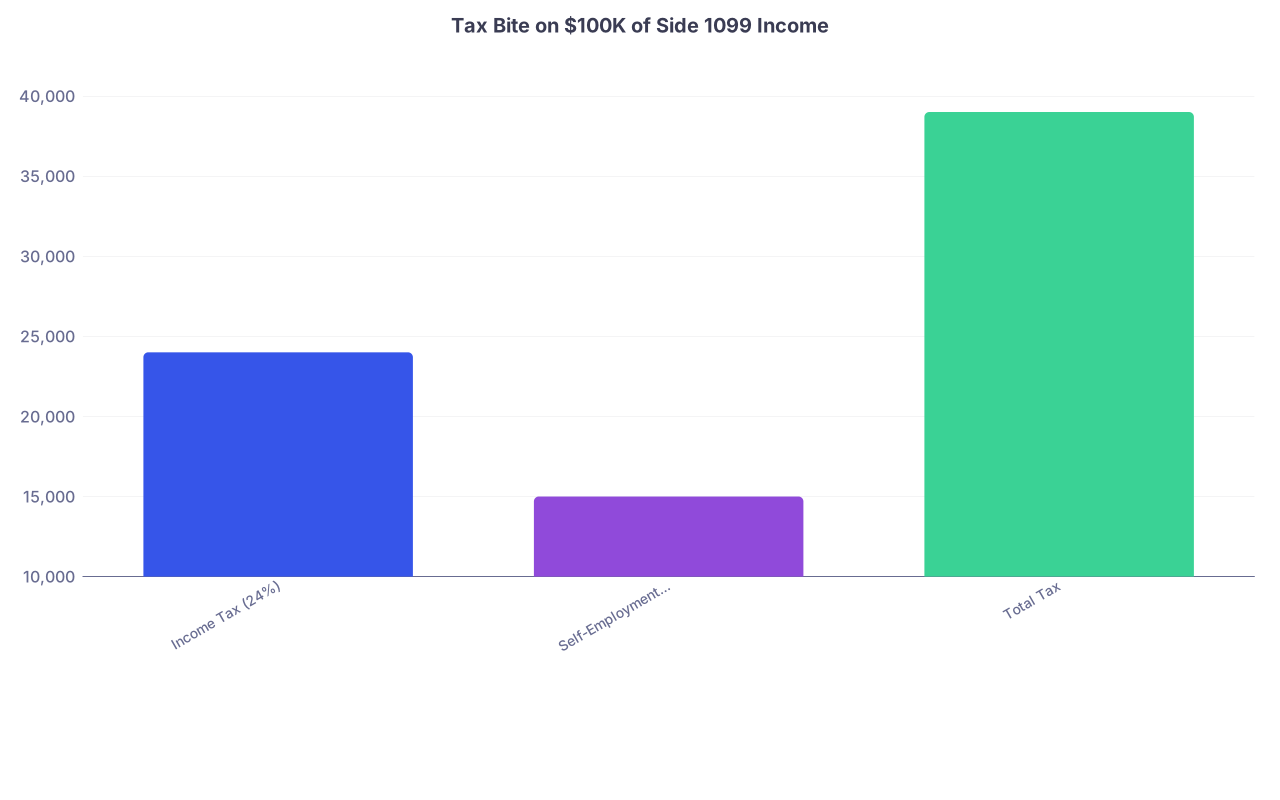
Side income is not just subject to regular income tax. It is also hit with self‑employment tax (roughly 15.3% up to the Social Security wage base; Medicare portion above that).
And no, your W‑2 job withholding does not automatically cover this.
| Category | Value |
|---|---|
| Income Tax (24%) | 24000 |
| Self-Employment Tax (~15%) | 15000 |
| Total Tax | 39000 |
On $100,000 of 1099 income, you might easily owe:
- ~$24,000 in federal income tax (assuming 24% marginal bracket, could be higher)
- ~$15,000 in self‑employment tax
- Plus state income tax
Physicians make two big mistakes here:
No estimated payments.
They assume their employed job withholding will “kind of cover it.” It will not. Result: underpayment penalties and a nasty surprise bill.Not planning for self‑employment tax at all.
I have seen attendings with $200,000 of side income owe a six‑figure tax bill in April. They thought they were “crushing it.” After taxes? Not so much.
How to avoid this:
- As a rough rule of thumb, set aside 30–40% of every 1099 check for taxes (federal + state + SE tax).
- Make quarterly estimated payments (Apr 15, Jun 15, Sep 15, Jan 15).
- In year one, overshoot. It is better to get a refund than scramble for cash.
Mistake #3: Choosing the Wrong Entity (or None at All)
Physicians love overcomplicating entity structure. Or totally ignoring it. Both are bad.
Common bad patterns:
- Earning $150,000+ as a sole proprietor with no thought to S‑Corp election or retirement optimization.
- Setting up a random LLC in the wrong state “for asset protection” because a friend said Wyoming is magical.
- Forming an S‑Corp too early for a tiny side hustle and drowning in admin.
The real risks:
- Overpaying self‑employment tax
- Losing easy retirement contributions
- Creating legal/tax complexity for no actual benefit
Here is a simplified view of how structures compare once income is meaningful:
| Structure | Typical Use Case | Admin Burden | SE Tax Optimization |
|---|---|---|---|
| Sole Prop | < $60–80K profit | Very Low | None |
| Single‑Member LLC | Liability/branding only | Low | Same as sole prop |
| LLC taxed as S‑Corp | $80–100K+ stable profit | Medium | Often favorable |
| C‑Corp | Rarely ideal | High | Usually poor |
General (not absolute) guidance:
Under $50–60K profit and unstable income:
Sole prop or single‑member LLC is usually fine. Focus on bookkeeping and estimated tax.Around $80–100K+ stable profit:
Time to discuss S‑Corp option with a competent CPA who understands physicians. You may reduce self‑employment tax by paying yourself a “reasonable salary” and taking the rest as distributions.C‑Corp:
Almost never needed for a typical physician side hustle. If someone is pushing one on you for a small course, consulting, or telemed practice, big red flag.
Do not DIY entity structure based on YouTube. You are not saving money. You are pre‑paying tuition for your future tax problems.
Mistake #4: Sloppy or Aggressive Deductions That Will Not Survive Scrutiny
There is a divide: some doctors deduct nothing. Others deduct everything. Both are wrong.
The danger zone is when income grows fast and documentation does not.
Sloppy mistakes I see repeatedly:
- Taking a home office deduction without any written description, measurements, or clear exclusive use.
- Deducting 100% of your cell phone bill because “I use it for work.” Good luck defending that.
- Writing off vacations as “conferences” with no agenda, registration, or clear business purpose.
- Deducting scrubs and white coats under the side business when they are for your W‑2 job, not the actual business activity.
You need to think like an auditor. For each deduction, ask:
- Is it ordinary and necessary for this specific business?
- Could I clearly explain it to an IRS agent in one or two sentences?
- Do I have evidence? (receipts, calendar notes, logs, emails)

Reasonable, documented deductions you should not skip:
- Professional subscriptions and CME directly related to the side work
- Software and tools used for your consulting, practice, or content
- Legal and accounting fees for the business
- Portion of internet used for the business (allocated reasonably, not 100%)
- Travel that is clearly business‑driven, with registration/agenda and notes
What you must avoid:
“Everyone writes this off” logic. “My colleague deducts X” will not help you when the letter arrives.
Mistake #5: No System for Tracking Income Streams
The modern physician side hustle rarely has just one source:
- Telemedicine platform #1
- Telemedicine platform #2
- Speaking honoraria from multiple conferences
- Expert witness checks
- Royalty or affiliate payments
- Course or subscription revenue from Stripe, PayPal, or Kajabi
- Small equity payouts from startups
That is where people start dropping the ball. Missed 1099s. Unreported income. Conflicting numbers between what you think you made and what payers reported.
Here is the nightmare chain:
- A consulting client issues a 1099‑NEC.
- You never see it (old address, spam, or wrong email).
- IRS computer matches your return, sees unreported income.
- You get a notice. Now you are fixing the past instead of building the future.
You need a revenue map: a simple list of all side‑income sources and how they pay you.

| Step | Description |
|---|---|
| Step 1 | Side Hustle Ideas |
| Step 2 | Signed Contracts |
| Step 3 | Active Income Streams List |
| Step 4 | Dedicated Business Bank Account |
| Step 5 | Monthly Bookkeeping |
| Step 6 | Quarterly Review With CPA |
| Step 7 | Accurate Tax Return |
Do this, minimally:
- Maintain a YEARLY sheet that lists: payer, type of work, how they pay (check, ACH, platform), and expected 1099.
- Cross‑check that list every January–February against what actually shows up.
- Pull transaction reports from platforms (PayPal, Stripe, telemed portals) and reconcile them.
Do not assume all platforms issue 1099s correctly or at all. The IRS cares about what you actually made, not just what got reported.
Mistake #6: Ignoring Retirement and Health Optimization Opportunities
Ironically, physicians with side hustles often miss one of the biggest perks: the ability to stack retirement accounts and use the business for smarter benefits.
Common mistake:
You have a 403(b) or 401(k) at your hospital. You assume that is all you can do. Meanwhile, your growing side business could be funding a significant solo 401(k) or SEP IRA.
Done correctly, that can:
- Slash your taxable income
- Accelerate your path to financial independence
- Convert “tax problems” into “retirement savings”
Simplified example:
You have $150,000 in side business profit from consulting. You set up a solo 401(k):
- You may already be maxing your employee deferral at your W‑2 job.
- But your side business can still contribute the employer portion (up to 20% of net self‑employment income, subject to IRS limits).
That is potentially tens of thousands of additional pre‑tax savings per year.

| Category | Value |
|---|---|
| $50K Profit | 10000 |
| $100K Profit | 20000 |
| $150K Profit | 30000 |
You also may be able to:
- Deduct health insurance premiums if you are not covered elsewhere and meet the rules.
- Use your business to justify tools or CME that are legitimately for that work.
The big mistake: doctors fear “complicating things” and leave huge, legal tax advantages on the table. You already handle ICU call and high‑risk deliveries. You can handle an extra retirement account—with help.
Mistake #7: Mixing Malpractice, Licensing, and Tax Realities
Side income in medicine is not freelance graphic design. There are clinical, licensing, and malpractice implications.
Where people get in trouble tax‑wise is when:
- They create a new entity for their side practice without coordinating with their malpractice carrier.
- They start seeing patients under an entity name and forget to update credentialing, payor contracts, or DEA registration.
- They try to deduct licensing, DEA, or CME that is purely for their employed role under the side business.
You cannot just push every professional expense into the side business because “it is all medicine.” The IRS does not care that it is the same degree. It cares whether the expense is directly related to the business activity generating that income.
Example:
- If your side business is expert witness work, that does not mean all your general CME, board fees, and hospital dues belong there.
- If your side business is a non‑clinical online course for patients, your trauma surgery CME is not a business expense of that course company.
Doctors try to get cute here. Some get away with it. Some do not.
Your rule:
If you cannot point to a clear link between the expense and the revenue‑generating activity of THAT business, you are playing games.
Mistake #8: DIY Tax Strategy Once Income Crosses Real Money
TurboTax is fine when you have one W‑2 and a tiny bit of interest income. Once your side hustle crosses about $50–75K of profit consistently, the “I will just do it myself” approach gets expensive.
The common pattern:
- Year 1–2: You use DIY software. It works okay.
- Year 3: Income spikes. You guess your way through S‑Corp questions.
- Year 4: IRS letter. Or realization you screwed up retirement contributions or payroll.
At that point, a competent CPA is not a luxury. It is risk management.

What to look for in a CPA:
- Familiarity with physician side work: locums, telemed, consulting, expert witness, small practices, online education
- Comfort with S‑Corp analysis and retirement design
- Someone who will proactively suggest structure and strategy, not just data entry
What to avoid:
- The “tax preparer” in a strip mall who only does W‑2 employees and small cash businesses
- Advisors who push high‑fee insurance products as “tax strategies” (permanent life insurance for everyone, captive insurance schemes, etc.)
You can absolutely understand your taxes. You do not need to prepare them yourself once things get complex.
Mistake #9: Forgetting State and Local Tax Landmines
Physicians doing telemedicine, multi‑state consulting, or remote work are playing with state tax fire if they are not careful.
The quiet mistakes:
- Earning side income from patients or clients in other states and never considering whether you created a tax nexus there.
- Moving states (residency, fellowship, first attending job) while your side business continues, and not tracking where the income should be sourced.
- Being in a “no income tax” state personally (like Texas or Florida) but working for entities based in high‑tax states and misunderstanding withholdings.
This is not theoretical. I have seen physicians get letters from states they had forgotten they even had a license in, questioning whether they owe state income tax there based on work done.
You must:
- Tell your CPA exactly where your clients, patients, or platforms are based and where you are physically when doing the work.
- Be cautious about taking “work from anywhere” literally without understanding state lines from a tax perspective.
If your side income grows and crosses states, ignoring this is a slow‑burn problem that surfaces years later when it is hardest to fix.
Mistake #10: No Exit Plan When the Side Hustle Becomes a Real Company
Last mistake: success without structure.
Your “little” side gig can suddenly:
- Match your clinical income
- Require employees or contractors
- Attract investor interest
- Create meaningful intellectual property (courses, software, media)
At that point, you are no longer dabbling. You are running a company that happens to be owned by a physician.
Tax mistakes here include:
- Never formalizing ownership (especially if a spouse or partner contributes materially).
- Not protecting IP properly and messing up how revenue is recognized or licensed.
- Ignoring sales tax or digital product tax rules if you are selling online products.
- Staying in the wrong entity structure out of inertia and losing hundreds of thousands over a decade.
This is where you graduate from “CPA only” to a team:
- CPA who understands growing businesses
- Attorney who understands healthcare and online/digital businesses
- Possibly a financial planner who is fee‑only and not trying to sell you products
The earlier you treat it like a real company, the cheaper your education will be.
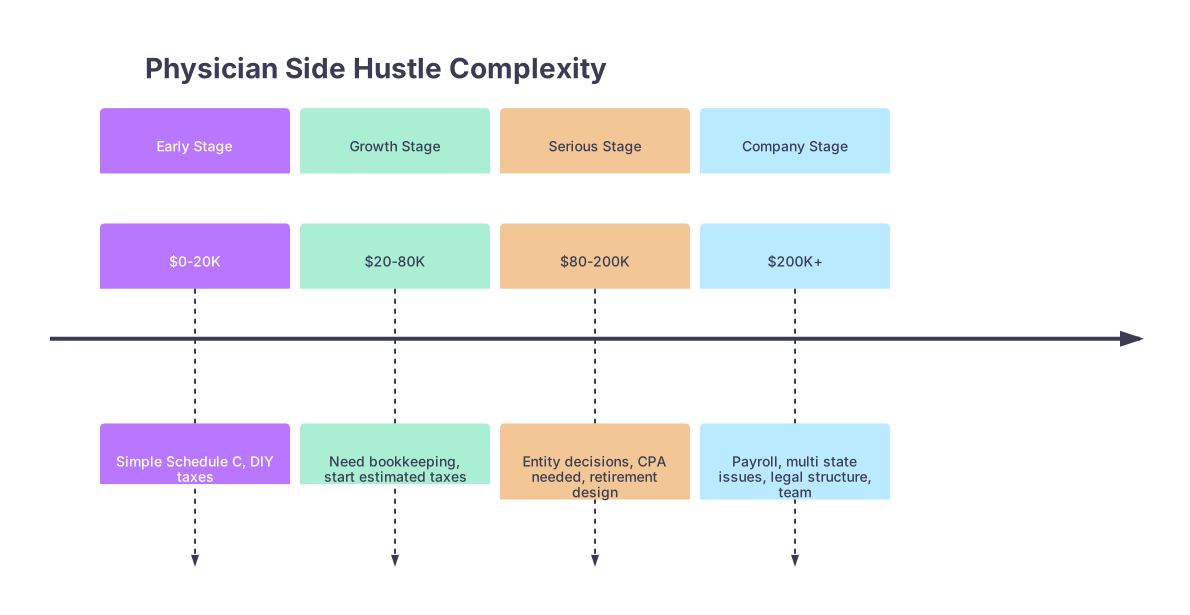
Quick Visual: How Physician Side Income Complexity Escalates
| Period | Event |
|---|---|
| Early Stage - $0-20K | Simple Schedule C, DIY taxes |
| Growth Stage - $20-80K | Need bookkeeping, start estimated taxes |
| Serious Stage - $80-200K | Entity decisions, CPA needed, retirement design |
| Company Stage - $200K+ | Payroll, multi state issues, legal structure, team |
FAQs
1. When should I consider switching my side hustle to an S‑Corp?
You should not jump into an S‑Corp just because you heard it “saves taxes.” The discussion becomes serious when:
- Your net profit (after expenses) is consistently around $80–100K+
- Income looks reasonably stable, not a one‑off spike
- You are willing to deal with payroll, separate returns, and more formal bookkeeping
At that point, the potential savings on self‑employment taxes and expanded retirement options often outweigh the added complexity. But do this only after a detailed review with a CPA who understands physician income, not based on generic thresholds.
2. Can I combine all my physician‑related work (W‑2, locums, consulting) into one big “business” for tax purposes?
No. Your W‑2 job at the hospital is separate from your self‑employed activities. You cannot just mash everything into one shell entity and write off all your professional expenses there. You can have one business that includes multiple related 1099 activities (for example: several consulting clients, expert witness work, and speaking), but W‑2 work belongs on its own. Try to force everything into one “business,” and you will likely overstep what is defensible if the IRS looks closely.
3. How much should I set aside from my side income for taxes to be safe?
If you want to avoid panic, take the conservative route:
- 30–40% of net income (after expenses) into a separate “tax” savings account
- Higher end of that range if you are already in a high bracket and live in a high‑tax state
It will feel aggressive. That is the point. Anything left after paying federal, state, and self‑employment taxes can go toward investments or debt. The mistake to avoid is treating every 1099 payment as spendable money. A big chunk of it never belonged to you in the first place.
If your side income is growing, stop pretending it is casual.
Treat it like a business, respect the tax rules, and get help before—not after—the IRS forces the lesson.