
The fastest way to lose thousands of dollars from your side hustle is to ignore intellectual property until it burns you.
You’re not “just making a little app” or “just a quick mini‑course for colleagues.” You’re creating IP. And if you treat it casually, someone else will own it, steal it, or shut it down when you least expect it.
Let me walk you through the common IP mistakes doctors make with apps, courses, and e‑books—because I’ve watched too many physicians learn these lessons the expensive way.
1. Assuming “If I Made It, I Own It” (You Might Not)
The most dangerous belief doctors have about side hustles: “I created it, so obviously it’s mine.”
Sometimes that’s true. Often it’s absolutely wrong.
The employment and contract trap
If you:
- Wrote your e‑book on your hospital laptop
- Built your app on a computer your group bought
- Filmed your course in the sim center using their staff/resources
- Used your institution’s research data or proprietary protocols
…you’ve just opened the door for your employer to claim ownership or partial rights.
Many physician contracts have broad “work for hire” or “inventions assignment” clauses that say anything you create related to your professional work, or using employer resources, belongs to them. That includes:
- Clinical decision tools (apps, calculators)
- Educational materials (slide decks, videos, e‑books)
- Protocols, checklists, frameworks
I’ve seen an academic doc finish a gorgeous course on ventilator management, only to discover his institution’s policy claimed ownership because he used hospital cases, images, and the media department to record it.
Do not make that mistake.
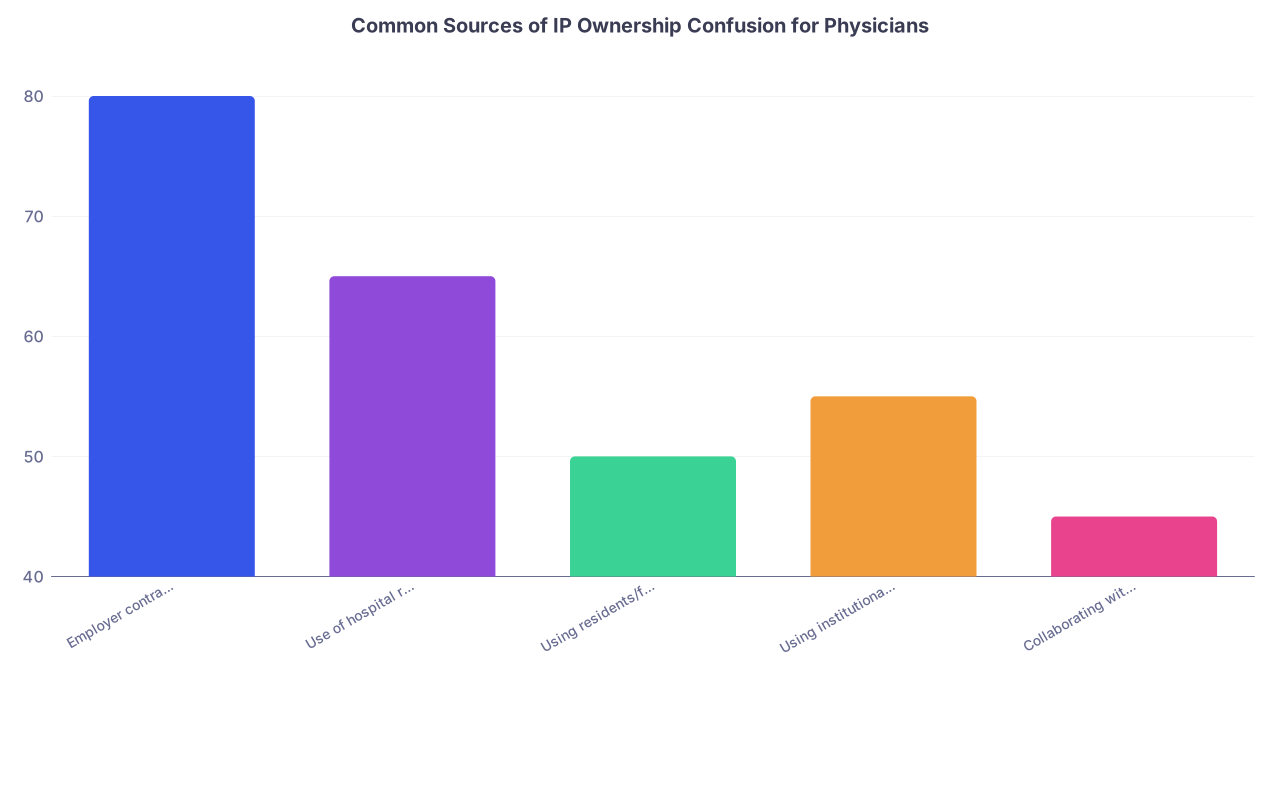
| Category | Value |
|---|---|
| Employer contracts | 80 |
| Use of hospital resources | 65 |
| Using residents/fellows | 50 |
| Using institutional data | 55 |
| Collaborating with industry | 45 |
How to avoid this:
Read your contract like a business owner, not a resident.
Find the sections labeled: “Intellectual Property,” “Inventions,” “Work for Hire,” “Outside Activities,” or “Moonlighting.”Get written clarification before you build.
Email HR or legal with something like:
“I plan to develop a general-education [app / course / e-book] on [topic], on my own time, using my own equipment, not using identifiable patient data. Can you confirm this would not be considered employer-owned IP?”
If they give you verbal reassurance only, that’s useless. You want written confirmation or an amendment.Use your own equipment and time.
Do not build on hospital Wi‑Fi, hospital computers, or with hospital staff unless there’s a clear agreement about ownership. Night and weekend work, at home, on your own devices is safer.Avoid obvious institutional branding.
No hospital logos, templates, or proprietary slide decks without explicit permission.
If you skip this, you might spend years building something your employer can claim—or worse, force you to take down when it finally starts making money.
2. Ignoring Copyright Basics: “I Got It From Google Images”
Doctors are chronically sloppy with content sourcing.
You’re building a landing page for your new OB course, so you grab a nice photo from Google. You’re writing an e‑book and paste in a figure from UpToDate or NEJM. You’re recording a course and reusing that gorgeous institutional slide you “borrowed” during fellowship.
This is how you get DMCA takedowns, legal letters, or quiet blacklisting from serious partners.
What you’re getting wrong about copyright
Common mistakes:
- Thinking “I’m just a small creator, no one will notice.”
- Assuming “educational use” = “fair use.” It doesn’t. Especially when you’re charging money.
- Copying other people’s diagrams, frameworks, or tables and just changing colors.
- Lifting whole paragraphs from guidelines, textbooks, or blogs into your e‑book.
If you didn’t create it, or don’t have a license to use it, it’s almost certainly not yours to use commercially.

Safer practices:
- Use royalty-free, commercially licensed images (e.g., paid stock sites, or free ones with clear commercial licenses like Unsplash/Pexels—still check terms).
- Create your own diagrams, even if they’re simpler. Simple and legally safe beats polished and infringing.
- Summarize and paraphrase guidelines; don’t copy text or images verbatim.
- When in doubt, ask for permission in writing or skip it.
Do not assume that “everyone in medicine does this” will protect you. It will not.
3. Over-Sharing Clinical Content: HIPAA and PHI in Disguise
You already know not to post identifiable patient photos. That’s the kindergarten level.
Where doctors screw up is in the “almost de-identified” zone: case discussions, screenshots, EMR snippets, and radiology images that feel anonymous but are not.
IP and privacy collide in side hustles
If your app, course, or e‑book includes:
- Real patient images, even without the face
- Distinctive injuries, tattoos, or rare conditions
- Date and time or room numbers in the background
- EMR screenshots, including test environments that might still include identifiers
…you risk both HIPAA trouble and takedowns from platforms that are increasingly sensitive to this.
Example: a derm course that used “anonymous” lesion pictures lifted from clinical photos taken in clinic, without signed media consent for commercial educational use. When marketing ramped up, one complaint was enough to trigger a major headache for that physician.
Protect yourself:
- Get specific written consent if you ever use real patient images in a product you sell. Not just standard clinical photo consent.
- Better: use stock clinical images with clear commercial licenses or anonymized teaching files with documented permissions.
- For case discussions, alter non-essential details (age, location, timing, exact comorbidities) to prevent identification.
- Never, ever show real EMR screens in a course, even if you think they’re blurred or cropped. Recreate de-identified mockups instead.
If you wouldn’t put it on Twitter under your real name, don’t put it in a paid product with your name on the cover.
4. Building an App Without Owning (or Controlling) the Code
This one hurts the most financially.
A doctor hires an overseas developer for $5–20k to build a medical app. The app works. People love it. Then:
- The developer disappears.
- The doctor wants to switch to a new dev but has no access to the source code.
- The dev claims they own the underlying code and will “license” it for extra fees or a revenue share.
I’ve watched a promising calculator app die because the physician did not have a clear contract that assigned IP in the code to them.

| Step | Description |
|---|---|
| Step 1 | Idea for app |
| Step 2 | No contract with developer |
| Step 3 | Developer owns code |
| Step 4 | App launches |
| Step 5 | Need updates or bug fixes |
| Step 6 | Developer unresponsive or demands more money |
| Step 7 | App stagnates or is shut down |
What you must lock down with developers
Before a single line of code is written, your contract should:
- Clearly state that all code, designs, and assets created for your project are “work for hire” and assigned to you, fully and exclusively, upon payment.
- Clarify you get access to the source code, not just the compiled app.
- Specify where the code lives (e.g., your GitHub/Bitbucket account, not just theirs).
- Address what happens if you part ways: you keep all code and assets developed to date.
And yes, pay a real lawyer a modest fee to review this once. Cheaper than losing your entire app later.
If a developer pushes back and insists on retaining ownership? That’s a red flag. Walk away.
5. Being Casual About Co‑Creators: “We’ll Figure It Out Later”
This is where physician friendships go to die.
Two colleagues decide to create a course or e‑book together. Or a group builds an app. Everyone’s excited. No one wants to talk percentages or control. Then:
- One person does 80% of the work.
- Another wants to bring in a third partner.
- Someone leaves the group but still appears on the sales page.
- The project takes off financially and suddenly people remember every minor contribution they ever made.
Without an IP agreement, you end up with joint ownership by default in many jurisdictions. That means every co‑owner might have:
- The right to use the material however they want, sometimes even without paying the others.
- The power to block licensing or changes if they don’t agree.
| Setup Type | IP Ownership Clarity | Conflict Risk | Fixing Problems Cost |
|---|---|---|---|
| Solo, no contract | Medium | Medium | Medium |
| Group, no contract | Very low | Very high | Very high |
| Group, written IP deal | High | Lower | Lower |
Avoid this landmine with one simple rule
If more than one person is contributing meaningfully to an app, course, or e‑book, you need a written agreement before launch that covers:
- Who owns what (joint or one entity with revenue sharing)
- How revenue is split
- Who controls branding and future updates
- What happens if someone wants out
- Whether anyone can create “competing” products later
No, you don’t need a 40‑page contract from BigLaw. A clear 3–5 page document reviewed by a lawyer who understands small businesses is often enough.
If someone refuses to put it in writing? That’s not a partner. That’s a future problem.
6. Failing to Protect Your Brand: Trademarks and Name Nightmares
Too many doctors fall in love with a clever name for their app, course, or e‑book… and stop there.
Then they find out:
- A similar name already exists in the same space.
- They get a cease‑and‑desist after launching.
- Or a copycat shows up later, piggybacking off their success because nothing was protected.
You do not need to trademark every idea you scribble on a napkin. But you should not ignore basic brand protection once something is real and growing.
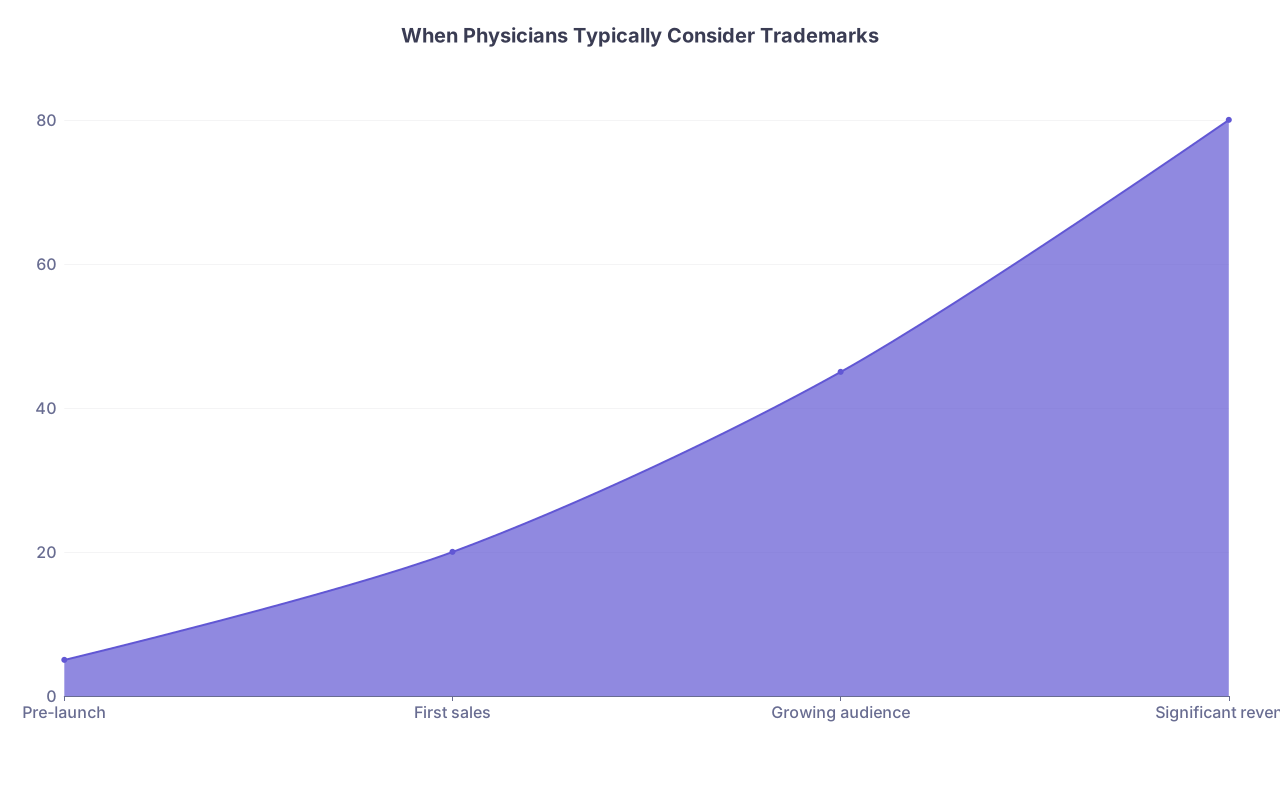
| Category | Value |
|---|---|
| Pre-launch | 5 |
| First sales | 20 |
| Growing audience | 45 |
| Significant revenue | 80 |
At minimum, avoid these naming mistakes:
- Choosing a name that’s confusingly similar to an existing app/course in healthcare.
- Using trademarked terms in your name (e.g., “USMLE® Mastery” without permission).
- Mixing protected brand names in your domain (e.g., “[BigBoardExam]ReviewMD.com”).
Quick checks:
- Search the USPTO trademark database (or your country’s equivalent).
- Google the name with “app,” “course,” “book,” “medicine,” “doctor.”
- Search the App Store / Google Play and major course platforms.
Once your product is making consistent money or has growing recognition, talk to a trademark lawyer about protecting:
- Your brand name
- A distinctive logo (if it truly matters for your marketing)
Don’t spend thousands on filings before you have proof of concept. But don’t wait until you’re popular enough to be a target.
7. Sloppy Agreements with Platforms and Publishers
You’d be shocked how many doctors click “accept” on platform agreements for:
- Publishing an e‑book
- Hosting a course
- Licensing content to a company
…without reading what rights they’re giving away.
Common hidden problems:
- Perpetual rights: They can use your content forever, even if you leave.
- Broad sublicensing: They can let others use your content without additional pay.
- Non‑compete clauses: You can’t create a similar course/book/app elsewhere for years.
- Territory and format creep: You grant rights to “all media now known or later developed” worldwide. Translation: they can do audiobook, print, digital, courses, etc., potentially with minimal added compensation.
You think you “licensed” your course to a platform. In reality, you might have almost sold it.
Minimum due diligence:
- Look for any clause with: “perpetual,” “exclusive,” “irrevocable,” “in all media,” “sublicensable.”
- If it’s exclusive, insist on serious compensation or reconsider.
- If they want long‑term rights, negotiate a finite term (e.g., 3–5 years) with renewal options.
- If you don’t understand it, pay a contract-savvy lawyer once. It’s cheaper than signing away your life’s work.
If a platform won’t allow any negotiation and the terms are heavily one‑sided, at least walk in knowing you’re trading a chunk of IP control for distribution.
8. Forgetting That Your “Opinions” Are Also Liability
This isn’t classic IP, but it’s glued to it in medicine.
You create a clinical app, course, or e‑book. People use it in practice. Something bad happens. Lawyers start sniffing around.
If your content:
- Looks like direct clinical advice rather than education
- Uses absolute language (“always,” “never”)
- Presents your app as a decision‑maker rather than a tool
- Lacks clear disclaimers and scope
…you’re not just holding IP. You’re holding exposure.
This gets worse when people copy your content to other platforms without your context or disclaimers. Your name and brand are still there, but your protections vanish.
Basic protection steps:
- Use strong, visible disclaimers: education only, not a substitute for clinical judgment, not establishing a physician‑patient relationship.
- Avoid guaranteeing outcomes.
- Make it clear when something is your personal approach vs guideline‑standard.
- Consider liability coverage that includes your side business, especially for clinical‑adjacent tools.
No, a disclaimer won’t magically save you from all risk. But having nothing in place is amateur hour.
9. Not Documenting Creation and Ownership From Day One
When things go well, people suddenly care who did what.
You’ll want clean proof that:
- You wrote that e‑book
- You built that specific version of the app
- You created those cardiology diagrams for the course
If there’s a dispute, vague memories and “we all helped” won’t cut it.

Simple habits that save you later:
- Keep project files in organized, dated folders.
- Use versioning for major updates (v1.0, v1.1, etc.).
- Save copies of contracts, emails discussing ownership, and any contributor agreements.
- For major works (book-length, substantial courses), consider registering copyright where available—it’s cheap insurance in some jurisdictions.
You don’t need to behave like a giant tech company. But you can’t behave like a resident shoving notes into random pockets, either.
10. Treating Your Side Hustle Like a Hobby Forever
The final and biggest mistake: you keep thinking, “It’s just a little side thing.”
So you:
- Mix personal and business spending.
- Use your hospital email for logins.
- Never form an LLC or similar entity.
- Never clean up contracts, rights, or ownership.
Then suddenly that “little” app or course is pulling in $50k/year. Now every messy decision you made early, every loose end, every handshake deal becomes a problem.

| Step | Description |
|---|---|
| Step 1 | Idea |
| Step 2 | Hobby Project |
| Step 3 | First Sales |
| Step 4 | Serious Revenue |
| Step 5 | Business With Systems |
| Step 6 | Conflicts and Legal Risk |
You don’t need to over‑engineer things on day one. But if your product is:
- Making real money, or
- Getting real attention, or
- Being used by people you don’t personally know
…you’re past the “cute experiment” stage. You’re running a business, whether you admit it or not.
At that stage, you should:
- Have a separate entity (LLC, corporation—talk to a professional).
- Have at least one lawyer who has looked at your core contracts.
- Have a clear understanding of what IP you own, and how it’s protected.
FAQ (Exactly 4 Questions)
1. Do I really need to worry about IP if my app/course/e‑book only makes a few hundred dollars?
Yes, at least at a basic level. You don’t need to register trademarks or hire a big law firm for something that might go nowhere. But you do need to avoid obvious copyright infringement, clarify ownership with co‑creators, and avoid signing away rights in terrible platform agreements. The worst IP mistakes show up years later—when a “small” project suddenly takes off and all the early sloppiness becomes expensive to fix.
2. Can I reuse slides and images I created for lectures at my hospital in my paid online course?
Maybe—but don’t assume. If you created that content as part of your job, especially during on‑the‑clock work or using institutional templates, your employer might claim some rights. The safest path: create a fresh version for your commercial product, on your own time, without institutional branding, and ask for written clarification from your employer about who owns what.
3. If I hire a freelancer on Upwork or Fiverr to help with my app or course, do I automatically own what they create?
No. Not automatically. You only truly own it if your contract or the platform’s terms explicitly assign IP to you as “work for hire” or through a clear assignment of rights upon payment. Many physicians skip this and end up with a partial or disputed claim over graphics, code, or course assets. Always confirm IP ownership terms in writing before they start.
4. When is the right time to register a trademark or copyright for my project?
For most physicians, it’s overkill to do this before you’ve proven there’s demand. A reasonable rule: once your app, course, or e‑book has consistent sales, visible branding, and you’d be genuinely upset if someone copied the name or core content, that’s when to talk to an IP or trademark lawyer. Until then, focus on not infringing others’ rights, cleaning up contracts, and documenting your own creation process.
Open your contract folder—or your email—right now and pull up your current employment agreement and any developer or platform contracts. Highlight every section that mentions IP, ownership, or content rights. If you can’t explain those clauses in plain English to a colleague, that’s your next task to fix before you build anything else.