
You just finished a 12‑hour day. Charting is still not done. Your inbox is ugly. Your kids are asleep. You are scrolling some physician group on Facebook where people casually mention an extra $5–10k a month from “simple side gigs.”
You have two immediate reactions:
- That would change my life.
- I have zero time and zero spare cash to burn on a failed experiment.
You are not lazy. You are maxed out. And you are rightly allergic to “start a business” advice that assumes you have:
- 10 free hours a week
- $5,000 to drop on coaching, branding, and a website
- Perfect clarity on what you want to do
You have none of that. You have maybe 3–5 “real” hours per week and a healthy fear of burning out even more.
So let us fix this.
Below is a stepwise blueprint for launching your first side hustle as a physician with:
- No extra capital
- Fragmented time
- High cognitive load from your day job
The goal is not to “build an empire.” The goal is to get to your first $1,000 of non‑clinical income without wrecking your life.
Step 1: Choose a Hustle That Fits a Physician Life (Not Instagram)
First problem: most side hustle ideas are garbage for physicians. They assume you can grind 20–30 hours a week. You cannot.
So you start by ruthlessly filtering ideas with three criteria:
- Low or zero upfront capital
- Very low operational complexity
- Asynchronous and flexible (no fixed extra “shifts”)
Here is what typically fails those criteria for doctors:
- Restaurant / brick‑and‑mortar anything
- Amazon FBA with large inventory buys
- Any franchise
- High‑touch 1:1 coaching requiring set appointments every evening
- Real estate flipping if you are starting from scratch with no cash
Here are side hustles that do work well for time‑starved physicians and can start with almost no capital:
- Consulting and advising (start lean, no LLC needed day one)
- Expert freelance work (medical writing, reviewing, education)
- Micro‑courses or digital products built from what you already know
- Niche content / newsletter that leads to sponsorship or consulting
- Tele-advisory / second opinion services via existing platforms
- Non‑clinical hourly work through existing marketplaces (chart review, utilization management prep, med‑legal expert work at entry level)
You are not married to one forever. You just need one good enough lane to get you to your first $1k.
Use this quick selection filter
Pick one idea that passes this 5‑question test:
- Can I start with under $200?
- Can I do useful work in 40‑minute chunks?
- Does it use knowledge/skills I already have (no new degree, no new board)?
- Could I land my first paying client in 30 days?
- Could this reasonably get to $500–1,000/month within 6 months?
If you cannot answer yes to at least 4/5, it is the wrong first hustle.
Take 10 minutes and write down three possible options. Then force yourself to pick one. Analysis paralysis is the quiet killer of physician side hustles.
Step 2: Define a Micro‑Niche and a Painful Problem
Vague side hustles die. “I do consulting. I help people with health.” That is nothing. No one knows when to hire you.
Your job is not to “follow your passion.” Your job is to become the obvious solution to a very specific, painful problem.
You are not starting “a business.” You are building a simple solution for a defined person with a defined problem.
Three levers: who, what, outcome
Write one sentence with these blanks:
I help [who] with [problem] so they can [outcome].
Examples tailored to physicians:
- “I help small private practices cut charting time so they can reclaim 5 hours a week without adding staff.”
- “I help premed and PA applicants with low stats craft realistic school lists and compelling personal statements so they get at least one acceptance.”
- “I help health tech startups avoid clinical landmines in their product design so they ship something physicians actually use.”
You want that sentence to make someone think, “That is exactly what I need.”
Check your niche with a reality test
Ask:
- Can I name at least 5 real people or companies who have this problem now?
- Do they already spend money to fix it? (Time, staff, services, software)
- Can I reach them without a giant audience? (Existing contacts, LinkedIn, alumni groups, specialty societies)
If the answer is no across the board, tighten or shift the niche.

Step 3: Build a 4‑Hour Minimum Viable Offer (MVO)
This is where most doctors overbuild.
They want a logo, website, complex course platform, legal entity, business bank account, branding color palette. All before they have a single paying client.
You do the opposite.
The first goal is not “launch a company.” The first goal is get one human to pay you once. That is your proof of concept.
What your Minimum Viable Offer includes
In 4 focused hours you can build:
A clear 1‑page description of your offer
- Who you help
- Problem you solve
- Your process in 3 simple steps
- What is included
- Price (or range if you are testing)
One simple outcome‑oriented package Not hourly. Not “open‑ended.” A defined deliverable.
Example for a med writing side hustle:
- “I will draft a 1,200‑word patient article on [condition] with references and plain‑language edits within 7 days – $300.”
Example for admissions coaching:
- “Two 60‑minute Zoom sessions plus 2 async edits of one personal statement – $450.”
A dead‑simple way to deliver Use what you already know:
- Zoom + email + Google Docs
- Or Loom (screen recording) + email
- No fancy platforms required
A way to get paid At the start:
- PayPal
- Stripe payment link
- Square
- Or even Venmo/Zelle for your very first test client
You can formalize later.
What you explicitly skip at this stage
Do not waste weeknight energy on:
- Name, logo, or LLC paperwork
- Website copy for 7 pages
- Social media content calendars
- Complicated email funnels
If you have not made a dollar yet, all of that is procrastination dressed up as productivity.
Step 4: Time Management for the “No Time” Physician
You do not need 10 free hours. You need 3–5 intentional hours per week protected like an OR block.
The biggest mistake is saying “I will work on this when I have time.” That time never comes. The clinical job expands to fill all available space.
Create a micro‑schedule that actually works
Pick two blocks per week:
- One 90‑minute block on a weekday evening
- One 90‑ to 120‑minute block on a weekend
That is all. Non‑negotiable.
During those blocks, you are in “side hustle mode.” Phone on Do Not Disturb. No charting. No inbox. No doomscrolling physician forums.
Then you layer a 15‑minute daily micro‑slot on 3–4 days per week for “tiny tasks”:
- Sending 1–2 outreach messages
- Replying to an interested lead
- Posting 1 short value‑add post on LinkedIn / group

| Category | Value |
|---|---|
| Clinical Work | 50 |
| Family/Personal | 30 |
| Side Hustle | 4 |
| Admin/Charting | 6 |
Notice: 4 hours. That is it.
Protect those blocks like a clinic session
Treat them exactly like scheduled OR time:
- Put them on your calendar now
- Tell your partner / family what you are doing and why
- Decide a specific task for each block 24 hours in advance
“Work on side hustle” is vague. “Write 1‑page offer doc” is concrete.
You are not trying to be heroic. You are trying to be consistent.
Step 5: Land Your First Paying Client Without Ads, Website, or Audience
This is the scary part. It is also where 90% of physicians quietly stall out.
You do direct, respectful outreach to people who already know you or are close to your network. No spam. No begging. No MLM nonsense.
Warm network > strangers at the start
You start with:
- Colleagues
- Former co‑residents/fellows
- Former attendings
- Non‑physician friends in healthcare, startups, administration
- School alumni networks
- Specialty or professional groups where you already participate
You are not asking for charity. You are offering a clear, valuable service.
Use a simple 3‑part outreach script
- Context (how you know them)
- What you are doing now (your offer)
- Clear, low‑pressure ask
Example message to a former co‑resident:
Hey [Name],
Quick note – I have been working on a small side project. I am helping small practices cut down documentation time by reviewing their workflows and templates and giving them a simple 2‑week “charting cleanup” plan.
If you know any practice owners who are drowning in notes and might want to test this with a colleague instead of a generic consultant, I would be happy to chat with them. First few I am doing at a reduced rate to refine the process.
Feel free to connect us by email or text if someone comes to mind.
Example to a health‑tech contact:
Hi [Name],
I am doing some focused advisory work with early‑stage health tech companies – specific to [your niche, e.g. “designing clinical decision support that physicians actually use in clinic instead of ignore”].
If any of your portfolio companies are working in that space and would benefit from a few structured feedback sessions with a practicing [your specialty] doc, I would be happy to connect. I have a simple advisory package I am testing with 2–3 teams.
No pressure – just wanted to put this on your radar.
Set a concrete target: 20–30 personalized messages in the first 30 days. That is your real “launch.” Not a website.
Step 6: Deliver Once, Learn Hard, Refine Fast
Let us assume you land 1–3 paying clients. Good. Now your job is:
- Deliver value
- Document everything
- Turn chaos into a repeatable mini‑system
Create a simple delivery checklist
Before the engagement:
- Confirm scope and price in writing (plain email is fine)
- Set expectations: timeline, communication method
- Collect what you need from them (intake form, sample documents, etc.)
During:
- Follow your 3–5 step process
- Keep notes on what takes time, what confuses them, what they love
- Capture exact phrases they use about their problems
After:
Ask 2 questions:
- “What was most helpful?”
- “If you could change one thing about how this went, what would it be?”
Ask permission to use:
- A short testimonial
- Their result story (no PHI, obviously)
Then you refine:
- Cut steps that add no value
- Add clarity where they got confused
- Adjust price if you wildly underpriced

| Step | Description |
|---|---|
| Step 1 | Land first client |
| Step 2 | Deliver service |
| Step 3 | Collect feedback |
| Step 4 | Refine offer |
| Step 5 | Update pricing and messaging |
| Step 6 | Reach out to next clients |
Treat this first cycle as a live experiment, not a final exam.
Step 7: Decide When and How to Formalize (LLC, Website, Etc.)
You do not need to lawyer up for $300 of freelance writing. But you should not be sloppy as you grow either.
Use this progression:
Stage 1: Under $1,000 total revenue
- Operate as a sole proprietor
- Track income and expenses in a simple spreadsheet
- Use basic payment methods (PayPal, Stripe links, etc.)
- Simple written agreements in email
Focus: proof of concept.
Stage 2: $1,000–$10,000 total revenue
Now you start to formalize:
- Consider forming an LLC (talk to an accountant who actually understands physician side work)
- Open a separate business bank account
- Get a simple one‑page website:
- Who you help
- What you do
- One clear way to contact/book
This does not need custom design. A templated site from Squarespace, Carrd, or WordPress is fine.
| Revenue Level | Legal/Business Steps |
|---|---|
| $0–$1,000 | Sole proprietor, track income/expenses |
| $1k–$10k | Consider LLC, business bank account, simple website |
| $10k+ | Accountant, formal contracts, liability review |
Stage 3: Over $10,000 total revenue
Now you behave like a real micro‑business:
- Engage an accountant for tax strategy
- Use proper contracts (can start from template, then customize)
- Review any medico‑legal risk (particularly if doing anything health‑related)
But none of this is required to get started and get paid.
Step 8: Choose a Growth Path That Matches Your Capacity
After your first few clients, you have a choice. You can:
- Keep it as a small, stable $500–$1,500/month add‑on, or
- Deliberately grow toward $3k–$5k+ per month
Do not drift. Decide.
Levers to grow without adding time
If you want to grow without doubling your hours, you have three main levers:
Raise prices
Once you have proof that you are solving a painful problem with clear outcomes, you can increase rates.Example:
- First 3 clients at $300
- Next 3 at $450
- Then $600, etc.
Streamline and standardize Turn custom work into semi‑template work:
- Checklists
- Standard operating procedures
- Reusable slides or documents
This lets you deliver more value in the same or less time.
Shift from 1:1 to 1:many Once you have:
- A clear process
- Repeated results
- Language that resonates
Then you can build:
- A short, focused course
- Group sessions
- A workshop for organizations
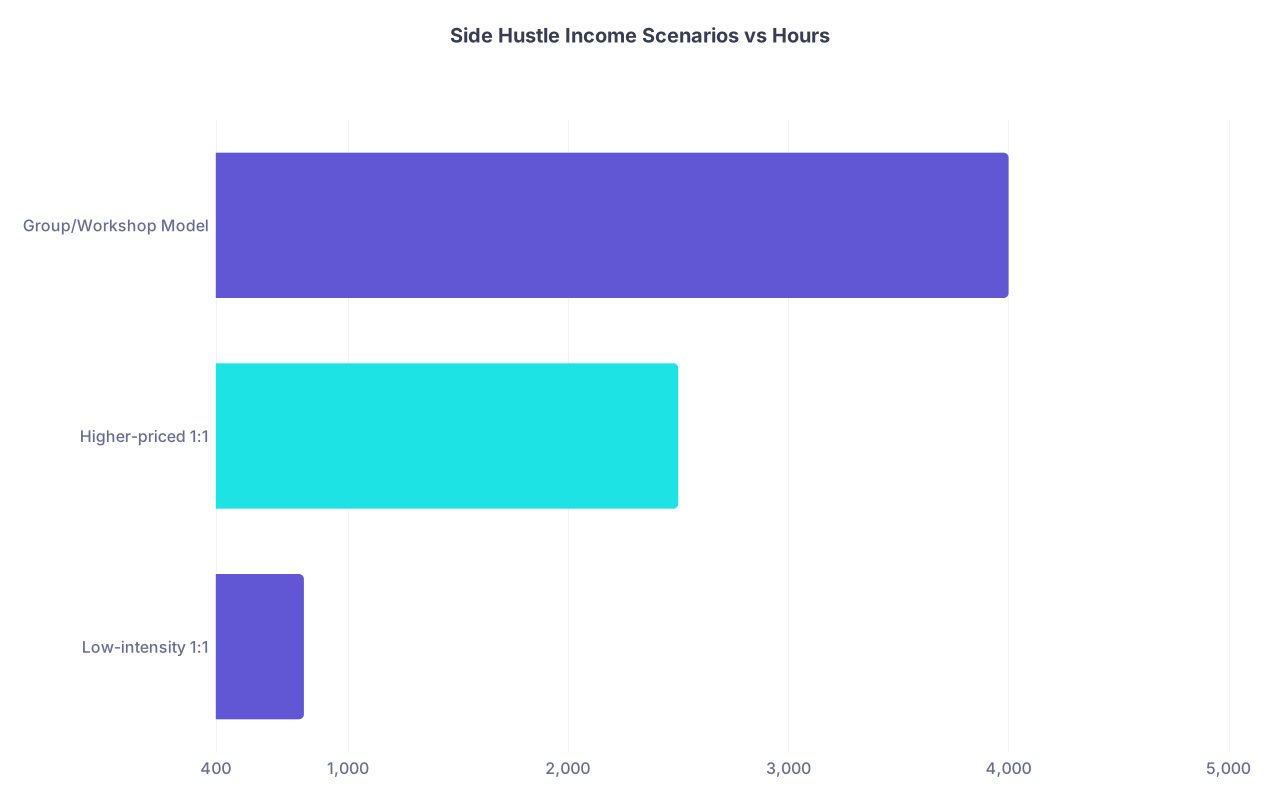
| Category | Value |
|---|---|
| Low-intensity 1:1 | 800 |
| Higher-priced 1:1 | 2500 |
| Group/Workshop Model | 4000 |
(Values above: rough monthly income with ~4–6 hours/week.)
Notice what I am not saying: “Quit medicine and go full entrepreneur.” Not the point. The point is optionality and margin.
Step 9: Guardrails – How Not to Blow Up Your Career or Sanity
You are still a physician. You are still subject to licensing, contracts, and ethics. You also do not want your side hustle to quietly wreck your home life.
So you set guardrails.
Professional and legal guardrails
- Review your employment contract for:
- Non‑compete clauses
- “No outside clinical work” clauses
- IP clauses (who owns what you create)
- Stay away from direct clinical care in your side hustle at the start
- Focus on education, consulting, non‑clinical advising
- No use of PHI in examples, stories, marketing
- Avoid conflict of interest:
- Do not push your employer’s patients into your side service
- Be transparent if you work with companies that intersect with your clinical work
You want this to be boringly compliant, not excitingly risky.
Personal and family guardrails
Agree on a few rules with your partner/family:
- How many nights per week you will protect for this (1–2, not 5)
- What is off‑limits (no working during dinner, for example)
- What “success” would allow you to do for them:
- Extra travel
- Paying off a loan early
- Outsourcing chores (cleaning, lawn, etc.)
Side hustles that create resentment at home rarely last.

Step 10: A Realistic 90‑Day Blueprint (Week by Week)
You are exhausted. You do not need inspiration. You need a plan.
Here is a 90‑day sequence that works for a real, busy physician.
Weeks 1–2: Pick and Define
- Choose your niche and problem
- Write your 1‑sentence positioning
- Draft your first Minimum Viable Offer on a 1‑pager
Output by end of week 2:
- One clear offer description
- A simple payment method set up
Weeks 3–4: Outreach Sprint #1
- Block two 90‑minute sessions per week
- Send 15–20 personalized outreach messages
- Have 3–5 exploratory conversations
Output by end of week 4:
- At least 1 paying client, or
- Clear feedback that your messaging needs adjustment
Weeks 5–8: Deliver and Refine
Deliver for first 1–3 clients
Take obsessive notes on:
- Time spent
- Questions asked
- What they valued most
Adjust:
- Your process
- Your messaging
- Your pricing (if needed)
Output by end of week 8:
- A refined, slightly better version of your offer
- At least 1 testimonial or concrete success story
Weeks 9–12: Outreach Sprint #2 and Light Formalization
- Update your 1‑pager with clearer outcomes and maybe higher price
- Send another 20–30 targeted outreach messages
- Optional: build a simple one‑page website
Output by end of week 12:
- Total of 3–6 paying clients
- A side hustle that is now a repeatable micro‑business, not an idea
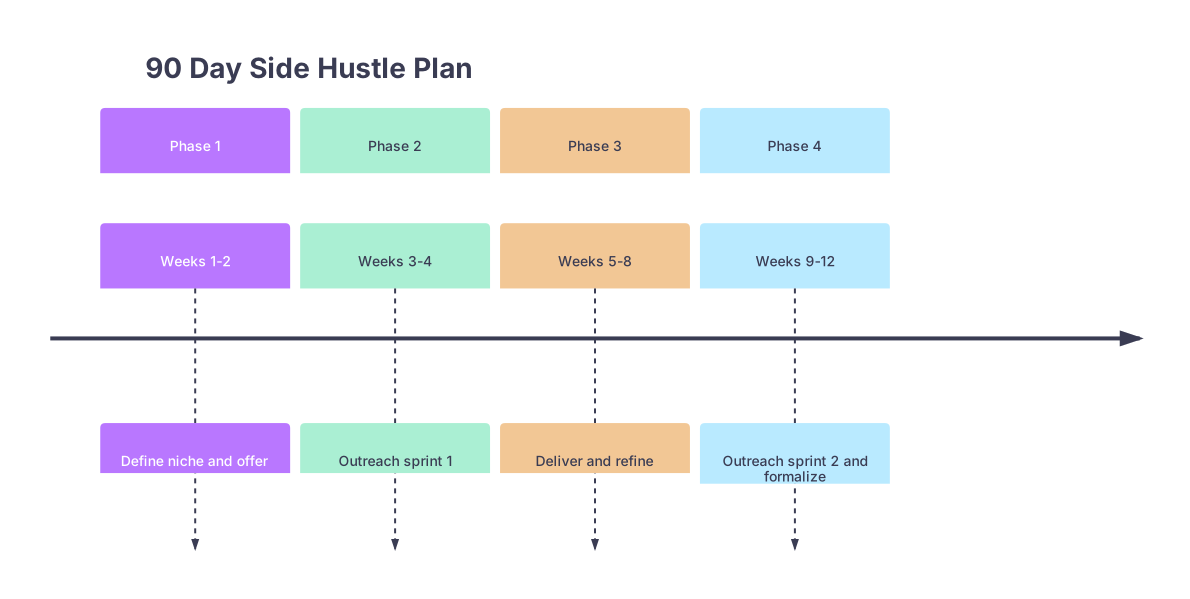
| Period | Event |
|---|---|
| Phase 1 - Weeks 1-2 | Define niche and offer |
| Phase 2 - Weeks 3-4 | Outreach sprint 1 |
| Phase 3 - Weeks 5-8 | Deliver and refine |
| Phase 4 - Weeks 9-12 | Outreach sprint 2 and formalize |
What This Looks Like in Real Life (Three Physician Examples)
Briefly, so you can see what “small but real” looks like.
1. Hospitalist → Admissions micro‑consulting
- Time: 4–5 hours/week
- Offer: 2‑call + email support package for med/PA school applicants with “non‑traditional” backgrounds
- Pricing: Started at $250, then $450, then $650
- Clients: 2–3 per month
Outcome: ~$1,500/month within 6 months, no website for first 4 months. All from word of mouth and a few LinkedIn posts.
2. EM doc → Health‑tech product advisor
- Time: 3–4 hours/week
- Offer: Fixed‑scope advisory packages for 2 small startups (one pre‑seed, one seed stage)
- Pricing: Cash + minor equity, plus paid hourly calls
- Path: Founders via alumni network and a regional startup event
Outcome: ~ $2,000/month cash equivalent average, plus upside from equity. No huge time burden. Extremely flexible around shifts.
3. Outpatient pediatrician → Parent education micro‑courses
- Time: 4–6 hours/week
- Offer: $49–$79 short video courses around sleep, picky eating, and behavior basics
- Launch: Simple Gumroad pages, email list from her practice newsletter (with clear COI boundaries)
Outcome: $300–$700/month after 6 months. Not life‑changing alone, but enough to pay for recurring family expenses and validate demand.
None of these people raised capital. None built a fancy brand. All of them started with a scrappy, specific service.
The Quiet Mindset Shift You Need
You have been trained to believe that anything less than perfect is dangerous. That might be true in the OR. It is not true in business.
For a first side hustle:
- Done beats perfect
- One paying client beats 100 hours of planning
- A simple, slightly underpriced offer beats a hypothetical “dream business”
You do not need to “figure out your long‑term vision.” You need to ship something small, real, and useful.
Your Next Action: 25 Minutes Today
Do not “think about this.” Do this:
- Set a 25‑minute timer.
- Write your one‑sentence positioning:
“I help [who] with [problem] so they can [outcome].” - List 5 specific real people who match “who” or who know those people.
- Draft one simple outreach message you could send to any of them about what you are exploring.
When the timer goes off, take one more minute and send that message to one person.
That is the first brick. The rest of the blueprint only matters if you lay that one.