
The nonsense about needing a huge audience before you monetize your medical writing is wrong. You can get paid with zero followers, a basic LinkedIn profile, and three solid writing samples.
Here is how you actually do it.
Step 1: Decide What You Will Sell (Not “I’ll Write Anything”)
“Medical writing” is too vague. Clients do not buy “writing.” They buy specific outcomes: better patient engagement, more sign‑ups, more trial sites, fewer regulatory headaches.
You need a clear, monetizable service menu. Not a vague identity.
Start here:
| Niche | Typical Client Types | Starter Project Types |
|---|---|---|
| Patient education content | Hospitals, telehealth, health apps | Articles, FAQ sheets, email series |
| B2B content for clinicians | SaaS tools, CME orgs, device companies | Blog posts, white papers, case studies |
| Regulatory / clinical docs | CROs, pharma, med device | Protocol sections, IB updates, CSR support |
| Marketing copy | Private practices, coaching, apps | Landing pages, email funnels, ad copy |
| Continuing medical education | CME companies, specialty societies | Needs assessments, slide decks, course scripts |
Pick one main lane and one backup. For example:
- Main: Patient education for digital health startups
- Backup: B2B blog posts for healthcare SaaS selling to clinicians
Why focus?
- Your pitches become sharper.
- Your samples become clearly relevant.
- Clients think “specialist,” not “random doctor who writes sometimes.”
You are not stuck forever. You are choosing a beachhead so you can get paid faster.
Quick positioning templates (fill in the blanks):
- “I help [type of client] create [type of content] that [business outcome].”
- “I write [content format] for [target audience] so they can [specific result].”
Examples:
- “I help telehealth companies create clear patient education that reduces no‑shows and increases adherence.”
- “I write case studies and blog posts for health tech companies so clinicians actually understand and use their tools.”
Write yours down. You will use it everywhere: pitches, website, LinkedIn headline, email signature.
Step 2: Build “Fake” But Legitimate Samples the Right Way
You will not get hired without proof. But you do not need past clients. You can create your own portfolio.
Most doctors overcomplicate this. They wait for “real” work. Backwards.
You will create 3–5 flagship samples in your chosen niche that look like live client work.
What to create
Aim for:
- 2–3 short pieces (800–1200 words)
- 1 longer or more technical piece (1500–2500 words or a detailed slide deck / white paper)
- 1 piece that shows you understand business goals (e.g., a case study or sales/landing page)
Examples by niche:
Patient education:
- Article: “What to Expect At Your First Telehealth Visit for Anxiety”
- FAQ: “Ozempic and Weight Loss – 12 Questions Patients Actually Ask”
- Email series: “3‑Email Onboarding for New Hypertension Program”
B2B content:
- Blog: “How Remote Patient Monitoring Cuts Readmissions in Heart Failure”
- Case study: “How Clinic X Reduced No‑Show Rates by 27% With [Product]”
- White paper: “Implementing Virtual Scribes Without Burning Out Your Docs”
CME / professional:
- Needs assessment summary
- 15‑slide deck (with speaker notes) on an updated guideline
- Activity overview draft
Template: patient‑facing article
Use this skeleton:
Title: Clear, concrete benefit.
- “A Step‑by‑Step Guide to Starting Insulin Safely at Home”
Opening:
- One sentence naming the fear or frustration
- One sentence promising clarity and safety
- One sentence on who this is for
Sections:
- “What this medication does (plain language, no jargon)”
- “What to expect in the first week”
- “Red flag symptoms – when to call your doctor or 911”
- “Common myths and what is actually true”
- “Questions to ask at your next appointment”
Close:
- 3–5 bullet summary
- One clear call: “Bookmark this and bring it to your next visit.”
Template: case study for B2B
Headline: Outcome first
- “How Clinic X Cut ER Visits by 19% Using Remote Monitoring”
Client snapshot:
- Who they are, patient population, problem
Problem:
- Quantify pain (no‑shows, readmissions, low portal use)
Solution:
- What they implemented (product) + how it fits into workflow
Results:
- 2–3 metrics, time frame
- One short quote (invent a plausible one for samples, label as “Sample copy”)
Why it worked:
- Tie to features of the tool
Call to action:
- “Book a demo,” “Download full case study,” etc.
These do not sit in a drawer. Put them where you can link them:
- Simple portfolio website (Carrd, Squarespace, whatever)
- Google Docs with view‑only links
- PDF samples in a clean shared folder
- LinkedIn featured section
Polish counts more than quantity. Five sharp, niche‑relevant pieces beat 25 random blog posts on everything from keto to psoriasis.
Step 3: Create Lean, Repeatable Templates (So You Do Not Burn Out)
If you want this to be real income, not random chaos, you need templates. Reusable structures for:
- Discovery calls
- Proposals
- Project checklists
- Content outlines
- Invoices and follow‑ups
This is where you stop being “a doctor who writes sometimes” and become a business.
Client intake / discovery call template
Steal this outline and tweak:
Opening (2 minutes)
- Confirm time and goal: “We have 20 minutes. I want to understand what you need and see if I am a good fit.”
Context (5–7 minutes)
- “Tell me about your product / service.”
- “Who are you trying to reach?” (patients, PCPs, hospital admins, etc.)
- “What have you already tried in terms of content?”
Goals (5 minutes)
- “If this project worked perfectly, what would have changed in 3–6 months?”
- “Which metrics do you care about? (sign‑ups, open rates, guideline adherence, etc.)”
Scope (3–5 minutes)
- “What kind of content are you thinking about? Articles, emails, patient handouts, something else?”
- “What timeline are you aiming for?”
Close (3 minutes)
- Repeat back: “So you need X by Y date to achieve Z.”
- “I will send a short proposal with scope, timeline, and fee by [time].”
Have this as a one‑page checklist next to you. You will sound organized from day one.
Content outline template (for most articles)
Use the same basic skeleton for 80% of work:
- Working title
- Target reader (1–2 sentences)
- Goal of this piece (educate? convert? reduce support calls?)
- 3–5 main section headings
- 2–4 bullets under each heading
- Call to action (what should reader do next?)
- Compliance checklist (reading level, references, disclaimers, required approvals)
You can send this outline to the client for quick alignment before writing. Saves rewrites.
Project workflow checklist
Put this in a simple doc and duplicate for each client:
- Confirm brief (topic, audience, goal, word count, tone, references)
- Send outline + confirm
- Draft v1
- Self‑edit (clarity, accuracy, structure, reading level)
- Send with clear subject line and next steps
- Receive edits / comments
- Apply revisions
- Final QC (typos, formatting, links)
- Deliver final files
- Invoice
- Request testimonial or permission to use as portfolio (if possible)
You are building a system. Not winging it.
Step 4: Set Your Prices Without Apologizing
If you bill like a hobbyist, you will be treated like one.
You do not need a complex pricing spreadsheet. You need:
- A minimum project fee
- A rough range for common formats
- A plan for scope creep
Simple starting structure
Think per‑project rather than per‑hour whenever possible. Clients like knowing the total.
For early stage (first 3–5 clients), reasonable ranges for physicians:
- Short patient article (800–1200 words): $300–$600
- Longer professional article / white paper (1500–2500 words): $800–$2000
- Case study: $600–$1200
- Email sequence (3–5 emails): $400–$1000
- Slide deck (20–30 slides with notes): $800–$1500
You can charge more as you gain testimonials and niche credibility.
Use one consistent line in your proposals:
“Fees are per project and include one round of revisions within 14 days of delivery.”
For ongoing clients, you can shift to monthly retainers:
- Example: 4 blog posts per month (1000–1200 words) for $1800–$2600
- Example: 2 case studies per month for $1600–$2200
The exact number will depend on your speed, market, and how picky the client is. But the structure stands.
Never do this
- Do not write for “exposure.” Exposure does not pay malpractice premiums.
- Do not accept “we will pay if the piece performs well.” That is a marketing gamble, not contract work.
- Do not give away your medical expertise as a bonus. It is central to your value.
Step 5: Send Pitches That Actually Get Read
Here is where most physicians stall. They overthink, write a three‑page life story, and then never hit send.
You need short, sharp, relevant outreach. Not a novel.
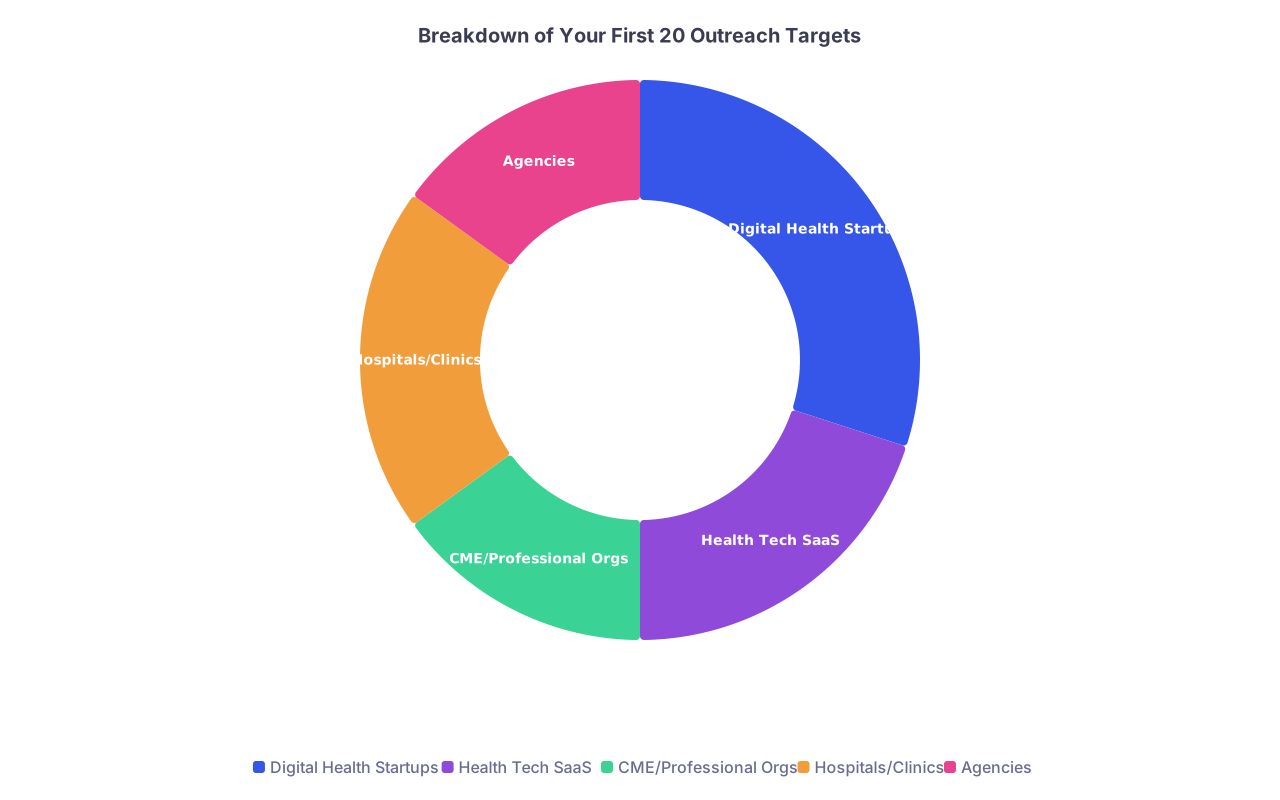
| Category | Value |
|---|---|
| Digital Health Startups | 6 |
| Health Tech SaaS | 4 |
| CME/Professional Orgs | 3 |
| Hospitals/Clinics | 4 |
| Agencies | 3 |
Find targets fast
You are looking for specific humans with content budgets, not generic “info@” black holes.
Search:
LinkedIn:
- “Content marketing manager” + “healthcare”
- “Medical education director”
- “Clinical content lead”
Company websites:
- Careers page: if they are hiring writers or content marketers, they spend money on content.
- “Blog,” “Resources,” “For patients,” “For clinicians” sections.
CME companies and specialty societies:
- Look for “Education” or “Publications” contacts.
Make a simple spreadsheet:
- Company
- Contact name
- Role
- Email / LinkedIn URL
- Date contacted
- Result / follow‑up date
Cold email template (for companies already publishing content)
Subject options:
- “Clinician‑written content support for [Company]”
- “Telehealth patient content – physician writer”
- “CME content help from practicing [specialty]”
Email body:
Hi [Name],
I am a [your specialty] physician with [X years] of clinical experience and a focus on [niche]. I help [type of companies] create [type of content] that [simple business outcome].
I have attached / linked a few short samples:
– [Title] – [1 line on what it does]
– [Title] – [1 line]I noticed you are publishing [blog posts / patient guides / CME modules] on [topic or area]. If you are looking for a clinician who can write clear, accurate content and understands both patient concerns and workflow realities, I would be glad to help.
Typical projects I handle:
– [2–3 project types you want]Would it be useful to set up a 15‑minute call to see if I might support your team this quarter?
Best,
[Name, credentials]
[Short positioning line]
[Link to portfolio or LinkedIn]
Short. Specific. Demonstrates you did more than copy‑paste.
LinkedIn message variation (when you do not have email)
Hi [Name], I am a [specialty] physician who writes [type of content] for [type of client]. I like the work [Company] is doing around [brief note].
I have helped similar teams with [1–2 project types]. If you ever use external writers, I would be glad to send 2–3 relevant samples for future consideration.
Best, [Name]
If they respond, then you move to email and send the fuller note with samples.
Follow‑up protocol
Most people quit after one try. Do not.
Use this simple sequence:
- Day 0: Initial email
- Day 7–10: Follow‑up #1 (“Just checking if this landed on your radar…”)
- Day 21–30: Follow‑up #2 (“Last note from me unless I hear back…”)
Follow‑up #1:
Hi [Name],
Just a quick follow‑up on my note about medical writing support for [Company]. Totally understand if now is not the right time.
If you ever need a clinician writer for [X/Y projects], I would be glad to send over a couple of highly relevant samples.
Best,
[Name]
Follow‑up #2:
Hi [Name],
Last note from me on this. If you are all set for content right now, no problem at all.
If things change and you would like clinician‑written support for [specific area], you can find a few samples here: [link].
Best,
[Name]
Then move on. You need volume, not emotional attachment to any single lead.
Step 6: Where Your First 3–5 Clients Usually Come From
They are not magically discovered. They come from deliberate, unglamorous sources.

| Step | Description |
|---|---|
| Step 1 | Decision to Monetize Writing |
| Step 2 | Build Portfolio Samples |
| Step 3 | Optimize LinkedIn and Simple Site |
| Step 4 | Leverage Existing Medical Network |
| Step 5 | Targeted Cold Outreach |
| Step 6 | Freelance Platforms and Job Boards |
| Step 7 | First Referral Client |
| Step 8 | Small Project Test Client |
| Step 9 | Good Delivery and Testimonial |
| Step 10 | Repeat Work and Referrals |
1. Your existing medical network
Underused gold mine.
- Colleagues doing admin or leadership roles
- Hospital marketing departments
- Specialty societies you are involved with
- Old residency program directors, chiefs, faculty
Send a short, non‑awkward message:
Subject: Side work in medical writing
Hi [Name],
I have started taking on a small amount of paid medical writing work, focused on [niche]. Projects include [2–3 types].
If you hear of anyone needing this kind of help (hospital marketing, CME, digital health, etc.), I would appreciate it if you would keep me in mind. I am happy to share a few sample pieces.
Hope you are doing well,
[Name]
You are not begging. You are informing. There is a difference.
2. Targeted cold outreach (Section 5)
This will feel uncomfortable for about a week. Then it becomes a numbers game.
Aim for:
- 5–10 targeted outreach messages per week for the first 2–3 months
That is it. That is how you seed a pipeline.
3. Strategic platforms, not race‑to‑the‑bottom sites
Avoid places where everyone is bidding $30 for 2000‑word “medical blogs.” You are a physician. Act like it.
Reasonable starting points:
- LinkedIn – posting short, educational content in your niche and connecting with content leads
- Specialized job boards:
- AMWA (American Medical Writers Association)
- Professional society career pages
- Health tech / startup job boards (search “contract writer,” “medical writer,” “content”)
You can use one or two general freelance platforms as a testing ground if you are disciplined:
- Filter for “medical writer,” “physician writer,” “clinical content”
- Ignore absurdly low budgets
- Apply to 2–3 that seem aligned and well‑funded
- Use them for testimonials / first portfolio items if they pay reasonably
Step 7: Turn One‑Off Projects Into Ongoing Income
The real money is not in random one‑off gigs. It is in ongoing relationships.
Here is how you systematize that.
After a successful first project
Send a simple “after action” note:
Hi [Name],
Glad to hear the [article / case study] landed well and your team is happy with it.
If you would like, I can suggest 3–4 additional topics that would fit your audience and goals around [X]. I find that consistent content performs better than one‑off pieces.
Would you like me to send a short list of proposed topics and estimated fees?
Best,
[Name]
Then:
- Pitch a mini‑package (e.g., 3 articles over 6 weeks)
- Offer a small discount for bundling, if you want, but do not undercut yourself
Example:
“Three 1000–1200 word articles at $450 each, or $1200 if booked together for the next 6 weeks.”
Ask for a testimonial (or at least permission)
Once something goes live:
“Would you be comfortable with me mentioning this project in my portfolio, and perhaps a short comment from you about working together?”
Even 1–2 lines help you raise rates.
Step 8: Protect Your Time and Sanity
You are still a physician. You cannot let this side hustle become another full‑time job (unless that is the goal later).
Set some hard rules early:
- Maximum hours per week: Decide your cap (e.g., 5–10 hours). Stick to it.
- Turnaround times: Do not promise unrealistic deadlines. “7 business days” is fine.
- Revision boundaries: One included round of revisions. State it in writing.
- Communication channels: Email > endless Zoom. Say so.
Use a basic project tracker:
- A simple spreadsheet or Trello / Notion board with:
- Client
- Project
- Status
- Draft due date
- Final deadline
- Invoice date / paid status
You are aiming for predictable small wins, not heroic all‑nighters.
FAQ (Exactly 2 Questions)
1. Do I need formal medical writing courses or certificates before I start charging?
No. Courses and certificates are nice add‑ons, not prerequisites. Your clinical experience is already valuable. What clients care about first:
- Can you write clearly for their audience?
- Do you hit deadlines?
- Do you reduce, not increase, their workload?
If you want structure, one short AMWA course or similar can help you avoid rookie mistakes. But do not wait for a certificate before sending pitches. Build 3–5 strong samples and start small. You can always layer in credentials later.
2. How much can a physician realistically earn from medical writing as a side hustle?
Numbers vary wildly, but realistic early targets:
- Months 1–3: $500–$1500 per month as you build samples and land first clients
- Months 4–12: $1500–$4000 per month if you maintain 5–10 hours per week and keep a steady client list
- Beyond a year: $4000+ per month is common for physicians who niche down, raise rates, and keep 3–5 solid, recurring clients
The ceiling is higher if you move to part‑time clinical work or full‑time writing/consulting. The foundation is the same: focused niche, clear samples, consistent outreach, and boundaries that keep the work sustainable.
Key points, so you actually move:
- Pick a narrow, high‑value niche and build 3–5 laser‑relevant samples.
- Use simple, repeatable templates for calls, outlines, projects, and pitches.
- Commit to consistent outreach and turn one small win into ongoing work.