
The worst mistake physicians make with side hustles is not taxes. It is running real revenue through a fake business structure. You fix that by getting your LLC and compliance done fast, clean, and in the right order.
You want to go from idea to legally billable entity in days, not months. You also want to avoid the traps: accidentally practicing medicine through the wrong entity type, mixing personal and business funds, or creating an IRS headache that eats your entire “extra” income.
Let me walk you through a direct, no-drama build: from “I think I could consult / coach / review charts” to “I just sent my first invoice from my LLC and it is compliant.”
Step 1: Decide Exactly What This LLC Will Do (And What It Will Not Do)
Most physicians skip this. Then they ask a lawyer a vague question and pay for an hour of confusion.
You start by defining the scope of the side hustle, in plain English. Because what you do drives:
- Whether you need a Professional LLC (PLLC) or standard LLC
- Whether you trigger medical board rules or Stark/AKS issues
- Whether you need extra insurance and licenses
- How risky this entity really is
Bucket your idea: clinical vs non-clinical
Write your idea in one sentence. Then put it into a bucket:
Bucket A – Clearly NON-clinical (usually OK as a normal LLC)
No diagnosis, no prescribing, no ordering tests, no altering patient care.
Examples:
- Expert witness work
- Legal chart review for attorneys
- Non-clinical consulting (pharma advisory boards, medtech usability input)
- Cohort-based teaching, online courses, paid webinars
- Non-medical coaching (productivity, career transitions, study skills)
- Writing, speaking, content creation, paid newsletters
Bucket B – “Gray zone” / possibly clinical
Examples:
- “Telehealth-like” second-opinion services
- Direct-to-consumer health education programs that feel close to diagnosis
- Personalized protocol design, even if you say “for education only”
- Any service where you talk about their symptoms and their labs
Bucket C – Clearly CLINICAL (medical practice)
Examples:
- Telemedicine visits
- In-person or virtual direct primary care
- Procedure-based micro-practice
- Concierge practice side gig
Why this matters:
- Bucket A: In many states you can often use a standard LLC as a “consulting / services” business.
- Buckets B and C: You may need a PLLC or professional corporation, and you absolutely must check medical board rules and corporate practice of medicine laws.
If you are in Bucket A and want to move quickly, good. You can.
If you are in Bucket B or C, the right move is: pause and get a 30–60 minute consult with a healthcare attorney licensed in your state. Not your cousin’s real estate lawyer. A real health-law person.
Step 2: Check Your State Rules Before You Click Anything
Now you know what you want to do. Next: confirm you are allowed to do it the way you intend.
Two things to verify in your state
Does your state require a PLLC for professional services?
Many states require that if the business is practicing medicine, you must form a PLLC or professional corporation, often owned only by licensed physicians.Does your employer contract restrict side work?
Look at:- “Outside employment” or “moonlighting” clauses
- Non-compete or non-solicitation terms
- “Intellectual property” assignments (for courses, apps, content)
- “Conflicts of interest” language (especially academic centers)
If your side hustle is:
- Non-clinical
- 100% separate from employer resources, patients, and time
- Allowed by contract (or at least not restricted)
…then you can usually move ahead quickly.
If you find:
- “No outside clinical work without permission” – ask for written approval if relevant.
- “All inventions / content created during employment belong to employer” – you might need to:
- Develop the product on your own time with your own resources
- Or negotiate carve-outs
Do not guess. One email to HR or legal saying, “I’m planning to do X under an LLC. Any conflict with my current contract?” can prevent a career-level headache.
Step 3: Name and Structure Your LLC the Smart Way
Fastest path is not the same as smartest. You want both.
Pick a name you can live with
Rules of thumb:
- Avoid the word “medical” if you are not practicing medicine in this entity.
- Use neutral terms: “consulting,” “solutions,” “advisory,” “education,” “services.”
- Check for:
- State business registry (make sure the name is available)
- Basic domain availability (even if you do not build a site yet)
- Obvious trademark conflicts (quick USPTO search helps)
Example names:
- Horizon Physician Consulting LLC
- White Oak Clinical Advisory LLC
- Apex MedEd Services LLC
If you might someday expand into courses, speaking, consulting for industry—avoid hyper-specific names like “Midwest Prior Auth Experts LLC.”
Decide where to form your LLC
Ignore the Reddit noise about Delaware and Wyoming — for a small physician side hustle, 90% of the time you form the LLC in the state where you live and work.
Why:
- You avoid having to register as a “foreign LLC” in your own state
- You keep tax filing and annual reports simple
- You avoid surprise fees
Form in another state only if:
- You are specifically advised by a healthcare/tax attorney; and
- You understand you will probably still register in your home state anyway
Step 4: Form the LLC (or PLLC) – The Exact Steps
Now to the part people overcomplicate. Here is the clean sequence.
4.1 Use the state website first, not a random third-party
Go to your state’s Secretary of State or Corporations Division website. Look for:
- “Form a New Business”
- “Domestic Limited Liability Company” or “Professional Limited Liability Company”
Very often you can file online in 10–20 minutes.
You will usually need:
- Business name
- Business address (can be home, virtual office, or registered agent address; check your comfort with public records)
- Registered agent (someone who can receive legal documents during business hours – often you)
- Management structure: “member-managed” is fine for solo
- The business purpose: use something broad like “professional consulting services” if non-clinical
If PLLC is required:
Expect:
- Proof of your medical license
- Sometimes approval from your state medical board before the Secretary of State will accept your filing
Turnaround: often same day to 1–2 weeks depending on state.
4.2 Consider a registered agent service if you want privacy
If you do not want your home address on public record:
- Use a registered agent service (typically $100–$200/year)
- Some also give you a mailing address and scan your mail
This matters if you are a public-facing physician, do controversial work, or just do not want your home address searchable in 2 seconds.
Step 5: Get Your EIN and Basic Paperwork in Place
Once your LLC is approved, you immediately do two things:
Get an EIN from the IRS (free, online).
- Use the official IRS website
- Apply as “Limited Liability Company”
- Owner = you (or you and partners, if any)
- Save that EIN letter PDF like your medical license
Draft a simple Operating Agreement.
Even if you are solo.
It does not have to be 40 pages of legalese. But it should say:- Who owns the LLC
- How profits are distributed
- What happens if you shut it down or add partners later
For a single-member LLC, this can be a short document. But having it:
- Strengthens your liability separation
- Makes banks and accountants happier
- Helps if you are ever audited
Step 6: Open a Proper Business Bank Account and Payment Setup
This step is where “side hustle” becomes a real business. You must separate money.
6.1 Open a business checking account
Bring or upload:
- LLC approval/Articles of Organization
- EIN letter
- Your ID
- Operating Agreement (sometimes)
Non-negotiable rules:
- All business income goes into this account.
- All business expenses come out of this account.
- You do not use this account to buy groceries, vacations, or your kid’s soccer gear.
You can pay yourself by:
- Writing yourself a check labeled “Owner Draw”
- Transferring from business account to your personal account as “Owner Distribution”
6.2 Decide how you will get paid
You are not a hospital billing department. Keep it simple and clean.
Common options:
- ACH / bank transfers: Best for B2B consulting, expert witness, advisory boards
- Check: Slow but fine if you are invoicing law firms or corporations
- Stripe/PayPal/Square: Useful for online courses, coaching, or productized services
- Practice management/telehealth platforms: If you are doing legal clinical work, use healthcare-grade systems
Whatever you choose, run it through the business bank account.
Step 7: Make Your Services and Rates “Invoice-Ready”
Before you send your first invoice, you need clarity on:
- What exactly you are delivering
- How you are charging (hourly, flat fee, retainer, per unit)
- Your standard terms

| Category | Value |
|---|---|
| Expert Witness | 400 |
| Industry Consulting | 300 |
| Coaching | 200 |
| Courses | 150 |
(Values represent typical hourly or equivalent effective rates in USD for many physicians. Your numbers may be higher or lower, but the structure holds.)
7.1 Define packages, not just a vague “consulting” label
Example for a non-clinical consulting LLC:
- Package 1: 60-minute consultation + written summary – $400
- Package 2: 5-hour block of advisory support, valid 90 days – $1,800
- Package 3: Ongoing retainer – $3,000/month for up to 10 hours
Example for expert witness LLC:
- Record review: $500/hour
- Deposition: $600/hour, 4-hour minimum, paid in advance
- Trial: $700/hour, 4-hour minimum, paid in advance
- Travel time: $300/hour
Get these onto one internal document. You can adjust later. But you never want to “wing it” when someone asks, “What are your rates?”
Step 8: Build a Simple, Compliant Invoicing System
You do not need enterprise software. You do need structure.
8.1 Choose a lightweight invoicing method
Good options:
- Wave, Zoho Invoice, or similar free/low-cost tools
- QuickBooks Online if you want accounting built in
- At minimum, a clean invoice template in Google Docs / Word / Excel
Your invoice must have:
- Your LLC name, address, email, phone
- Your EIN (optional, but often requested by corporate clients)
- Client name and address
- Unique invoice number
- Date of invoice and payment due date
- Clear description of services
- Amount due and payment instructions
Example description lines:
- “Physician consulting – 3 hours at $300/hr – advisory board preparation and meeting”
- “Expert witness services – record review – 4 hours at $500/hr”
8.2 Lock down your standard payment terms
Default for first-timers:
- Net 15 or Net 30 (15 or 30 days from invoice date)
- Late fee terms if you want them (often unnecessary for large corporate clients)
Spell out:
- Accepted payment methods
- Who covers payment platform fees (e.g., 3% credit card fees)
This makes collections boring, not emotional. That is exactly what you want.
Step 9: Address Compliance: Licensure, Insurance, Documentation
This is where your physician brain helps. You already think in risk and rules. Use that.
9.1 Are you practicing medicine? Then:
You must:
- Be licensed in the state(s) where patients are located
- Follow state telehealth and scope-of-practice regulations
- Carry malpractice insurance that covers the specific side activity
- Use HIPAA-compliant systems for any PHI
If your LLC activity is non-clinical, you can still reduce risk by:
- Avoiding individualized medical advice entirely
- Using clear disclaimers:
- “This service does not provide medical care, diagnosis, or treatment.”
- “No physician-patient relationship is created.”
And never blur the line:
- No prescribing
- No specific treatment recommendations for an identifiable patient
- No modifying another clinician’s plan of care
9.2 Business insurance
At minimum, consider:
- Professional liability / E&O insurance for consulting or coaching
- General liability if you ever see clients in person or host events
For pure online non-clinical work, a small E&O policy is often adequate. For clinical work, coordinate malpractice and entity coverage with a specialized broker.
| Side Hustle Type | Key Insurance |
|---|---|
| Expert witness | E&O / professional |
| Industry consulting | E&O / professional |
| Coaching (non-medical) | E&O / general liability |
| Online courses | E&O / cyber (optional) |
| Telemedicine practice | Malpractice + entity |
Step 10: Get Tax and Entity Treatment Right from Day One
Here is where many physicians wake up in April swearing. You avoid that by making 3 decisions early.
10.1 Decide how the LLC will be taxed (at least for year one)
For most new, simple, solo physician LLCs:
- Default IRS treatment as disregarded entity / sole proprietorship is fine for year one.
- You file your business income on Schedule C of your personal return.
Once your net income grows (often $80k–$100k+), you talk with a CPA about:
- Electing S-corporation status to reduce self-employment tax
- Paying yourself a “reasonable salary” and taking distributions
Do not elect S-corp blindly on day one because a YouTuber said so.
10.2 Start tracking income and expenses immediately
Bare minimum:
- A spreadsheet with:
- Date
- Client
- Description
- Income amount
- Expense category
- Receipt link
Better:
- Use simple accounting software (QuickBooks, Xero, or even Wave)
Standard deductible expense categories for a small physician LLC:
- Licensing and professional fees
- CME and professional education tied to your side hustle
- Software (Zoom, email, accounting, project tools)
- Home office portion (talk to a CPA about correct method)
- Marketing, website, domain, design
- Legal and accounting fees
- Travel related to client work
Step 11: Build a Minimal “Professional Presence” in One Afternoon
You do not need a full website and a content strategy before your first invoice. But you should look like a real business when someone Googles you.
Minimum viable presence:
Professional email using your domain
- [email protected], even if the site is not live yet
LinkedIn profile updated
- Add a position: “Founder, [LLC Name] – Physician Consulting”
- Short description of your services
Simple one-page site (optional but nice)
- Your name and credentials
- What you do, in 3–4 bullet points
- How to contact you
This is enough to pass the “is this person real?” test for most corporate or legal clients.

Step 12: Workflow: From Lead to Invoice to Payment
Let me give you a simple process flow you can literally follow tomorrow.

| Step | Description |
|---|---|
| Step 1 | Inquiry from client |
| Step 2 | Quick email or call |
| Step 3 | Confirm scope and rate |
| Step 4 | Send short engagement email |
| Step 5 | Do the work |
| Step 6 | Send invoice |
| Step 7 | Receive payment |
| Step 8 | Record income and file documents |
Add detail:
Inquiry comes in (email, LinkedIn, referral).
You respond with:
- “Here is what I do.”
- “Here is my rate.”
- “Here is the deliverable and timeline.”
If they agree:
- For larger engagements: send a simple letter of engagement or contract.
- For small one-offs: confirm via email and proceed.
Do the work. Track hours or deliverables as you go.
Send invoice within 24–48 hours of completing the agreed work (or per milestone).
Record payment when it hits the business bank account.
File the work product, invoice, and any related emails in a client folder.
That is your from-idea-to-invoice engine.
Step 13: Common Mistakes Physicians Make (And How To Avoid Them)
I have seen these repeatedly.
Using personal Venmo or Zelle for business income
- Fix: Open the business account and link proper payment tools. Keep personal and business separate.
Mixing clinical and non-clinical work in one entity in a messy state
- Fix: If clinical care is involved, talk to a health-law attorney. You might need a PLLC or even separate entities.
Ignoring employer contracts
- Fix: Re-read your contract tonight. Highlight anything about outside work. Send one clarifying email if needed.
Delaying the LLC until “after I see if this works”
- Fix: If you are already making money, you are already in business. Formalize it. Retroactive panic is worse.
Overbuilding before the first dollar
- Fix: You do not need a logo, trademark, full website, paid ads, or complex funnel. You need: LLC, EIN, bank, rates, simple invoice.
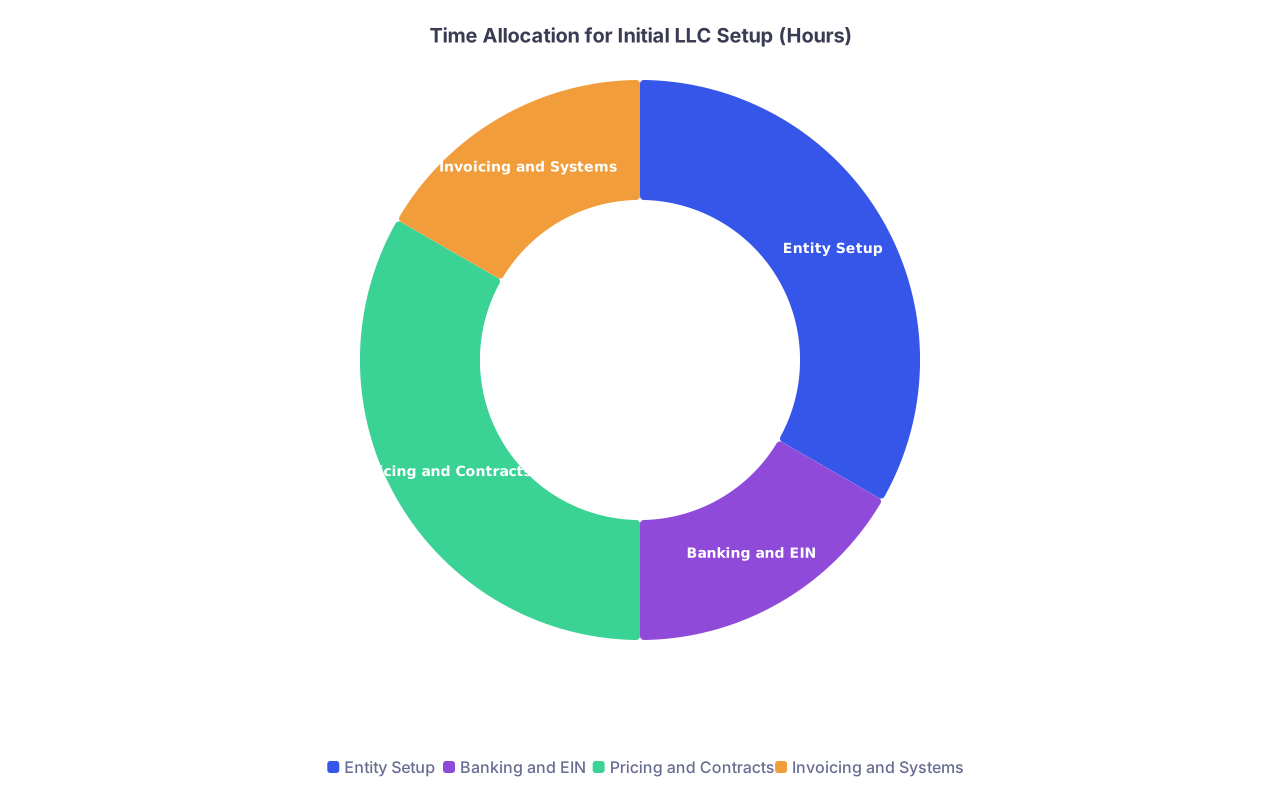
| Category | Value |
|---|---|
| Entity Setup | 2 |
| Banking and EIN | 1 |
| Pricing and Contracts | 2 |
| Invoicing and Systems | 1 |
This is not a multi-month project. It is a 1–2 day focused sprint.
Your 24-Hour Action Plan
Here is how you move from vague idea to real entity fast.
Tonight (1–2 hours):
- Write a one-sentence description of what your LLC will do.
- Bucket it: non-clinical vs clinical.
- Re-read your employment contract for outside work clauses.
- Draft a rough list of services and ballpark rates.
Tomorrow (2–3 hours):
- Check your state’s business entity search and confirm a name.
- Form the LLC/PLLC on your state site.
- Apply for an EIN on the IRS site.
- Draft a simple Operating Agreement.
Next 2–3 days (2–4 hours):
- Open a business bank account.
- Set up a basic invoicing tool or template.
- Create a simple rate sheet and engagement email template.
- Update LinkedIn and, if you can, create a one-page site.
Then say yes to the next reasonable opportunity that comes your way. With structure behind it.