

The biggest lie about physician side hustles is that you “don’t have time.” You do—just not if you wing it week to week.
You need a year plan. Quarter by quarter. With hard decisions, clear milestones, and built-in guardrails so your side hustle grows without wrecking your clinical life or your sanity.
Here’s your playbook for one full “Side Hustle Year” as a busy physician—whether you’re starting from zero or formalizing something you’ve been dabbling in: consulting, telemedicine, coaching, content, a niche practice, or tech/AI work.
We’ll run this as a 12‑month, quarter-by-quarter timeline, then zoom into weeks when it matters.
Quarter 1 (Months 1–3): Decide, Design, and Protect Your Time
At this point, you should stop “thinking about a side gig” and actually commit to one lane.
If you’re trying to “maybe do coaching, maybe real estate, maybe a YouTube channel,” you’re not building a business. You’re procrastinating.
Month 1: Pick Your Lane and Set Constraints
Week 1: Draw the hard lines
You start here, not with logos or websites:
- Maximum side hustle hours per week (realistic for a physician):
- Full-time attending: 4–8 hrs/week
- Resident/fellow: 2–4 hrs/week
- Protected days: e.g., “No side work post-call,” “Nothing on clinic days after 8 pm.”
- Burnout rules: What are the early warning signs you’ll watch? (Snapping at staff, charting backlog, skipping workouts.)
Write this down. In plain language. If you ignore this later, that’s a choice.
Week 2: Choose 1 primary side hustle
Examples that actually fit a physician schedule:
- Expert consulting (med-legal review, pharma, startups, payer advisory)
- Telemedicine/locums (if you want straightforward extra income)
- Physician coaching or career advising
- Content/education business (CME courses, niche newsletter, online course)
- Clinical niche micro-practice (e.g., migraine clinic 1 day/month, ADHD consults)
- AI/health tech collaboration (advisory, product validation, prompt/UX design)
Pick one as primary for this year. You can layer later. Not now.
Week 3–4: Define your offer and audience
Answer these in writing:
- Who exactly do you serve? (Not “people who need help.” Try “overworked hospitalists 2–10 years out of residency” or “digital health startups pre-Series B.”)
- What painful problem are you solving?
- What’s your paid offer? (Not free content. Money.)
- Example: “90-minute clinical workflow consult for digital health startups – $1,000”
- Example: “3‑month burnout coaching package – $1,500”
- Example: “Asynchronous telederm consults – $XX per case”
Your Month 1 milestone:
One specific paid offer, one clearly defined audience, and written time boundaries.
Month 2: Build the Minimum Viable Infrastructure
At this point, you should stop fiddling with “research” and actually stand something up that can accept money.
Week 1: Legal/structural basics
You don’t need a 40‑page business plan. You do need to not be reckless.
Minimum set-up (US-centric, adjust locally):
- Choose a business name (or just your name + MD).
- Register an LLC or similar simple entity in your state.
- Get an EIN (takes ~5 minutes on IRS site).
- Business bank account. Separate from personal. Non-negotiable.
- Malpractice / professional coverage check:
- If it’s clinical (telemed, micro-practice): talk to your carrier.
- If it’s non-clinical (consulting, coaching): consider a simple professional liability policy.
Week 2: Payment + scheduling
Set up:
- Payment: Stripe, PayPal Business, Square, or platform-integrated billing.
- Scheduling: Calendly, Acuity, or simple booking tool.
- Document templates:
- Service agreement or engagement letter
- Informed consent (for clinical/coaching as needed)
- Simple invoice template if not using built-in billing
Week 3–4: Basic digital presence
You don’t need a fancy website. You need credibility in one glance.
Minimum viable setup:
- A single simple landing page (Carrd, Squarespace, or Webflow template) with:
- Who you are (one tight paragraph, not your full CV)
- Who you serve
- What you offer + starting price point or “from $X”
- How to book / contact
- A clean LinkedIn profile updated for your side role:
- Headline: “Hospitalist | Healthcare Consultant for Digital Health Startups”
- Add a “Services” or “Consulting” section.
- Optional but useful: one-page PDF “services sheet” you can email.
Month 2 milestone:
You can send a single link to someone and they can (a) understand what you do and (b) pay you.
Month 3: Test the Market and Book Your First 3–5 Clients
By now you should be done “setting up” and start doing the only thing that tells you if this works: talk to people and sell.
Week 1–2: Direct outreach (yes, you have to)
You don’t need 10,000 followers. You need the first 3–5 paying engagements. Start with:
- 10–20 targeted messages:
- Former colleagues
- Program directors
- Startup founders you know
- Prior residents/fellows
- Message template (adapt, don’t copy-paste robotically):
“Hey [Name], I’ve started working with [audience] on [problem]. I’m taking on 3–4 beta clients at a reduced rate while I refine the process. If you or someone you know at [org/type] could use help with [specific outcome], happy to share details.”
Offer a beta rate that still respects your time. Discount, don’t give away.
Week 3–4: Deliver, document, and refine
For every paid engagement:
- Track:
- Time spent
- What parts of the work felt heavy vs. easy
- What the client actually cared about vs. what you assumed
- Collect:
- A short testimonial (even 2–3 sentences)
- Permission to use their org logo if relevant
- Adjust:
- Your pricing (if you underpriced badly, fix it for the next one)
- Your offer scope (cut the fluff, emphasize the parts that got results)
End of Quarter 1, you should have:
- A legal and financial structure.
- A real, paid offer.
- At least 3 beta clients or paid uses of your services. If you have zero, your problem is outreach and clarity, not “the market.”
Quarter 2 (Months 4–6): Systematize and Decide If This Scales
At this point, you should know whether your side hustle deserves more oxygen or needs a pivot.
Month 4: Analyze and Decide Your Growth Path
Week 1: Brutal reality check
Ask and answer honestly:
- Am I energized or drained after doing this work?
- Is the hourly effective rate (revenue ÷ true hours) at least 2–3x my clinical rate potential?
- If not yet, can it realistically get there with better pricing/systems?
- Did I have to violate my time boundaries to make it work?
If the answers are consistently bad, you pivot now, not in Month 11.
Week 2–4: Pick a growth strategy
Choose one primary growth lever for the next 3–6 months:
- Referral-based: Deepen relationships and build a tight referral network.
- Content-based: Become the “go-to” on a niche topic via LinkedIn, Substack, or YouTube.
- Platform-based: Telemed platforms, consulting marketplaces, expert networks.
| Path Type | Fastest Income | Scales Well | Time Flexibility |
|---|---|---|---|
| Telemedicine | Yes | Limited | High |
| Expert Consulting | Moderate | High | Medium |
| Coaching | Slow | High | Medium |
| Content/Courses | Slow | Very High | High |
| Niche Micro-practice | Moderate | Moderate | Low-Medium |
Pick one main path, maybe one supporting path. That’s it.
Month 5: Build Simple Systems
At this point, you should stop doing everything manually.
Client workflow system
Create:
- A repeatable onboarding sequence:
- Inquiry → short call → proposal/offer → payment → scheduling → delivery
- Standardized documents:
- One core proposal template
- One standard intake form
- One follow-up / summary template
Time system
Block your calendar for side work at the same time each week:
- Example: “Tuesdays 7–9 pm, Saturdays 9–11 am” = 4 hrs/week.
- Protect those like OR time. If you constantly cancel your own block, you’re not serious.
Use a simple task manager (Todoist, Notion, ClickUp—pick one) with:
- “This Week” board
- “Pipeline / Leads” list
- “Projects” board (for multi-step client work or course builds)
Month 6: Increase Pricing and Decide Your Ceiling
At this point, you should not still be charging “beta” rates.
Week 1–2: Raise prices
If:
- Clients were happy
- You have more inquiries than you can handle in your limited hours
Then:
- Increase price by 25–50% for new clients.
- Tighten scope: fewer deliverables, clearer outcomes.
Week 3–4: Define your ceiling
You’re a physician, not a full-time freelancer (unless that’s the long-term goal). Decide:
- Maximum monthly revenue you want from the hustle this year
(Example: $3–5k/month for residents, $10–15k/month for attendings.) - Maximum hours/month (often 16–32 hrs/month).
Use this to decide whether to stay solo premium (fewer, higher-priced clients) or volume (lots of telemed shifts). One is not morally better, but for most overworked docs, premium + fewer clients wins.
End of Quarter 2, you should have:
- A validated offer
- Simple systems
- Non-trivial revenue and a sense of where this is going
Quarter 3 (Months 7–9): Build Assets That Compound
This is the quarter where you stop trading every extra dollar for hours and start building leverage.
Month 7: Create One Signature Asset
At this point, you should have repeated the same explanations so often you’re sick of hearing yourself. Good. Turn that into an asset.
Pick one:
- A flagship presentation / webinar you can reuse.
- A standardized framework or methodology (3–5 steps) that becomes your brand.
- A mini-course or workshop you can sell live or on-demand.
Focus on a single, sharp outcome.
Instead of:
“Physician career coaching”
Try:
“90-minute workshop: How hospitalists can negotiate a 20% raise without changing jobs.”
Build:
- Clear outline
- Slides or talking points
- Supporting worksheet or checklist
Month 8: Grow Visibility Without Burning Out
You do not need to post 4 TikToks a day. You need consistency in one channel.
Pick one primary content channel:
- LinkedIn (excellent for B2B, consulting, startup work)
- Email newsletter (for long-term audience building)
- YouTube (slower build, higher ceiling)
- Niche podcast guesting (fast credibility if you already have connections)
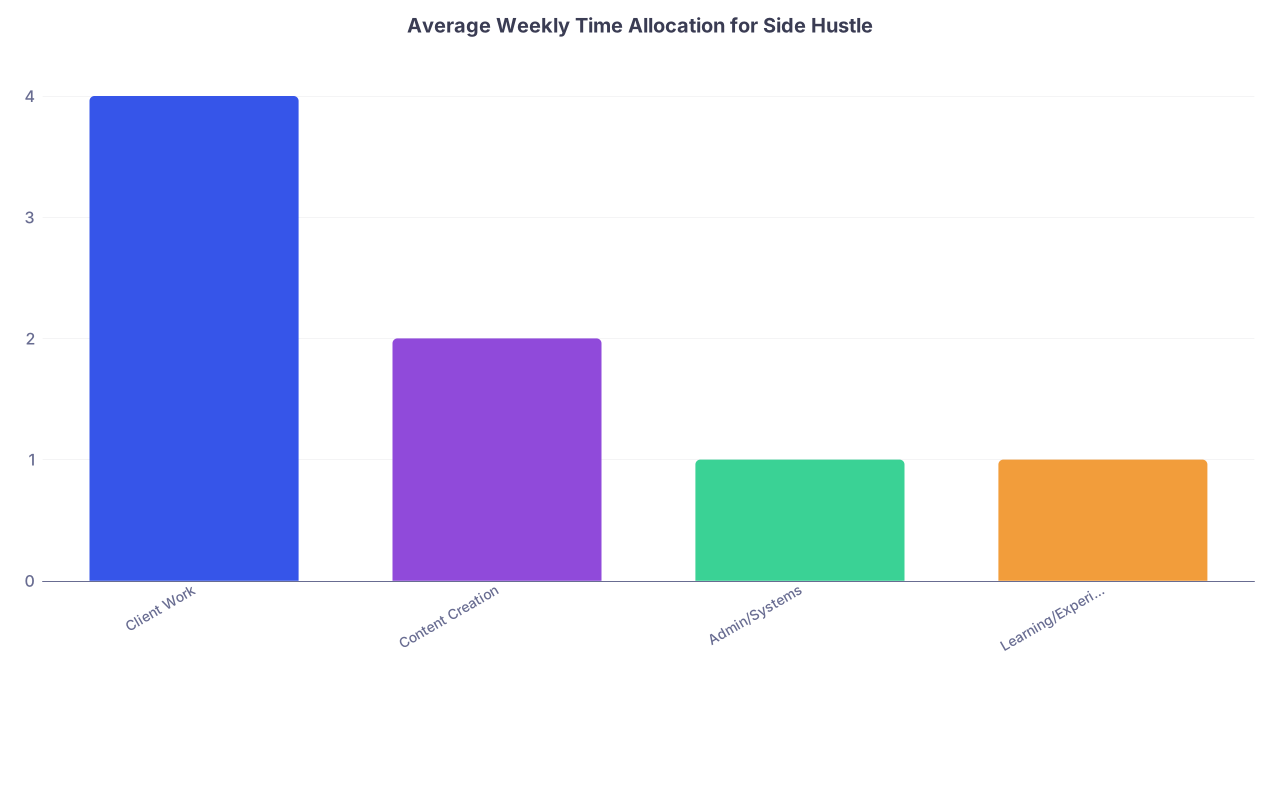
| Category | Value |
|---|---|
| Client Work | 4 |
| Content Creation | 2 |
| Admin/Systems | 1 |
| Learning/Experimenting | 1 |
For a busy physician, a realistic weekly content cadence:
- 1–2 short posts (LinkedIn or similar)
- 1 longer piece every 2–4 weeks (newsletter, blog, video)
Batch this:
- 1 hour every other week to outline.
- 1–2 hours to create and schedule.
Month 9: Experiment With Scalable Offers
At this point, you should test one scalable layer:
- Group coaching program
- Paid workshop (live, small group)
- Low-ticket digital product (template pack, guide, checklist)
- Small online course
Keep it lean:
- No giant 20-module course.
- Aim for something you can create and deliver in 4–6 focused hours.
Price it so you don’t hate yourself if only 5 people buy, and don’t resent it if 50 people join.
Examples:
- $97–$297 live workshop
- $497–$1,500 group coaching over 4–8 weeks
- $29–$99 downloadable template or guide
End of Quarter 3, you should have:
- At least one reusable flagship asset
- A consistent (not heroic) content routine
- A first experiment in scalable income, even if small
Quarter 4 (Months 10–12): Optimize, Automate, and Align With the Future of Medicine
This is where you stop thinking “side hustle” and start thinking long-term leverage in a healthcare system that’s changing fast.
Month 10: Automate Ruthlessly
At this point, you should treat anything repetitive as a bug.
Automate or semi-automate:
- Scheduling & reminders
- Auto-confirmations and reminders from Calendly/Acuity.
- Onboarding
- Automated welcome email with intake links and expectations.
- Follow-ups
- Pre-written “2 weeks later” check-in emails.
- Content
- Use tools to repurpose one long post into short snippets.
Also decide what to stop doing:
- Low-yield platforms where no clients have ever come from.
- Over-customized proposals that always end up with the same structure.
Month 11: Tie Your Hustle to the Future of Medicine
If your side hustle doesn’t align with where healthcare is actually going, you’re building a relic.
Look at the intersection:
- AI and automation
- Are you advising on AI deployment?
- Are you using AI to increase your throughput (drafting documents, structuring reports, analyzing patterns) while staying firmly within ethical and legal boundaries?
- Telehealth and remote care
- Can your niche micro-practice go partly virtual?
- Can your consulting help organizations transition workflows?
- Value-based care and outcomes
- Can you measure and present outcomes from your work in ways that matter to systems and payers?

| Category | Value |
|---|---|
| AI/Tech Advisory | 25 |
| Telehealth & Virtual Care | 25 |
| Education & Content | 20 |
| Coaching/Mentorship | 20 |
| Other | 10 |
Position your side hustle as future-resilient:
- Update your messaging to explicitly reference:
- AI/tech
- Remote/hybrid work
- System-level outcomes
Example:
Instead of “I help clinics improve documentation,”
Go with “I help clinics redesign documentation workflows to work with AI tools instead of fighting them.”
Month 12: Evaluate, Decide, and Reset for the Next Year
At this point, you should treat your side hustle like a micro-practice review.
End-of-year review (take 2–3 hours, uninterrupted)
Look at:
- Numbers
- Total revenue
- Total expenses
- Estimated hours spent
- Effective hourly rate
- Sources
- Where did your best clients come from?
- Which offers produced most revenue with least stress?
- Energy
- What work made you feel more alive vs. threadbare?
- What did you dread? (That’s a cut candidate.)
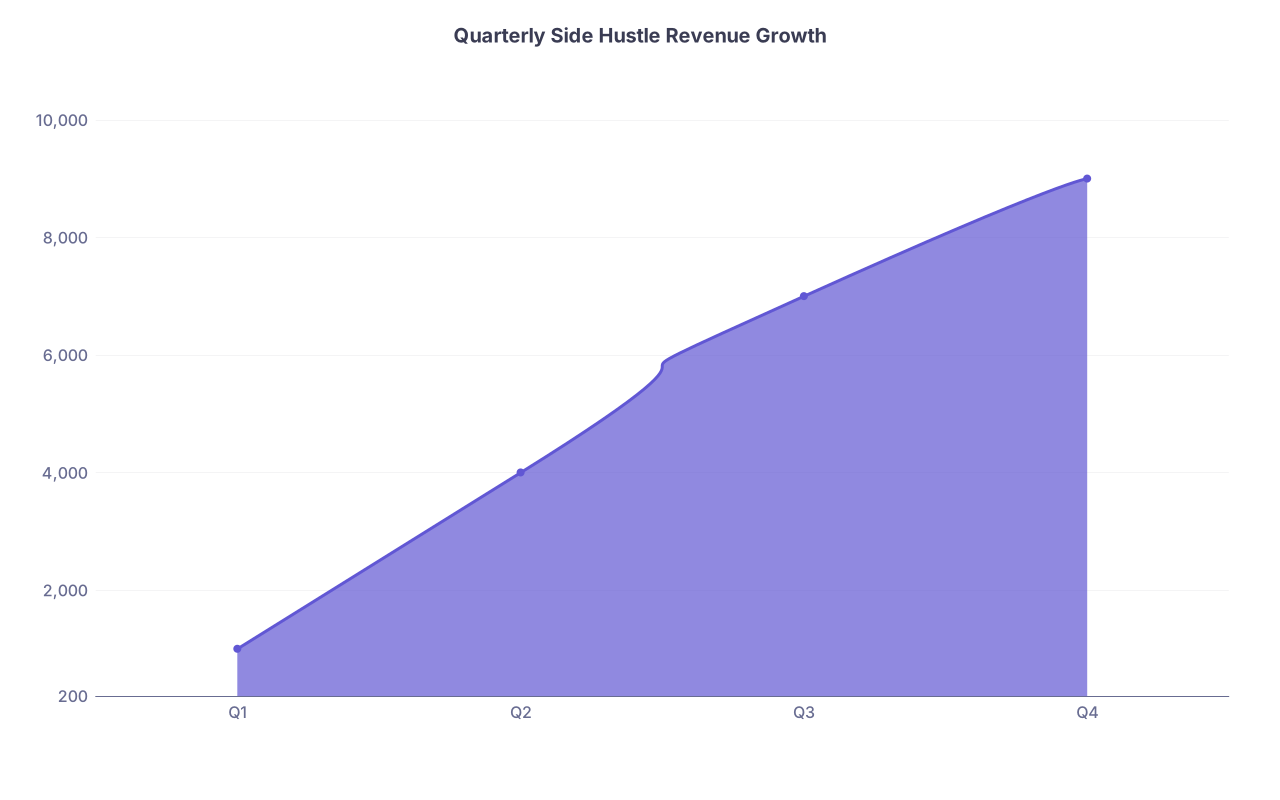
| Category | Value |
|---|---|
| Q1 | 1000 |
| Q2 | 4000 |
| Q3 | 7000 |
| Q4 | 9000 |
Make hard decisions:
- Will you:
- Keep it stable where it is?
- Intentionally grow it next year?
- Pivot to a different lane?
- Wind it down because it’s not worth the trade-offs?
Nothing is more expensive than a side hustle you resent but keep “just because it’s there.”
Design Year 2 with intention:
- Choose:
- One main income driver (offer)
- One main visibility channel
- One experimental frontier (new product, new audience, or deeper tech integration)
Micro-Timeline: A “Typical” Hustle Week for a Busy Physician
To ground all this, here’s how a stable side hustle might look in real life during Months 7–12.
| Day | Time Block | Focus |
|---|---|---|
| Mon | 20:00–21:00 | Admin & planning |
| Wed | 19:30–21:00 | Client sessions / consulting |
| Sat | 09:00–11:00 | Deep work (content/assets) |
| Sun | 30 min flexible | Review metrics & adjust |
You’re looking at 4–5 hours total, consistently. Not heroic binges.
Reality Check: What This Side Hustle Year Is Not
This is not:
- A guarantee of replacing your full-time salary in 12 months. Possible, but rare.
- A “passive income” fantasy. There’s nothing passive about being a physician who does high-value side work.
- A way to escape all the frustrations of modern medicine.
It is:
- A way to build leverage.
- A way to anchor yourself in the parts of medicine and healthcare you actually enjoy.
- A hedge against the insane volatility in our field, especially as AI and corporatization reshape everything.
Your Next Step Today
Do not start by buying a course or designing a logo.
Open a blank document and write three things right now:
- The one side hustle lane you’re committing to for the next 12 months.
- The maximum hours per week you’ll allow it to use.
- The first paid offer you’ll test in the next 30 days.
Once those three are written, your Side Hustle Year has started. The rest of this timeline is just execution.


