

The biggest tax mistake physicians with new side hustles make is pretending they are still “just W‑2 employees.” You are not. The IRS now thinks you run a business.
You need a timeline, not a pile of receipts the night before April 15.
Below is a chronological checklist for your first tax season with side hustle income. Assume you are a practicing physician with:
- W‑2 income from your main job
- New 1099 / side income (locums, consulting, telemedicine, courses, aesthetics, expert witness, etc.)
We will walk from last year’s Q4 through next year’s Q1 so you see what “normal” looks like once this becomes routine.
Big‑Picture Timeline: What Happens When
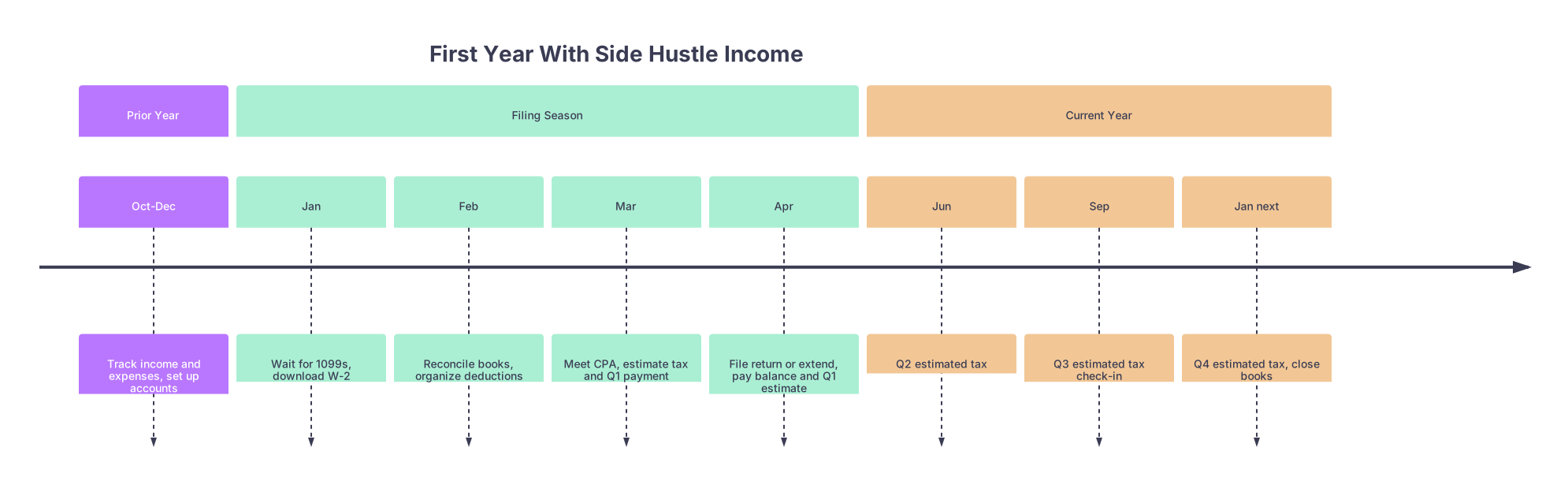
| Period | Event |
|---|---|
| Prior Year - Oct-Dec | Track income and expenses, set up accounts |
| Filing Season - Jan | Wait for 1099s, download W-2 |
| Filing Season - Feb | Reconcile books, organize deductions |
| Filing Season - Mar | Meet CPA, estimate tax and Q1 payment |
| Filing Season - Apr | File return or extend, pay balance and Q1 estimate |
| Current Year - Jun | Q2 estimated tax |
| Current Year - Sep | Q3 estimated tax check-in |
| Current Year - Jan next | Q4 estimated tax, close books |
Keep that structure in your head. Now we drill into each stage.
Phase 1 – October–December (Before Your First “Side Hustle” Tax Season)
At this point you should stop treating the side gig as “extra cash” and start treating it as a business.
Step 1: Separate where the money lives (Week 1)
You do this once. Do not skip it.
- Open:
- One business checking account (even if you are a sole proprietor).
- One business credit card used only for side‑hustle expenses.
- Redirect:
- Have all 1099/side payments land in that checking account.
- Put every side‑hustle expense on the business card or from that account.
Why this month? Because by January you want a clean annual record coming from a single feed. I have seen physicians spend 10+ hours crawling through personal AmEx statements to pick out coaching platform fees. Brutal. Avoidable.
Step 2: Decide your entity (Week 1–2)
Your default is sole proprietor. That is fine to start.
- If side income is under ~$100k and you are in your first year:
- Usually stay as sole proprietor or single‑member LLC.
- File on Schedule C with your personal return.
- If you already know this will be a mid‑six‑figure operation:
- Talk to a CPA about an S‑Corp election for the following year.
- Do not rush into an S‑Corp in December without understanding payroll, reasonable compensation, and extra admin.
At this point you should have:
- A clear legal name for the business (even if it is just your name).
- A decision: remain sole prop / LLC for this filing season.
Step 3: Build a minimum‑viable bookkeeping system (Week 2–3)
You do not need a full ERP. You do need structure.
Pick one:
- Spreadsheet (simple, fine for <$30k side income)
- Wave / QuickBooks / Xero (use if you have lots of transactions or multiple clients)
Create categories that match common tax lines:
- Income: locums, telemed, expert witness, speaking, consulting, digital products (you can group if small)
- Expenses:
- CME / courses
- Subscriptions (UpToDate, EM:RAP, journal access)
- Licenses / DEA / state fees
- Malpractice (side work portion)
- Home office
- Internet / phone (business share)
- Software (Zoom, Canva, EHR plug‑ins, email provider)
- Marketing (website, ads, design, logo)
- Travel (hotel, flights, Uber, conference)
- Meals (business meetings only)
- Equipment (computer, monitor, camera, lights)
- Professional services (CPA, attorney)
Now, backfill everything from January 1 through today for the side hustle. Yes, it is annoying. You do it once. Next year you are just maintaining.
Phase 2 – Early January: Document Collection Mode
Now the calendar year is closed. At this point you should freeze 2024 data and focus on documents.
Week 1–2 of January: Make your “side hustle tax folder”
Create:
- One digital folder: “2024 Taxes – Side Hustle”
- Inside it, subfolders:
- Income docs (1099s, PayPal/Stripe summaries, platform reports)
- Expense backup (receipts, PDFs, invoices)
- Home office docs (lease/mortgage, utility summaries, square footage calc)
- Auto/travel logs
- Retirement contributions (SEP IRA, Solo 401(k), etc.)
- Health insurance (if paid through side business)
What should you be watching for?
Between January 1 and February 15, you should expect:
- From employers:
- W‑2 from your main hospital/clinic.
- From side‑hustle payers:
- 1099‑NEC from locums agencies, telemedicine platforms, consulting clients.
- Occasionally 1099‑K from Stripe, PayPal, or platforms (if you meet thresholds).
- From banks/brokers:
- 1099‑INT, 1099‑DIV, 1099‑B, etc. (not side hustle, but they affect your tax).
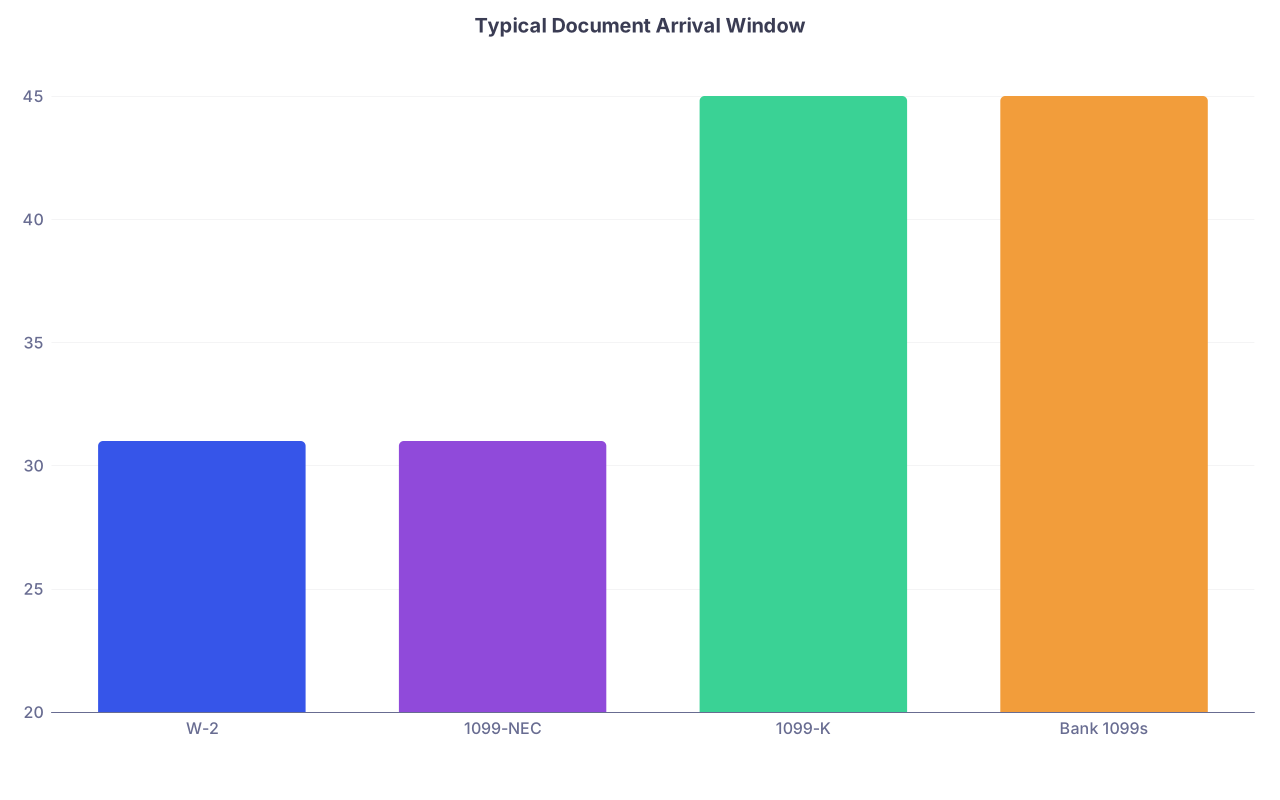
| Category | Value |
|---|---|
| W-2 | 31 |
| 1099-NEC | 31 |
| 1099-K | 45 |
| Bank 1099s | 45 |
(Values are days after year‑end when they usually show up.)
Red flag check (Week 3–4 of January)
At this point you should:
- List all side‑hustle payers from your own records.
- Match them to 1099s you have received.
If you earned income from Company X and did not get a 1099, two possibilities:
- They are under the reporting threshold
- They are disorganized
Either way, you still must report the income. The 1099 is an informational document, not your income limit.
For each payer, record:
- Total you received (from your own books)
- 1099 amount (when it arrives)
- Any mismatch
If there is a big mismatch, contact them now. Do not wait until April.
Phase 3 – Late January to February: Reconcile and Categorize
This is the real work. At this point you should close the loop between what happened in real life and what you will tell the IRS.
Week 4 of January: Lock in your income totals
From your bookkeeping system:
- Pull total gross side‑hustle income for the calendar year.
- Cross‑check:
- Sum of all 1099‑NECs + 1099‑Ks
- Plus any income that did not generate 1099s (small consulting checks, Venmo, etc.)
They will not match perfectly. That is fine, as long as:
- Your reported income ≥ what the IRS sees on 1099s.
Record one clean number: “2024 Side Business Gross Revenue”.
Early–Mid February: Categorize expenses
Now you go category by category. This is where physicians either save five figures or waste it.
For each transaction in your business account/credit card:
- Assign it to one of your expense categories.
- Add a brief note if not obvious from the merchant name.
Watch for the big deduction buckets most doctors underuse:
Home office
- Must be:
- Exclusive use for business
- Regular use
- Two methods:
- Simplified: $5/sq ft up to 300 sq ft
- Actual expenses: share of rent/mortgage interest, utilities, insurance, etc. based on % of home used
- Track:
- Home total square footage
- Office square footage
- Annual totals for utilities, rent, insurance (for actual method)
- Must be:
Internet and phone
- Reasonable business %. Common: 50–80% internet, 20–70% phone.
- Do not write off 100% of your family plan unless it truly is business only.
Auto (if used)
- Keep a mileage log:
- Date, destination, purpose, miles
- Choose:
- Standard mileage rate or actual expenses (gas, depreciation, maintenance). Standard is simpler for most.
- Keep a mileage log:
Education and CME
- Side‑hustle relevant courses (e.g., aesthetics training, coding course, business coaching) are usually deductible.
- General medical board review for W‑2 job? Gray zone. Talk to your CPA.
Equipment
- Laptops, monitors, cameras, ring lights, mic, printer, etc.
- These may be deducted fully in year 1 (Section 179 / bonus depreciation) or depreciated over several years. CPA call.
At this point you should have:
- A profit and loss (P&L) summary for the side business:
- Revenue
- Expenses by category
- Net profit
This net profit is what flows onto Schedule C and gets hit with income tax + self‑employment tax (~15.3% on the first chunk).
Phase 4 – Late February to March: Strategy and Professional Review
If your side‑hustle net income is more than a few thousand dollars, this is where you bring in help.
Week 3–4 of February: Meet a tax pro (or do a serious self‑review)
At this point you should schedule a meeting with:
- A CPA or EA who:
- Works with physicians
- Understands 1099/locums/consulting income
- Knows retirement options for small businesses (Solo 401(k), SEP, defined benefit plans)
Bring:
- W‑2 from your main job
- 1099s and income summary
- P&L for the side business
- Prior year’s tax return
- Retirement contributions from both W‑2 and side business
- Major life events: marriage, kids, home purchase, big moves, student loan repayment changes
Ask, bluntly:
- Should I be making estimated tax payments right now?
- What is my expected effective tax rate with this side income?
- Do you recommend any retirement plan for the side business for this tax year (if still open) or next?
- Is S‑Corp worth considering next year? At what income level?
If you are doing it yourself, you still need to run these calculations, using tax software that supports Schedule C and self‑employment tax.
Estimate tax and cash needs (March)
At this point you should know:
- Your projected total tax due for last year
- How much has already been paid via:
- W‑2 withholding
- Any estimated taxes you might have made
- Your remaining balance and plan to pay it by April
You also need to set up the rhythm for this year’s estimated payments:
| Quarter | Income Period | Payment Due Date |
|---|---|---|
| Q1 | Jan 1 – Mar 31 | April 15 |
| Q2 | Apr 1 – May 31 | June 15 |
| Q3 | Jun 1 – Aug 31 | September 15 |
| Q4 | Sep 1 – Dec 31 | January 15 (next year) |
You can pay via IRS Direct Pay directly from a bank account. Set reminders in your calendar for all four.
Phase 5 – Early to Mid April: Filing Week
This is where the consequences of your prep show up. If you have done the earlier work, this part is boring. That is the goal.
At this point you should have ready:
- All W‑2s and 1099s
- Side‑business P&L
- Retirement contributions documented
- Health insurance premiums if paid by the business
- Home office calculations
- Auto mileage totals
- Charitable contributions
- HSA contributions
Decide: File now or extend?
Extensions are not a failure. They are a tool.
You should file now if:
- Your data is complete.
- No major unresolved 1099 discrepancies.
- You and your CPA agree the return is accurate.
You should file an extension (Form 4868) if:
- A key 1099 is wrong or missing.
- You are still clarifying complex issues (e.g., K‑1s, new S‑Corp, multistate questions).
- Your CPA is telling you they do not have time to do quality work by April 15.
Important: Extension to file ≠ extension to pay.
You must still estimate and pay the tax owed by April 15 to avoid penalties.
Double‑check side‑hustle items on the return
Before you sign:
- Confirm:
- Schedule C exists for your side business.
- Gross receipts match or exceed total 1099s + your own records.
- Expense categories look reasonable (no “office supplies – $60,000” on a telehealth gig).
- Schedule SE (self‑employment tax) is present.
- If you set up a retirement plan:
- Check that deductible contributions are actually on the return under the correct line.
Pay your balance and your Q1 estimated tax at the same time. One pain session.
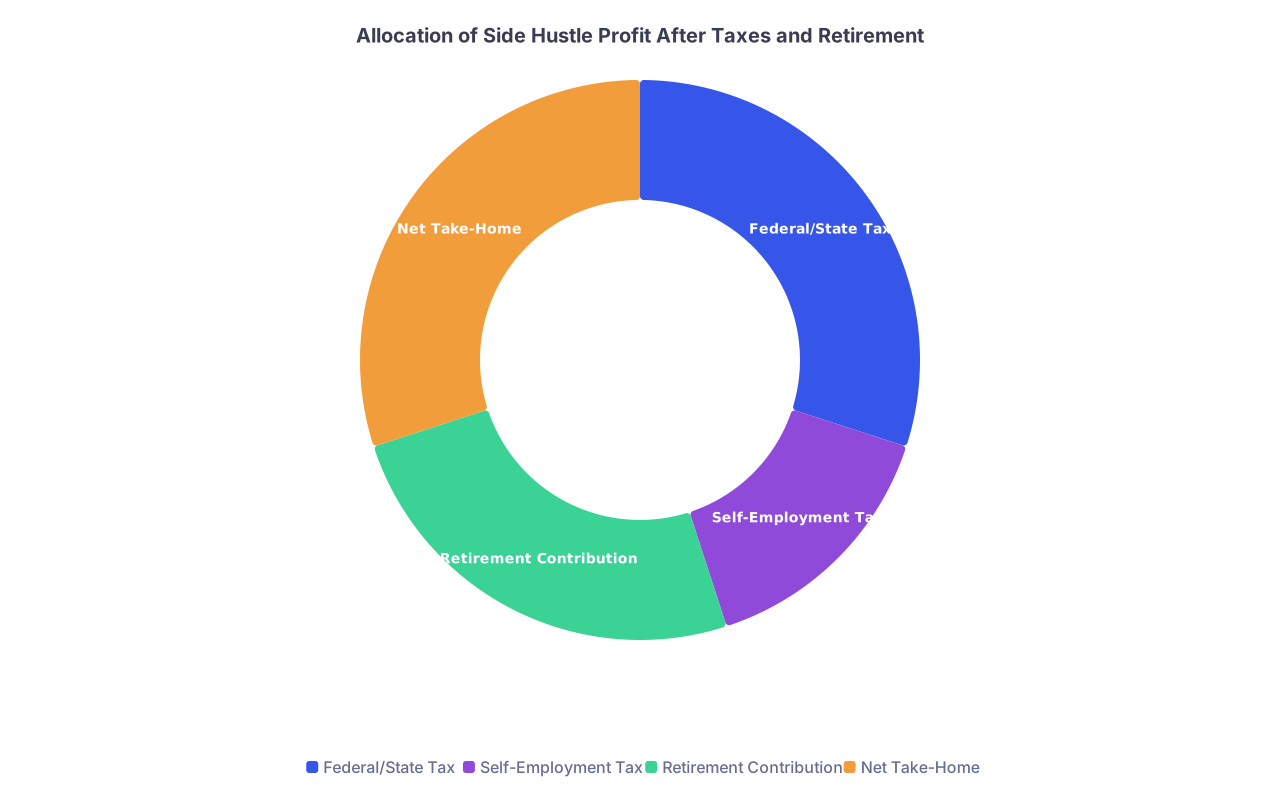
| Category | Value |
|---|---|
| Federal/State Tax | 30 |
| Self-Employment Tax | 15 |
| Retirement Contribution | 25 |
| Net Take-Home | 30 |
Phase 6 – After Filing (Late April–May): Post‑Mortem and Adjustments
Most physicians stop thinking about taxes once they file. That is how they stay perpetually behind.
At this point you should:
1. Analyze last year’s side‑hustle numbers
Grab your Schedule C and P&L:
- Revenue:
- Was income lumpy or steady? Seasonal?
- Expenses:
- Which categories were largest?
- Any categories that will drop off (one‑time startup costs)?
- Net profit:
- Use this to project this year’s profit.
Write down a rough target profit for your side hustle this year. Even if it is just, “Similar to last year” or “About 2x.”
2. Reset estimated taxes for the current year
Now that you have a target, calculate:
- Additional tax from side hustle ≈
- (Marginal tax rate + self‑employment rate portion) × projected profit
- Divide by 4 for quarterly payments
Example (simplified):
- Projected side profit: $60,000
- Combined marginal + SE effect: ~35%
- Extra tax: ~$21,000
- Quarterly estimate: ~$5,250
Set those numbers in your calendar:
- April 15: already paid
- June 15: pay $5,250
- September 15: pay $5,250
- January 15 next year: adjust based on updated income, then pay
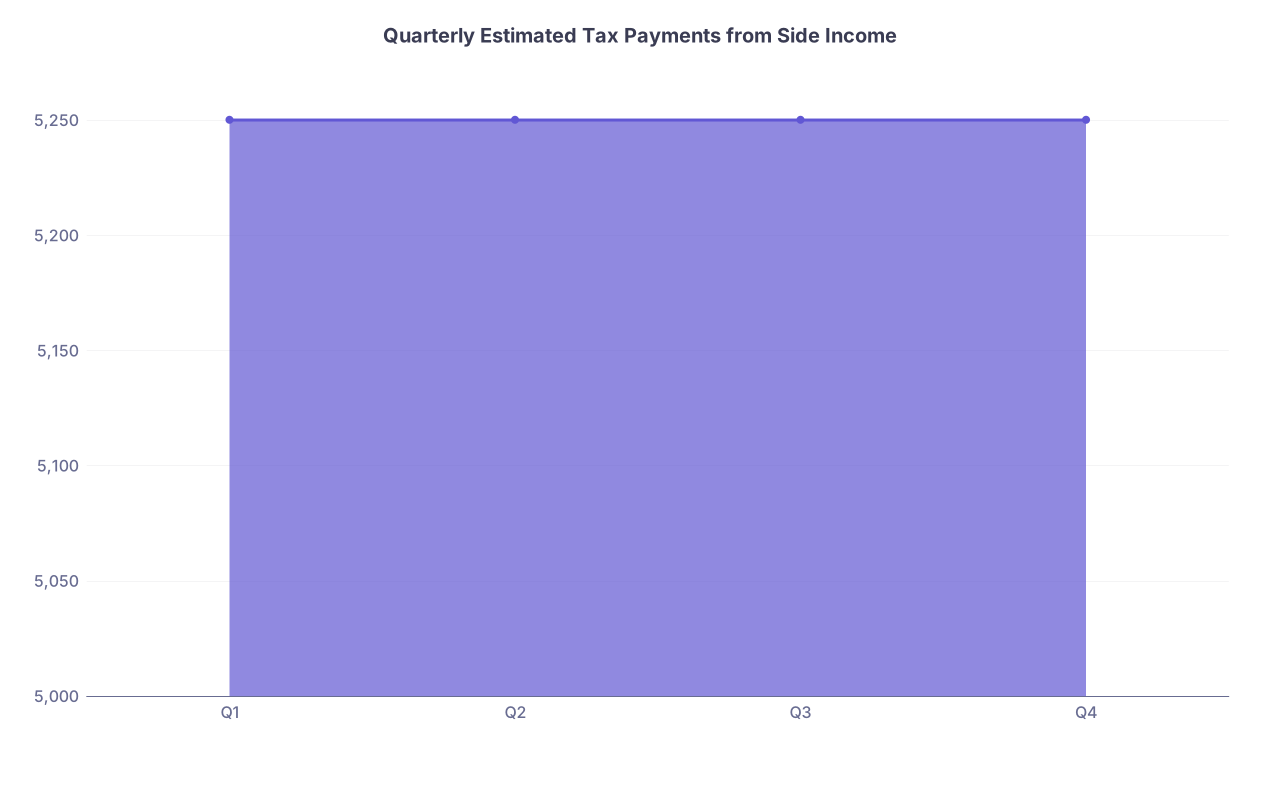
| Category | Value |
|---|---|
| Q1 | 5250 |
| Q2 | 5250 |
| Q3 | 5250 |
| Q4 | 5250 |
3. Decide entity/retirement moves for next year
This is the window to set yourself up differently for the future.
Use the fresh data to ask:
- Does my side profit justify:
- A Solo 401(k) (often superior to SEP if you want employee deferrals and Roth options)?
- An S‑Corp election (for earnings above a certain threshold where payroll + admin make sense)?
This is not theoretical. If you are consistently netting over $150–200k from the side hustle, not looking at S‑Corp is usually leaving money on the table. But if you are at $20k and hate paperwork, stay put.
Have that conversation now, not next March.
Phase 7 – June–December: Building Tax Systems into Your Side Hustle
You are now in your second cycle. At this point you should stop running ad‑hoc and build habits.
Monthly routine (pick one day each month)
On, say, the 5th of each month:
- Reconcile the prior month’s:
- Bank transactions
- Credit card charges
- Categorize every expense
- Record:
- Side‑hustle income received
- Mileage and any travel
- Hours spent (helps later for “reasonable compensation” if you ever do an S‑Corp)
This turns April from a fire drill into a copy‑paste exercise.
Quarterly routine
Right before each estimated tax deadline:
- Update:
- Year‑to‑date P&L
- Cash on hand in business account
- Adjust:
- Next estimated payment up or down based on actual profit
- Sweep:
- Move a set percentage of side‑hustle income into:
- Tax savings subaccount (e.g., 30–40%)
- Retirement or investment account (set goal, e.g., 20%)
- Move a set percentage of side‑hustle income into:
Some physicians keep it brutally simple:
- Every side‑hustle payment:
- 35% into “Tax”
- 15% into “Retirement”
- 50% available to spend
Phase 8 – The Next Tax Season: What Should Feel Different
By the time you hit your second tax season with side income, here is what “normal” should look like:
- All business transactions already separated.
- P&L for the entire year takes under an hour to finalize.
- You already know roughly what you owe before your CPA runs anything.
- You are not surprised by self‑employment tax.
- Quarterly payments are on autopilot.
- You are deliberately using at least one retirement vehicle through the side business.

At that point, the side hustle is no longer “extra money.” It is a real business feeding your long‑term financial plan.
Future‑Facing: Side Hustles, Taxes, and the Direction of Medicine
Here is the hard truth: side income is not a phase anymore. It is becoming standard for physicians who want autonomy and financial leverage as traditional employment gets tighter.
The ones who win this game long term:
- Treat their side hustle as a business from year one
- Use taxes as a design constraint, not an afterthought
- Build systems so each April is a non‑event, not a crisis

And yes, that starts with one very unglamorous thing: a disciplined, chronological tax checklist you follow every year.
Key points to remember:
- Once you have side income, the IRS sees a business. Act like it: separate accounts, real books, documented expenses.
- Tax season starts the previous October. If you wait until March, you are already losing money.
- Your second tax season should feel dramatically easier than your first—if you use this year to build permanent systems, not do a one‑off cleanup.


