

The worst time to start a physician side business is the day you become an attending. That is exactly when most people try.
If you want your side business to last longer than your first call week, you need a ruthless, time‑based plan for those first 90 days. Not vibes. Not “I’ll see how it goes.” A timeline.
Below is how I would structure it, week by week, from Day 1 to Day 90. At each point: what you should and should not do about a side business. When to plan, when to prototype, and when to absolutely keep your hands off it.
Big Picture: 90-Day Progression
Here is the arc you are aiming for:
| Phase (Time) | Primary Focus |
|---|---|
| Days 1–30 (Month 1) | Stabilize as an attending |
| Days 31–60 (Month 2) | Evaluate bandwidth, test ideas |
| Days 61–90 (Month 3) | Small launch or deliberate delay |
And visually:
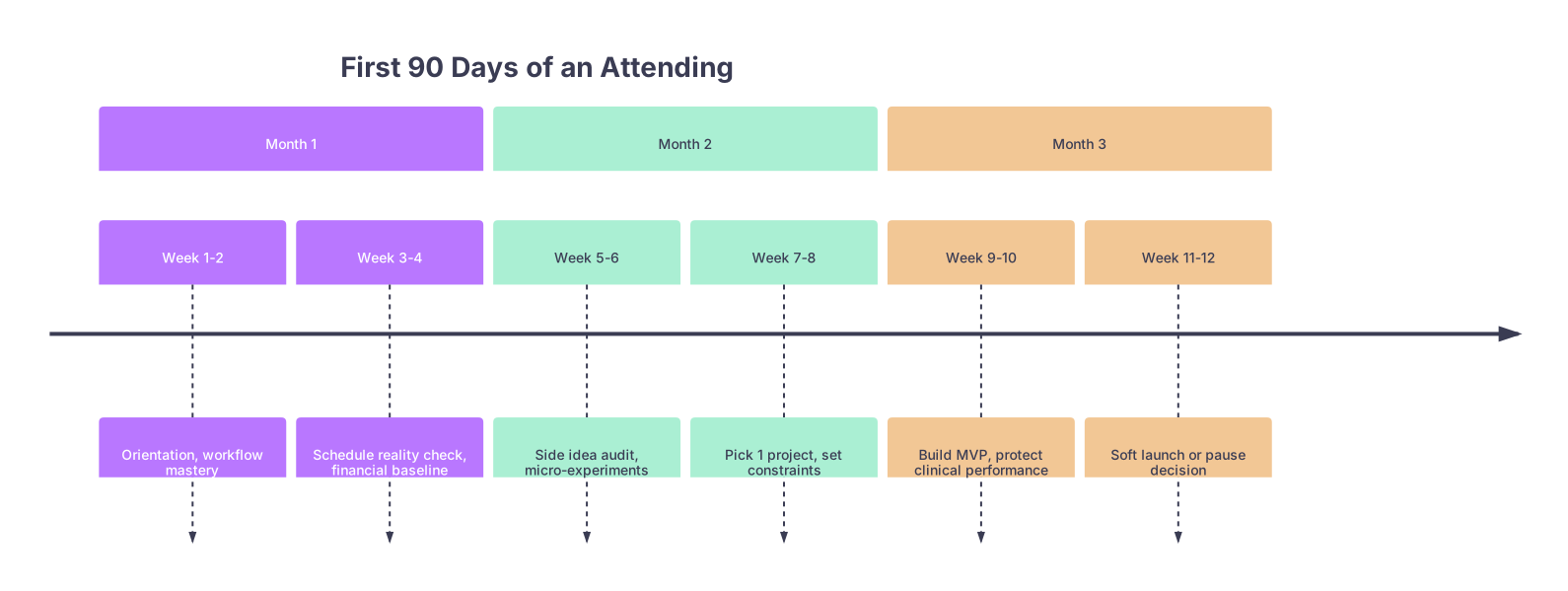
| Period | Event |
|---|---|
| Month 1 - Week 1-2 | Orientation, workflow mastery |
| Month 1 - Week 3-4 | Schedule reality check, financial baseline |
| Month 2 - Week 5-6 | Side idea audit, micro-experiments |
| Month 2 - Week 7-8 | Pick 1 project, set constraints |
| Month 3 - Week 9-10 | Build MVP, protect clinical performance |
| Month 3 - Week 11-12 | Soft launch or pause decision |
Now let us walk it chronologically.
Days 1–30: Stabilize as an Attending, Ignore the “Hustle”
At this point you should treat any business idea as background noise. Your only “side project” is becoming a safe, efficient, respected attending.
Week 1–2: Orientation and Reality Shock
What you do now sets the ceiling for every future side hustle. If you melt down in month one, you will be gun-shy about anything extra for years.
Focus:
- Learn your clinical system cold:
- EHR templates, order sets, usual pitfalls.
- How consults actually get placed, how discharges really work.
- Map the true workflow:
- What time the first patient actually shows up.
- When the OR really turns over.
- Which nurses, techs, and admins quietly run the place.
- Track your time for 7 days:
- Use a simple note on your phone.
- Log blocks: pre-rounding, rounding, notes, procedures, meetings, commuting, email.
At this point you should not:
- Register an LLC.
- Build a website.
- Announce anything on LinkedIn or Twitter about a “new venture.”
- Commit to collaborations or long-term projects with friends.
You think you know your bandwidth from residency. You do not. Attendings burn out in month one because they underestimate the cognitive overload of being “the final sign‑off.”
Week 3–4: Schedule, Money, and Energy Audit
Now your days have a pattern. Imperfect, but real. Your side business evaluation starts here—quietly.
Schedule audit (based on your time logs):
- Identify consistent, protected blocks:
- Commute (podcasts, calls).
- Early morning (if you wake up clear-headed).
- Post-call (probably useless at first).
- Note your true usable weekly time. For most new attendings:
- 3–5 high-quality non-clinical hours per week.
- The rest is fantasy.
- Identify consistent, protected blocks:
Money baseline:
- List:
- New salary (post-tax estimate).
- Student loans and minimums.
- Fixed costs: rent/mortgage, childcare, insurance.
- Decide: are you chasing a side business for:
- Income replacement?
- Margin and freedom?
- Ego and identity (be honest)?
- List:
Energy profile:
- On a 1–10 scale, rate:
- Mental energy at 6 a.m., noon, 6 p.m., 9 p.m.
- You might discover you are useless after 7 p.m., which kills a lot of late‑night startup fantasies.
- On a 1–10 scale, rate:
At this point you should only:
- Start a single “idea parking lot” document.
- Drop in thoughts when they come up. Nothing more.
Days 31–60: Evaluate Bandwidth and Test Ideas Quietly
By the second month, the adrenaline wears off. This is where two paths diverge: either you double down on being a competent attending and design a sustainable business timeline, or you chase every idea and drown.
Week 5–6: Side Idea Audit and Hard Filters
Now you should open that idea list and get ruthless.
Common physician side business types:
| Type | Time Intensity | Startup Complexity |
|---|---|---|
| Locums / extra shifts | High | Low |
| Coaching / advising | Medium | Medium |
| Digital products | Medium | Medium |
| Consulting | Low–Medium | Medium |
| Brick-and-mortar (medspa, clinic) | Very High | High |
Apply three filters:
Clinical performance safety filter
- If your business:
- Requires late-night calls.
- Involves high-stakes decision-making.
- Demands weekday daytime presence.
- Then during your first 90 days, it is probably a bad idea. You cannot risk errors because you were up tweaking a website until 1 a.m.
- If your business:
Time block fit filter
- Look at your identified usable weekly hours.
- If your idea requires:
- 15–20 hours/week to even get off the ground.
- And you currently have 4 good hours/week.
- That idea is “future attending” material, not “month 3” material.
Licensing and conflict-of-interest filter
- Check:
- Your employment contract: moonlighting clauses, non-competes, IP ownership.
- Hospital/health system policy: can you:
- Sell to hospital patients?
- Use hospital email or time?
- Promote services to colleagues or trainees?
- Check:
If your contract lets your employer claim ownership over anything you build “related to your clinical work,” you need legal advice before you write a single line of code or curriculum.
At this point you should narrow down to 1–2 feasible ideas that:
- Fit in 2–5 hours/week.
- Do not conflict with your employer.
- Do not require outside capital or staff yet.
Examples that usually pass this test for new attendings:
- Specialty-specific online course (e.g., “How to interpret basic peds EKGs for PCPs”).
- Consulting for startups in your clinical area.
- Niche coaching: interview prep, residency application review.
- Anonymous blog/newsletter that may later be monetized.
Week 7–8: Micro-Experiments, Not Launches
Now you should run tiny tests, not build full businesses.
The goal: validate demand and your own interest with minimal time and no public pressure.
Pick one idea for 2-week testing.
Example experiment structure:
Coaching / advising
- Offer:
- 3 free 30-minute sessions to residents/med students.
- Observe:
- Do you enjoy it?
- Do they ask to follow up?
- Are they surprised by the value?
- Offer:
Digital product / course
- Write:
- A 1-page outline and one sample module or lesson.
- Share:
- With 2–3 trusted colleagues in your specialty.
- Ask bluntly:
- “Would you pay for this? Why or why not?”
- Write:
Consulting
- Reach out to:
- One startup or local company in your field.
- Offer:
- A short unpaid call framed as “market feedback.”
- Pay attention:
- Do they start asking, “What would it take to keep you involved?”
- Reach out to:
During these two weeks you should:
- Limit “business thinking” to 2 defined blocks per week.
- Document friction:
- Did you miss sleep?
- Did your notes fall behind?
- Did you snap at staff?
Any deterioration in clinical performance is a red flag. Your ability to be an excellent attending is not negotiable.
Days 61–90: Decide, Design, and (Maybe) Soft Launch
By month three, you have enough data to make a conscious call. Not a guilt-based, FOMO-driven one.
You are choosing between three legitimate paths:
- Micro‑launch a very small, well‑defined service or product.
- Stay in research/prototype mode for a few more months.
- Deliberately postpone the business until you have 6–12 months of attending experience.
Week 9–10: Choose One Path and Set Constraints
At this point you should decide one of three:
Path A – Micro-launch (for low-risk, low-time ideas)
Good candidates:
- 60-minute paid consult calls.
- Simple digital product (PDF guide, short async course).
- Limited coaching spots (e.g., 2 clients/month).
Design strict constraints:
- Maximum hours/week: 3–5.
- Clear boundaries:
- “No calls on post-call days.”
- “Only 2 evenings/week with business work.”
- Hard clinical rule:
- If you are behind on notes or charts, business time disappears that week.
Path B – Deepen prototype (for bigger but promising ideas)
Examples:
- Medspa concept.
- Tech platform.
- Full online school.
Your main moves in Week 9–10:
- Sketch:
- Basic business model (who pays, how often, how much).
- Identify:
- Regulatory and legal hurdles.
- Map:
- Realistic launch window (probably 6–18 months out, not month 4).
Your “side hustle work” here is reading, sketching, and talking to a few experts. Not signing leases or hiring staff.
Path C – Intentional pause (the underrated move)
If:
- You are still clinically overwhelmed.
- Your schedule is variable or being restructured.
- You are more tired than you expected.
Then your smartest “business move” is to wait. But do it intentionally:
- Set:
- A review date (e.g., 6 months from now).
- Keep:
- Your idea list updated.
- Focus:
- On improving efficiency and building your reputation.
You are not falling behind. You are extending your runway.
Week 11–12: Build a Minimum Viable Version (or Codify the Pause)
Assuming you chose Path A (micro-launch), this is where a very small “live” business appears.
For a micro-consulting or coaching offer
At this point you should create:
Simple offer statement
Example:- “I help [target group] go from [pain point] to [specific outcome] in [format].”
- “I help IM residents turn scattered notes into a polished fellowship application in 3 focused sessions.”
Barebones infrastructure
- A booking link (Calendly or similar).
- A way to get paid (Stripe, PayPal, Square).
- A basic one-page site or even a single Notion/Google Doc explaining:
- Who you are.
- Who this is for.
- What it costs.
- How to book.
Gentle, targeted announcement
- Email 10–20 people you know who might know your audience:
- “I am piloting a small consulting/coaching offer for [X]. If you know anyone who could use this, feel free to share.”
- Do not spam every social network yet.
- Email 10–20 people you know who might know your audience:
Your initial goal:
- 3–5 paying clients or customers.
- Data, not dollars. You are testing fit, not getting rich.
For a small digital product
Example: A $49 PDF guide for new hospitalists, or a short CME-eligible webinar.
Week 11–12 steps:
- Finish:
- A “good enough” version. Not perfect.
- Set up:
- A simple checkout page.
- Share:
- With a narrow, relevant circle:
- Local listserv.
- Specialty Slack group.
- Alumni network.
- With a narrow, relevant circle:
Again, constraint:
- Total build + launch time over these two weeks: 5–10 hours total, not 5–10 hours per week.
If you chose Path B or C
Then at this point you should:
- Document in writing:
- Why you are not launching yet.
- What would need to be true (income, schedule, support) before you do.
- Build one thing only:
- A one-page roadmap for the future business.
- Rough milestones at 6, 12, 24 months.
This keeps the idea alive without draining your attention right now.
Common Pitfalls During the First 90 Days (And When They Hit)
I have watched people crash on the same rocks repeatedly. The timing is predictable.
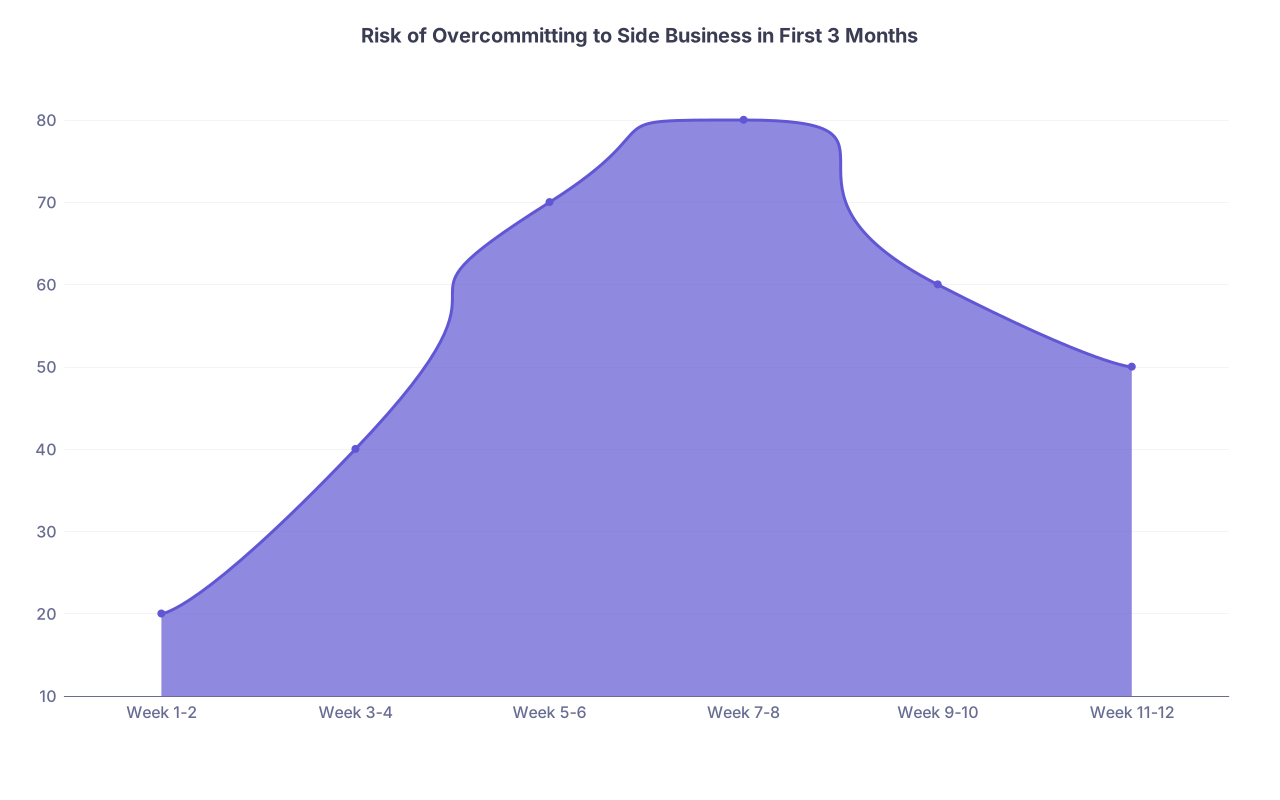
| Category | Value |
|---|---|
| Week 1-2 | 20 |
| Week 3-4 | 40 |
| Week 5-6 | 70 |
| Week 7-8 | 80 |
| Week 9-10 | 60 |
| Week 11-12 | 50 |
Weeks 1–2 – Overconfidence
- “I finally have a salary, I can fund a startup.”
- Reality: you do not understand your job yet. Sit on your hands.
Weeks 3–4 – Schedule denial
- You start saying yes to everything: committees, QI projects, research, plus a side gig.
- By week 8 you are drowning. I have watched smart people miss note deadlines here.
Weeks 5–6 – Idea explosion
- You meet a med school friend doing a private practice, someone else has a medspa, LinkedIn is screaming about physician entrepreneurship.
- You feel behind and commit to 3 ideas at once. Bad move.
Weeks 7–8 – Quiet burnout
- Chronic sleep debt and decision fatigue show up.
- If business tasks are stealing recovery time, your clinical quality will slip. Non-negotiable red flag.
Weeks 9–12 – Pressure to “show something”
- You think: “I have been an attending for 3 months and have nothing to show outside work.”
- This is where people rush launches that should have stayed prototypes.
Your job is to expect these phases and decide in advance how you will respond.
How to Know You Are Actually Ready to Launch Anything
By Day 90, if you can honestly say:
Clinical:
- Your complication rates, note timeliness, and peer feedback are stable or improving.
- You do not dread going to work every day from exhaustion.
Schedule:
- You have 3–5 protected non-clinical hours weekly that have been consistent for at least 4 weeks.
Financial:
- Your basic living expenses and minimum loan payments are covered by your attending salary.
- You are not depending on side income to survive this year.
Psychological:
- You are pursuing the business out of curiosity and leverage, not desperation or comparison.
Then a small, clearly scoped side business launch in the first 90–120 days can be reasonable.
If any of these are false, your better move is deliberate delay and internal optimization.
Final Takeaways
- Your first 30 days as an attending are for stabilization, not entrepreneurship. Protect your clinical performance above everything.
- Between days 31 and 60, you should filter and test ideas with tiny experiments, not full launches.
- By days 61 to 90, either execute a tightly constrained micro‑launch or intentionally pause, with a written plan for when and how you will revisit the business.
Follow the timeline. Your career is long. You get one chance to start it without avoidable self-inflicted chaos.


