
It’s 10:45 p.m. after a brutal call. You’re in the call room, shoes off, scrubs stained, charting finally caught up. Your co-resident is scrolling on their phone, but you’ve got a Shopify dashboard open. Or a TikTok draft. Or a locums staffing spreadsheet.
You think you’re being discreet.
Your chair knows.
Let me tell you what actually gets said about residents with side businesses when you are not in the room. I’ve sat in those rooms. Department meetings, CCC meetings, PD–chair one‑on‑ones. I’ve heard the “Are we okay with this?” conversations.
And it’s not as simple as “they hate side hustles” or “they secretly admire entrepreneurs.” It’s a lot more twisted than that.
The First Reaction: Respect, Suspicion, or Threat?
The first time a chair hears about your side business usually isn’t some formal disclosure. It’s from one of three sources:
- An attending: “Did you know Dr. X has a whole YouTube channel / real estate portfolio / coaching business?”
- A fellow resident complaining: “They’re always on their phone doing their business stuff.”
- A patient complaint or social media screenshot that lands in the program director’s inbox.
Here’s how most chairs actually think, in sequence, when they first hear about it.
Step 1: “Is this going to cause problems?”
Before they care what you do, they care if it’s going to blow back on them.
The chair’s mental checklist looks like this:
- Could this hurt patient care?
- Could this get us sued?
- Could this drag our program into an ACGME issue?
- Could this make us look bad to the Dean / CMO?
They’re not thinking about your financial independence yet. They’re thinking risk management.
If your side business is anything in medicine-adjacent space—telehealth, consulting, med-ed content, “coaching,” or anything that even smells like giving medical advice online—their radar spikes immediately.
I’ve seen a chair forward a resident’s TikTok to legal with the subject line: “Is this a problem yet?”
That resident thought they were “just educating.” The hospital thought, “Uncompensated, unsupervised brand liability.”
Step 2: “Is this why they’re underperforming?”
Let’s be blunt. If you’re crushing it clinically, your side business is a “quirk.” If you’re barely holding it together? It’s the built‑in scapegoat.
In CCC meetings, I’ve heard almost this exact sentence more than once:
“Look, they’re smart, but they’re spread too thin with all that other stuff they’re doing.”
If your evals are mediocre, notes are late, your consults are half-baked, or you’re “checked out” on rounds, your side hustle becomes the explanation everyone grabs onto. Whether it’s true or not.
On the flip side, if you’re a top‑tier resident, it plays very differently:
“Honestly, I don’t know how they do it all. They’re one of our best. As long as it doesn’t interfere, I’m fine with it.”
So no — they don’t hate side businesses in the abstract. They hate excuses and risk. And your side gig is an easy label for both.
The Unspoken Hierarchy of “Acceptable” Side Hustles
Not all side businesses are treated equally. Chairs have an unspoken ranking system. They won’t spell this out to you, but it absolutely shapes how they judge you.
| Type of Side Hustle | Chair Reaction (Typical) |
|---|---|
| Low-key investing / index funds / real estate LP | Mostly invisible / neutral |
| Academic-adjacent consulting or paid writing | Mild approval if discreet |
| Social media med-ed / YouTube / podcast | Suspicious but tolerable if branded well |
| Direct clinical services (telehealth/locums) | High concern / often disapproved |
| MLM, shady products, medical “coaching” w/ gray lines | Universally hated / red flag |
The “Invisible” Ones: Investing, Anonymous Stuff
If you’re doing boring stuff like:
- Maxing out retirement accounts
- Buying rental properties quietly
- Angel investing with your spouse’s email
- Coding some SaaS tool that has nothing to do with medicine
Most chairs never know and never care. And frankly, this is where the savvier residents live.
If they don’t see it, they don’t judge it. Which is why the smartest people keep the visible footprint minimal.
The “Respectable” Ones: Academic-Adjacent
Writing board questions. Getting paid for textbook chapters. Helping build CME modules. Doing legit, disclosed, above-board consulting for a hospital system or EHR vendor through faculty channels.
Chairs actually like these. They can spin it as “our residents are in demand.”
They’ll still watch for time conflicts, but philosophically, this fits their worldview: academic productivity, reputation building, aligned with medicine.
This is the safe zone.
The Ones That Make Them Nervous
Here’s where things get more uncomfortable.
1. Telehealth and Clinical Side Gigs
This is where chairs get visibly tense behind closed doors.
Their thought process:
- “Are you moonlighting without approval?”
- “Are you giving medical advice under another entity without malpractice coverage we control?”
- “What if something goes really wrong at 2 a.m. and they’re also on our call schedule?”
I’ve seen PDs say:
“You cannot be on our pager and also doing video visits for some startup. Period.”
If you’re doing clinical work for pay outside the official, signed-off-on moonlighting structure, the chair sees that as both a professionalism issue and a safety issue. They also see it as you thinking you’re smarter than the system. Chairs hate residents who think they’re gaming the system.
And if your telehealth gig demands hours that cut into your sleep before call or into your documentation after shifts? Your evals will quietly reflect that.
, MLM/Gray-zone Coaching](https://cdn.residencyadvisor.com/images/articles_svg/chart-chair-concern-by-side-hustle-type-1031.svg "Chair Concern by Side Hustle Type")
| Category | Value |
|---|---|
| Investing | 10 |
| Academic Consulting | 20 |
| Med Social Media | 50 |
| [Telehealth/Locums](https://residencyadvisor.com/resources/physician-side-hustles/malpractice-and-moonlighting-liability-traps-doctors-overlook) | 80 |
| MLM/Gray-zone Coaching | 95 |
2. Social Media, Influencing, and Public Brands
You know that “separate personal/private account” myth? Chairs do not care what you intended. They care what’s screenshot-able.
The mental calculus:
- Are you identifiable as “Doctor at X Hospital”?
- Are you giving anything that looks like medical advice?
- Are you mocking patients, staff, the hospital, or training?
- Are you talking about burnout in a way that exposes their internal problems publicly?
If yes to any of the above, they don’t see “side business,” they see “PR exposure.”
I watched a resident with a rapidly growing TikTok get pulled into a meeting with the chair and PD. They told them, nicely, to remove the hospital from their bio, add an explicit disclaimer, stop filming anything on hospital grounds, and not reference specific cases or colleagues. The subtext: “We’re being generous. Don’t push it.”
The resident complied. Then grew to 500k followers. Chair tolerated it because their evaluations were pristine and the content was mostly generic med-ed and lifestyle. The second that resident started critiquing hospital policies on call schedules? That “generosity” evaporated.
3. MLMs, Supplements, Dubious “Coaching”
This is where chairs move from “cautious” to “disgusted.”
If your side hustle:
- Sells supplements or products that sound pseudoscientific
- Leans on your MD/DO/RN/PA identity to sell junk
- Looks even remotely like you’re exploiting vulnerable patients or trainees
You’ll be labeled unprofessional very fast.
I watched a PD literally say:
“If they don’t stop this, I won’t sign their board paperwork. I am not putting my name next to this.”
That’s not an idle threat. They can do that.
What They Won’t Tell You: Envy and Projection
Here’s the part residents almost never understand.
Your chair is a product of a different era. They were trained on the implicit belief:
You sacrifice everything. You give the system your 20s, half of your 30s, and you’re rewarded later with a stable, respected career.
Then they watch you:
- Build a six-figure e‑commerce store
- Grow a social media platform that could out-earn faculty salaries
- Pick up contract work with startups that invites you to conferences they’re not invited to
They won’t say it out loud, but some part of them is threatened. On status. On relevance. On control.
I have watched older faculty roll their eyes at residents doing things on the side. But then ask me, privately, “So how exactly are they making money with that?” They’re curious because they’re stuck in a system you’re trying to escape — or at least de-risk.
So yes, some of the hostility you feel? It’s generational and financial insecurity, masquerading as “professionalism concerns.”
How Your Chair Actually Evaluates You
Strip away the drama, and the evaluation is surprisingly simple.
Your chair, your PD, your CCC ask three questions about you, with or without a side business.

| Step | Description |
|---|---|
| Step 1 | Resident with Side Business |
| Step 2 | Side business blamed for problems |
| Step 3 | Pulled into meeting / restrictions |
| Step 4 | Mostly tolerated or quietly respected |
| Step 5 | Are they clinically solid? |
| Step 6 | Does business create risk or bad optics? |
Question 1: “Are they clinically solid?”
If the answer is no, everything else is noise. They don’t care how many properties you own or how many followers you have. You’re a problem.
Clinical performance includes:
- Knowledge
- Reliability
- Work ethic
- Documentation
- Ability to not implode on call
If any of that is weak, your side business is Exhibit A in the case for “they’re distracted.”
Question 2: “Are they a professionalism or PR risk?”
They look for:
- Social media content that can be weaponized
- Documentation of you working clinically for entities they haven’t vetted
- Use of your institution’s name or logo for your gain
- Blatant time conflicts (doing business tasks during clinical time, missing teaching, late notes due to “meetings”)
This is why some of the sharpest residents keep everything:
- Off-hours
- Off-premises
- Off-brand (using a non-medical identity online)
It’s not paranoia. It’s just understanding how the game is wired.
Question 3: “Is this aligned with or against our culture?”
A program that prides itself on “grinding” and old-school martyrdom will look at your entrepreneurial efforts as disloyalty.
A program with leadership dabbling in consulting, speaking, boards, or startups will be more tolerant — as long as you don’t embarrass them.
Look at what your chair and PD do.
- If your chair has 17 side titles, runs national committees, and makes pharma talk money on the side, they are not anti-side-hustle. They’re anti-you-doing-it-in-a-way-they-can’t-control.
- If your PD brags about “I live and breathe this residency, I don’t have time for anything else,” they’re going to judge you for building something outside.
How to Run a Side Business Without Getting Crushed
You want the real playbook, not the Instagram version. Fine.
Rule 1: Be unquestionably good at your job
Not “fine.” Not “passes.” Good.
No one goes to bat for the resident with a powerful brand and poor evals. Chairs will throw you under the bus to make a point.
If you’re set on building something big, front-load your credibility:
- Crush intern year. Build your reputation as dependable.
- Show up prepared, on time, and engaged.
- Be the resident people want on their team.
Only then do you get the political capital to be “the one with a side thing.”
Rule 2: Keep it off their radar as long as possible
You do not get points for “transparency” about every creative project you have. You’re not hiding. You’re just not volunteering bait.
Concrete boundaries:
- No work on your side business while on shift or in conference. Phones stay away. Laptops closed.
- No branding that explicitly ties your business to your residency program or hospital unless someone very senior has approved it. In writing.
- No content on social media from inside clinical areas. Literally, none. No badges, no logos, no hallways, no patients even blurred.
The fewer emails your PD gets about you, the safer you are.
Rule 3: If you go public, go professional
The bar is higher for you than some random med student influencer. You carry your institution’s name whether you like it or not.
So:
- Clean bio. No “future neurosurgeon at X” unless X knows and is fine with it.
- Explicit disclaimers that your content isn’t medical advice or representing your employer.
- Skip hot takes about your specific hospital’s call system, scheduling, or “toxic attendings.” You can talk about systems problems without filming your night float room.
And for the love of your future self, don’t drag colleagues or patients for content. Chairs have zero patience for this.
Rule 4: Avoid clinical gray zones
Telehealth, coaching, prescriptions, “medical optimization” plans — these are landmines.
If you are doing anything that a normal human would interpret as “you gave me medical advice for money,” you need:
- A legal entity
- Contracts and malpractice
- A clean separation from your role as a trainee
And you need to clear that with someone who actually understands your institution’s policies, not just a co-resident who says “I think it’s fine.”
Most residents don’t have the leverage or infrastructure to pull this off safely in training. Many think they do. Chairs are used to cleaning up the messes.
Where This Is Headed: The Future Your Chair Pretends Not to See
The generation that believes medicine should be your “one true calling” is aging out. Slowly.
Newer faculty and some younger PDs understand:
- Salaries are stagnating.
- Non-clinical opportunities are exploding.
- The traditional academic ladder is not the only path to influence or stability.
They’re uneasy about it, but they see the writing on the wall: smart residents will diversify. The system is not as safe or loyal as it pretends to be, and residents are starting to respond rationally.
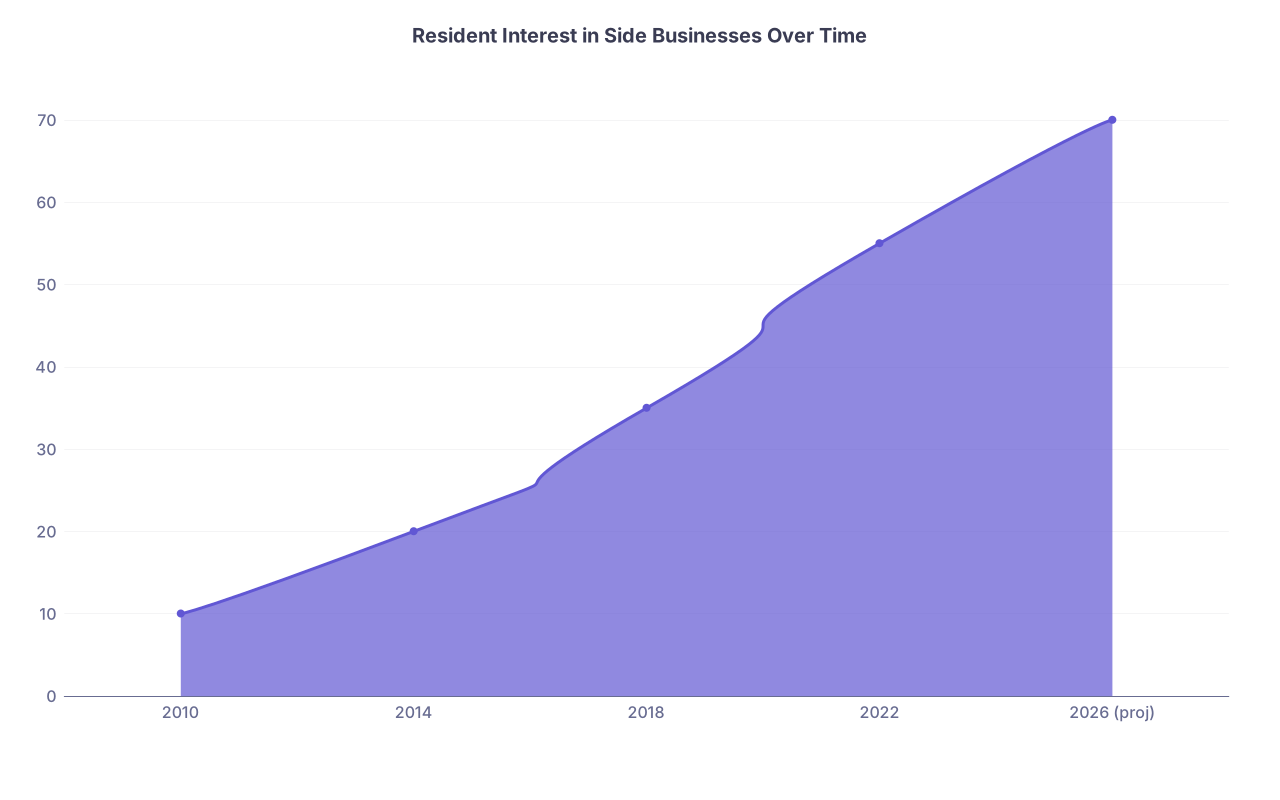
| Category | Value |
|---|---|
| 2010 | 10 |
| 2014 | 20 |
| 2018 | 35 |
| 2022 | 55 |
| 2026 (proj) | 70 |
What does that mean for you?
- The hard‑line “no outside anything” stance is going to soften. Slowly. In some places sooner than others.
- Institutions will start branding and “partnering” with residents who have platforms. Think co-created content, official ambassadors, sponsored med‑ed.
- More residents will match already having six‑figure businesses. Chairs will be forced to adapt, not pretend this is a fringe thing.
But don’t mistake trendlines for protection. You live in the transition period. That’s the most dangerous time. Culture hasn’t caught up with reality yet.
Quick Reality Checks: What Chairs Actually Say
A few real lines I’ve heard from chairs and PDs, cleaned up to protect people:
- “If they were half as focused on their rotations as they are on their brand, they’d be chief.”
- “I don’t mind the podcast. I mind that they were 20 minutes late to my clinic because of ‘recording.’”
- “They’re smart. Honestly, I think they’re going to leave medicine early, and that bothers me more than the business itself.”
- “I wish we paid them enough that they didn’t feel like they needed all this.”
That last one is key. Some of your leadership secretly knows you’re not crazy for wanting other income streams. They just won’t say it out loud because it indicts the system that pays them.
FAQ: What Chairs Really Think – Condensed
Should I tell my chair or PD about my side business?
If it’s clinical, medicine-adjacent, or highly public, yes — after you’ve cleaned it up and thought through risk. If it’s non-medical, quiet, and doesn’t touch your work time or reputation, I’d keep it separate and professional without making a big show of “disclosure.”Can having a side business hurt my fellowship chances?
Yes, if it’s framed as you being distracted, unprofessional, or “not serious” about the specialty. No, if you’re excellent clinically and the business is either aligned (research, med-ed) or clearly separate and successful. The key is what your PD writes in your letter. That’s what matters.Is social media as a resident a bad idea?
It’s not inherently bad. It’s just high‑risk, high‑visibility. If you don’t have iron discipline about boundaries, content, and timing, it will hurt you. If you do, it can be an asset. Most residents overestimate their discipline.What type of side business do chairs tolerate the most?
Anything that’s invisible to them: simple investing, boring online businesses unrelated to medicine, academic consulting routed through proper channels, paid writing. The further it is from “medical advice” and from hospital branding, the calmer they are.Do any chairs actually respect residents with side businesses?
Yes. Especially the ones who are quietly consulting, on boards, or building their own non-clinical careers. They recognize hustle. They just demand you uphold your end of the residency bargain: be good, be safe, don’t embarrass them, and don’t turn your side gig into their problem.
Take this with you:
First, your chair does not inherently hate side businesses; they hate distraction, risk, and public embarrassment.
Second, if you are excellent clinically, your leverage skyrockets. Your side business becomes “impressive” instead of “concerning.”
Third, run your business like a professional, not a bored intern: clean boundaries, no gray‑zone clinical work, and zero drama that lands on your PD’s desk.