
The way most physicians pick side hustles is backwards. They commit first and test later—usually with their time, sanity, and sometimes their license.
You are going to do the opposite.
You are going to treat side hustles the way you treat new treatments or protocols: hypothesis → small controlled test → data → scale or discard. No more “my colleague is making six figures doing this, I should jump in too” nonsense.
This is a systematic way to test side hustle ideas before you commit.
Step 1: Define Your Personal Constraints Like You Would a Clinical Trial Protocol
Before you test any idea, you need the equivalent of your inclusion/exclusion criteria. Most physicians skip this. Then wonder why they are burned out, sleep-deprived, and stuck in three committees plus two side hustles.
You fix that first.
A. Hard constraints (non‑negotiable)
Write these down. Not in your head. On paper or in a note.
Time ceiling
- How many hours per week in a bad week can you safely allocate?
- For most full-time clinicians: 3–6 hours per week max, if you want this sustainable.
- Anything that needs 20 hours/week “just at the beginning” is fantasy.
Red lines
- No conflicts with your employment contract (non-compete, moonlighting rules, use of PHI).
- No activities that materially increase medicolegal risk without compensation to match.
- No dependency on your hospital’s branding, patients, or facilities unless you have written approval.
Money tolerance
- What is your maximum “tuition fee” for testing an idea?
- I recommend:
- Residents: $100–$250
- Attendings: $250–$1,000
- If an idea cannot be tested for less than that, flag it as “later, when I have proof from cheaper tests”.
Energy pattern
- When do you actually have usable brainpower? Early morning before shift? Post‑call? Weekends?
- You do not put cognitively heavy tasks after 12‑hour shifts. That is how you kill the project and your sleep.
B. Soft goals (what “success” looks like)
Pick two of these. Not five.
- Income: e.g. “I want to see if this can eventually generate $2–5k/month.”
- Flexibility: “I want something I can pause for 2 weeks during ICU month.”
- Exit potential: “I want something I can sell or hand off later.”
- Skill building: “I want to sharpen my teaching / writing / tech skills.”
Your test protocol will be built around these.
Step 2: Put Your Ideas Through a Brutal Triage
Stop treating every idea as precious. Most do not survive a basic screen. Good. That is the point.
Make a simple spreadsheet or note. You need 5–10 ideas, not one “perfect” one.
Common physician side hustle categories:
- Clinical: telemedicine shifts, expert witness work, chart review, occupational medicine, medical consulting.
- Knowledge-based: coaching residents, USMLE/MCAT tutoring, CME content, online courses, niche newsletters.
- Non-medical: real estate, small business ownership, consulting in non-health sectors, software tools, investing education.
- Creative: book writing, YouTube, podcasts, niche blogs, paid newsletters.
For each idea, rate it 1–5 on:
- Fit with time/energy constraints
- Legal/contract risk
- Skill match (do you have 70% of what it needs already?)
- Expected time to first dollar (near-term wins matter)
Then kill at least half of them. No mercy.
| Idea | Fit Score (1-5) | Legal Risk (1-5, higher=worse) | Time to First Dollar |
|---|---|---|---|
| Telemedicine shifts | 4 | 2 | 2-4 weeks |
| Expert witness work | 3 | 3 | 2-3 months |
| USMLE tutoring | 5 | 1 | 2-4 weeks |
| Real estate syndication | 2 | 4 | 6-12 months |
| YouTube channel | 3 | 1 | 6-12 months |
Keep the top 2–3 ideas. Those are the only ones you will systematically test.
Step 3: Turn Each Idea Into a Clear, Testable Hypothesis
Vague ideas cannot be tested. “I want to start a telemedicine side gig” is vague. Here is what a testable version looks like:
Telemedicine example
“If I sign up with 2 telemedicine companies and make myself available for 2 evenings per week for 4 weeks, I can generate at least $800 in that month without feeling more than 3/10 additional burnout.”Tutoring example
“If I publish 3 posts in relevant Facebook groups and 1 Reddit post and set up a booking page, I can book at least 3 paid tutoring sessions in 30 days at $75/hour.”Newsletter / content example
“If I publish 4 weekly emails aimed at [niche, e.g. new hospitalists] and promote each one to 2 communities, I can grow to 100 subscribers and get at least 2 paid consult inquiries in 8 weeks.”
Notice each has:
- A behavior to perform
- A time frame
- A minimum success metric
- A sanity/burnout guardrail
That is your test protocol.
Step 4: Choose the Right Type of Test (MVP for Physicians)
You are not building a full business. You are building a Minimum Viable Test.
Think of it like a short pilot study with surrogate outcomes.
Here are four test types that cover 90% of physician-side hustles:
1. Demand test (do people even want this?)
Use this for: tutoring, coaching, digital products, consulting, content businesses.
Core question: “Will anyone raise their hand and pay something for this?”
How to run it:
Create a one-page offer
- Clear who it is for
- Clear what problem you solve
- Clear price for an initial session / package
- Simple way to book/pay (Calendly + Stripe/PayPal is enough)
Put it in front of real people (not your friends)
- 2–3 targeted Facebook groups (med students, IMG, premeds, niche physician groups)
- Reddit (r/step1, r/medicalschool, r/Residency match, etc.), if allowed
- Your own network: “I am piloting X for the next 30 days. Here is who it is for, here is the fee, limited to 5 people.”
Set a clear success threshold
- Example: “If I get 5 paying clients at $100 each in 30 days, I pass the demand test.”
If no one bites, the idea is not dead. But your current version of the offer is.
2. Time and energy test (does this crush your schedule?)
Use this for: any idea that trades time for money (telemed, expert witness, locums-lite).
Core question: “Does this fit my real life without wrecking sleep or family time?”
How to run it:
Book a 2–4 week pilot
- Example: 2 telemed shifts per week, 3 hours each.
- Track: prep time, charting spillover, emotional load.
Log your reality
After each session:- Hours scheduled
- Actual hours spent (including pre/post work)
- Burnout score (0–10)
- Hourly effective rate (total pay ÷ total time including spillover)
Predefine your cut points
- “If my effective hourly rate drops below $80/hour or burnout >6/10 more than twice, I stop or adjust.”
3. Pricing test (are you undercharging or overcharging?)
Relevant to: tutoring, consulting, expert witness, procedure-based moonlighting.
Core question: “What will the market pay me now, not in theory?”
How to run it:
Start at a confident but slightly uncomfortable price
- If market is $60–80/hr tutoring, start at $75–90 if your credentials justify it.
- For expert witness work, do not be the $200/hr person when market is $400–700/hr for specialists.
Use 3–5 client increments
- First 3–5 clients at Price A
- Next 3–5 at Price +20%
- Watch conversion and pushback.
Success markers
- If ≥50% of serious leads convert and nobody balks strongly, you are undercharging.
- If <20% convert and everyone says “too expensive,” you are too high or you are not communicating value.
4. Leverage test (is this endlessly tied to your hours?)
Critical if you want something that can scale beyond your nights and weekends.
Core question: “Can I eventually decouple this from my direct time?”
How to run it:
Ask: can any part of this be:
- Standardized into templates?
- Delegated to a VA, editor, assistant, junior tutor?
- Turned into an on-demand product (course, PDF, membership)?
In your pilot, force one leverage experiment
- Example: record your tutoring calls, turn common explanations into a short PDF or Loom video, send to future clients as pre-work.
- Track whether this reduces session time or increases capacity.
If, after the pilot, there is zero path to leverage, accept that this is a pure time-for-money play. That might be fine. But label it accurately.
Step 5: Treat Your Test Like a Micro-Study (Yes, With Data)
You are a physician. You know how to track outcomes and make decisions with imperfect data. Use that skill.
Create a single test dashboard. One page. Not a monster spreadsheet you abandon after day 3.
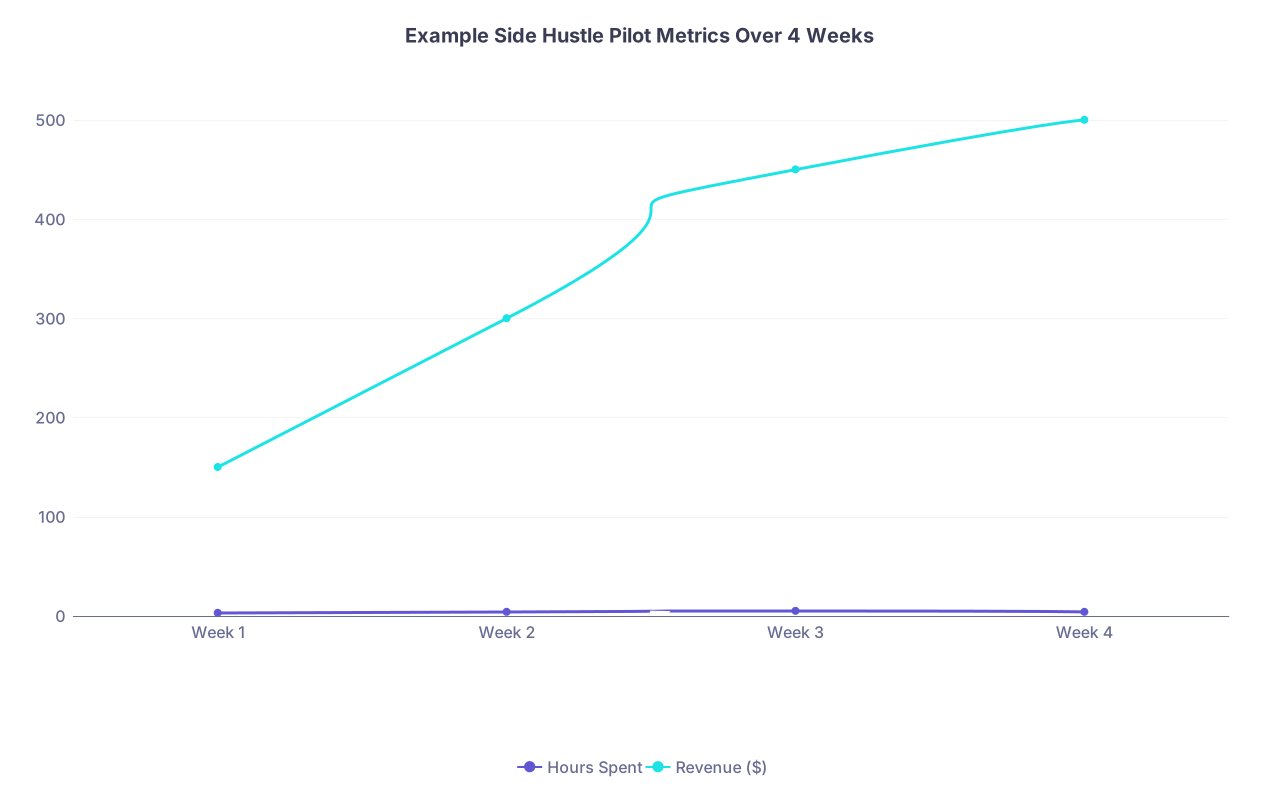
| Category | Hours Spent | Revenue ($) |
|---|---|---|
| Week 1 | 3 | 150 |
| Week 2 | 4 | 300 |
| Week 3 | 5 | 450 |
| Week 4 | 4 | 500 |
For each idea you test, track weekly:
- Hours spent (scheduled + spillover)
- Revenue generated
- Number of leads / opportunities
- Number of conversions (who actually paid)
- Burnout / stress score (0–10)
- Subjective “enjoyment” (0–10)
You do not need insane precision. Good-faith estimates are enough. The pattern is what matters.
Step 6: Fixed Pilot Period, Then a Hard Yes/No/Modify Decision
Here is where most people fail: they drift. They “see how it goes” for 6–12 months and then realize they have built a job they hate.
You will not drift. You will predefine:
- Pilot length: 4–8 weeks is usually enough
- Minimum quantitative success criteria
- Minimum qualitative success criteria
Example criteria:
Quantitative:
- Earn at least $500 total in 6 weeks, or
- Book at least 5 paying clients, or
- Achieve at least $75 effective hourly rate.
Qualitative:
- Burnout score ≤5/10 on average.
- At least 6/10 enjoyment.
- No serious conflicts with main job or family.
At the end of the pilot you force a decision:
- Stop – idea fails, and that is a win because you prevented a bigger mistake.
- Modify and retest – if it showed some life but failed one major metric.
- Scale slowly – if it met or exceeded your criteria.
No “keep kinda doing it and hope it improves.”
Step 7: Safety Checks—Licensing, Compliance, and Your Contract
Here is where physicians get burned. Not because the side hustle was bad. Because they ignored guardrails.
A. Employer contract review
Do this at the very beginning, not after you have a website.
Look for:
- Non-compete / non-solicit clauses (especially for telemed, private consults, coaching that looks like clinical advice).
- Policies on external consulting, media appearances, and business ownership.
- Requirements to disclose outside income or obtain pre-approval.
If it is unclear, pay an attorney for one hour. It is cheaper than getting fired.
B. Licensing and malpractice
Depending on the idea:
- Telemedicine: verify state licensure requirements, whether your telemed company covers malpractice, and where you can legally see patients.
- Expert witness: usually covered under separate professional liability; understand documentation and discovery risks.
- Coaching / education: keep a hard line—this is not medical advice, no PHI, no diagnosis or treatment plans. Document that clearly.
I have seen smart physicians do “informal cash consults” for friends-of-friends and end up in messes. Do not do backdoor clinical work. Either it is proper clinical care under your license with documentation and coverage, or it is explicitly non-clinical.
C. Privacy and PHI
Rule of thumb: if your side hustle involves patient data, assume you need:
- A BAA (business associate agreement) for vendors storing data
- HIPAA-compliant tools
- Institutional approval if using data from your workplace (even de-identified, check research/IRB rules)
If your idea cannot survive without cutting corners on PHI, pick another idea.
Step 8: Build a Testing Timeline That Fits a Physician Schedule
You are not a full-time entrepreneur. You cannot test everything at once. So you structure the year.
Here is a simple 12‑week testing timeline for 1–2 ideas:
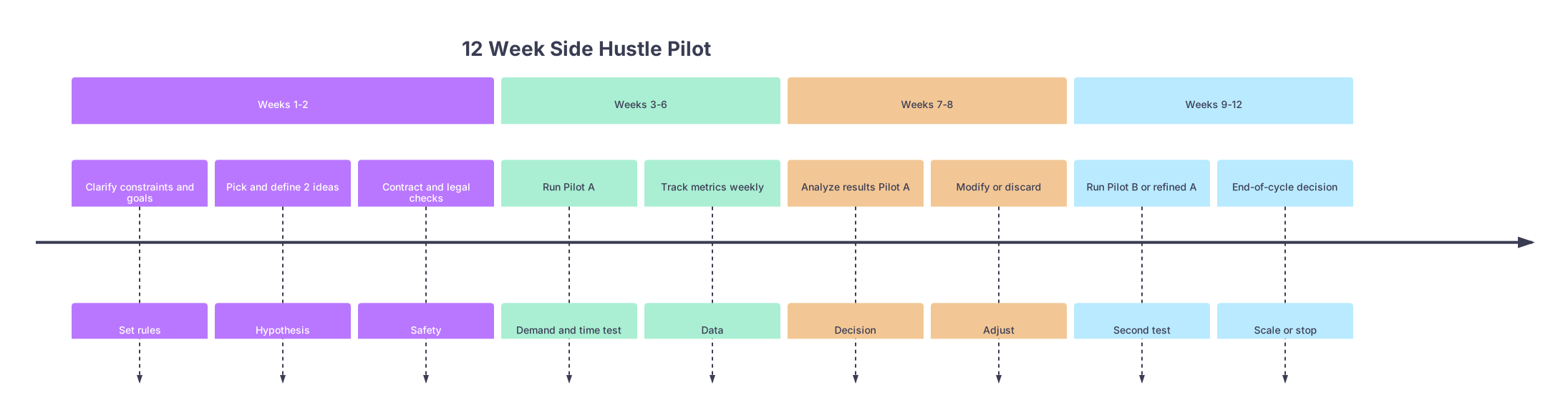
| Period | Event |
|---|---|
| Weeks 1-2 - Clarify constraints and goals | Set rules |
| Weeks 1-2 - Pick and define 2 ideas | Hypothesis |
| Weeks 1-2 - Contract and legal checks | Safety |
| Weeks 3-6 - Run Pilot A | Demand and time test |
| Weeks 3-6 - Track metrics weekly | Data |
| Weeks 7-8 - Analyze results Pilot A | Decision |
| Weeks 7-8 - Modify or discard | Adjust |
| Weeks 9-12 - Run Pilot B or refined A | Second test |
| Weeks 9-12 - End-of-cycle decision | Scale or stop |
This way you:
- Never test more than one heavy idea at a time.
- Have built-in decision points.
- Can repeat this 2–3 times a year without wrecking your life.
Step 9: Decide Which Ideas to Scale (and Which Stay as Small Gigs)
After one or two pilots, you will have data. Now you classify each idea into one of three buckets:
Kill it politely
- Fails demand, or
- Fails time/energy, or
- Creates real legal/contract risk.
This is not a tragedy. This is tuition you paid to avoid a bigger mistake.
Keep it as a stable, limited side gig
- Good hourly rate
- Dependable demand
- Enjoyable enough
- But no real leverage or growth beyond your time
Examples: one expert witness case per quarter, 2 telemed shifts per month, 3 ongoing tutoring clients.
Scale project
- Good demand
- Good economics
- Obvious leverage path (products, team, systems)
These are the ideas you might build into a serious business over 2–5 years.
For the scale-worthy ideas, your next tests will not be “does anyone want this?” but:
- Can I raise prices without killing demand?
- Can I reduce my direct hours and keep revenue flat or growing?
- Can this run during my worst clinical month with only 2–3 hours/week from me?
That is how you know you have something real.
Realistic Examples: What This Looks Like for Actual Physicians
Let me sketch three scenarios I have watched play out.
Example 1: Hospitalist tests telemedicine vs tutoring
- Constraints: full-time hospitalist, 7 on / 7 off, two young kids, wants $1–2k/month extra.
- Ideas: telemedicine shifts, USMLE tutoring, and a hospitalist newsletter.
Testing:
- Telemed: Pilot 4 weeks, 1 shift per 7‑off block. Effective hourly $120, but burnout 7/10, documentation spillover annoying. Passes income, fails energy.
- Tutoring: Pilot 6 weeks, 3 Facebook posts, 1 email to alumni group. Books 6 students at $80/hr. Effective hourly $80, burnout 3/10, enjoyment 8/10.
- Newsletter: After 8 weeks, 70 subscribers, 0 paid anything. Great, but not yet a side hustle—more like a long-term content play.
Decision:
- Kill telemed as regular thing. Keep as rare backup.
- Keep tutoring and gradually raise rates.
- Keep newsletter as a low-pressure asset builder; not counted as income strategy yet.
Example 2: Anesthesiologist tests expert witness work
- Constraints: 0.8 FTE, operates almost full-time, wants high-margin work that is flexible.
- Idea: plaintiff/defense expert witness work.
Testing:
- Pilot: completes 2 case reviews and 1 deposition over 3 months.
- Tracks:
- Time: 25 hours total
- Revenue: $9,000
- Effective hourly: $360/hr
- Stress: 5/10 (prep is heavy but controllable)
Decision:
- Passes all tests. Decides to cap at 4–6 cases/year, no scaling. This stays as a high-yield, constrained side gig.
Example 3: Pediatrician tests online parent education
- Constraints: outpatient pediatrician, wants less dependence on RVUs, cares about parent education.
- Idea: online course + group Q&A sessions for new parents (non-clinical).
Testing:
- Demand test: sets up a simple landing page with a 4‑week “Newborn Survival” cohort, $129 per family, 10 spots. Promotes to clinic mailing list (with employer permission) and 2 mom groups.
- Results: fills 8/10 spots in 3 weeks.
- Time: 6 live hours + 4 hours prep + 2 hours admin = 12 hours.
- Revenue: $1,032. Effective hourly $86.
- Enjoyment: 9/10.
Decision:
- Passes. On next cohort, records sessions, slices into modules, and moves toward a hybrid model: part on-demand, part live. Starts building leverage.
That is what intelligent, systematic testing looks like. No fantasies. Just controlled experiments.
FAQ (Exactly 4 Questions)
1. How many side hustle ideas should I test at once as a busy physician?
One at a time for anything that requires real cognitive effort. You can keep a low-level, long-term experiment (like a blog or newsletter) running in the background, but only one “active pilot” where you are pushing for revenue and tracking metrics. More than that and you dilute your limited time and focus, then blame the ideas instead of your testing process.
2. How long should a proper test run before I decide to stop or scale?
For most physician side hustles, 4–8 weeks is enough to see early signal: Do people respond? Will anyone pay? What is your effective hourly rate? If you are testing something slow-burn like YouTube or a podcast, you will not see real income in 8 weeks, but you can track leading indicators (views, watch time, email signups, inbound inquiries) and then choose whether to commit to a longer runway.
3. What if my first test completely fails—does that mean the idea is bad?
Not necessarily. Often the offer is bad, not the core idea. For example, “$300 initial consult” might flop, but “$97 45‑minute strategy session” could book up. Or you pitched in the wrong communities. Your decision after a failed test is not “good vs bad idea” but “do I see a specific, testable way to improve this, or am I just hoping?” If you cannot identify a precise change, move on.
4. How much money is reasonable to spend testing a side hustle idea?
Your test budget should feel meaningful enough that you take it seriously, but not so large that a failure hurts. For most attendings, $250–$1,000 per idea is a sane range (software tools, 1–2 legal consult hours, simple website, small ads or design work). Residents and fellows should be far leaner, often under $250. If an idea demands $10,000+ before you have any real-world validation, you are not testing—you are gambling.
Key points: Treat side hustles like pilot studies, not passion projects. Build explicit test protocols with time, income, and burnout thresholds. Make hard decisions at the end of each pilot: stop, modify, or scale—no drifting, no wishful thinking.