
It is 8:45 p.m. on a Tuesday. Your hospital shift ended two hours ago, but you are not on Epic anymore. You are staring at a Dropbox folder labeled “Plaintiff Production – Medical Records” and a retainer check that is larger than an entire week of call pay. An attorney is expecting your preliminary opinion by Friday. You are not sure if you are undercharging, overthinking, or both.
That is expert witness work in real life. It is medicine. But sideways.
Let me break this down specifically: what cases physicians actually see, what people are really charging, and how the workflow looks from first email to walking out of a courtroom.
1. What Expert Witness Work Actually Is (And What It Is Not)
Expert witness work is opinion work. You are not treating. You are not doing QI. You are being paid for three things:
- Your expertise and credentials.
- Your ability to apply standards of care to a specific fact pattern.
- Your ability to explain that in plain English to non‑physicians (lawyers, judges, jurors).
You are almost always doing one of four roles:
- Clinical standard of care expert (most common).
- Causation expert (did X actually cause Y, and how).
- Damages/injury expert (extent and trajectory of harm).
- Sometimes pure “medical explainer” (for complex pathophysiology or future care needs).
What it is not:
- It is not consulting “to help the patient.” It is to assist the court.
- It is not risk‑free. Your opinions are discoverable. Your prior testimony can be pulled.
- It is not something you can do sloppily. Bad expert work gets shredded. On the record.
You are hired not to help a side “win.” You are hired to give a defensible, well‑grounded opinion that will not embarrass that side.
2. Common Case Types By Specialty
Most physicians dramatically underestimate how broad the expert market is. It is not just obvious malpractice catastrophes.
2.1 Classic medical malpractice
This is the bread and butter.
Core buckets:
- Diagnosis delay / failure (missed MI, missed sepsis, missed appendicitis, missed stroke).
- Procedural/surgical complications (common vs negligent).
- Medication errors (dosing, contraindications, monitoring).
- Inpatient management (ICU care, floor deterioration, handoffs).
- Perioperative management (VTE prophylaxis, infection control, post‑op monitoring).
- OB catastrophes (shoulder dystocia, HIE, delayed C‑section).
Example patterns:
- EM physician reviewing sepsis bundle timing and triage.
- Hospitalist reviewing whether it was negligent to keep a patient on the floor with rising lactate.
- Neurosurgeon opining on timing of decompressive surgery in cervical fracture.
2.2 Personal injury and liability
Non‑malpractice but medically heavy. The medical issues are “downstream” of an accident or event.
- Motor vehicle collisions (acute injuries and long‑term impairment).
- Slip‑and‑fall, workplace injury, sports injury.
- Product liability (defective equipment causing harm).
- Premises liability (unsafe conditions causing injuries).
Who gets pulled in here?
- Orthopedists, neurosurgeons, PM&R for spine and joint injury.
- Neurologists for TBI, post‑concussive syndrome.
- Pain specialists for chronic pain syndromes and treatment reasonableness.
- Primary care/specialists for causation (was this really from the crash?).
2.3 Workers’ compensation and disability
Often more document heavy, less adversarial (not always).
- Independent medical exams (IMEs) and reports.
- Opinions on maximum medical improvement (MMI).
- Functional limitations and work restrictions.
- Future care needs and cost projections alongside life‑care planners.
Physiatrists, orthopedists, occupational medicine, and neurologists are heavily used here. Primary care with occupational medicine experience is underrated in this space.
2.4 Criminal cases and forensic work
More niche, but for some specialties this is a steady stream.
- Forensic pathologists – cause/manner of death.
- Psychiatrists – capacity, competency, insanity defenses, risk assessment.
- Neurologists – capacity, TBI relevance to behavior.
- Toxicologists – drug levels, impairment, overdose.
You are either state/prosecution side, defense side, or occasionally a court‑appointed neutral.
2.5 Regulatory / administrative / licensing
Not classic “expert witness” in front of a jury, but same skills.
- State medical board hearings (standard of care, fitness to practice).
- Hospital/credentialing disputes.
- CMS/Medicare overpayment or fraud cases.
- EMTALA, HIPAA, and regulatory violations.
You may review other physicians’ records and testimony, and testify before an administrative law judge (ALJ) instead of a jury.
2.6 Emerging: digital health, AI, and novel tech
This is where the “future of medicine” side hustle angle gets interesting.
- Telemedicine standard of care (was a video visit enough? appropriate triage?).
- Remote patient monitoring device failures.
- Algorithmic triage apps and digital symptom checkers.
- AI‑assisted radiology or pathology with alleged misses.
Who fits well here? People with actual informatics, telehealth leadership, or AI deployment experience. Your credibility comes from real-world implementation, not just reading a few papers.
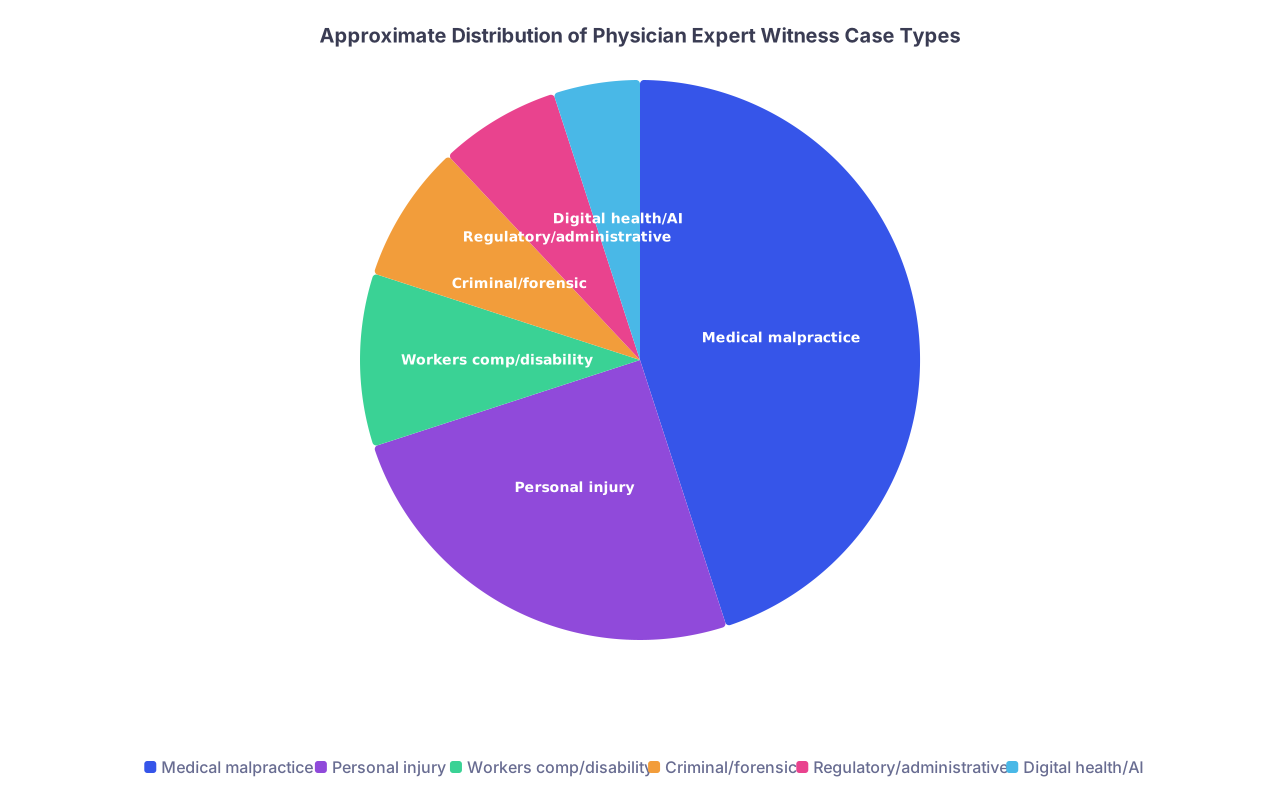
| Category | Value |
|---|---|
| Medical malpractice | 45 |
| Personal injury | 25 |
| Workers comp/disability | 10 |
| Criminal/forensic | 8 |
| Regulatory/administrative | 7 |
| Digital health/AI | 5 |
3. How Physicians Are Actually Paid: Rates and Structures
Let us talk numbers. Because this is why you are still reading.
3.1 Typical hourly rate ranges
These are real‑world ballparks in the U.S., 2024ish, for board‑certified attendings with at least a few years in practice:
| Specialty Group | Record Review / Prep | Deposition | Trial Testimony |
|---|---|---|---|
| Primary care / IM / FM / Peds | $300–$500/hr | $400–$600 | $400–$700 |
| Hospitalist / EM / Anesthesia | $400–$600/hr | $500–$800 | $600–$900 |
| Surgical specialties (ortho, NS) | $500–$800/hr | $600–$1,000 | $700–$1,200 |
| Highly specialized (cards, NICU) | $450–$750/hr | $550–$900 | $650–$1,100 |
Yes, some people charge more. Yes, some underprice themselves badly. What matters: you are not billing like an insurer‑beaten clinician. You are billing like a consultant.
A few realities:
- Trial testimony is the highest rate and usually requires a higher minimum.
- Plaintiff and defense rates should be the same. Charging differently is ammunition against you.
- Regional variation exists, but complexity and your CV matter more than geography.
3.2 Minimums, retainers, and cancellation fees
Serious experts do not do “pay as you go” with no commitment.
Common structures:
- Retainer: upfront payment (often $2,500–$10,000) applied against your time.
- Minimum blocks:
- Deposition: 3–4 hour minimum at your depo rate, even if it is 90 minutes.
- Trial: half‑day or full‑day minimums. You are blocked from clinic; this is non‑negotiable.
- Cancellation fees: if depo or trial is canceled within X days (often 3–7 business days), a portion or all of the minimum is owed.
You will see sloppy firms try: “We pay at the end of the case.” Translation: you are now an unsecured creditor with no leverage. Do not do this. Prepayment or at least a meaningful retainer first.
3.3 Flat fees vs hourly
Hourly is standard. However, some scenarios lend themselves to flat fees:
- Straightforward IME with standard report.
- Simple, low‑volume record review (e.g., one ED visit, one admission).
- Screening reviews (to decide if a case has merit) – often a fixed fee for up to X pages.
Be careful with flat fees for complex malpractice – you will underestimate the time, and these cases always “grow.”
3.4 Annual income potential (part‑time)
If you are selective, do not want your life consumed by lawyers, and just want a serious side stream, here is how it typically shakes out:
Rough, conservative example:
- 4–6 active cases per year.
- 20–40 hours per case (review, calls, reports, deposition, maybe trial on a couple).
- Rate of $400–$600/hr.
That can land you:
- Low end: 80 hours × $400 = $32,000 per year.
- Moderate: 150 hours × $500 = $75,000 per year.
- Aggressive but still “part‑time”: 250 hours × $600 = $150,000 per year.
And unlike clinic, those are your dollars, not RVUs minus hospital “overhead.”
4. The Workflow: From First Call To Testimony
Here is the part you actually need drilled into muscle memory. Because attorneys will assume you know this; they will not teach you.

| Step | Description |
|---|---|
| Step 1 | Attorney contact |
| Step 2 | Conflict and fit check |
| Step 3 | NDA and CV sent |
| Step 4 | Retainer paid |
| Step 5 | Record review |
| Step 6 | Initial opinion call |
| Step 7 | Written report or affidavit |
| Step 8 | Deposition |
| Step 9 | Trial testimony |
| Step 10 | Case closure and final invoice |
Let’s walk through it.
4.1 Initial contact and conflict check
It usually starts with:
- Cold email from a paralegal or associate.
- Referral from another physician expert.
- Contact through an expert referral service (mixed quality).
Your job in that first 10–15 minute call:
- Confirm specialty/issue match. If you are a hospitalist, do not take a neurosurgical technique case.
- Identify the posture:
- Plaintiff vs defense?
- Malpractice vs injury vs regulatory?
- Are you being asked for standard of care, causation, or both?
- Ask about timeline:
- Deadlines for reports.
- Deposition or trial dates (approximate).
- Conflict screen:
- Prior involvement with any of the parties, hospital systems, or specific clinicians.
- Employment with institutions in the case.
You do not opine on the merits in that call. You just decide whether to proceed with a formal engagement.
4.2 Engagement letter, NDA, and retainer
Before you touch documents:
- Send your fee schedule.
- Execute:
- Engagement letter (ideally your template, not just theirs).
- NDA (not strictly required, but common).
- Retainer paid and cleared.
A decent engagement letter should cover:
- Hourly rates and which tasks they apply to.
- Minimums for depo/trial.
- Billing increments (0.1 hr, 0.25 hr).
- Cancellation policy for scheduled testimony.
- Travel time billed at your usual or slightly lower rate.
- Payment terms (e.g., net 15 days, interest on late payments).
4.3 Record review
This is where your clinical brain works, but you must adjust your approach.
You are not “treating.” You are reconstructing what happened and when, from the record. That is different.
Practical habits that separate good experts from amateurs:
- Build a timeline document:
- Date/time stamped events.
- Vital sign trends, lab trends, key orders.
- Staff notes and handoff points.
- Tag or index important pages (PDF bookmarks, annotations).
- Keep a running “questions” list (what is missing, what is unclear).
- Separate “medical fact” from “later narrative.” Discharge summary spin is common.
You bill for all of it. Do not apologize. This is the work.
4.4 Preliminary opinion and strategy call
Once you have a tentative view:
- Have a substantive call with the attorney (usually 60–90 minutes).
- You should be clear on:
- Do you believe standard of care was breached? Where and by whom?
- Do you see causation clearly or is it weak/uncertain?
- Are there alternative explanations or contributing factors?
This is where you must be blunt. Lawyers particularly value experts who are willing to say: “You do not want me on this case. I will bury you on cross.” Because you just saved them time and money.
4.5 Written report or declaration
Not every jurisdiction or case type requires a formal report. But many do (federal court cases, some states).
Good reports:
- Are logically structured: background, materials reviewed, relevant facts, opinions, and basis for opinions.
- Tie specific actions/omissions to defined standards of care.
- Avoid medical jargon or explain it immediately.
- Are not advocacy pieces. They read calm, neutral, and fact‑driven.
You can easily spend 5–15 hours on a serious report. Again, you bill all of it.
4.6 Deposition
Deposition is where most physician experts decide whether they love or hate this work.
Basic structure:
- You are under oath in a conference room (or via Zoom).
- Opposing counsel questions you. Retaining counsel mostly observes.
- It is recorded (stenographer, sometimes video).
- They will bring prior reports, some literature, your CV, and try to box you in.
What separates competent from excellent here:
- You know your own report cold, including any numbers and citations.
- You know the critical timeline without reading every note.
- You answer what is asked. Not more, not less.
- You resist the reflex to “help” or fill silence.
In practice, attorneys often prep you for 1–3 hours the day before or morning of deposition. That prep time is billable.
4.7 Trial testimony
The least common but highest stress component.
Two phases for you:
Direct examination (by the side that called you):
- You walk the jury through your credentials.
- Then through what happened and your opinions.
- Think structured, teaching style. Analogies. Simple, layered explanations.
Cross‑examination (opposing counsel):
- They attack your assumptions, prior testimony, potential bias, fees.
- They put up exam questions like: “Doctor, if you had known X, would your opinion change?”
Your job in both:
- Stay in “teacher” mode. Jurors read tone.
- Guard your wording. “Possible” vs “probable” vs “to a reasonable degree of medical certainty” are not interchangeable here.
- Do not argue with the lawyer. You are there for the jury.
And yes, on trial days you block out the whole day. Half‑day minimum is the bare minimum you should accept.
5. Practicalities: Finding Work, Avoiding Traps, Staying Clean
5.1 How physicians actually get expert work
There are four main pipelines:
Direct repeat relationships:
- You do good work for one firm.
- They call you again and refer you to colleagues.
- This is how serious expert careers are built.
Expert witness directories:
- SEAK, TASA, JurisPro, specialty‑specific lists.
- Mixed signal‑to‑noise. Can be good early on to get your first few cases.
Professional networking:
- Speaking at medico‑legal conferences.
- Publishing medicolegal articles in specialty society newsletters.
- Word of mouth from colleagues already doing this.
Cold outreach:
- Some physicians send targeted letters/emails to plaintiff/defense firms in their region.
- If done professionally and sparingly, it can work.
You do not need to be on every list. One or two solid pipelines is enough.
5.2 Plaintiff vs defense work
The mature way to do this: be willing to work for both sides, as long as the medicine supports it.
- Plaintiff work:
- Often more “merit filter” upfront (good plaintiff lawyers do not want junk cases).
- You are usually opining on breaches and causation.
- Defense work:
- Often more volume in some markets.
- You may be explaining why care was within a reasonable standard or why causation is weak.
If your testimony pattern shows you are 95% plaintiff or 95% defense, opposing counsel will hammer bias. Does not mean you are wrong. But you better have a clean explanation.
5.3 Common traps and how to avoid them
I have seen physicians burn themselves on the same mistakes repeatedly:
Overstating certainty:
- Using “never” and “always” in complex clinical scenarios.
- Claiming a standard of care that is actually your preference, not genuinely widely accepted.
Ignoring your own charting/clinical record:
- Opposing counsel will cross‑reference your testimony with your own charting habits.
- If you testify something “must be documented” but your own notes do not do it, you are exposed.
Allowing lawyers to edit your opinion:
- They can clarify formatting.
- They do not get to substantively rewrite your medical opinion language.
Sloppy billing:
- No contemporaneous time logs.
- Letting invoices pile up until the end of the case.
- Negotiating fees mid‑case because you undercharged.
Run your expert work like a micro‑consulting practice, not a favor.
5.4 Ethical and professional landmines
Two big ones:
Specialty mismatch:
- If you are boarded in internal medicine and working as a hospitalist, do not take a critical care management case unless you actually practice that at a critical care level and can defend that against a board‑certified intensivist.
Opinion‑shopping:
- If you suspect the firm has fired prior experts who disagreed with their desired narrative, proceed carefully.
- Make clear in writing that your opinions will not be shaped to advocacy and that you will withdraw if pressured.
You are always testifying “to a reasonable degree of medical certainty,” not “to a reasonable degree of what helps Counsel’s client.”

6. Time Management and Integration With Your Clinical Life
Expert work will leak into your nights and weekends if you let it. You need structure.
6.1 Time blocks and boundaries
Common workable patterns I see:
- One evening block per week (2–3 hours) reserved explicitly for expert work.
- One weekend half‑day per month reserved for heavy review/report drafting.
- Planned vacation days if you know you have a major deposition or trial upcoming.
You tell attorneys your availability windows. Not the other way around. They will adapt more than you expect.
6.2 How many cases can you realistically handle?
It depends on:
- How much clinic/hospital time you have.
- Your specialty’s complexity.
- How fast you read and synthesize.
Rough sanity checks for a full‑time clinician:
- Starting out: 1–3 cases/year to learn the rhythm.
- Comfortable: 4–8 cases/year with staggered time lines.
- High volume side hustle: 10–20 active cases/year if you deliberately cut clinical time.
If you are waking up at 2 a.m. thinking about cross‑examination instead of patients, you have too many cases.
6.3 Keeping your institutional employer happy
If you are employed by a hospital or large group:
- Check your contract:
- Some require pre‑approval for outside work.
- Some prohibit testifying against local affiliated physicians.
- Clarify:
- You are acting as an independent expert, not speaking for the institution.
- You will not use EMR access or institutional resources for cases.
Better to get explicit sign‑off than have a CMO see your name in the paper and start asking questions.
7. The Future: Where Expert Work Is Headed
The medicolegal world moves slower than tech, but it does move.
7.1 Telemedicine and cross‑state issues
Post‑COVID explosion of:
- Tele‑psychiatry mis‑prescribing allegations.
- Tele‑urgent care missing serious diagnoses (e.g., “allergies” that were early anaphylaxis).
- Cross‑state licensing questions.
Attorneys will increasingly look for:
- Physicians with real telehealth leadership roles.
- People who can distinguish “best practice tele‑care” from “wild‑west urgent care app.”
7.2 AI and algorithmic decision support
Expect more cases where the questions are:
- Did the clinician reasonably rely on the AI tool?
- Was the tool’s output within standard risk tolerance?
- Who is responsible: clinician, vendor, hospital?
Physicians with clinical informatics board certification or real AI deployment experience will have disproportionate authority here.
7.3 Data and documentation complexity
Medical records are not getting simpler:
- EHR bloat: 2,000+ page PDFs are routine.
- Device data streams (wearables, RPM).
- Hospital surveillance tools (predictive sepsis alerts, etc).
Your edge as an expert will increasingly be:
- Ability to filter signal from noise.
- Ability to explain “what mattered clinically” to people who see 1,800 pages and panic.
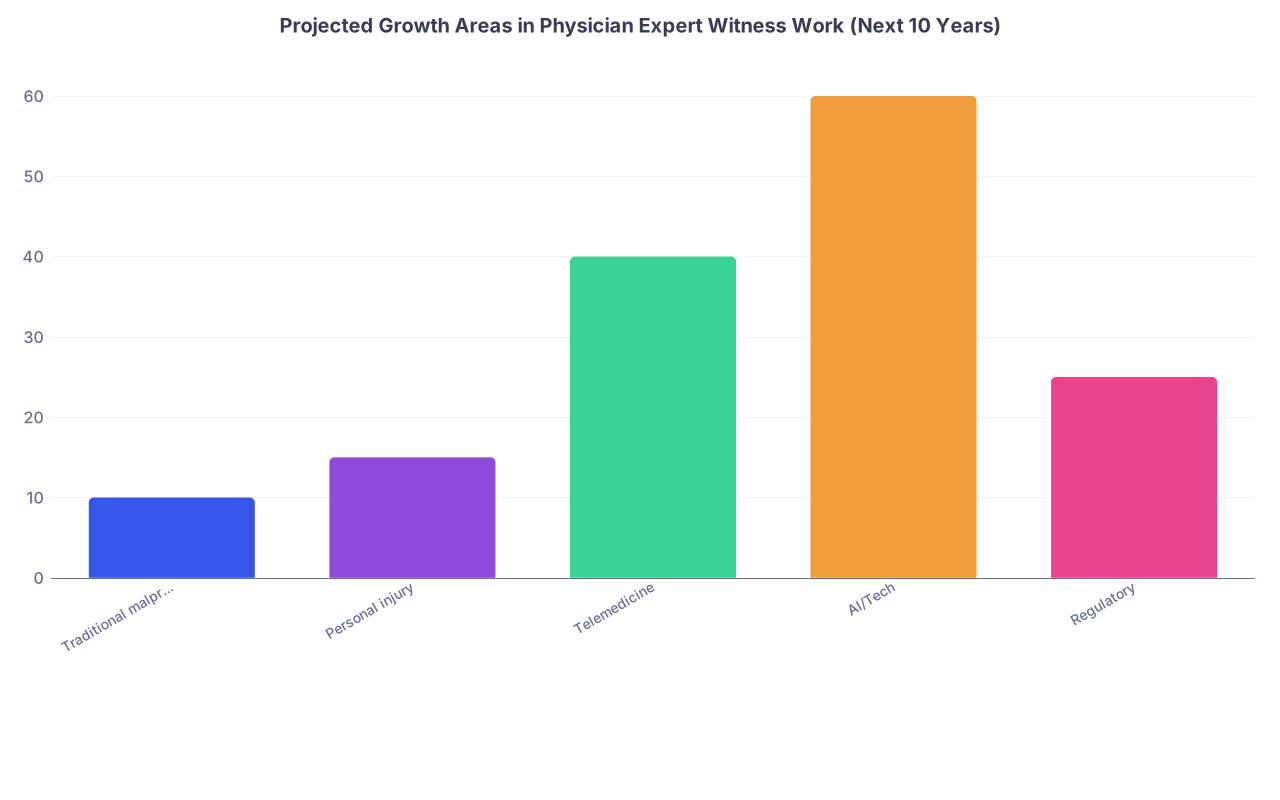
| Category | Value |
|---|---|
| Traditional malpractice | 10 |
| Personal injury | 15 |
| Telemedicine | 40 |
| AI/Tech | 60 |
| Regulatory | 25 |
FAQ (Exactly 6 Questions)
1. Do I need formal training to start expert witness work, or can I just begin taking cases?
You do not need formal certification, but you should not wing it either. A short, focused course (like a SEAK expert witness training or a solid medicolegal workshop from your specialty society) is worth the money. You will learn how depositions work, how to structure reports, and what cross‑examination actually feels like. Then start with a couple of lower‑stakes cases, preferably through a firm that handles many medical cases and can guide you on mechanics.
2. Will doing plaintiff work hurt me with my hospital or colleagues?
It can, if you are sloppy or appear to be a “hired gun.” If your opinions are well reasoned, align with mainstream standards, and you are balanced (willing to work both sides when the medicine supports it), most colleagues quietly respect it, even if they grumble. The real problem is when physicians repeatedly testify that common, defensible practices are negligent. That spreads fast, and you will get a reputation. Stay within realistic, defendable standards and avoid local politics when possible.
3. How do I set my initial hourly rate without underpricing myself?
Start by anchoring to your clinical value. If your clinical time is effectively worth $250–$350/hour to your employer, your expert rate should be comfortably above that, not below. For most early experts, $350–$450/hour for review time and $450–$600/hour for testimony is entirely reasonable, even at the beginning. If you get zero pushback from any firms, you are probably too low. If everyone says you are too expensive, you might have overshot for your market or CV. Adjust after a few cases.
4. Should I use an expert witness referral service or avoid them?
They are a tool, not a religion. Early on, a listing or two can help you get your first cases and learn the landscape. Just read the fine print. Some services take a brutal cut or try to dictate your rates. Avoid anything that restrains you from working directly with firms later or that tries to own your client relationship. Ultimately, the best work comes from direct relationships with firms that like your work and trust your judgment.
5. How much risk is there that my expert work will be used against me personally?
Your testimony is public and discoverable. Opposing counsel in a future case can (and will) pull your prior depositions and trial transcripts. That is not a bug, that is the system. If you stay fact‑driven, avoid extreme positions, and keep your testimony consistent with your actual clinical practice and charting, the risk is manageable. The people who get burned are those who took wild positions to help a side win. Or those who testified standards they themselves do not follow.
6. I am still in residency/fellowship. Can I do expert witness work now?
Generally, no. You lack the independent practice experience and board certification that courts and attorneys expect. There are rare, narrow exceptions for highly technical or research‑specific niches, but they are uncommon. What you can do now: read medicolegal cases in your specialty, attend a malpractice review conference, and pay attention to how real cases against your department unfold. That way, when you are attending‑level and tempted by that first referral, you are not starting from zero.
Key takeaways:
First, expert witness work is real, serious medicine translated into legal language, not a casual side gig you squeeze between notes. Treat it like a consulting practice. Second, your rate should reflect your expertise and the disruption to your schedule, not your RVU‑trauma conditioning. Third, the physicians who thrive in this space are the ones who stay brutally honest in their opinions, learn the workflow cold, and remember that they are there to help the court understand medicine, not to rescue a particular side.


