
Last week a PGY-2 IM resident told me she was scared to publish her own medical blog under her real name. Not because she was saying anything wild, just because her program “feels strict” and she was terrified she’d end up in the PD’s office getting grilled about professionalism.
Honestly? She’s not overreacting. This is exactly the kind of thing that keeps driven, entrepreneurial residents and attendings stuck in analysis paralysis—wanting to build something, but constantly thinking: “What if this costs me my career?”
Let me say the quiet part out loud: yes, your side business can get you in real trouble if you’re reckless. Fired? Very possible. Reported to the board? It’s happened. Blacklisted from future jobs? Also happened.
But most people don’t get burned because they had a side hustle. They get burned because they were sloppy, arrogant, or clueless about the rules.
You’re trying not to be that person. So let’s go through the actual risks—worst case first—then back into how to do this without blowing up your residency or job.
The Nightmare Scenarios (Yes, They’re Real)
If you’re like me, your brain goes straight to the darkest timeline. So let’s drag it into the light.
Here are the big ways a side business can realistically get you fired or disciplined:
- Conflict of interest
- Competing with your employer
- Using employer resources or time
- Violating professionalism / social media / ethics rules
- Messing with patient privacy (HIPAA)
- Contract violations (moonlighting clauses, non-competes, outside employment policies)
These aren’t theoretical. I’ve seen versions of these play out. Residents quietly “disappear” from the schedule mid-year. Attendings suddenly “mutually separate from the organization” right after a major social media dust-up. You know the script.
Let’s go through them one by one, with the ugly details.
1. Conflict of Interest: The Subtle Career Killer
Conflict of interest is the broad, vague bucket programs and hospitals lean on when they don’t like what you’re doing but don’t want to fight over specifics.
Classic examples:
- You start a telemedicine company and see patients in the same geographic area as your residency or hospital system.
- You’re teaching for an MCAT/USMLE company that aggressively markets “Dr. X from Big Name Hospital” and your institution never signed off.
- You’re consulting for a pharma or device company while you’re enrolling patients in studies involving similar products.
- You own a weight-loss coaching company and push your clinic patients to sign up.
Even if you feel like, “But I’m doing this on my own time”… that’s not the only test that matters. Institutions care about:
- Whether your side business affects your judgment
- Whether it looks like it affects your judgment
- Whether their name or reputation gets dragged into it
- Whether you’re financially benefitting off patients tied to them
And this is where programs can absolutely hammer you. They can say:
- You failed to disclose a conflict
- You violated institutional policy on outside work
- You compromised professionalism and patient trust
No, they usually won’t say “We hate that you’re entrepreneurial.” They’ll call it “concern for patient trust” and “appropriateness of judgment.” And those phrases show up in letters. And you don’t want that.
2. Competing with Your Employer: The “You Stole Our Patients” Problem
If your side hustle looks like you’re siphoning off patients, clients, or revenue from your employer, you’re in dangerous territory. This is where things can escalate from “stern talking to” into “pack your things.”
Examples that raise red flags:
- You’re a hospitalist or PCP and you start a concierge primary care practice across town, marketed to the same zip codes.
- You’re an EM doc and you open an urgent care a mile from the hospital with identical branding vibes.
- You do cash-pay procedures in your own LLC that your hospital also offers, and you quietly steer certain patients toward your private option.
Your contract may have explicit language calling this out: “no competing business,” “no outside medical practice without written approval,” etc. If you violate that, they actually have clean cause to fire you.
And no, “But it’s 100% telehealth” doesn’t necessarily save you. If you’re licensed in the same state, serving the same population, they can still argue conflict or competition.
This is one of the few areas where I’ll say: don’t dance near the line unless you’ve had a real attorney read your contract and the hospital’s conflict policies. Not TikTok. Not some random Facebook group. A real, boring lawyer.
3. Using Employer Time or Resources: The Sloppy Mistake People Actually Make
This one gets people who think they’re safe because their side business is “totally unrelated” and “only on my own time.”
Then someone notices:
- You’re doing coaching calls between consults in the call room.
- You built your entire side business on your hospital-issued laptop.
- You used hospital email or logos in your marketing.
- You chart late constantly, but your Instagram for your brand is magically very active.
Even if no one cares about your knitting Etsy shop, they do care if you’re obviously using work hours to knit and ship orders.
Programs will call this “dereliction of duty,” “unprofessional behavior,” or “failure to meet performance expectations.” HR will call it “misuse of employer resources.” Both can be grounds for termination if you’re already on thin ice.
I’ve seen residents get pulled in because they were answering course-platform messages during rounds, or because a nurse saw them editing YouTube videos during a slow night shift. People talk. Screens are visible. You are not invisible just because you’re behind a workstation.
This is the low-hanging fruit that’s totally avoidable.
4. Professionalism and Social Media: The Fastest Way to Get Nuked
Let’s be blunt: if your side business has a social media component under your real name or face—and you’re a resident or attending—you’re playing in a minefield.
Things that can blow up on you:
- Criticizing your own hospital or leadership publicly, even without naming them
- Making “jokes” that are sexist, racist, fatphobic, or punch down at patients
- Posting “day in the life of a resident” content that makes your program look unsafe, incompetent, or exploitative
- Posting photos/videos from inside patient care areas without explicit permission and institutional clearance
- Giving medical advice off the cuff, especially if something bad happens and someone points back to your video
No program wants to be “that residency that went viral for the resident TikTok scandal.” It doesn’t matter that you meant well, or “everyone else is doing it.” All it takes is one angry email from the wrong attending or a local journalist.
And then you’re in a “professionalism and judgment” meeting you can’t win.
Do people pull this off successfully? Absolutely. But the ones who survive long term are absurdly careful with:
- Language (everything they say could be screen-shotted into a board complaint)
- Disclaimers (not magic protection, but helpful)
- Visuals (no badges, no logos, no semi-identifiable patients, no workstations showing PHI)
- Topics (they avoid ranting about their own institution)
If your content overlaps with medicine even 1%, assume someone from your hospital will eventually see it and ask themselves, “Does this make us look bad?”
If the answer is even slightly “maybe,” they can—and will—use that.
5. Patient Privacy and HIPAA: The One That Can Follow You Forever
This is the one that keeps me up at night for people.
You don’t have to say a name or show a face to violate HIPAA. “That crazy STEMI we just had in Bay 3” with enough context + date + location can be enough for a complaint, especially in smaller communities.
Places side hustles intersect badly with HIPAA:
- Podcasting or blogging case stories without fully de-identifying and/or getting consent
- “Storytime” medicine content on TikTok/Instagram/YouTube
- Screenshotting parts of your day and accidentally capturing PHI in the background
- Remote work for your own business from hospital computers where protected information is visible
Hospitals are paranoid about HIPAA, for good reason—real penalties, real lawsuits, real PR disasters. They will sacrifice you in a heartbeat to contain risk.
Worst-case chain:
- Someone complains →
- Hospital investigates →
- You’re terminated for HIPAA violation →
- Report goes to the board and maybe NPDB →
- Every future credentialing committee sees that forever
All because of a 30-second TikTok or a “funny story” in your coaching email list.
If your side hustle involves “content,” especially storytelling, assume that you have to build it as if you were not allowed to mention your current patients or workplace at all.
Because practically? You aren’t.
6. Contract and Policy Violations: The Boring Stuff That Actually Matters
Most residents and attendings never fully read:
- Their employment contract
- The institutional “outside work” policy
- The moonlighting policy (for residents)
- The social media policy
- The conflict of interest policy
Then they’re shocked that their “innocent little LLC” is suddenly a problem.
Typical landmines:
- Clauses requiring written approval for any outside employment, medical or not
- Non-compete language that covers any similar healthcare service in a geographic radius
- “Duty hours and primary commitment” language for residents that lets programs argue your performance is impaired
- Requirements to disclose any compensation from external sources (sponsorships, pharma speaking, consulting)
You might think, “But it’s just a blog making $200/month in ad revenue.” Your institution might see “undisclosed financial relationship with third party companies while using your professional identity.”
They don’t care that the money is small. They care that you didn’t follow their process.
And they always have more leverage than you think.
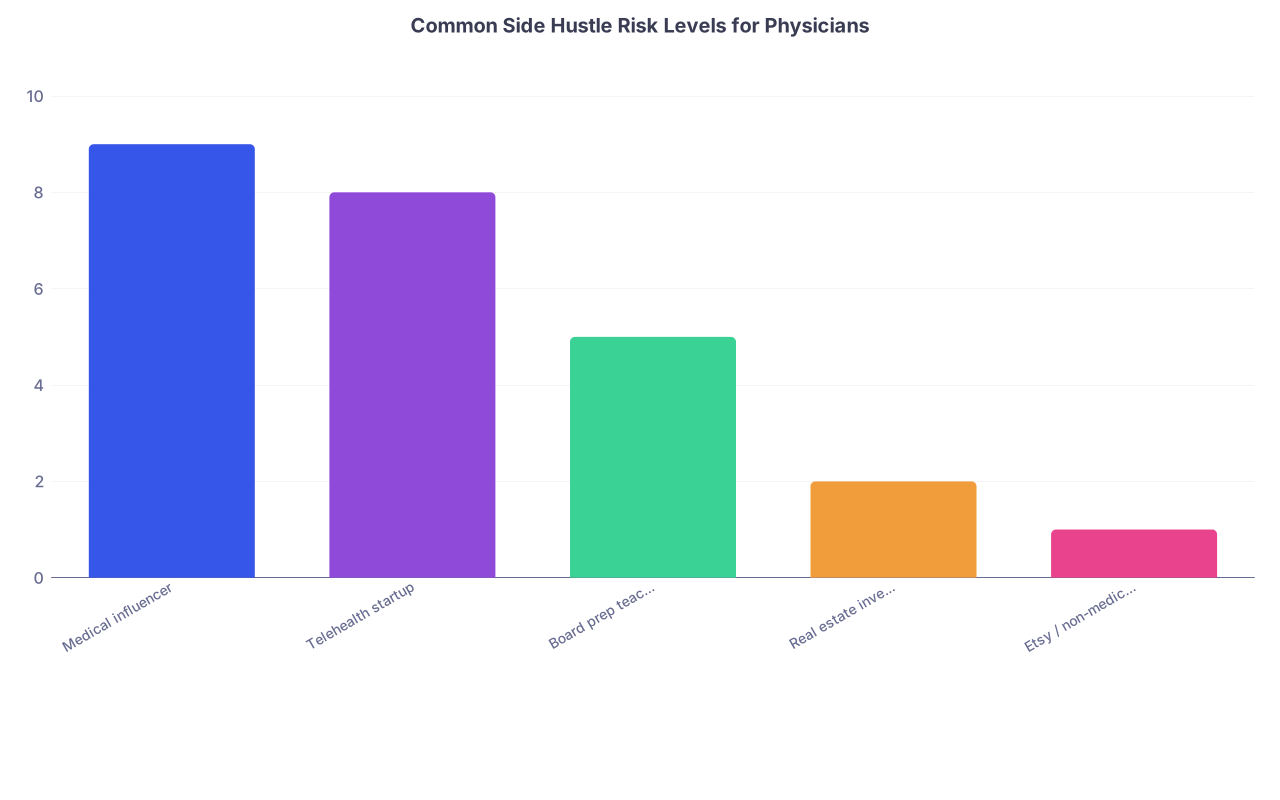
| Category | Value |
|---|---|
| Medical influencer | 9 |
| Telehealth startup | 8 |
| Board prep teaching | 5 |
| Real estate investing | 2 |
| Etsy / non-medical ecom | 1 |
So… Is Any Side Business Actually Safe?
This is the part where your anxiety brain is already saying, “Okay, so I just can’t do anything until I’m 45 and tenured.”
I’m not going to lie: the safest side hustle is the one that doesn’t touch your employer, your patients, or medicine at all.
Lower-risk categories (not zero risk, but much easier to defend):
- Real estate investing (done privately, without using your hospital name or time)
- Index fund investing / personal finance content that doesn’t give individualized advice or sell securities
- E-commerce not related to medicine
- Tech / coding work that’s clearly separate from patient care and done fully off the clock
- Writing under a pen name that doesn’t involve your current patients or employer
Moderate-risk, doable with care:
- Board exam tutoring or teaching for premeds/med students (with employer approval and clear disclosures)
- Medical blogging / podcasting with strict de-identification and conservative content
- Speaking or consulting not directly overlapping your employer’s services
High-risk, proceed-with-lawyer:
- Telemedicine / private clinical care on your own
- Any business that diagnoses, prescribes, or orders tests
- Coaching that shades into individualized medical advice
If your side hustle involves clinical care, using your MD, DO, PA, or NP license directly—it’s not “just a hobby.” It’s high risk. Treat it that way.

How to Not Get Fired: A Paranoid But Practical Checklist
Let me be overly cautious for a minute—because that’s probably why you’re still reading.
Here’s the mental checklist I’d run through before launching or growing anything:
Have I actually read my contract and policies?
Specifically look for: “outside employment,” “moonlighting,” “non-compete,” “intellectual property,” “social media,” “conflict of interest.” Highlight them. If you don’t understand something, you’re not dumb—the language is intentionally vague. Ask a lawyer.Does my side business touch medicine or patients at all?
If yes, assume:- You need explicit written approval, not just “my attending said it was fine.”
- There’s a chance this becomes part of how people view your professionalism.
Could this be seen as competing with my employer?
Same geography, same patient population, same services = red flag.
If you’re even vaguely unsure, that’s your anxiety trying to protect you. Listen and check.Am I using any employer resources, time, or branding?
Hospital laptop? Hospital Wi-Fi? Badge? Logo? Email? Forget it. Keep it 100% separate:- Your own laptop
- Your own email
- Your own Wi-Fi or home internet
- No hospital logos, building shots, or even name-drops without approved context
If my program director saw this side business, would I be okay sitting in a meeting explaining it?
Not “could I defend it logically?” but “would they feel blindsided or embarrassed?” If they’d feel ambushed, you’re at risk.If the worst patient, worst journalist, or worst co-resident saw my content, what could they do with it?
Screenshot out of context. Report to hospital. File a board complaint. Trigger a Twitter storm.
If that thought makes you nauseous, adjust the content or don’t post it.If it all went sideways, is there a clear paper trail that I asked permission or disclosed?
Emailed GME? Got written approval from compliance? Documented that your consulting was disclosed? That stuff matters when the knives come out.
| Side Hustle Type | Relative Risk of Employer Issues |
|---|---|
| Non-medical e-commerce | Low |
| Real estate investing | Very Low |
| Board prep / tutoring | Medium |
| Medical content / influencer | High |
| Independent telehealth | Very High |
The Emotional Side: Living with the Anxiety
Here’s the part no one talks about: even if you do everything “right,” you might still feel sick to your stomach when you hit publish on that blog post or file your LLC paperwork.
Because this isn’t just a “fun little project” for you. It’s wrapped up in:
- Wanting financial security in a system that exploits you
- Wanting an exit ramp if medicine keeps getting worse
- Wanting to use your brain for something besides RVUs and templates
- Fear of being “the problem resident” or “the difficult attending”
You’re trying to build a life raft without alerting the ship’s captain that you’re not 100% confident in the ship.
That’s exactly how it feels. And it’s not irrational.
So you overthink. You read every horror story. You wonder if you should just shut it all down until after boards, after fellowship, after partnership—basically, forever.
Here’s my honest take: waiting for a “safe” time in medicine is like waiting for a day in residency that isn’t busy. It doesn’t come.
But reckless isn’t the only alternative. The middle path is:
- Start small
- Start boring
- Start away from your license and your employer
- Get more sophisticated later, when you’re not on a GME leash
If you’re a resident, you are the most vulnerable you’ll ever be in your career: no leverage, dependent on evaluations and letters, no reputation buffer. Act like it. Bias toward lower-risk, non-clinical, non-public-facing work.
If you’re an attending, you have more room—but contracts and credentialing still follow you. Act like anything you do might show up on a privileging application in five years. Because it might.

| Step | Description |
|---|---|
| Step 1 | Have a side business idea |
| Step 2 | Check contract for outside work clause |
| Step 3 | Review contract and policies |
| Step 4 | Redesign to be separate |
| Step 5 | Low risk - proceed carefully |
| Step 6 | Consult lawyer and compliance |
| Step 7 | Request written approval |
| Step 8 | Build clear boundaries and documentation |
| Step 9 | Is it medical or clinical? |
| Step 10 | Uses employer time or resources? |
| Step 11 | Could it compete with employer? |
What You Can Do Today (So You’re Not Just Panicking)
Don’t let this just swirl in your head as vague dread. Do something concrete and small.
Here’s your next step:
Today, pull up your current contract and your institution’s “outside work” or “moonlighting” policy. Read only those sections, and highlight anything related to: outside employment, conflict of interest, social media, and non-compete.
That’s it. Don’t try to fix your entire life tonight. Just:
- Find the words that govern what you’re “allowed” to do
- See in black and white how strict or vague they actually are
Once you’ve done that, you’ll know if your anxiety is overfiring or if it’s warning you about a real landmine.
Then you can decide: do I keep this side business exactly as-is, tweak it, or pause and get a professional opinion?
But don’t keep operating blind. That’s how people get fired.