
What if everyone at work finds out my side hustle flopped?
That’s the thought that actually keeps you up, right?
Not “what if it doesn’t make money?”
Not “what if it’s a waste of time?”
It’s: What if this thing fails, publicly, and my partners, residents, nurses, and old attendings see it and think I’m an idiot?
You’re not just scared of losing money. You’re scared of losing face. As a doc, your whole identity is built around competence. Control. Getting it right. Side hustles are the opposite of that. Messy, public, experimental.
And your brain is like: “Cool, so let’s imagine the most humiliating version of that. On repeat. At 2 a.m.”
Let’s walk straight into that fear instead of pretending it’s not there.
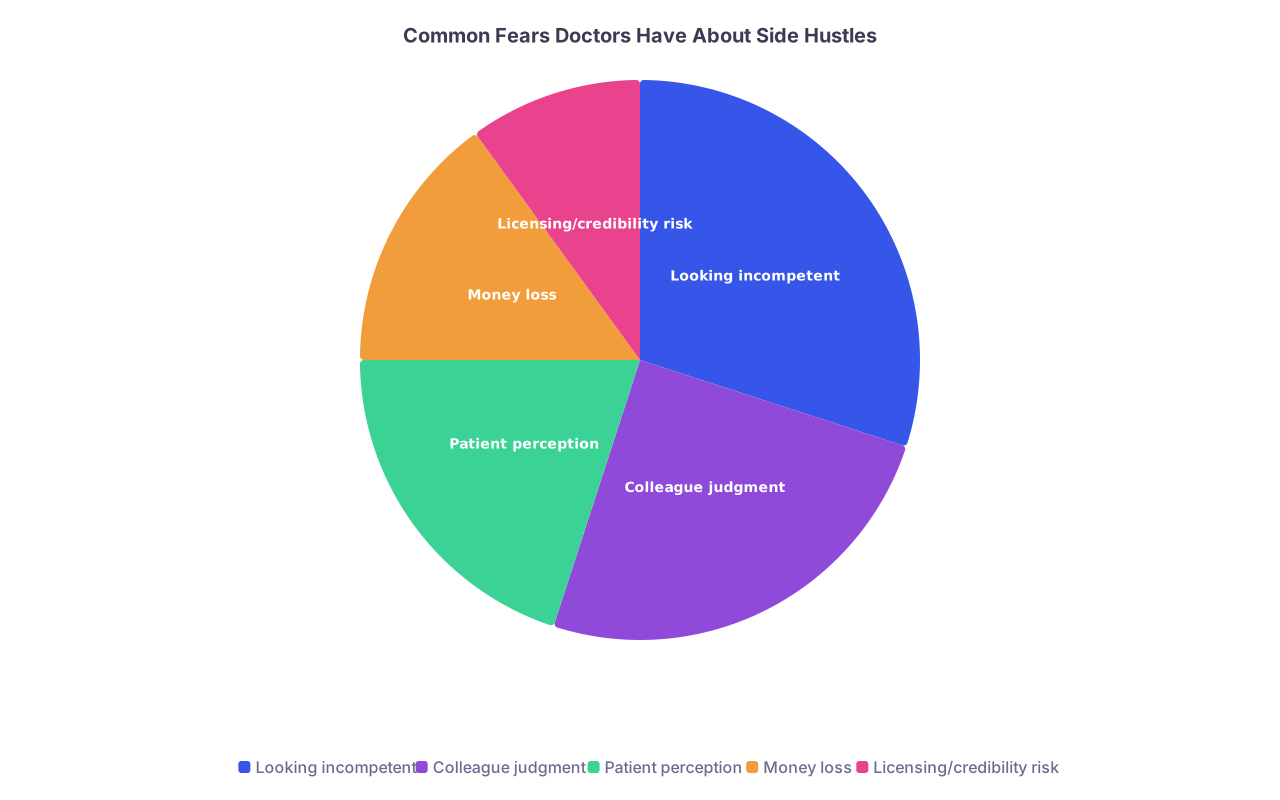
| Category | Value |
|---|---|
| Looking incompetent | 30 |
| Colleague judgment | 25 |
| Patient perception | 20 |
| Money loss | 15 |
| Licensing/credibility risk | 10 |
The specific nightmare scenarios (that feel way too real)
Let me just say them out loud the way your brain probably does in the shower.
You launch a coaching service for residents. You post carefully crafted content on LinkedIn and Instagram. Six months later, you have… three clients, two of whom are your med school friends “supporting you.” Your group’s senior partner pulls up your website on his phone at lunch and jokes, “So you’re a guru now?” Cue internal death.
Or you start a YouTube channel about ICU medicine. You invest in a mic, lighting, editing. Twenty videos, 150 subscribers. A co-resident finds it and says, “Damn, only 40 views in three weeks?” with that half-joking, half-mean tone that hits way too hard.
Or worst of all: you launch some digital product, advertise a webinar, 60 people register… 7 show up. You present anyway, but the chat is dead. Afterwards, you imagine all 53 no-shows texting their group chats: “Lmao look at this doc trying to be a business bro.”
If your stomach dropped reading those, okay, yes—those are the exact little horror movies the anxious brain plays.
Here’s the uncomfortable truth: some version of that might happen. People might see. Some might snicker. A few might be weird about it.
And still… you’re catastrophizing the wrong things.

What actually happens when a side hustle “fails” in public
I’ve watched this play out with real physicians:
Hospitalist launches a blog on burnout. Posts weekly for four months. Barely any traction. She feels exposed because her colleagues follow her on Twitter. One day an attending says, “Oh hey, saw your blog, you still doing that?” She hears “so that didn’t go anywhere, huh?” and spends the night mentally rewriting her LinkedIn to hide it.
Here’s what I’ve actually seen:
Most colleagues… don’t care that much. They’re too consumed with their own RVUs, their own kids, their own call schedule, their own silent panics. They notice, they clock it, maybe they check your website once. Then they move on.
The reactions usually fall into a few buckets:
- A small group quietly admires you and never says it out loud. They think, “I could never put myself out there like that.”
- A few are mildly curious: “How’s that side thing going?” Not accusatory. Just socially awkward doctor small talk.
- One or two will be weird or condescending. These are the same people who roll their eyes at everything that isn’t exactly what they chose.
- Patients? 99% never see it. The 1% who do mostly think it’s cool their doc does something else too.
The pattern I’ve noticed: the physician themself feels 100x more embarrassed than the world actually is interested.
And yes, sometimes something really flops. Course launch with 0 sign-ups. Podcast with 50 downloads total. A startup that burns cash and shuts down. That’s not “oops, small thing” fail. That’s big, obvious, can’t-pretend-it-didn’t-happen fail.
What happens then?
You learn the most brutal but freeing reality: the internet moves on in about 48 hours. Your colleagues in about a week. You? You’ll think about it for months. That’s the real problem.

| Step | Description |
|---|---|
| Step 1 | Idea excitement |
| Step 2 | Public launch |
| Step 3 | Low response or negative feedback |
| Step 4 | Shame spiral |
| Step 5 | Hide or delete everything |
| Step 6 | Quiet reflection |
| Step 7 | Reframe as experiment |
| Step 8 | Decide to iterate or pivot |
Why this feels so much worse for doctors
Non-physicians mess up publicly all the time. Failed blogs, dead apps, bad startups. They shrug, maybe cringe a little, move on.
Docs? Totally different wiring.
You were selected, trained, and rewarded for:
- Not being wrong
- Not guessing
- Not showing uncertainty in front of others
Residency beats any tolerance for visible failure out of you. You learn quickly: don’t present a plan unless you’ve triple-checked it. Don’t say you’re sure unless you are. Don’t expose your ignorance on rounds unless you like humiliation.
Side hustles demand the opposite: move before you’re ready, launch before it’s perfect, test publicly, fail in the open. It’s the same muscle med school trained you to suppress.
So when your side hustle doesn’t explode out of the gate, your brain doesn’t say, “Data point; adjust.” It says, “I am incompetent. People can see that. I should crawl into a hole.”
You’re not overreacting because you’re weak. You’re reacting like someone who’s been professionally conditioned to equate visible error with danger.
| Domain | Clinical Medicine Expectation | Side Hustle Reality |
|---|---|---|
| Being wrong | Avoid at all costs | Happens constantly |
| Public image | Always competent | Messy, experimental |
| Feedback | From seniors, structured | From strangers, random |
| Timeline | Linear, predefined | Nonlinear, unknown |
| Failure | Dangerous, punished | Data, inevitable |
The part you secretly dread: seeing people again after it flops
Let’s say the nightmare happens.
You build a “physician wellness membership” with a fancy landing page. You share it in a few Facebook groups. You do a webinar, you hype it on LinkedIn. You ask colleagues for support. Six months later, you quietly shut it down because you have 4 paying members and you’re drained.
And then… conference. Or grand rounds. Or Monday morning sign-out.
You imagine:
- Your old program director asking, “So how’s that business going?” with eyebrows raised.
- A colleague whispering, “Did you see they took the site down?”
- Someone presenting your failure as cautionary tale: “This is why you shouldn’t get distracted from real medicine.”
Let me offer you some scripts. Because thinking through the exact words helps calm the vague terror.
If someone asks, “What happened with that side thing?” you can say, very calmly:
“It didn’t work the way I hoped. I learned a ton about what doesn’t work though. Honestly, it was a good experiment.”
Or:
“I realized the model wasn’t sustainable for me. So I shut it down on purpose instead of letting it drag on.”
Or the simplest:
“It failed. But I’m glad I tried. I’d rather have a failed project than spend my life wondering.”
You don’t owe them a TED Talk. Just a sentence or two, said like it’s not a scandal. Because it isn’t.
People take their cue from your energy. If you act like it’s a shameful secret, they’ll treat it as one. If you treat it like a normal attempt that didn’t pan out, most will shrug and move on.
The person who keeps poking or mocking? That’s not a “you started a side hustle” problem. That’s a “they’re kind of an ass” problem.
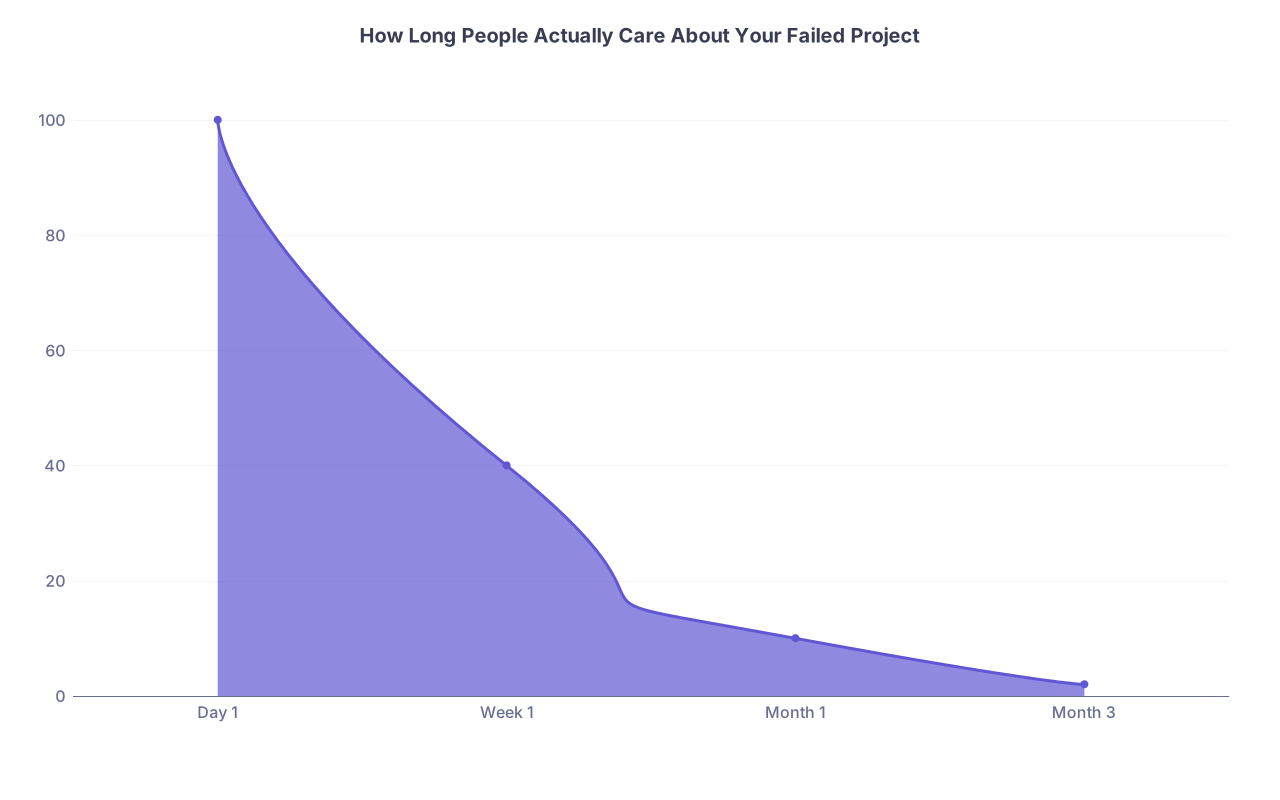
| Category | Value |
|---|---|
| Day 1 | 100 |
| Week 1 | 40 |
| Month 1 | 10 |
| Month 3 | 2 |
Managing the embarrassment in real time (when your chest is tight and you want to vanish)
The hardest part isn’t the big explanation. It’s the tiny, everyday moments. Someone mentions your project in passing and your brain lights up: shame, heat in your face, you want to change the subject, maybe pretend it was “just for fun” all along.
Here’s a way to handle those micro-moments without spiraling.
First: name the feeling, in your head, with zero judgment.
“This is embarrassment. My nervous system thinks I’m in danger of social exile.”
Not poetic. Just factual. It shifts you from “I am a failure” to “I’m feeling a thing.”
Second: pre-decide your narrative. If you don’t, your brain fills in the worst version.
Your narrative needs to be one sentence you believe at least 60%, like:
“I’m someone who is willing to try things publicly, and sometimes they won’t work. That’s not a character flaw. That’s how you build anything outside medicine.”
If that feels like too much, soften it:
“I’m allowed to have projects that don’t work out. That doesn’t cancel out the rest of who I am.”
Then: when someone brings it up, you answer with that narrative in mind.
Them: “Hey, how’s that YouTube channel?”
You: “I paused it. The growth wasn’t there, and I didn’t want to keep forcing it. Learned a lot though.”
And stop. Don’t over-explain. Don’t nervously word-vomit your entire emotional autopsy. You know that thing on rounds where the more you talk, the more you expose what you don’t know? Same rule. Brief, confident, done.
Last: resist the urge to scrub your entire online footprint out of shame. Pause before you delete everything.
You can quietly:
- Update your bio as “previously built X, now working on Y”
- Leave the site up but mark it “archived project”
- Keep the content as proof (for yourself) that you did something, not just thought about it
Erasing everything often makes you feel more like it was some unspeakable disaster. Sometimes your future self will be grateful you left the evidence—cringey and all.

The hidden upside of a publicly failed side hustle
This is the part nobody believes until it happens to them.
A visible fail:
- Instantly filters who you actually respect
- Exposes who only values you when you’re “shiny” and impressive
- Cuts through the illusion that your professional identity must stay perfectly polished forever
I’ve seen physicians:
- Get unexpected job offers because someone respected that they tried to build something, even if it didn’t land
- Be invited to speak on “what I learned building a failed startup” panels that led to bigger, better opportunities
- Use their “failed” blog or podcast as portfolio proof for a non-clinical pivot later
And then there’s the personal piece. Once you’ve experienced a public flop and survived, the terror around “What if it fails?” goes way down the next time.
You realize:
“I had a thing that didn’t work. Some people knew. Some probably thought things. And I’m still here, still a doctor, still me.”
That’s not inspirational-poster fluff. That’s a specific kind of freedom physicians almost never get, because our whole training is about not messing up where anyone can see.
A public failure in a relatively low-stakes arena (no patients harmed, no licenses at risk) is exposure therapy for shame.
Is it fun? No.
Is it useful? Absolutely.
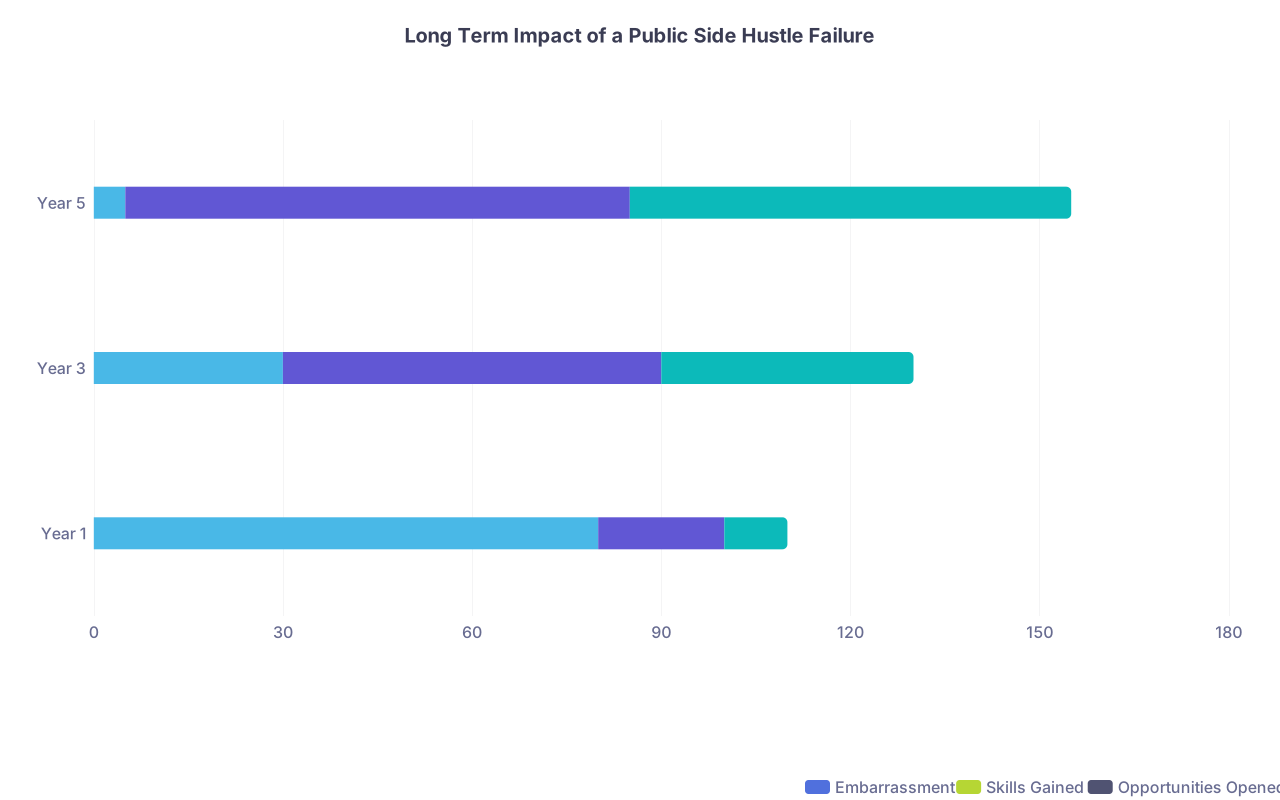
| Category | Embarrassment | Skills Gained | Opportunities Opened |
|---|---|---|---|
| Year 1 | 80 | 20 | 10 |
| Year 3 | 30 | 60 | 40 |
| Year 5 | 5 | 80 | 70 |
So should you even risk it?
You might be thinking, “Honestly, this all sounds miserable. Why not just keep my head down, see patients, collect paycheck, and skip the public humiliation?”
You can. Many do. Some are genuinely happy that way.
But you’re reading this because part of you already wants something else. More creativity. More autonomy. Another identity that isn’t charting and call and Press Ganey.
You don’t get that without risk. And not just financial risk. Ego risk.
The real question isn’t “What if my side hustle fails publicly?”
It’s “Am I willing to feel embarrassed and not let that emotion run my entire life?”
If your honest answer right now is “no, not yet,” that’s okay. You can keep things smaller, more private:
- Anonymous writing
- Quiet freelancing work no one at the hospital knows about
- Tiny experiments instead of a big public “launch”
But if your answer is “I’m terrified, but I can tolerate it,” then that’s enough.
Your job isn’t to guarantee no one ever sees you fail. That’s already impossible. Your job is to fail in a way that’s compatible with your values: no patient harm, no ethical or legal disaster, just the very human mess of trying something new.
When the fear spikes at 1 a.m., remember this
You’re scared your side hustle might fail publicly. Let’s be blunt:
- Some version of “not working” is extremely likely on the first (or second, or third) try. That’s normal, not damning.
- Other people will notice far less and care far less than your anxious brain insists. A few may judge; most won’t.
- Your capacity to feel embarrassed and keep going is a far better predictor of your long-term happiness outside pure clinical work than whether your first project succeeds.
You are not your download count. You are not your subscriber number.
You are a doctor who dared to build something when it was way safer to stay silent.
That’s not embarrassing. That’s rare.