
You just finished a 12‑hour shift, your EMR inbox is still full, and you’re staring at yet another social media post about some doctor making “passive income” in their sleep.
You don’t want another job. You want something that can actually scale without devouring your nights and weekends. And you’re asking the only question that matters:
Which physician side hustles actually scale with limited time—and which ones are just second jobs with better marketing?
Here’s the answer you’re looking for.
The Core Question: What “Scales” For a Physician?
Before we rank anything, define the game. A scalable physician side hustle should:
- Sever the link between income and hours (at least partially).
- Have multiplicative upside: work done once can pay off many times.
- Fit into small, inconsistent blocks of time (post‑call brain fog is real).
- Not risk your license or your main job.
So a Saturday moonlighting shift? That’s income, but it’s not scalable. You trade time for money at a fixed rate.
Now let’s cut the noise and rank the common physician side hustles by how well they scale with limited time.
Quick Comparison: What Actually Scales?
| Side Hustle | Scalability | Time Flexibility | Startup Effort | Licensing Risk |
|---|---|---|---|---|
| Niche digital products | Very High | Very High | Moderate | Low |
| Content & audience building | Very High | High | High | Low–Moderate |
| Equity-based medical startups | Very High | Low–Moderate | Very High | Variable |
| Asynchronous telemedicine | Moderate | High | Low | Moderate |
| Expert consulting / advisory | Moderate | Moderate | Moderate | Low–Moderate |
| Real estate (leveraged, systems) | Moderate | Moderate | Moderate–High | Low |
Let’s go one by one, and I’ll tell you bluntly where the time leverage is and where people are kidding themselves.
1. Niche Digital Products: Top Tier Scalability
If you want the cleanest “do work once, get paid many times” model, this is it.
You create something once and sell it repeatedly with almost no incremental time per customer. For physicians, the best opportunities are in niche, high‑value problems where your expertise is obvious and rare.
Examples that actually work:
- A short, hyper‑focused course: “How to interpret complex PFTs” for pulmonologists, “Prior auth survival guide” for PCPs, “OR game plan for PGY‑1s”
- Templates and tools: peri‑op protocols, ED order set cheatsheets, patient education bundles, onboarding playbooks
- Premium PDFs or micro‑books: “Realistic guide to hospital credentialing,” “First 90 days as an attending”
Why this scales with limited time:
- Creation is time‑intensive once. Then:
- Delivery is automated.
- Support can be minimal if you build the right thing (not a high‑touch cohort course).
- You can work on it in 60–90 minute chunks with no one else waiting on you.
Where physicians screw this up:
- Building huge, unfocused courses nobody finishes.
- Making products for “everyone” instead of a narrow, painful problem.
- Not building any kind of distribution (no email list, no audience, no partnerships).
Practical way to start with low time:
- Brain dump a list of 10 problems colleagues ask you about repeatedly.
- Pick one you can solve in 30–60 minutes of content or templates.
- Create a simple landing page + Stripe checkout.
- Share first with 50–100 people you already know (residents, coworkers, alumni lists).
This is the highest‑ROI starting point for most clinicians who are comfortable teaching or systematizing what they already do.
2. Content & Audience Building: Slow to Start, Massive Upside
This is the classic: YouTube channel, newsletter, TikTok, blog, podcast.
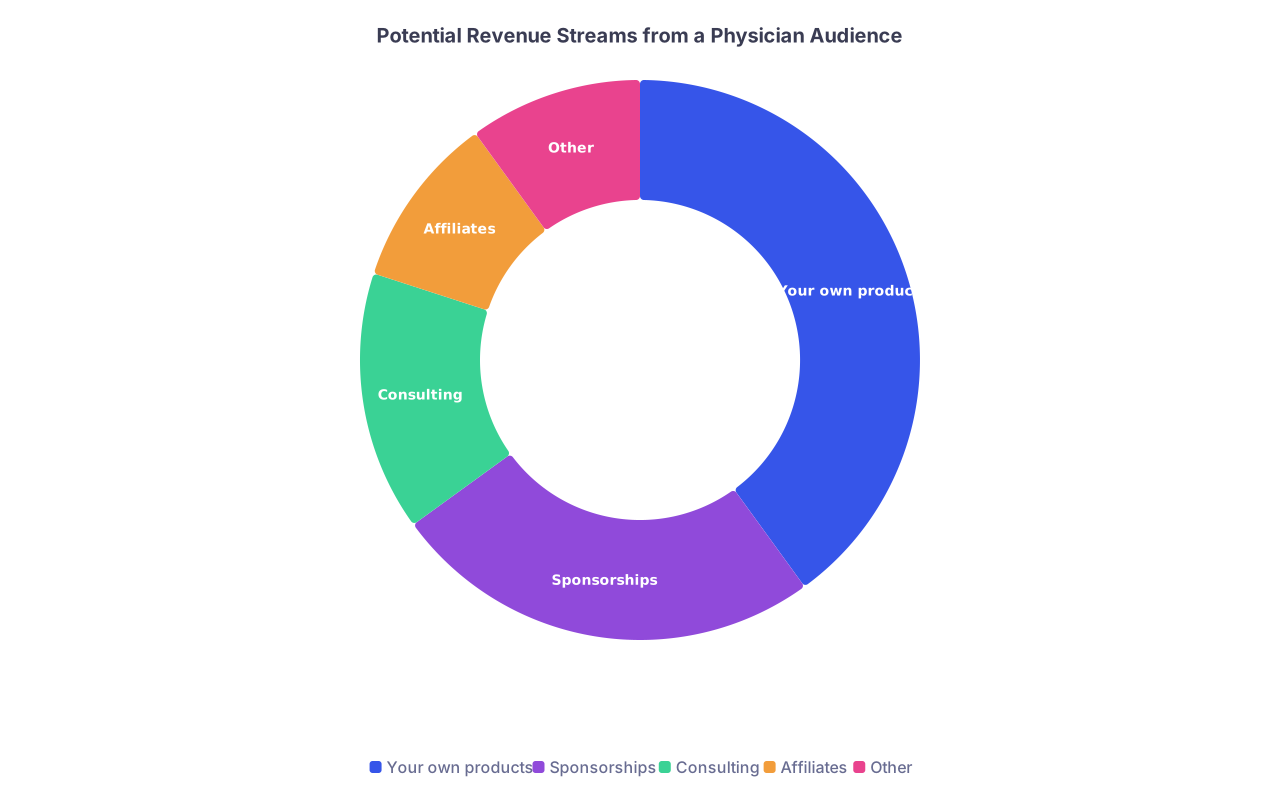
99% of it is noise. But for the 1% of physicians who do it well for 2–3 years, the leverage is unmatched. Because once you control attention, you can plug in multiple revenue streams on top:
- Sponsored content
- Your own digital products or courses
- Affiliate income
- Speaking, consulting, advisory roles
- Eventually, your own brand or company
| Category | Value |
|---|---|
| Your own products | 40 |
| Sponsorships | 25 |
| Consulting | 15 |
| Affiliates | 10 |
| Other | 10 |
Why this can work even with limited time:
- You can batch content: record 4–6 videos or write 4 newsletters in one weekend once a month.
- You can repurpose: 1 deep piece → clips, posts, email, etc.
- The compounding comes from consistency, not daily heroics.
Why most physicians fail here:
- They quit at 6 months. Audience flywheel usually needs 18–24.
- They talk like a textbook instead of like a human.
- They choose topics with tons of competition and no differentiation.
- They never pick a clear “who” (demographic) and “what” (problem) they exist for.
Time‑smart strategy:
- Choose one primary channel (newsletter, YouTube, or LinkedIn/Twitter).
- Commit to 1 high‑quality piece per week for a year.
- Focus on a narrow persona: “US FMGs anxious about Step 2,” “new hospitalists drowning in EMR,” “ICU nurses and residents learning ventilator management.”
- Build an email list from day 1. Social is rented land.
This is not quick money. But once it’s working, it’s the most scalable foundation you can own.
3. Equity‑Based Roles in Medical Startups: High Risk, High Leverage
Now we’re in “lottery ticket with logic behind it” territory.
You lend your expertise to a company—usually early stage—in exchange for equity, advisory shares, or a blend of small cash + equity.
Types of roles that can scale:
- Clinical advisor for a digital health or medtech startup
- Chief Medical Officer (fractional) for a small company
- Board member for a healthcare services group
- Co‑founder (if you actually want to build a company, whole different life)
Why this can be incredibly scalable:
- Time can be limited: 2–4 hours/month in an advisory capacity.
- If the company succeeds or exits, that small equity slice can dwarf years of consulting fees.
- Your MD/DO plus niche expertise (e.g., stroke workflow, ICU protocols, algorithm development, reimbursement) is hard to replace.
Where physicians get burned:
- Taking equity in garbage companies because “founders seem nice.”
- No clarity on time expectations, IP, or liability.
- Overcommitting and under‑delivering because clinical work always wins.
- Doing unpaid advisory work long term with no meaningful upside.
Time‑smart approach here:
- Only consider startups where your expertise is clearly central to the product or go‑to‑market.
- Be explicit: scope, time cap per month, equity/cash structure, and term.
- Work on 1–2 serious roles max. More than that, you’re not useful to anyone.
This is not the first place you should start, but it’s where seasoned physicians with some reputation or audience can get dramatic leverage.
4. Asynchronous Telemedicine: Flexible, Some Scale, Still Trading Time
Asynchronous telehealth (eVisits, inbox care, text‑based consults) sits in the middle.
It’s still fundamentally time for money. But the time is:
- Highly flexible (answer messages at 10:30 pm if you want).
- Often batched (review multiple cases in 30–60 minute sprints).
- Less cognitively brutal than full in‑person shifts.
Where slight scalability comes in:
- Once you’re fast with a specific protocol set (UTIs, acne, ED triage, contraception), your earnings per hour can climb.
- Some platforms allow you to work across multiple states once licensed, effectively increasing the opportunity pool.
But be honest: this is mostly an income smoother, not a true scalable engine.
It’s useful if:
- You want near‑term supplemental income.
- You have uneven clinical schedules with dead blocks.
- You’re testing remote work as a lifestyle option.
It’s not going to make you rich without stacking it on top of something more scalable.
5. Expert Consulting & Advisory Work: High Hourly, Low Scale
This includes:
- Med‑legal work (expert witness, chart review)
- Pharma/biotech advisory boards
- Guideline committees
- Clinical protocol consulting for hospitals or payers
- Insurance utilization review
Let me be blunt: these can pay extremely well per hour. I’ve seen physicians earn $400–$800/hour range on med‑legal work. But it does not scale well long term because:
- Each hour is a discrete billable unit.
- Demand is limited by your niche, reputation, and connections.
- You’re capped by your calendar and your tolerance for emails and meetings.
Where can you squeeze some leverage?
You can standardize and productize pieces of your consulting:
- Template reports, checklists, training modules for junior consultants.
- A small group practice where you bring in other physicians and keep a margin.
- Paid workshops or CME events based on your consulting expertise.
But those productized versions pull you back toward digital products and content—which is exactly the point. Pure hourly consulting is not a scalable core; it’s a high‑value income layer.
6. Real Estate: Moderately Scalable, System‑Dependent
Real estate isn’t a “physician specific” side hustle, but doctors love it. Some do very well. Many end up as stressed‑out landlords with a second EMR called “Spreadsheets.”
The scalable versions:
- Passive syndication where you invest capital, not time.
- Small portfolio of properties with a professional property manager.
- Commercial or medical office buildings with triple‑net leases.
The non‑scalable versions:
- Self‑managing multiple single‑family homes around your call schedule.
- Flipping houses “on the side” (that’s a job, not a side hustle).
- DIY heavy rehab projects while you’re on Q4 call.
Real estate can scale, but time leverage comes from:
- Systems and people (property managers, contractors, bookkeepers).
- Standardizing types of properties and processes.
- Treating it like a business with SOPs, not a hobby.
For physicians with limited time, I’d classify real estate as “moderately scalable if you use your money more than your hours.”
Why Traditional “Extra Clinical Work” Almost Never Scales
Moonlighting, extra call, locums, urgent care shifts—they have a role. They can:
- Pay off high‑interest debt faster.
- Buy you runway to build something more scalable.
- Temporarily boost savings.
But don’t confuse them with scalable side hustles. They:
- Depend entirely on your presence.
- Burn your limited willpower and time.
- Rarely compound. Next year, your rate is roughly the same. Your earning power doesn’t multiply unless you raise your clinical skillset dramatically, and even then it plateaus.
If you’re constantly tired and still signing up for more shifts, you’re not “building a side hustle.” You’re patching a broken system.
How to Decide What’s Right for You in 10 Minutes
Use this simple filter. If a hustle idea fails more than one of these, skip it.

| Step | Description |
|---|---|
| Step 1 | New Side Hustle Idea |
| Step 2 | Low priority with limited time |
| Step 3 | Consider as temporary income boost |
| Step 4 | Good candidate to pursue |
| Step 5 | Requires strict schedule? |
| Step 6 | Income tied 1 to 1 to hours? |
| Step 7 | Can work in short time blocks? |
| Step 8 | High licensing or legal risk? |
Priority order for most physicians with limited time:
- Niche digital products based on your existing expertise.
- Audience building in a focused niche.
- Selective equity‑based advisory roles once you have real leverage.
- High‑value consulting + med‑legal for cashflow.
- Asynchronous telehealth and real estate as supplements, not anchors.
Time Reality Check: What’s Actually Required
You’re thinking, “I barely have time to eat a real lunch, how am I supposed to build any of this?”
You don’t need 20 hours a week. You need focused, protected 4–6 hours a week that aren’t destroyed by call.

| Category | Value |
|---|---|
| Planning | 1 |
| Creation | 3 |
| Distribution | 1 |
| Admin | 1 |
A realistic structure:
- 1 hour: Plan (what you’ll create, who it’s for, where you’ll share it).
- 3 hours: Deep work on product or content (uninterrupted, phone silent).
- 1 hour: Distribution (posting, emailing, reaching out, partnerships).
- 1 hour: Admin (tech setup, metrics, refining systems).
If you can carve out one 3‑hour block and a couple 1‑hour blocks per week, you can make progress. If you truly cannot, your problem is not side hustles. It is your core job, debt, or life structure—and those need fixing first.
What I’d Do If I Were You (Year 1 Blueprint)
Here’s a concrete path that respects your time and builds real leverage:
Month 1–2
Pick a narrow domain you know cold. Start sharing 1–2 posts per week on one platform + build an email list. Do this even if you have 23 subscribers.
Month 3–4
Identify the most common question or pain point your micro‑audience keeps hitting. Create a simple digital product that directly solves it (90‑minute workshop, PDF bundle, template pack).
Month 5–8
Refine the product based on feedback. Double down on content that attracts the same type of person. Aim to sell your product weekly, then daily.
Month 9–12
Decide: do you expand your product line, upgrade your flagship offer, or spin your expertise into consulting or advisory work? At this stage, you can start saying “no” to low‑leverage opportunities.
This is how it scales: not by magic, but by stacking leverage on top of itself.
Your Move: One Concrete Action Today
Open a notes app right now and list five specific problems colleagues or trainees repeatedly ask for your help with.
Then circle the one that:
- You can explain or solve in under 60 minutes.
- You’d be willing to talk about 50 more times without hating life.
- Has obvious financial or emotional stakes for the person dealing with it.
That circled problem? That’s the seed of a scalable side hustle. Start there. Not with another extra shift.