
The default advice that “you must form an LLC for any side hustle” is lazy and often wrong for physicians.
You don’t automatically need an LLC for your physician side hustle. Sometimes it’s smart, sometimes it’s a waste of time and money, and sometimes it gives you far less protection than you think. Let’s walk through when it actually matters, what it really does, and how to decide.
Quick answer: Do you need an LLC for your side hustle?
Here’s the blunt version:
- No, you don’t legally need an LLC to start most physician side hustles.
- Yes, you should seriously consider one if you’re doing anything with:
- Contracts
- Employees/contractors
- Meaningful revenue
- Physical products
- And no, an LLC will not magically protect you from medical malpractice or your own professional negligence.
If you want a rule of thumb:
- Under ~$5–10k/year, simple, low-risk work (e.g., expert witness, chart review, consulting for a startup, speaking): you can probably start as a sole proprietor and consider an LLC later.
- Over ~$10–20k/year, recurring contracts, or anything more complex: you should strongly consider an LLC or PLLC after talking to a CPA and/or attorney.
Now let’s ground this in what actually happens in real life.
What an LLC really is (and what it’s not)
LLC = Limited Liability Company. It’s a state-level legal entity. It’s not a tax strategy by itself. It’s not a magic asset shield. And it’s not a professional license.
What an LLC can do for your physician side hustle:
Separate business and personal:
- The LLC is a separate “person” in the eyes of the law.
- The business signs contracts, holds the bank account, gets paid.
- This separation helps keep your personal finances distinct and cleaner for taxes and accounting.
Limit certain types of liability:
- If the business is sued over a business obligation (e.g., breach of contract, non-clinical service error, certain types of business debt), the plaintiff usually can only go after business assets, not your house and personal accounts.
- This is the “limited liability” people talk about.
Look more legit:
- “XYZ Medical Consulting LLC” looks more established to clients than “write the check to Dr. Smith.”
- You can easily get an EIN, business bank account, and pay contractors.
What an LLC does not do:
It doesn’t protect you from your own professional negligence.
- If you’re doing clinical work (telemedicine, locums, aesthetics, clinical direct-care side practice), your malpractice exposure comes from your role as a physician, not the LLC wrapper.
- If you personally commit malpractice, plaintiffs can usually sue you individually and reach your personal assets (subject to state laws), LLC or not.
It doesn’t automatically lower your taxes.
- By default, a single-member LLC is a “disregarded entity” for IRS purposes. You still report income on Schedule C like a sole proprietor.
- The tax flexibility comes later if you elect S-corp status, pay yourself a salary, etc. That’s planning, not automatic.
It doesn’t make you a professional corporation.
- Some states require a PLLC (Professional LLC) or PC (Professional Corporation) for activities that involve the practice of medicine.
- Regular LLCs sometimes can’t be used for clinical practice at all. You have to check your state rules.
Common physician side hustles and whether an LLC makes sense
Let’s break it down by type of side hustle, because the answer changes a lot depending on what you’re doing.

| Side Hustle Type | LLC Priority |
|---|---|
| Non-clinical consulting | Medium |
| Expert witness / chart review | Low-Medium |
| Speaking, CME content, writing | Medium |
| Telemedicine / virtual clinic | High |
| Med spa / aesthetics | High |
| Digital products / online courses | Medium-High |
| Owning a clinic or group practice | Very High |
1. Non-clinical consulting (industry, startups, advisory roles)
Example: You advise a digital health startup on workflow design, get paid $300/hr or receive equity.
- Risk profile: Mostly contract and business risk, not malpractice, as long as you’re not directly treating patients.
- Early stage: If you’re billing a few thousand a year, you can start as a sole proprietor and get paid via 1099 to your SSN or an EIN.
- When an LLC helps:
- When you start signing bigger contracts.
- When clients expect to contract with an entity.
- When annual income becomes meaningful (say >$10–20k).
Verdict: LLC is useful but not mandatory from day one. You won’t be reckless if you start without one.
2. Expert witness, chart review, utilization management
You’re reviewing records, testifying, or doing UM work from a non-clinical standpoint.
- Risk profile: Defamation, contract issues, disagreement, but lower than treating patients directly.
- Malpractice coverage may or may not apply depending on the work.
- Many docs do this work without an LLC early on. Many eventually form one for branding, separation, and professionalism.
Verdict: LLC is nice to have, not urgent.
3. Speaking, CME, writing, content creation
You’re giving talks, running paid CME workshops, writing for paid outlets, or creating paid content.
- Risk profile: Low. Biggest risks are contract disputes, copyright stuff, and maybe someone claiming reliance on bad information.
- At low volume, it’s hard to justify the hassle of an LLC.
- Once you’re doing regular paid speaking/education, an LLC is helpful for:
- Making contracts and invoicing smoother.
- Keeping income and expenses organized.
- Building a brand separate from your employer.
Verdict: Start simple, add an LLC once you hit consistent revenue (e.g., a few gigs per year with >$10k+ total).
4. Telemedicine, virtual clinics, direct-care practices
Now we’re fully in clinical care territory.
- Risk profile: High. You’re practicing medicine. That’s malpractice territory.
- Employer vs independent:
- If you’re working as an employee or W-2 contractor for a telehealth company, they usually handle the entity/licensure. You may not need your own LLC at all.
- If you’re building your own telemedicine practice, you’re a business owner.
- State rules:
- Many states require a PLLC or professional entity for clinical practice.
- You’ll need appropriate licenses, malpractice coverage, payer contracts (if insurance-based), etc.
Verdict: If you’re owning and operating the practice yourself, you absolutely need a formal entity (LLC/PLLC/PC as allowed by your state) and legal help.
5. Med spa, aesthetics, IV hydration clinics
These are often marketed as “side hustles” but they’re really full businesses with real risk.
- Risk profile: High. Procedures, complications, delegation issues, supervision rules, corporate practice of medicine laws. Plaintiffs love med spas.
- An entity (often PLLC + management company, depending on state) is standard.
- You’ll have:
- Employees/contractors
- Leases
- Equipment
- Marketing and patient complaints
- This is not a “just throw up an LLC” situation. You want a lawyer who understands healthcare.
Verdict: Don’t even think about running this as a bare sole proprietorship. Entity structure + malpractice + compliance are mandatory.
6. Digital products, online courses, membership sites
You sell physician or patient-facing courses, ebooks, templates, coaching, or memberships.
- Risk profile: Mostly business and content-related, but lower than direct patient care.
- Income can scale quickly.
- An LLC becomes attractive once:
- You’re taking payments online.
- You’re hiring VAs, designers, or contractors.
- You have a recognizable brand name and website.
Verdict: For real revenue or automation (Stripe, PayPal, etc.), an LLC is smart. Not strictly required on day 1 but I wouldn’t stay as a sole proprietor once the business grows.
The liability myth physicians fall for
Let me be crystal clear on this, because I’ve seen physicians lulled into false security by bad internet advice.
- If you make a professional error as a doctor, an LLC will not magically wall off your personal assets.
- Malpractice suits are about your clinical actions, not just your business entity.
What the LLC can still help with:
- Non-clinical liabilities: copyright issues, contract disputes, website problems, vendor disputes.
- Shielding personal assets from business debts (e.g., your online course business gets sued over a contract issue, not over clinical care).
But if you’re doing anything touching patients, you also need:
- Proper malpractice coverage for that specific work.
- Entity structure that complies with your state’s professional practice rules.
- Clean documentation, policies, and risk management—not just an LLC filing.
Tax and money: LLC vs sole proprietor vs S-corp
You’re probably wondering about the tax side. Fair.
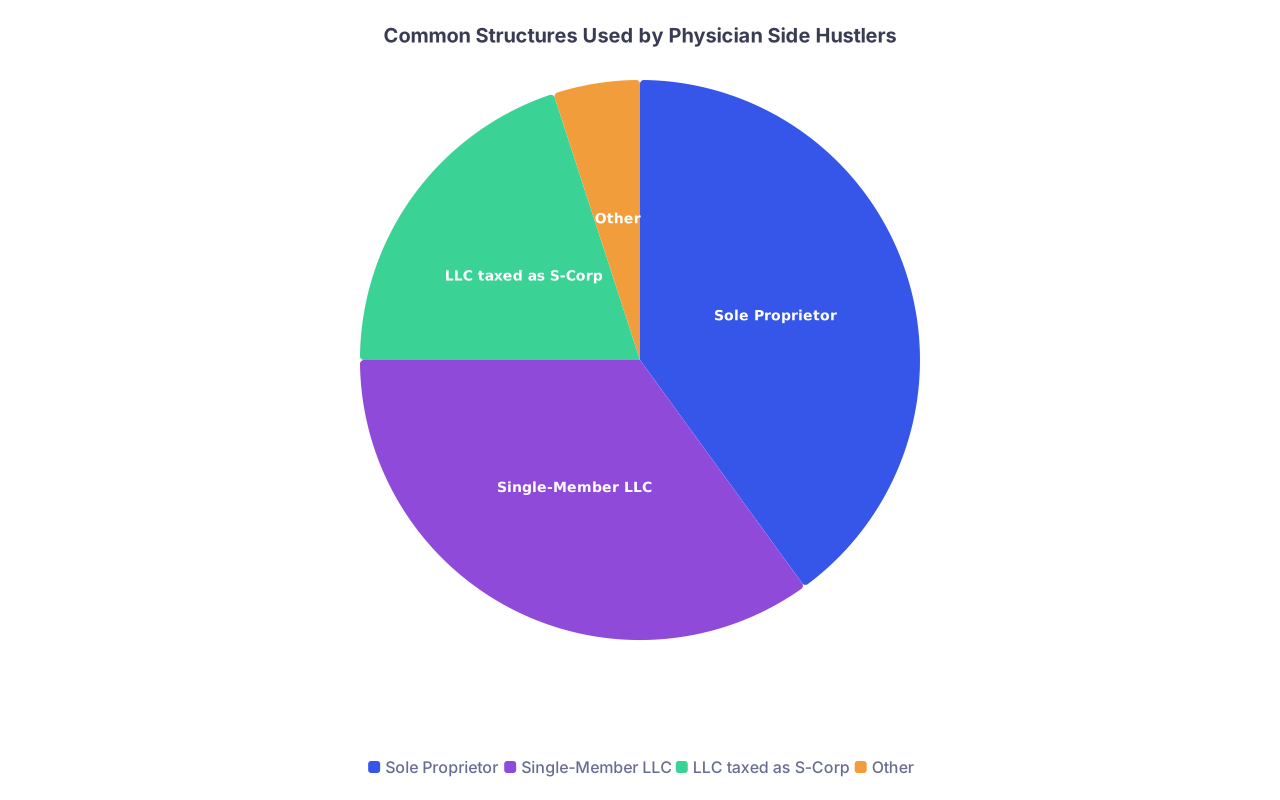
| Category | Value |
|---|---|
| Sole Proprietor | 40 |
| Single-Member LLC | 35 |
| LLC taxed as S-Corp | 20 |
| Other | 5 |
Quick breakdown:
Sole proprietor (default if you do nothing):
- Easiest to start. Use your SSN or get a free EIN.
- Report all income and expenses on Schedule C.
- Pay ordinary income tax + self-employment tax.
- No legal separation between you and the business.
Single-member LLC (no S-corp election):
- Legal entity at the state level.
- Still taxed like a sole proprietor by default (Schedule C).
- Advantages are legal/organizational, not tax.
LLC taxed as S-corp:
- Still an LLC legally, but for IRS purposes you elect to be treated as an S-corp.
- You pay yourself a “reasonable salary” (subject to payroll taxes) and then can potentially take extra profits as distributions (not subject to self-employment tax).
- This only makes sense once you’re netting enough profit (often >$80–100k/year, sometimes lower, talk to a CPA).
So forming an LLC today does not lock you into anything tax-wise. You can:
- Start LLC as a simple pass-through (default).
- Elect S-corp later if the numbers make sense.
How to decide: A simple decision framework
Here’s a straightforward way to think about it.

| Step | Description |
|---|---|
| Step 1 | Starting or growing side hustle |
| Step 2 | Usually no LLC needed - employer handles |
| Step 3 | Talk to healthcare attorney - likely PLLC or PC |
| Step 4 | Start as sole proprietor, track expenses |
| Step 5 | LLC optional - consider in 6-12 months |
| Step 6 | Form simple LLC and separate finances |
| Step 7 | Doing any clinical care? |
| Step 8 | Owning the practice or just employed? |
| Step 9 | Revenue under 10k per year? |
| Step 10 | Contracts, website, or contractors involved? |
Translation:
Purely non-clinical, low-dollar, low-complexity work → Sole proprietor to start is fine.
As soon as you add:
- Significant income, or
- Contracts, or
- Contractors, or
- Online infrastructure (website, payment systems)
…an LLC becomes the default smart move.
Any time you’re owning a clinical operation → This is no longer casual. You need:
- Correct entity type (PLLC/PC/LLC combo depending on state).
- Legal guidance.
- Compliance plan.
Practical steps if you decide you want an LLC
If you’re leaning toward “yes, I should probably have an LLC,” here’s the streamlined version.
Check if you need PLLC vs LLC
- Google: “YourState physician PLLC vs LLC” and confirm with an attorney or your state medical board resources.
- If you’ll do any clinical care, your state may force you into a professional entity.
Choose a simple, professional name
- “[Last Name] Medical Consulting LLC”
- “[City] Physician Advisory LLC”
Avoid cute or confusing names. You want clarity.
File LLC with your state
- You can do this via your state’s Secretary of State website.
- Or use a reputable online filing service if you don’t want to mess with forms.
- Fees usually range from ~$50–500 depending on the state.
Get an EIN from the IRS (free, online)
- You’ll need this for a business bank account and for W-9s.
Open a dedicated business bank account
- All side hustle income in. All business expenses out.
- This is non-negotiable if you want the LLC liability protection to hold up (commingling personal and business funds is how you “pierce the veil”).
Draft simple, consistent contracts
- For many non-clinical gigs, a basic, reviewed-by-an-attorney template can be reused.
- Negotiate to have the LLC, not you personally, as the contracting party when appropriate.
Get the right insurance
- For non-clinical work: professional liability for consulting/coaching and general liability if you have in-person work.
- For clinical work: correct malpractice coverage for the specific activity.
FAQ: LLCs for physician side hustles
If I’m an employee physician, can my employer stop me from forming an LLC for side work?
They can’t stop you from forming an LLC. But they can limit what kind of side work you do. Most contracts have “outside activity” or “moonlighting” clauses. You need to read your contract and, if required, get written permission before starting the side hustle—even if it’s through an LLC.Does having an LLC increase my audit risk with the IRS?
Not inherently. The IRS cares more about the numbers and whether they make sense than whether you used an LLC. Sloppy records and obviously inflated deductions trigger scrutiny, not the letters “LLC” on your return. Keep clean books and don’t get cute with deductions.Can I have multiple side hustles under one LLC?
Yes, often. Many doctors run “Smith Professional Services LLC” and use it for consulting, speaking, and digital products. If one line of business is very different or riskier (e.g., clinical aesthetics vs. non-clinical consulting), you may want separate entities—but that’s a strategic decision to make with a lawyer/CPA.What if I already started my side hustle as a sole proprietor—can I switch to an LLC later?
Absolutely. This is common. You can:- Form the LLC now.
- Get an EIN.
- Open a new bank account.
- Start using the LLC name on invoices and contracts going forward.
You don’t need to shut everything down and restart. Just transition cleanly and keep good records.
Is an LLC enough, or do I still need a contract for my side gigs?
You still need contracts. The LLC changes who is legally involved, not what you’ve agreed to. A clear written contract protects you more than the entity type in many day-to-day disputes. Think: scope of work, payment terms, cancellation, IP ownership, confidentiality.
Open your list of current or planned side hustles and label each one as: “no clinical,” “my own clinical practice,” or “employed/contracting clinical.” For each “no clinical” hustle earning more than a few thousand a year—or involving contracts or online systems—circle it and decide today whether you’re going to set up an LLC for it in the next 90 days.