Most applicants talk about advocacy at the wrong time, in the wrong place, and it costs them interviews.
You’re applying to medical school in a public health policy era. If your advocacy work is real, it can be your differentiator. If it’s scattered and badly timed in your application, it turns into white noise.
Here’s the blunt truth:
You cannot just “mention” advocacy. You have to stage it. Month by month, phase by phase, across the entire medical school application cycle.
I’ll walk you chronologically: from 18 months before you apply to post-interview thank-you emails. At each point: what to do, what not to do, and where advocacy actually belongs.
18–12 Months Before You Apply: Build Real Advocacy, Not Resume Confetti
At this point you should stop hunting random volunteer hours and start building 1–2 deep advocacy lanes.
For public health policy–minded applicants, your advocacy should have a spine:
- A clearly defined issue (e.g., housing insecurity, overdose prevention, Medicaid access, environmental justice)
- A consistent population (e.g., migrant workers, unhoused patients, low-income children)
- A tangible mechanism (e.g., lobbying, community organizing, data/assessment, education campaigns)
This phase is not about highlighting yet. It’s about doing the work in a way you can later write about competently and ethically.
At this point you should:
Pick 1–2 flagship advocacy commitments
- Join or deepen roles in:
- Health policy student groups
- Local public health department advisory boards
- Harm reduction organizations
- Community orgs that interface with healthcare (tenants unions, food policy councils, disability rights groups)
- Example: Serving on a city “Vision Zero” traffic safety taskforce rather than attending one protest and calling it advocacy.
- Join or deepen roles in:
Start tracking impact in a way you’ll use later
- Keep a simple log:
- Hours
- Role
- Specific actions (testified at city council, co-authored policy brief, ran 3 vaccine outreach events)
- Outcomes (resolution passed, program funded, screening rate increased)
- You’ll use this language word for word in activity descriptions and secondaries.
- Keep a simple log:
Clarify your ethical stance
- For personal development and medical ethics, you need:
- 1–2 stories where you grappled with:
- Conflicts between advocacy and institutional policy
- Speaking “for” vs amplifying community voices
- Confidentiality, consent, and patient stories in public advocacy
- 1–2 stories where you grappled with:
- Jot these scenarios down. The ethical tension will become gold in secondaries and interviews.
- For personal development and medical ethics, you need:
Do not at this point:
- Overpost on social media about your advocacy hoping schools “find it”
- Start drafting your personal statement centered on a single protest or petition you signed
You’re still in input mode, not highlight mode.
12–9 Months Before: Pre-Application Positioning (Quiet Highlighting Starts)
This is the “set the stage” window. You’re not submitting anything yet, but you are shaping what your application will look like.
At this point you should:
Decide your advocacy narrative arc Ask yourself:
- What public health problem have I consistently worked on?
- How has my role evolved? (observer → volunteer → organizer → policy contributor)
- Where do ethics show up in that arc? (e.g., pushing for safe injection sites, defending reproductive access, handling disagreements with supervisors)
You want one throughline you can echo in:
- Personal statement
- Most meaningful activities
- Public health or ethics-focused secondaries
- Interview answers
Clarify where advocacy fits in your “top 3” themes A strong application is not 17 separate hobbies. It’s 2–3 core themes.
If you’re in the PUBLIC HEALTH POLICY / MEDICAL ETHICS space, advocacy is probably:
- Theme 1: Advocacy / community engagement
- Theme 2: Clinical exposure
- Theme 3: Intellectual foundation (research in health policy, bioethics major, MPH coursework)
Start drafting bullets, not essays For each major advocacy role, write:
- 1–2 sentence scope: who, where, what scale
- 1 sentence impact: numbers or concrete outcome
- 1 sentence ethics or reflection: what changed in how you see physicians’ responsibilities
These proto-bullets will become your Work & Activities entries.
9–6 Months Before: MCAT + Application Framework (Where Advocacy Will Live)
You’re usually studying for the MCAT and planning your application year here. Perfect time to map where advocacy will be explicitly highlighted.
At this point you should decide:
| Component | Advocacy Role |
|---|---|
| Personal Statement | One anchor story, not the entire essay |
| Work & Activities | 1–3 “most meaningful” advocacy experiences |
| Secondaries | Targeted ethics/public health prompts |
| Letters of Recommendation | At least 1 from an advocacy/policy context |
| Interviews | Core “tell me about yourself” and ethics cases |
Personal Development + Ethics Angle
Right now you choose:
Is your personal statement primarily about advocacy, or is it a strong supporting pillar?
I recommend:
- Primary frame = Why medicine, grounded in patient experience and long-term commitment
- Embedded frame = How advocacy reshaped your understanding of what a physician’s role is in public health and policy
At this point you should:
- Identify one advocacy moment where:
- You faced resistance (from clinic, school, administration, or community partner)
- You had to decide what “doing the right thing” actually meant
- The outcome changed how you think about being a future physician
That becomes your ethical backbone story.
6–3 Months Before: Drafting Personal Statement and Activities (Heavy Highlighting)
Now you’re actually writing. This is where most people either overplay or underplay advocacy.
Personal Statement: How Much Advocacy?
At this point you should:
Use advocacy as catalyst, not costume
- Wrong: “I did lots of advocacy, therefore I care.”
- Right: “I learned that writing op-eds isn’t enough when my patient still couldn’t access insulin. I had to… [then tie to clinical care and systemic change].”
Anchor one major scene Good advocacy anchor scenes:
- Presenting data to a school board on asthma rates and watching them vote on a bus idling policy
- Working in a mobile clinic and realizing your “access” project was missing undocumented patients due to fear of exposure
- Being asked by a community member, “Will you still be here after you get into med school?”
You show:
- Your ethical reasoning
- How you respond to institutional constraints
- That you understand individual care ≠ structural justice, and medicine intersects both
Avoid savior narratives and victim tourism If your advocacy writing makes you the hero and the community the backdrop, admissions committees notice. And they’re unimpressed.
You must show:
- Partnership
- Humility
- Acknowledgment of your limits
Work & Activities: Where Advocacy Must Be Explicit
This is the most underutilized place to highlight advocacy.
At this point you should:
Tag 1–3 advocacy experiences as “Most Meaningful” For each:
- First 500 characters: clear responsibilities + context
- Second 1325 characters (for most meaningful):
- Specific story: “During our Medicaid enrollment drive…”
- Ethical tension: “We realized we were steering patients toward plans that their preferred clinic didn’t accept…”
- Reflection: How it informs your future role as a physician-advocate
Use numbers without fluff
- “Co-led a team of 12 volunteers, completed 150 Medicaid applications over 3 months; 82% were approved.”
- “Organized testimony from 5 community members at city council that contributed to passage of a $250k naloxone access program.”
Label advocacy clearly Admissions readers skim. Use words like:
- “Advocated for…”
- “Organized…”
- “Policy brief on…”
- “Community coalition focused on…”
You are now in explicit highlight mode. This is where advocacy moves from “thing I did” to “pillar of my application.”
3–0 Months Before Submission: Secondaries + School Selection (Targeted Highlighting)
Once primary is in and secondaries start flooding your inbox, advocacy becomes surgical: you use it where it clearly matches what schools care about.
School List: Where Advocacy Actually Matters
At this point you should:
- Prioritize schools with:
- Strong public health / policy infrastructure (e.g., joint MD/MPH, health policy centers)
- Visible commitment to underserved care and health equity
- Tracks in community health, primary care, urban/rural health
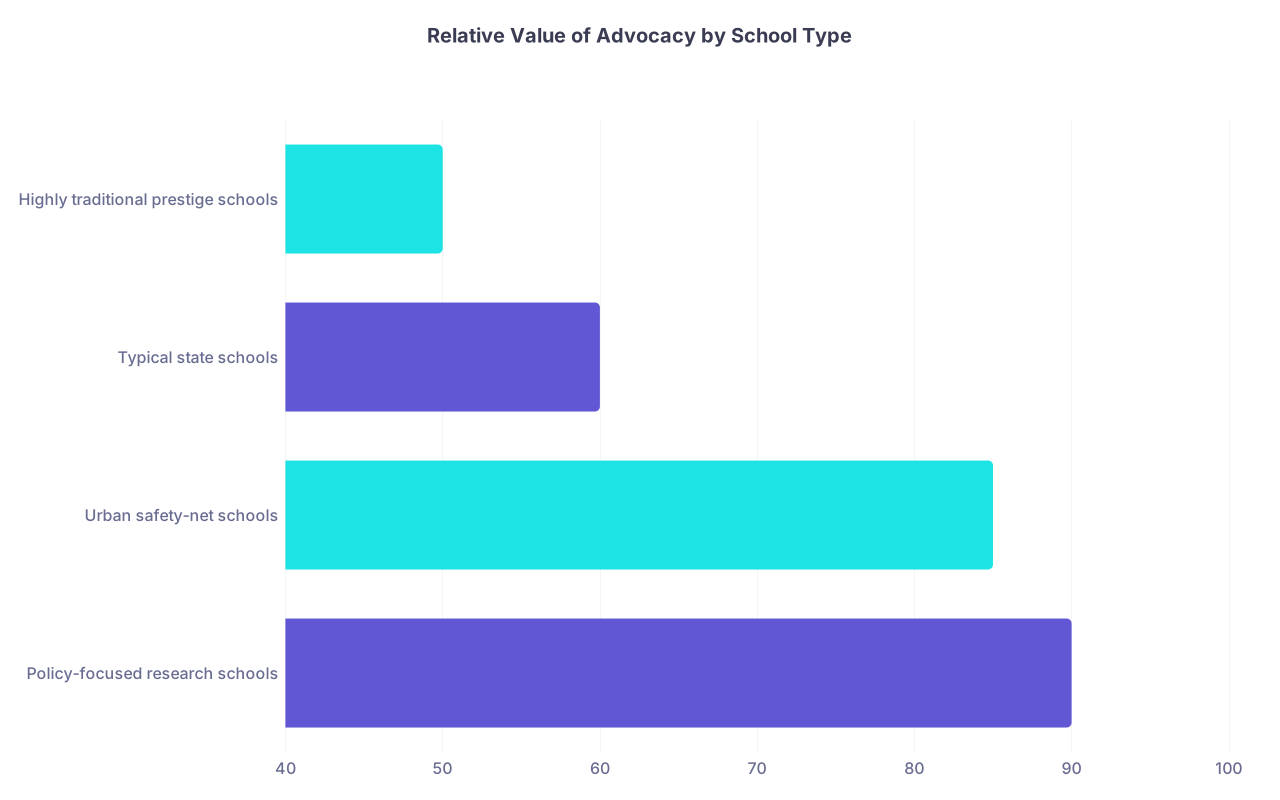
| Category | Value |
|---|---|
| Policy-focused research schools | 90 |
| Urban safety-net schools | 85 |
| Typical state schools | 60 |
| Highly traditional prestige schools | 50 |
Percentage here = how much advocacy depth tends to help relative to the average school.
Secondaries: Where to Lean In
At this point you should:
Hit every prompt about:
- Health disparities
- Serving underserved communities
- Structural racism / social determinants of health
- Leadership, especially in community or advocacy roles
- Ethical challenges, moral distress, or standing up for what’s right
Use case-based responses Do not write vague “I care about equity” paragraphs. Pick concrete episodes:
- “Our naloxone outreach program was blocked from being advertised in local schools…”
- “I was told to stay ‘non-political’ when pushing for safer discharge options for unhoused patients…”
Then walk through:
- Your reasoning
- Your actions
- How you balanced institutional constraints with patient/community welfare
- What you’d do differently as a physician with more power
Tailor to the school’s language
- If a school uses “structural competency,” “anti-racism,” “community partnership,” mirror those terms—but only if they genuinely fit your experience.
- Connect your advocacy to their programs: street medicine, student-run clinics, health policy centers, ethics institutes.
This is the phase where sloppy applicants copy-paste generic “I like social justice” paragraphs into 20 portals. That’s how you get screened out at schools that actually do this work.
Interview Season: Live-Action Ethics and Advocacy
Interviews are where your advocacy finally breathes. Or collapses.
At this point you should expect:
- “Tell me about yourself” → Your advocacy should naturally appear in your 60–90 second arc.
- “Why our school?” → You connect your advocacy trajectory to specific public health / policy opportunities there.
- “Ethical dilemma?” → You choose a scenario from your advocacy work, not an overused shadowing story.
- “How will you handle political or controversial topics as a physician?” → This is where your public health policy mindset shows.
Before Interviews: Prepare Advocacy Talking Points
At this point you should:
Develop 3 advocacy stories
- 1 showing leadership
- 1 showing ethical conflict
- 1 showing humility and listening to community partners
Practice framing “controversial” work If your advocacy touches:
- Reproductive rights
- Transgender health
- Police violence
- Harm reduction (safe injection sites, decriminalization)
You must:
- Stay patient-centered
- Emphasize evidence-based public health
- Show you respect diverse viewpoints while not abandoning core ethical commitments
Own your limits It’s okay to say:
- “We pushed for X, but in hindsight I underestimated Y…”
- “I realized I’d centered my perspective instead of the community’s, and I had to step back and listen.”
During Interviews: When to Bring Advocacy Up
At this point you should:
- Mention advocacy early in your “tell me about yourself” so it frames later questions.
- Tie it into:
- Why medicine now (public health problems that require clinician voices)
- How you’ll use your MD (policy work, community partnerships, health systems redesign)
- Your view of medical ethics as system-level, not just bedside informed consent
After the interview, in thank-you emails, briefly reference any advocacy-related threads you discussed that seemed to resonate. One sentence is enough.
Post-Interview / Waitlist: Quiet, Targeted Updates
You’re not in the spotlight now, but you can still intelligently highlight advocacy if it’s evolved.
At this point you should:
- Send a brief update letter only if:
- You took on a new advocacy leadership role
- A major project reached a visible milestone (publication, policy passed, program funded)
- Frame it as:
- Ongoing commitment
- Continued reflection on physician responsibility in public health
Do not send:
- Every small event you attend
- A list of “more hours volunteered”
Substance beats volume.
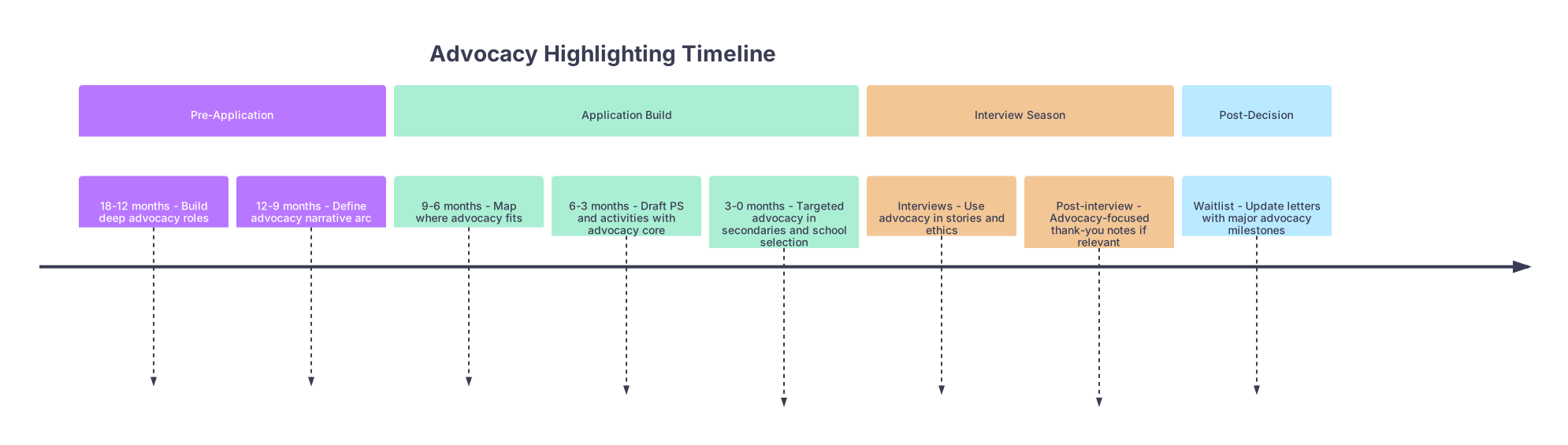
Visual Roadmap: When to Highlight Advocacy
FAQ (Exactly 4 Questions)
1. My advocacy is mostly campus-based (student org, campus protests). Is that worth highlighting?
Yes—if it shows depth and maturity. A student-led campaign to change your university’s mental health policy with measurable outcomes is absolutely worth spotlighting. A handful of marches with no sustained work behind them is weaker. You want at least one advocacy lane that engages beyond your campus—community partners, local government, or health systems.
2. I’m worried my advocacy is “too political” for some schools. Should I tone it down?
Do not erase it. Instead, reframe it. Emphasize patient outcomes, evidence-based public health, and ethical obligations rather than partisan identity. If a school is turned off by serious, patient-centered advocacy on health equity, you probably would not be happy training there anyway. Your goal is fit, not universal approval.
3. How do I avoid sounding performative or self-congratulatory when writing about advocacy?
Center the community, not yourself. Be specific about mistakes, blind spots, and how community members or mentors corrected you. Admissions committees read hundreds of “I helped the underserved” essays; the applicant who honestly admits learning curves and shared power stands out as far more ethical and grounded.
4. I started serious advocacy work only 6 months before applying. Is it too late to highlight it?
You cannot manufacture longevity, but you can demonstrate intensity and intentionality. Highlight what you’ve done, be honest about the timeline, and connect it to earlier experiences or values so it doesn’t feel random. Then be explicit in interviews and secondaries about how you plan to continue this work in medical school and beyond.
Key points:
- At each phase—pre-application, primaries, secondaries, interviews—you should know exactly where and how advocacy will appear, not sprinkle it randomly.
- The strongest applicants use advocacy to demonstrate ethical reasoning, long-term commitment, and a clear vision of the physician’s role in public health and policy.