Introduction: Why Research Matters for Your Residency Applications
In an increasingly competitive landscape of residency applications, strong grades and solid clinical skills are necessary but rarely sufficient. Program directors are looking for residents who not only provide excellent patient care but also think critically, engage with evidence, and contribute to the future of their specialty. Medical research sits at the intersection of these expectations.
Engaging in research during medical school does far more than add a line to your CV. It demonstrates intellectual curiosity, persistence, teamwork, and a commitment to improving patient outcomes through evidence-based medicine. Whether you’re working at the laboratory bench or analyzing clinical data on real patients, research experience can significantly strengthen your residency profile and help you stand out in the Match.
This guide explores how research enhances your residency application—from the types of projects that are most beneficial, to strategies for finding opportunities, to practical advice on showcasing your work effectively in ERAS, personal statements, and interviews. Ultimately, it’s about translating your “bench” experience into “bedside” impact and showing programs that you will be a thoughtful, evidence-driven clinician.
The Strategic Value of Research in Modern Medical Education
Research is no longer a “bonus” reserved for academic careers—it is woven into modern medical education and clinical practice. Understanding why residency programs value research can help you make smarter decisions about how and where to invest your time.
How Research Drives Medicine from Bench to Bedside
The phrase “bench to bedside” captures the essential pathway of Medical Research:
- Bench (Basic and Translational Science): Discovering mechanisms of disease, identifying targets for therapy, and developing diagnostic tools.
- Bedside (Clinical Application): Applying those discoveries in real-world settings to diagnose, treat, and prevent disease, and to improve patient care processes.
This continuum is central to high-quality Patient Care. As a future resident, your ability to understand and interpret research directly impacts:
- How you adopt new treatments and guidelines
- How you counsel patients with up-to-date information
- How you identify gaps in care and propose quality improvement projects
Programs want residents who can bridge this gap—who do not simply follow algorithms, but who understand the evidence behind them.
Why Research Is Highly Valued in Residency Applications
Residency programs evaluate far more than test scores. Research experience signals multiple attributes that are critical for success:
Demonstrated Commitment to Medicine and Lifelong Learning
Taking on a research project shows that you are engaged beyond the minimum curriculum. It reflects:- Curiosity about how and why medical knowledge evolves
- Willingness to pursue answers to complex questions
- Interest in contributing to your specialty’s growth, not just consuming information
Advanced Critical Thinking and Problem-Solving Skills
Effective physicians must interpret data, navigate uncertainty, and make complex decisions. Research:- Trains you to formulate hypotheses and test them objectively
- Develops your ability to analyze conflicting data and draw nuanced conclusions
- Builds resilience in the face of setbacks, negative results, or flawed assumptions
Residency directors recognize that these skills translate directly to complex diagnostic reasoning.
Evidence of Scholarly Productivity (Publications and Presentations)
While not mandatory, publications, abstracts, or posters:- Indicate you can take a project from conception to completion
- Show that mentors trust your work enough to attach their names to it
- Signal that you can contribute to a program’s academic mission, whether that’s clinical trials, QI initiatives, or educational research
Stronger Foundation in Evidence-Based Medicine
In an era of rapidly changing guidelines, clinical skills must be grounded in evidence. Research experience:- Makes you more comfortable reading and critiquing journal articles
- Helps you understand study design, bias, and statistical concepts
- Improves your ability to integrate evidence into day-to-day patient care decisions
Alignment with Academic and Subspecialty Career Paths
For competitive specialties (e.g., dermatology, orthopedic surgery, radiology) and academic careers:- Robust research experience is often expected, not just preferred
- Sustained, theme-focused work (e.g., oncology outcomes, global health, medical education) can help articulate a coherent career trajectory that appeals to academic programs
Choosing the Right Type of Research for Your Goals
Not all research is the same, and not every project fits every student. Choosing strategically can make the difference between a superficial line on your CV and a transformative experience that shapes your career.
Major Categories of Research in Medical Education
1. Basic Science Research
What it is:
Lab-based work exploring cellular, molecular, or genetic mechanisms of disease. Examples include:
- Studying signaling pathways in cancer cells
- Exploring neurobiological mechanisms of depression
- Evaluating novel biomaterials for wound healing
How it helps your residency profile:
- Shows strong analytical and technical skills
- Appeals to programs with a heavy research or physician–scientist focus
- Demonstrates persistence (experiments often fail before they succeed)
Best fit for:
Students considering academic medicine, MD/PhD trajectories, or specialties with strong research expectations (e.g., oncology, neurology, rheumatology).
2. Clinical Research
What it is:
Projects involving human subjects, clinical data, or patient outcomes, such as:
- Retrospective chart reviews (e.g., predictors of ICU readmission)
- Prospective cohort studies or clinical trials
- Observational studies of complications or outcomes
How it helps your residency profile:
- Directly connects to Patient Care and Clinical Skills
- Often more intuitive to talk about in interviews (“We found X changed Y outcome”)
- Provides hands-on experience with real-world data, EMRs, and clinical workflows
Best fit for:
Any specialty, especially those that emphasize outcomes, guidelines, and patient-centered care (e.g., internal medicine, pediatrics, EM, surgery).
3. Translational Research
What it is:
Research that bridges basic science and clinical application:
- Testing a lab-discovered biomarker in a patient population
- Adapting a novel drug delivery system for clinical use
- Validating a new diagnostic test in real patients
How it helps your residency profile:
- Highlights your ability to connect mechanisms to bedside decisions
- Signals an interest in innovation and implementation science
4. Quality Improvement (QI) and Health Systems Research
What it is:
Projects aimed at improving care processes, safety, or efficiency:
- Reducing hospital-acquired infections
- Improving handoff communication between teams
- Increasing vaccination rates in a clinic
How it helps your residency profile:
- Directly tied to daily resident work and hospital metrics
- Highly valued in many programs because QI is a core ACGME competency
- Can often be completed on shorter timelines and still yield posters or presentations
Best fit for:
Students with limited time but strong interest in systems-based practice and patient safety.
5. Medical Education Research
What it is:
Studying how we teach and learn medicine:
- Evaluating a new simulation curriculum
- Assessing the impact of a feedback tool on clinical performance
- Studying wellness interventions for residents
How it helps your residency profile:
- Ideal for applicants interested in teaching and academic leadership
- Frequently leads to conference presentations in education-focused meetings
How to Find and Secure Research Opportunities
Starting can be the hardest part. A systematic approach can help you identify meaningful opportunities that fit your goals and constraints.
1. Leverage Your Home Institution
Department Websites:
Browse faculty profiles in your target specialty. Look for:- Recent publications or ongoing grants
- Topics that genuinely interest you (e.g., stroke outcomes, surgical innovation)
Ask Residents and Fellows:
Residents often know which attendings:- Are active mentors
- Have projects ready for student involvement
- Will provide realistic timelines and expectations
Research Offices and Deans:
Many schools have an Office of Medical Education or a student research office:- Sign up for email lists announcing projects, grants, or summer research programs
- Ask about structured research tracks or scholarly concentration programs
2. Cold-Emailing Potential Mentors (Done Well)
When reaching out to potential research mentors:
Be Specific and Respectful
- Use a clear subject line: “MS2 Interested in Cardiology Outcomes Research”
- Mention 1–2 of their recent papers that you actually read
- Briefly describe your skills (e.g., prior statistics coursework, coding, writing) and time availability
Attach a Focused CV
- Highlight any prior research, leadership, or technical skills
- Keep it concise and well-organized
Ask for a Short Meeting
- Suggest a 15–20 minute conversation to learn about their work and discuss how you might contribute
- Be prepared with questions about timelines, expectations, and possible roles (data collection, analysis, manuscript drafting)
3. Explore Formal Programs and Fellowships
Summer Research Programs for Medical Students
- Many institutions and national organizations offer 8–12 week funded programs
- These often culminate in a poster presentation or abstract submission
Research or Scholarly Year
- Some students take a dedicated research year, especially in competitive specialties
- Can significantly deepen productivity (first-author papers, national presentations) but should be aligned with clear goals and strong mentorship
4. Conferences and Networking
- Attend local, regional, or national conferences—even before you have your own poster:
- Introduce yourself to speakers whose work interests you
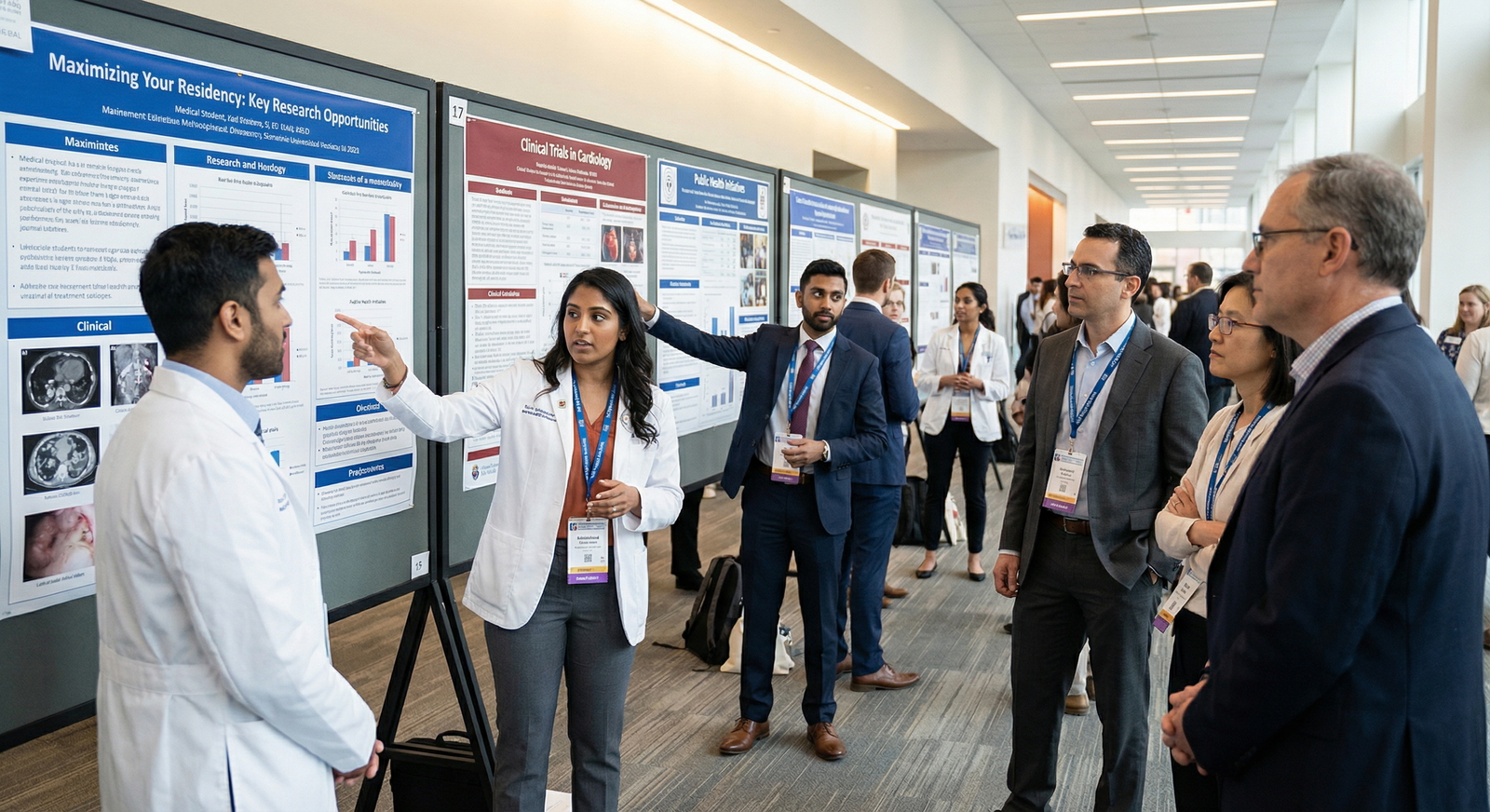
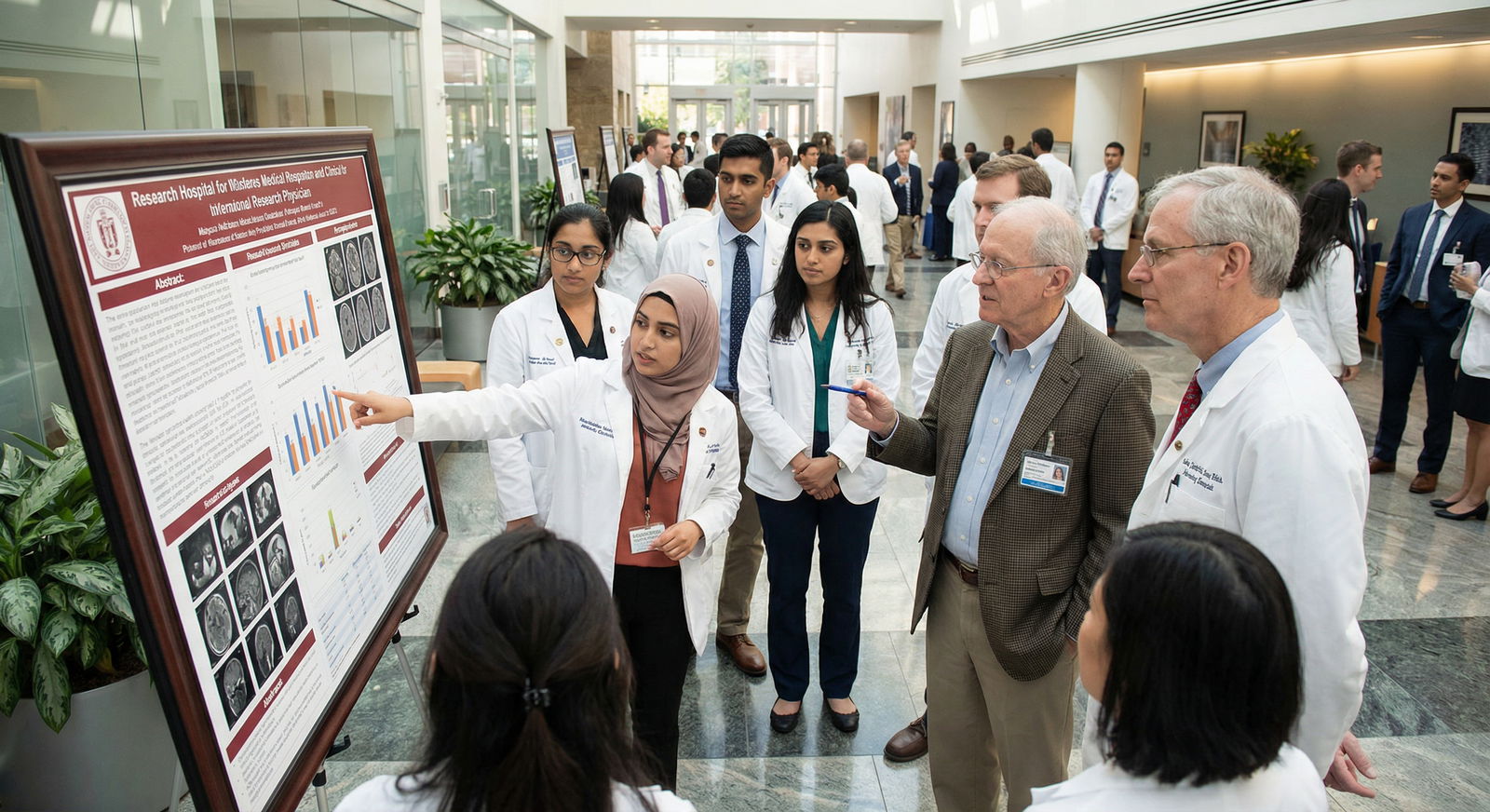
- Visit poster sessions and ask presenters about student involvement
- Follow up by email mentioning the conference conversation
Showcasing Your Research in the Residency Application
Having research is only half the battle. You must present it clearly and convincingly in ERAS, your CV, personal statement, and in interviews.
Crafting a Research-Forward CV for Residency
Your CV should highlight your scholarly activity in a way that is easy for busy faculty to scan.
1. Use Clear, Standard Sections
Consider including:
- Education
- Research Experience / Scholarly Projects
- Publications (peer-reviewed and others)
- Abstracts and Poster/Oral Presentations
- Grants, Scholarships, or Research Awards
- Relevant Skills (statistics, programming, lab techniques)
2. Describe Your Role and Impact
Under each research experience:
- Include project title, mentor, and timeframe
- Provide 2–4 bullet points describing:
- Your specific responsibilities (e.g., “Collected and managed data for 150 patient charts using REDCap”)
- Any outputs (e.g., “Co-authored abstract accepted to [Conference Name]”)
- Quantitative impact when possible (e.g., “Project contributed to a 15% reduction in 30-day readmissions after QI intervention”)
Programs care less about how “prestigious” the project seems and more about what you actually did and learned.
Using Your Personal Statement to Connect Research and Patient Care
Your research should support—not overshadow—the story of why you are pursuing a specialty and how you approach patient care.
Consider addressing:
Your Motivation for Research
- A patient encounter that led you to ask deeper questions
- A desire to improve outcomes in a disease that affected your community or family
Skills and Mindsets You Developed
- Learning to tolerate uncertainty and negative results
- Gaining humility in the face of complex data
- Understanding that behind every datapoint is a real patient
How Research Shaped Your Specialty Choice
Concrete examples:- “While studying heart failure readmissions, I became fascinated by the longitudinal management of complex cardiac patients, reinforcing my interest in internal medicine and cardiology.”
- “Analyzing delays in time-to-thrombolysis in our ED showed me how systems issues can shape patient outcomes, prompting my interest in emergency medicine and quality improvement.”
Future Plans as a Resident and Beyond
- Express specific goals: “I hope to pursue clinical outcomes research in [disease area]” or “I intend to integrate QI projects into my residency training.”
- Programs appreciate applicants who can articulate a trajectory that aligns with their institutional strengths.
Discussing Research Effectively in Residency Interviews
Many interviews will include questions like “Tell me about your research” or “What was your role in this project?”
Prepare by:
Creating a 60–90 Second “Research Elevator Pitch”
For each major project, be ready to explain:- The big-picture question (in lay terms)
- Your specific role
- The main findings or expected outcomes
- Why it matters for patient care or medical education
Being Honest About What You Don’t Know
If asked detailed statistical or technical questions:- It is far better to say, “Our statistician handled the advanced modeling; my role was primarily in data collection and preliminary analysis,” than to overstate your expertise.
Linking Research to Clinical Skills
Bring the conversation back to how research informs your practice:- How it improved your ability to appraise evidence
- How it shaped your approach to patient counseling and shared decision-making
- How it taught you teamwork, time management, and resilience
Highlighting Ongoing or Future Work
Discuss current manuscripts in progress or projects you hope to continue, especially if programs have similar research strengths.
Real-World Examples: From Project to Match-Day Impact
Case Study 1: Clinical Outcomes Research in Cardiology
A third-year medical student joined a cardiology team studying a new medication for heart failure. Their responsibilities included:
- Screening and enrolling eligible patients
- Conducting structured interviews at follow-up visits
- Entering and verifying clinical data for over 200 participants
The study ultimately showed a statistically significant reduction in 30-day readmission rates among patients treated with the new medication. The student:
- Presented a poster at a national cardiology conference
- Co-authored a manuscript submitted to a peer-reviewed journal
How this strengthened the residency application:
- In the personal statement, the student described how seeing patients return to clinic with improved symptoms transformed abstract numbers into meaningful patient stories.
- In interviews, they confidently explained study design, limitations, and implications for patient care.
- Cardiology and internal medicine programs recognized not only scholarly output, but also deep engagement with evidence-based management of complex patients.
The student successfully matched into a competitive internal medicine program with a strong cardiology research track, positioning them for future fellowship training.
Case Study 2: Basic Science Oncology Research with Clinical Relevance
Another student worked in a cancer biology lab studying resistance mechanisms to a targeted therapy in a rare sarcoma. Over two years, they:
- Learned cell culture, Western blotting, and CRISPR gene editing techniques
- Helped identify a signaling pathway associated with drug resistance
- Co-authored a paper in a high-impact oncology journal
Although the work was preclinical, the student’s mentor emphasized potential future applications in clinical trials. In the residency application:
- The student highlighted how this experience cultivated meticulous attention to detail and resilience through many failed experiments.
- They drew a clear connection between understanding molecular pathways and approaching oncology patients with more nuanced expectations of treatment response.
Outcome:
Programs in internal medicine and radiation oncology were impressed by the depth of experience, leading to multiple interview offers and a successful match at an academic institution heavily involved in cancer research.
Integrating Research into Your Long-Term Career in Patient Care
You do not need to plan a full physician–scientist career to benefit from early research. Even if your primary goal is clinical practice:
- You will constantly interpret new studies and guidelines
- You may lead or participate in QI initiatives or clinical trials
- You could become involved in medical education research as a faculty member
Early engagement with research helps you become:
- A more thoughtful consumer of medical literature
- A stronger advocate for high-quality, evidence-based patient care
- A better collaborator with colleagues across the research–clinical spectrum
Ultimately, research experience is one of the most powerful ways to show residency programs that you are ready not just to follow medicine’s current standards, but to help shape what comes next.

Frequently Asked Questions About Research and Residency Applications
How important is research experience for residency applications?
The importance of research varies by specialty and program type:
- Highly competitive specialties (e.g., dermatology, neurosurgery, orthopedics, radiation oncology) and academic programs often expect significant research experience and productivity.
- Moderately competitive specialties (e.g., internal medicine, pediatrics, EM, general surgery) value research but may weigh strong clinical evaluations, letters of recommendation, and board scores more heavily.
- Community-based programs may place less emphasis on publications but still appreciate applicants who can engage with quality improvement and evidence-based practice.
In all settings, meaningful research—especially when thoughtfully presented—can strengthen your application by demonstrating critical thinking and commitment to patient care.
Do I need a first-author publication to be competitive?
A first-author publication is helpful, but it is not an absolute requirement for most specialties. What matters more is:
- Substance of involvement: Did you meaningfully contribute to design, data collection, or analysis?
- Completion and follow-through: Did the project lead to a poster, abstract, workshop, or QI implementation?
- Reflection and integration: Can you clearly articulate what you did, what you learned, and how it influences your future practice?
Poster presentations, co-authored papers, abstracts, and QI initiatives are all valuable. Programs recognize that timelines for publications often extend beyond graduation.
What if I have little or no research experience when I start applying?
You can still be a strong candidate, especially if you:
- Highlight other strengths (clinical performance, leadership, teaching, service).
- Emphasize your engagement with evidence-based medicine—for example, journal clubs, guideline-based practice, or critical appraisal activities.
- Consider joining a short-term QI or retrospective study early in your application year; even small projects can be discussed in interviews and entered as “in progress” on ERAS.
If you are targeting highly research-intensive specialties and currently lack research, talk early with mentors about potential strategies (e.g., a research year, additional projects, or adjusted specialty choices).
How much time should I realistically devote to research in medical school?
There is no one-size-fits-all answer, but consider:
- Your goals and specialty: More competitive, research-heavy specialties generally require greater investment.
- Your capacity and wellness: Do not jeopardize core clinical skills or your mental health. A sustainable, consistent 3–5 hours per week can be more productive than short bursts of unsustainable intensity.
- Project timelines: Align your involvement with realistic milestones (abstract submission deadlines, manuscript drafts) and be honest with mentors about your schedule.
Quality and continuity often matter more than sheer hours. One well-executed, meaningful project can be more impactful than a long list of superficial involvements.
What types of research are most relevant for residency applications?
All types—basic science, clinical, translational, QI, and medical education research—can be relevant if you:
- Understand the project’s goals and methods
- Can explain its significance to patient care, medical education, or health systems
- Reflect on what the experience taught you about being a physician
Clinical and QI research are often easiest to connect directly to residency training and patient outcomes, but basic science and educational projects are equally valuable when clearly framed.
By thoughtfully engaging in research and effectively showcasing your experiences, you can significantly enhance your residency application, deepen your clinical reasoning, and position yourself to deliver better care from day one of residency—and throughout your career.