Understanding the Role of Research for Caribbean IMGs in EM–IM
Emergency Medicine–Internal Medicine (EM–IM) combined programs are small, competitive, and highly academic. As a Caribbean IMG, your research profile can be the difference between a courtesy glance and a serious look at your application.
Program directors in EM–IM consistently value:
- Strong US clinical performance
- Solid Step scores
- Evidence of professionalism and teamwork
- And increasingly, research productivity
For a Caribbean medical school residency applicant, research is often a way to:
- Demonstrate academic rigor beyond perceived stigma of a Caribbean school
- Show genuine interest in emergency medicine internal medicine (not just “any residency”)
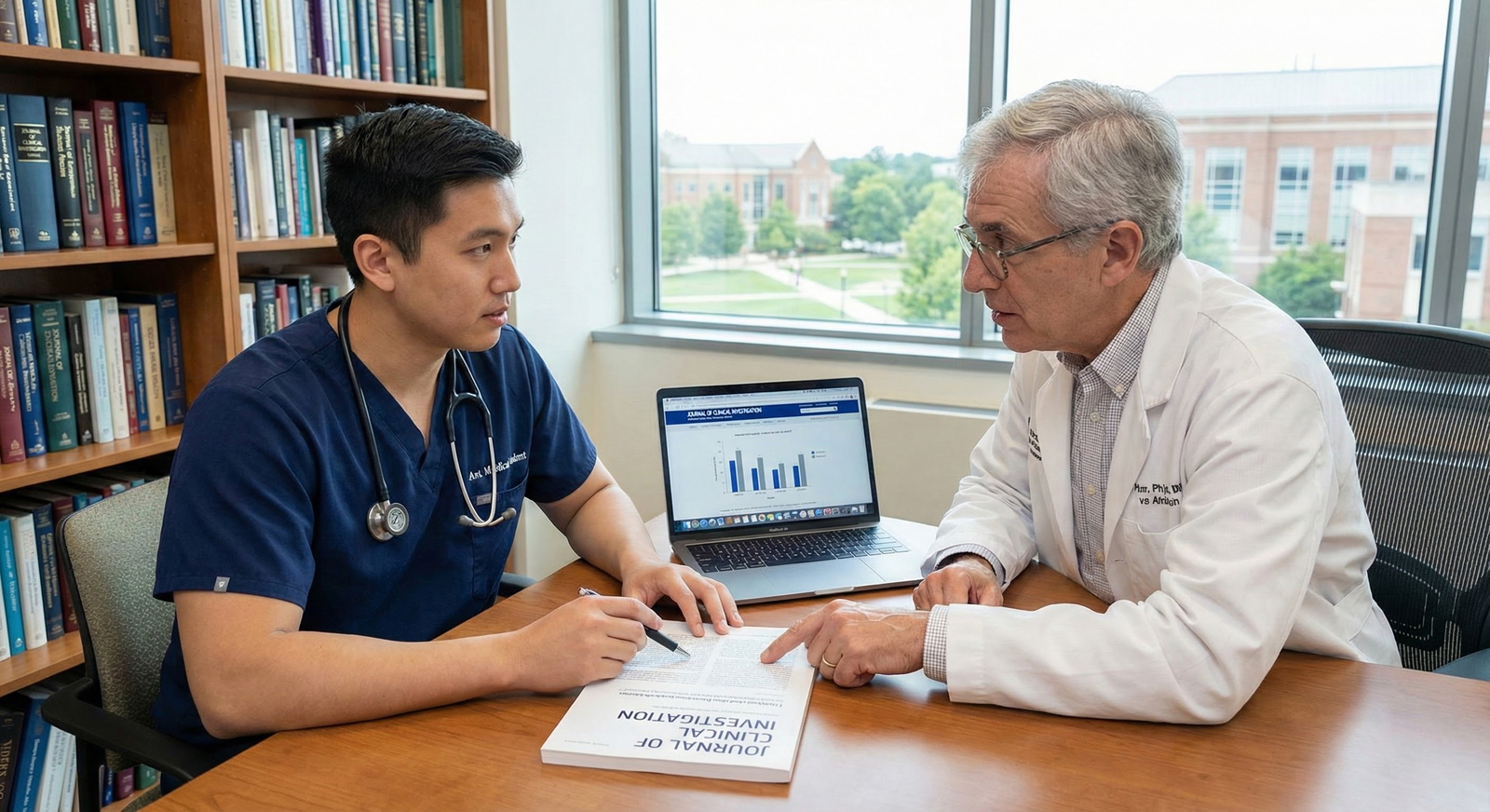
- Build relationships with US faculty who can write powerful letters
- Distinguish yourself among many IMGs with similar exam scores
This article will walk you through how to build a research profile from scratch as a Caribbean IMG, tailored specifically to EM–IM. It will address:
- Types of research that matter for EM–IM
- How many publications are realistically needed
- Strategies to find and secure research as an IMG
- Ways to work around time, visa, and geography constraints
- How to present your research optimally for the SGU residency match or any Caribbean medical school residency match
What Counts as “Research” for EM–IM Programs?
Program directors care more about what your research says about you than about impact factor alone. For EM–IM combined programs, valuable research experiences include:
1. Clinical Research (Highest Yield)
- Chart reviews (e.g., sepsis outcomes, ED utilization)
- Prospective clinical studies (e.g., observation protocols, risk stratification tools)
- Registry or database studies (e.g., MIMIC, NSQIP, NEDS, NIS)
Why it matters:
- Directly relevant to both emergency medicine internal medicine scopes of practice
- Shows you understand patient-oriented outcomes, statistics, and clinical reasoning
- Often leads to posters, presentations, and publications
Examples:
- Retrospective chart review of 30-day readmission rates for heart failure patients discharged from the ED vs admitted through internal medicine.
- Study of triage predictors of ICU admission among ED sepsis patients.
2. Quality Improvement (QI) and Patient Safety
EM–IM programs value residents who can function as system-level thinkers.
QI projects might include:
- Reducing ED boarding times for admitted internal medicine patients
- Improving sepsis bundle compliance in the ED
- Designing a protocol to reduce missed follow-up for high-risk ED discharges
These may not always lead to peer-reviewed publications but can yield:
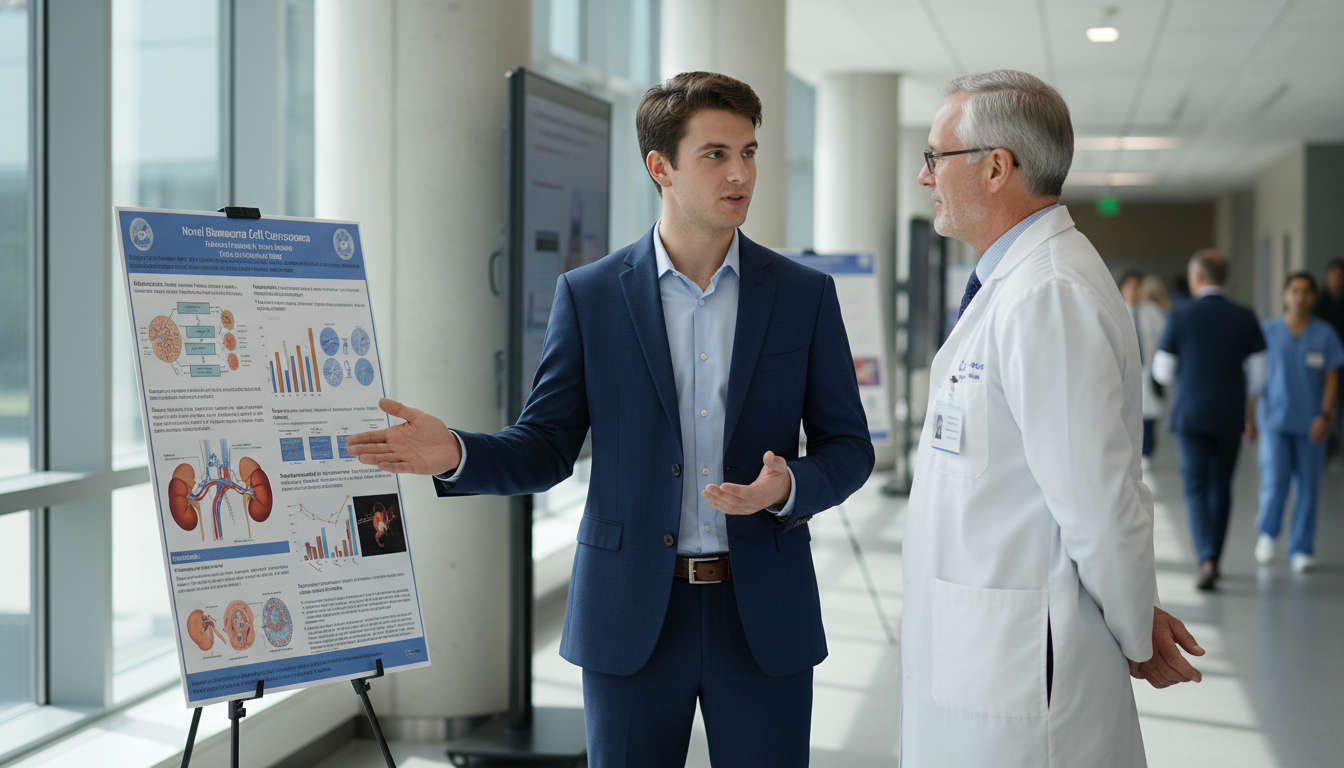
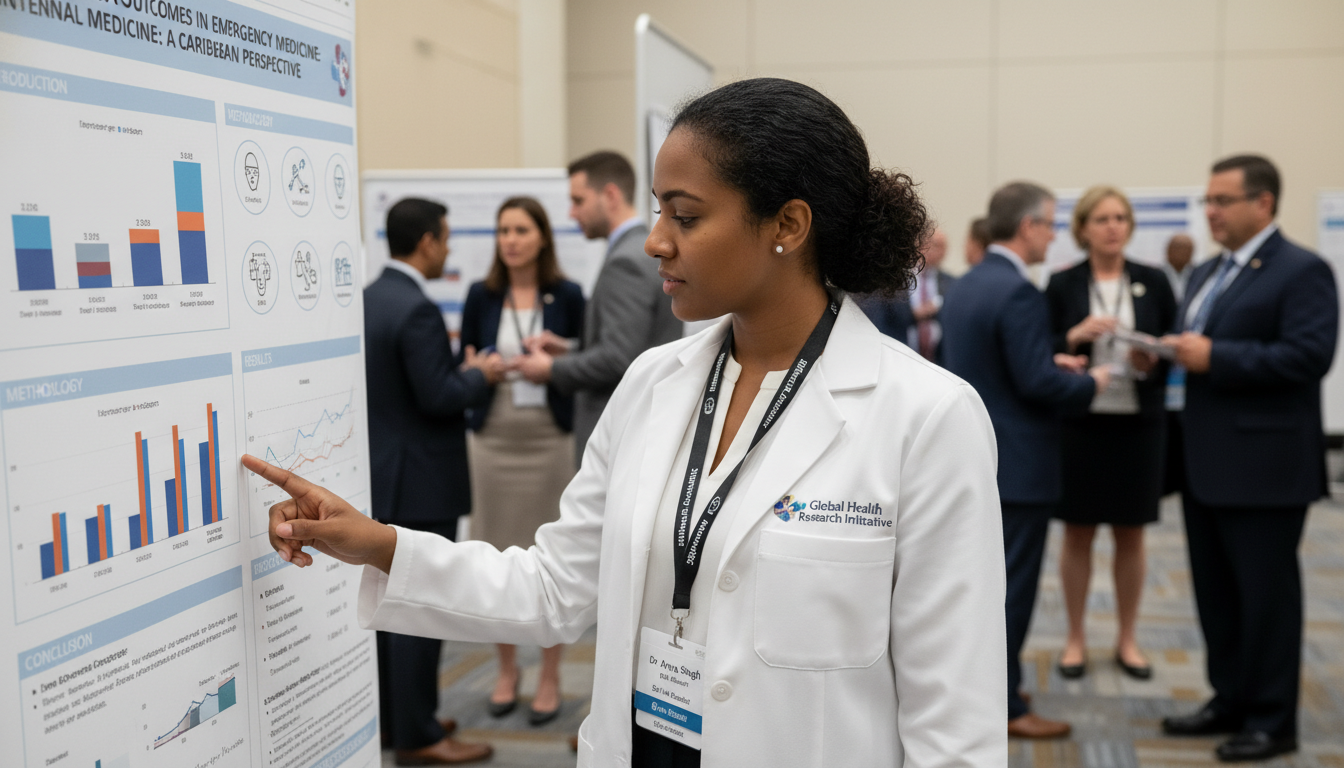
- Abstracts and posters at local or national conferences
- Strong talking points for interviews
- Clear alignment with dual EM–IM interests
3. Case Reports and Case Series
Case reports are often the easiest entry point for Caribbean IMGs:
- You can write them from clinical rotations (US or Caribbean)
- They can be completed on a shorter timeline
- They teach you structure: introduction, case presentation, discussion, references
High-yield topics for EM–IM:
- Rare or atypical presentations of common emergencies (e.g., quiet abdomen in perforated viscus)
- Diagnostic dilemmas often seen in both EM and IM (e.g., confusing sepsis vs systemic inflammatory response)
- High-risk procedural complications (e.g., central line complications, airway emergencies)
Though lower on the “academic hierarchy,” multiple well-written case reports show:
- Initiative
- Familiarity with scientific writing
- Real-world clinical exposure
4. Systematic Reviews and Narrative Reviews
If you lack direct access to patients or hospitals, literature-based projects are realistic:
- Systematic reviews (more rigorous, structured, stats-heavy)
- Narrative reviews (broader conceptual discussions)
Relevant themes for EM–IM:
- Management of acute decompensated heart failure in the ED and inpatient settings
- Strategies for ED-based transitions of care for chronic diseases (COPD, diabetes, CHF)
- Risk stratification tools for chest pain or syncope in emergency medicine internal medicine overlap areas
How Many Publications Do I Really Need as a Caribbean IMG?
One of the most frequent questions is: how many publications needed to be competitive?
There is no absolute number, but realistic targets for a Caribbean IMG aiming at EM–IM:
Baseline Competitive Profile
- 1–2 PubMed-indexed publications (can include case reports)
- 2–4 additional scholarly outputs, such as:
- Conference posters or oral presentations
- Non-indexed publications (e.g., institutional journals, society newsletters)
- Completed but unpublished QI projects
Stronger, Distinctive Profile
- 3–5 PubMed-indexed publications, including at least:
- 1 clinically relevant EM, IM, or EM–IM topic
- 1 original research project (retrospective or prospective)
- Multiple poster/oral presentations, ideally at national meetings (ACEP, SAEM, SHM, SCCM, etc.)
Important Context
Program directors will weigh:
- Your role in the project (first author vs middle author)
- Alignment with EM–IM interests
- Evidence of sustained involvement over time
A single high-quality project where you are first author, you know the methods deeply, and you can discuss limitations intelligently in interviews is more valuable than five superficial middle-author papers you barely understand.
For many Caribbean IMGs, especially from schools like SGU, AUC, or Ross, a well-planned research profile can help you stand out in the SGU residency match and in the broader Caribbean medical school residency match landscape.
Finding and Securing Research Opportunities as a Caribbean IMG
The biggest challenge for many Caribbean IMGs is access—to mentors, data, and US-based institutions. You’ll need a deliberate strategy.
1. Start at Your Own Caribbean Medical School
Even if your school is offshore, there are often underused opportunities:
Research electives or tracks: Ask your Dean’s office or student affairs whether there is:
- A scholarly concentration
- A research requirement
- Faculty with active projects
Student-interest groups:
- EM interest group
- IM interest group
These often host journal clubs or may already be working with faculty on projects.
Actionable steps:
- Search your school’s website and student handbook for “research,” “scholarly activity,” and “publications.”
- Email:
- Academic affairs
- Department chairs (e.g., Medicine, Emergency Medicine, Public Health)
- Course directors for epidemiology or biostatistics
Use a concise email template:
Dear Dr. [Name],
I am a [semester/year] student at [School], deeply interested in pursuing a combined Emergency Medicine–Internal Medicine residency. I am eager to become involved in research related to EM, IM, or quality improvement and would be grateful for any opportunity to contribute to ongoing work or develop a mentored project.
I have [briefly list any skills: Excel, basic statistics, prior research experience, language skills]. I am reliable, detail-oriented, and available to commit [X] hours per week.
Would you be open to a brief meeting to discuss how I might get involved with your work or that of your colleagues?
Sincerely,
[Your Name]
2. Maximize US Clinical Rotations for Research
Your US clinical rotations (core and electives) are prime opportunities:
- Before or early in a rotation, ask your attending or site director:
- “Do you or your department have any ongoing research or QI projects where a student could help?”
- Attend M&M conferences, journal clubs, and grand rounds. Afterward, approach interested faculty with specific questions and express interest in participating in related research.
Tips:
Look for patterns of problems you see repeatedly:
- Frequent ED readmissions for the same conditions
- Delays in consultation or imaging
- High rate of leaving without being seen (LWBS)
Propose small, feasible projects:
- “Would it be helpful to study the characteristics of patients who frequently return to the ED within 72 hours?”
- “Could we examine whether early hospitalist involvement reduces ED boarding times?”
Avoid vague offers (“I want to do research”) and instead demonstrate concrete, patient-centered curiosity.
3. Remote and Online Research Opportunities
If you are off-cycle, abroad, or unable to be physically in the US, consider remote collaboration:
- Look up:
- Faculty at US institutions with EM, IM, or EM–IM interests
- Authors of EM–IM-related papers you’ve read
- Search phrases like:
- “Emergency Medicine and Internal Medicine combined program publications”
- “Dual trained in Emergency Medicine and Internal Medicine”
Then:
- Email them a concise inquiry similar to the above template but emphasizing willingness to work remotely:
- Data extraction
- Literature reviews
- Manuscript drafting
You will send many emails; a 5–15% positive response rate is normal. Persistence without being pushy is key.
4. Formal Research Fellowships or GAP Years
Some Caribbean IMGs choose a dedicated research year at a US institution before applying:
- Titles might be:
- Research fellow
- Research assistant
- Clinical research coordinator
Advantages:
- Higher productivity (multiple abstracts/papers)
- Deep exposure to the US academic environment
- Strong letters from US faculty
Consider this if:
- Your exam scores are borderline for EM–IM
- You are changing specialty interests and need to show commitment
- You lack any prior research experience
You will need to plan around:
- Visa constraints (for non–US citizens)
- Financial limitations (some positions pay modestly; some may be unpaid)
- Timing relative to ERAS application cycles
Designing a Research Portfolio Tailored to EM–IM
An excellent research portfolio for EM–IM is coherent, not random. Think in terms of themes.
1. Choose 1–2 Focus Areas
For example:
- Critical care and resuscitation
- Sepsis, shock, ARDS, ICU utilization
- Chronic disease and acute presentations
- Heart failure, COPD, diabetes in crisis, chest pain risk stratification
- Health systems & transitions of care
- ED boarding, early discharge, readmission reduction strategies
Within these themes, compile a mix of project types:
- One chart review (e.g., sepsis outcomes in ED-to-IM pathway)
- One QI project (e.g., ED-initiated CHF follow-up clinic)
- One or two case reports (e.g., unusual sepsis, complex multi-organ failure case)
- Possibly a review article summarizing evidence-based management
2. Show Progression Over Time
Program directors like to see growth:
- Year 1–2: Case report, literature review, assistant role in an ongoing project
- Year 3: First author retrospective study, poster presentation
- Year 4: Another project at a US institution, oral presentation, manuscript submission
This demonstrates consistency and increasing responsibility.
3. Integrate Your Research Into Your Narrative
Your research should support your story, not exist as random extra lines on your CV.
In your personal statement or interviews, you might say:
- “Working on a project analyzing predictors of ICU admission among ED sepsis patients deepened my interest in resuscitation and the longitudinal care of critically ill patients, which naturally drew me to EM–IM.”
- “Our QI project aimed at reducing 72-hour ED return visits in heart failure taught me the importance of coordination between emergency medicine and internal medicine, from diagnosis to outpatient follow-up.”
Use research to:
- Show you understand both acute and chronic aspects of care
- Highlight your capacity for systems thinking
- Reinforce your genuine commitment to EM–IM combined programs

Practical Tips to Execute and Showcase Your Research Effectively
1. Be Systematic and Organized
Use tools to track:
- Project ideas
- Contacts (mentors, co-authors)
- Timelines and deadlines
Simple methods:
- A spreadsheet with columns:
- Project title
- Type (case report, QI, retrospective study)
- Your role
- Status (idea, data collection, analysis, manuscript drafted, submitted, accepted)
- Target journal or conference
This helps you manage multiple projects and avoid losing track.
2. Learn the Basics of Methodology and Statistics
Self-study resources:
- Online free courses (Coursera, edX) in:
- Epidemiology
- Biostatistics
- Clinical research methods
- Key topics:
- Study design (cohort, case-control, RCT, cross-sectional)
- Bias and confounding
- P-values, confidence intervals
- Common tests: t-test, chi-square, logistic regression
As a Caribbean IMG, fluency in these basics:
- Makes mentors more willing to work with you
- Helps you ask better questions
- Prepares you for detailed interview discussions
3. Aim for Presentations, Not Just Publications
Publications take time; EM–IM application cycles may catch your work in progress.
So:
- Submit abstracts to:
- ACEP (American College of Emergency Physicians)
- SAEM (Society for Academic Emergency Medicine)
- ACP (American College of Physicians)
- SHM (Society of Hospital Medicine)
- Regional EM or IM conferences
Benefits:
- Looks excellent on your CV
- Gives you talking points for interviews
- Helps you practice presenting complex ideas clearly
4. Be Honest About Your Role
In ERAS and in interviews:
- Do not exaggerate your contributions
- Be prepared to answer:
- What was the study’s primary outcome?
- What were the key limitations?
- What would you do differently in a follow-up study?
If you were mainly involved in data collection, say so, but show that you also understand the project conceptually.
5. Anticipate and Address Caribbean IMG Stigma
Programs may quietly worry:
- “Was this student really involved?”
- “Is this work mostly from their Caribbean institution and less transferrable?”
You can counter this by:
- Having at least one or two projects tied to US-based mentors or institutions
- Obtaining strong letters of recommendation from research supervisors attesting to:
- Your independence
- Work ethic
- Analytic thinking
- Being able to speak insightfully about clinical implications of your work in both EM and IM settings
Aligning Your Research with the EM–IM Match Strategy
1. Target EM–IM Combined Programs Explicitly
Research can be a direct tool to show program-specific interest:
- Know which programs are EM–IM combined and look up faculty research interests there.
- If you work on EM or IM research with dual-trained faculty (EM–IM or EM–CC), highlight that on your CV and in personal statements.
If contacting dual-trained faculty:
- Mention your EM–IM interest up front.
- Ask what kind of research EM–IM residents in their program typically do; this may guide your own projects.
2. Bridge EM and IM in Your Project Selection
For every project you join, ask:
- “Can this be framed as relevant to both emergency medicine and internal medicine?”
- Examples:
- Risk stratification of ED chest pain → ED management + IM admission decisions and outcomes
- QI project on antibiotic stewardship for pneumonia starting in ED and extending inpatient
- Study on adherence to diabetic ketoacidosis protocols, from ED arrival through IM floor or ICU
This will help you tailor your application content to EM–IM combined programs rather than pure EM or pure IM.
3. Use Research to Support Letters and Personal Statements
Ask your research mentors to comment on:
- Your intellectual curiosity
- Perseverance in dealing with data and setbacks
- Ability to synthesize complex information
In your personal statement:
- Weave in one or two specific stories from your research that changed how you see patient care.
- Tie research back to your desire to function at the intersection of acute stabilization (EM) and longitudinal management (IM).
Frequently Asked Questions (FAQ)
1. As a Caribbean IMG, is research absolutely required for EM–IM combined programs?
Research is not an official requirement, but in reality, most matched applicants to EM–IM have some research experience, especially at academic centers. For a Caribbean medical school residency applicant, research:
- Strengthens your academic credibility
- Helps offset concerns about school reputation
- Demonstrates serious interest in EM–IM
If you have no research at all, you may still match, but your path is harder, especially if your Step scores are only average. Even one or two thoughtful projects can significantly improve your profile.
2. How many publications needed to be competitive for EM–IM as a Caribbean IMG?
There is no magic number, but a practical guideline:
- Minimum competitive: 1–2 PubMed-indexed items (including case reports) + 2–4 other scholarly outputs (posters, QI projects).
- Stronger profile: 3–5 PubMed-indexed publications with at least one original research paper and clear EM, IM, or EM–IM relevance.
Quality, your role in the project, and your ability to discuss the work confidently matter more than the raw count.
3. I started late. Can I still build a research profile if I’m already in my clinical years?
Yes, but it requires focus and urgency:
- Prioritize feasible, high-yield projects:
- Case reports from interesting patients you encounter
- Retrospective chart reviews with existing data
- QI projects based on problems you see repeatedly on rotations
- Work closely with a mentor who is already actively publishing or presenting.
- Aim for at least:
- 1–2 case reports
- 1 small retrospective or QI project submitted as an abstract
by the time you apply.
Even “submitted” or “under review” looks better than having nothing.
4. Will research alone compensate for lower Step scores as a Caribbean IMG?
Research helps, but it is not a magic eraser:
- Strong research may tip the scales in your favor if:
- Your scores are modest but passing and consistent
- You have strong clinical evaluations and letters
- Your research shows clear EM–IM alignment and real depth
However:
- Severely low scores or multiple failures are difficult to overcome solely with research.
- Use research alongside:
- Improved test performance (if still possible)
- Excellent US clinical experiences
- Well-crafted personal statements and interviews
A thoughtful research profile will not just help you “check a box.” For a Caribbean IMG pursuing EM–IM, it is your chance to demonstrate intellectual rigor, commitment to dual training, and capacity to improve systems of care—the exact traits EM–IM programs seek in their future residents.