Understanding the Role of Research in Pediatrics Residency for IMGs
For an international medical graduate (IMG) targeting pediatrics residency in the United States, a strong research profile can significantly strengthen your application. While clinical performance, exam scores, and letters of recommendation are crucial, research demonstrates academic curiosity, critical thinking, and long-term potential in academic pediatrics.
In the context of the peds match, program directors often use research experiences and scholarly output as a marker of commitment and maturity in the field. This is especially true for IMGs, who may face additional scrutiny because programs have less familiarity with their medical schools and grading systems.
Why Research Matters Specifically in Pediatrics
Pediatrics is increasingly evidence-driven. Many programs—especially university-affiliated and children’s hospitals—expect residents to participate in quality improvement (QI), epidemiologic, or clinical research. Having prior experience shows you can:
- Ask relevant clinical questions about children’s health
- Work in teams and communicate clearly
- Handle data, protocols, and IRB processes
- See projects through to completion (posters, presentations, papers)
For IMGs, research can also:
- Bridge the time gap after graduation with meaningful academic activity
- Provide strong U.S.-based letters from faculty (critical for IMGs)
- Demonstrate comfort with U.S. academic culture and expectations
- Offset slightly lower scores or older year of graduation, when combined with solid clinical experience
Research vs. Publications: What Programs Actually Look For
Many applicants fixate on “how many publications needed” to match. While numbers do matter to some degree, the story your research tells is more important. Programs tend to consider:
- Trajectory: Have you built a coherent record over time, or is it all last-minute?
- Relevance: Is at least some of your work related to pediatrics or child health?
- Depth of Involvement: Did you meaningfully contribute, or only attach your name?
- Evidence of Completion: Are there posters, abstracts, manuscripts, or accepted papers?
The best pediatrics residency applications show a blend of activities: basic science or clinical research, QI or systems projects, and local or national presentations.
Setting Realistic Goals: What a Strong IMG Research Profile Looks Like
Before you start building, you need a clear target. A “strong but realistic” research profile for an IMG in pediatrics will vary by the competitiveness of the programs you’re applying to.
Tiered Target Profiles for Pediatrics IMGs
These are general reference points—not rigid rules—but they can help you calibrate your efforts.
1. Community / Mid-Tier University Pediatrics Programs
These programs may not require extensive research but appreciate evidence of scholarly engagement.
A competitive IMG might have:
- 1–3 abstracts or posters (local, regional, or national)
- 0–2 publications, ideally at least one pediatrics-related
- Participation in at least one QI or audit project with clear role
- Ability to discuss methodology, challenges, and outcomes in depth
2. Academic / University-Based Pediatrics Programs
These programs usually value research more highly.
A competitive IMG might aim for:
- 3–6 abstracts, posters, or oral presentations
- 1–3 peer-reviewed publications (even case reports or review articles count)
- At least one project clearly in pediatrics (e.g., neonatal sepsis, asthma, vaccination rates)
- Evidence of leadership (e.g., coordinating data collection, mentoring juniors, presenting at a reputable meeting)
3. Highly Competitive / Research-Heavy Tracks (e.g., Physician-Scientist, Academic Pediatrics)
Here, your research profile can be a primary differentiator.
A competitive IMG might have:
- Multiple peer-reviewed publications, ideally with at least one as first or second author
- A mix of project types (clinical, QI, outcomes research, or basic science)
- At least one national or international presentation
- Letters from well-known researchers describing your academic potential
Even if your current profile is far from this, you can still significantly strengthen your application with targeted, well-chosen projects.
Types of Research and Scholarly Work That Matter in Pediatrics
You don’t need an NIH grant to impress pediatrics residency programs. There are multiple forms of research and scholarship that are realistic and valuable for IMGs.
1. Clinical Research in Pediatrics
Examples:
- Retrospective chart review of asthma exacerbations in a pediatric ED
- Study of growth parameters in children with chronic disease
- Analysis of vaccination adherence in a primary care pediatric clinic
Why it helps:
- Directly relevant to pediatric practice
- Teaches study design, data cleaning, and collaboration with statisticians
- Often feasible to complete within 6–12 months
Action tips:
- Ask pediatric attendings: “Do you have ongoing data we can analyze or a question you’ve wanted to explore?”
- Volunteer to help with data collection and literature reviews, then work toward authorship through sustained involvement.
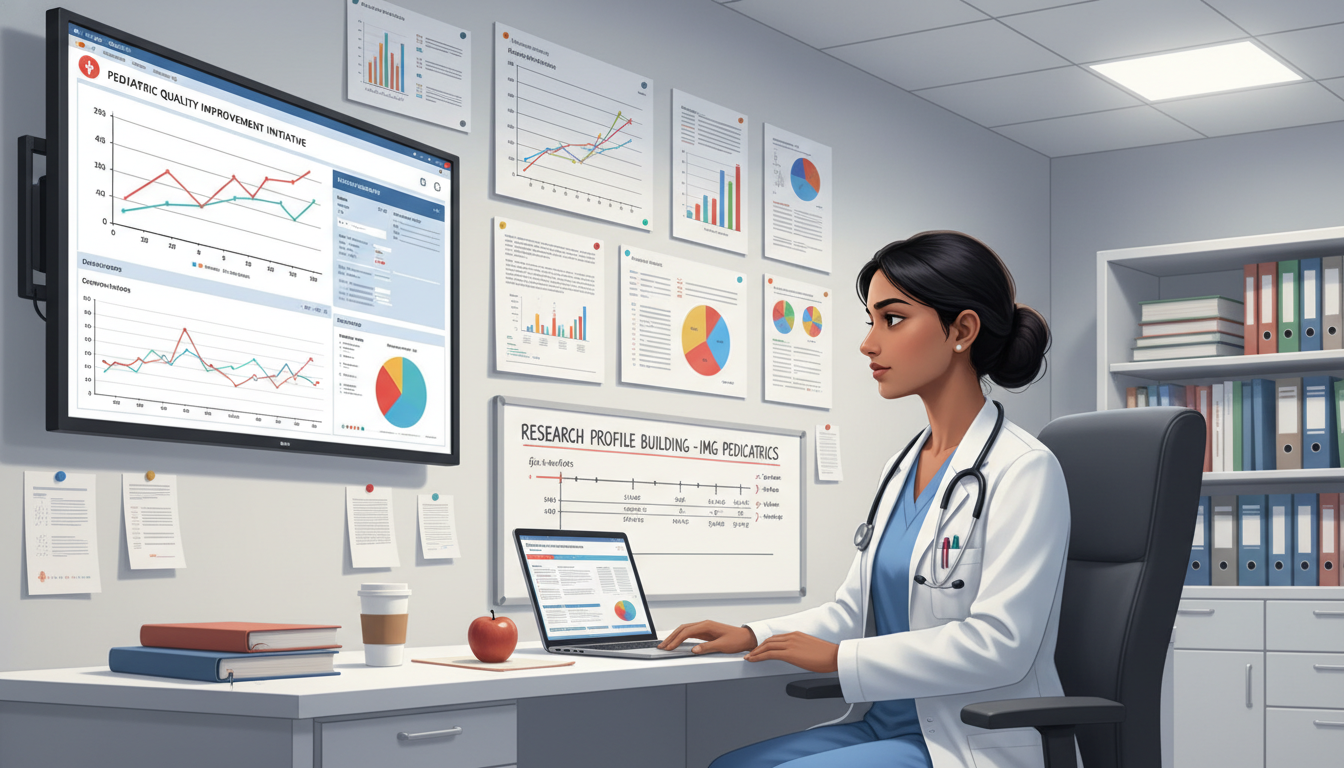
2. Quality Improvement (QI) and Patient Safety Projects
QI is heavily emphasized in pediatrics residency. Almost every program expects residents to complete a QI project, so prior experience is a major plus.
Examples:
- Reducing unnecessary bronchiolitis imaging in hospitalized infants
- Improving adherence to pediatric sepsis bundles
- Increasing influenza vaccination rates in a pediatric clinic
Why it helps:
- Directly aligned with residency requirements and ACGME competencies
- Often easier to start and complete within a year
- Can result in posters, QI abstracts, and local presentations
Action tips:
- Learn basic QI methodology (PDSA cycles, run charts, process mapping).
- Offer to join an existing hospital QI committee—many are eager for help collecting data.
3. Case Reports and Case Series
These are more achievable for IMGs with limited resources or in settings without major research infrastructure.
Examples:
- Rare metabolic disease presenting with atypical symptoms in a child
- Unusual complication of a commonly used pediatric medication
- A small series of children with an emerging infection
Why it helps:
- Builds writing skills and publication track record
- Often quicker to complete than full original research
- Shows attention to clinical details and literature review capabilities
Action tips:
- Look for interesting cases during observerships, externships, or home-country practice.
- Ask: “Would you consider working together on a case report for this patient?”
- Follow CARE guidelines for case report structure.
4. Systematic Reviews, Narrative Reviews, and Mini-Reviews
If you lack access to patients or data (e.g., before U.S. experience), literature-based projects are valuable.
Examples in pediatrics:
- Review of management strategies for pediatric inflammatory bowel disease
- Narrative review of long-term outcomes of preterm infants
- Mini-review of new vaccine technologies in children
Why it helps:
- Demonstrates ability to synthesize literature
- Trains critical appraisal and writing—key skills for residency
- Can be done remotely with good mentorship and access to databases
Action tips:
- Start with a narrowly focused topic to keep it manageable.
- Use tools like PubMed, Google Scholar, and PRISMA guidelines for systematic reviews.
5. Basic Science / Translational Research
More challenging to access but valuable, especially for academic pediatrics.
Examples:
- Lab work on genetic mechanisms of congenital heart disease
- Animal models of neonatal brain injury
- Biomarker studies for pediatric cancers
Why it helps:
- Shows depth of scientific training and persistence
- Strong signal for long-term academic and fellowship goals
Action tips:
- If you already have a PhD or lab background, link it to pediatric questions.
- Be ready to clearly explain your work in simple terms during interviews.
Strategically Finding and Securing Research Opportunities as an IMG
The hardest step for many IMGs is getting a foot in the door—especially in a new country or without local contacts. You’ll need a deliberate outreach strategy and a clear value proposition.
Step 1: Clarify Your Constraints and Strengths
Assess:
- Location (Are you in the U.S. or abroad?)
- Time (Full-time, part-time, or evenings/weekends?)
- Skillset (Statistics, basic science, literature review, chart review experience)
- Timeline to the peds match (1, 2, or 3+ application cycles away)
Align project choice with realistic timeframes. For example:
- Less than 1 year to application: prioritize QI, retrospective studies, and case reports.
- 2–3 years to application: consider more ambitious clinical or lab-based projects.
Step 2: Target the Right Institutions and Mentors
Look for:
- Children’s hospitals and pediatric departments at academic centers
- Community hospitals with pediatrics residencies (often more open to help)
- Faculty whose publication history overlaps with your interests (via PubMed)
To find receptive mentors:
- Check pediatrics residency program websites for “Faculty” and “Research” pages.
- Search:
[Hospital Name] pediatrics research, then look for contact emails. - Prioritize mid-career faculty or clinician-educators; they often have projects but less support.
Step 3: Craft High-Quality Outreach Emails
Faculty receive many unfocused requests. Stand out by being specific and professional.
Subject line examples:
- “Prospective IMG seeking pediatrics research experience – interest in asthma/QI”
- “Volunteer research support for pediatric endocrinology projects (IMG with prior experience)”
Core elements of your email:
- 2–3 sentence introduction (who you are, IMG status, visa, exam status if relevant)
- Brief description of prior research/relevant skills (no long CV recitation)
- Clear statement of what you are asking: “I would be grateful for the opportunity to assist with any ongoing pediatric research or QI projects, even in a volunteer capacity.”
- Show that you’ve read their work: “I read your recent paper on [topic] and am particularly interested in [specific aspect].”
- Attach a 1-page CV focused on research and clinical experiences
- Polite, concise closing
Don’t mass-email hundreds of faculty with generic messages. Instead, send 10–20 highly tailored emails per week over several weeks.
Step 4: Use Structured Programs When Possible
Some institutions offer formal pathways that can be ideal for IMGs:
- Research scholar / visiting research fellow positions
- Post-doctoral research fellowships in pediatrics departments
- Master’s or certificate programs in clinical research or public health with embedded research
These can provide:
- Visa sponsorship (in some cases)
- Protected research time
- Strong letters and publications
However, they can be competitive and may require tuition or living cost planning.
Building Publications and Presentations: Quality, Quantity, and Strategy
A central concern for many IMGs is: “how many publications needed” for a strong pediatrics residency application. There is no universal threshold, but you can maximize your impact by being strategic.

What Counts as “Research for Residency”?
ERAS allows you to list:
- Peer-reviewed journal articles
- Abstracts
- Posters
- Oral presentations
- Book chapters
- QI projects
- Teaching/education scholarship
All of these contribute to your scholarly profile if you can describe your role specifically and honestly.
Balancing Peak Achievements and Breadth
If forced to choose between:
- One well-executed project that leads to a strong letter, a national conference poster, and a manuscript under review
vs. - Five shallow involvements where you barely participated
The first is usually more valuable, especially if the mentor is known and can vouch for your depth of contribution.
Ideal scenario: a mix of 2–4 meaningful projects over a couple of years, with:
- At least one completed to the stage of submission or publication
- At least one clearly pediatrics-focused
- Multiple outputs (poster + manuscript from the same project)
Realistic Publication Pathways for IMGs
Local and Regional Conferences
- Hospital research days, state AAP chapter meetings, institutional QI days
- Faster acceptance, good for first posters and developing presentation skills
National Meetings
- Pediatric Academic Societies (PAS)
- American Academy of Pediatrics (AAP) national and section meetings
- Specialty society meetings (e.g., pediatric cardiology, neonatology)
Journals with Short Article Types
- Case reports, brief communications, and pictorial essays
- Education journals (if you do teaching or curriculum design)
- QI journals or sections in general pediatrics journals
Case Example: Two-Year Pre-Match Timeline
Year 1 (18–12 months before application):
- Secure a part-time volunteer research position in a pediatric department.
- Start one retrospective chart review (e.g., pediatric asthma admissions).
- Prepare 1–2 case reports from interesting cases encountered.
- Join an ongoing QI project.
Year 2 (12–0 months before application):
- Submit abstracts to at least one local and one national pediatric meeting.
- Convert accepted abstracts into posters and present.
- Work with mentor to prepare the main project for journal submission.
- Submit case reports to suitable peer-reviewed journals.
- Enter every project and output into a well-organized CV and tracking spreadsheet.
By the time you apply, you might realistically have:
- 1–2 peer-reviewed publications (including case reports)
- 2–4 abstracts/posters
- 1–2 substantive QI experiences
- 1–2 strong research-oriented letters of recommendation
This is a very competitive research portfolio for an IMG aiming for pediatrics.
Presenting Your Research Effectively in the Peds Match
Having research is only half the battle; you also need to communicate it clearly in ERAS, your personal statement, and interviews.
How to List Research in ERAS
For each entry:
- Use clear, non-technical titles understandable to non-specialists.
- Specify your role: “Designed data collection tool, performed chart review, led data entry and primary analysis.”
- Include status honestly: “Manuscript in preparation,” “Under review,” or “Accepted.”
- Avoid inflating your contribution—faculty often spot exaggeration quickly.
Integrating Research into Your Personal Statement
For an IMG residency guide like this, a strong personal statement often:
- Highlights 1–2 research experiences that changed how you think about children’s health
- Connects your projects to future goals (e.g., interest in pediatric pulmonology, neonatology, or general academic pediatrics)
- Emphasizes what you learned (teamwork, resilience, ethical issues, handling data, understanding social determinants of health)
Avoid turning the statement into a mini-CV. Focus on narrative impact rather than listing every project.
Discussing Research During Interviews
Be prepared to clearly explain:
- The main question of each project
- Study design (e.g., retrospective cohort, QI PDSA cycles, case report rationale)
- Your specific responsibilities
- Challenges and how you addressed them
- What the results mean for pediatric practice
Practice short, 1–2 minute summaries in simple language. Many interviewers are clinicians, not subspecialist researchers.
Common Pitfalls and How to Avoid Them
Even strong applicants can weaken their profile with avoidable mistakes.
1. Chasing Quantity at the Expense of Integrity
Red flags for program directors:
- Being listed on dozens of low-quality or dubious publications
- Involvement with predatory journals that charge high fees and skip proper peer review
- Inconsistent stories about your actual contributions
Solution: Prioritize quality, transparency, and mentorship from reputable institutions.
2. Starting Projects Too Late
Complex projects rarely yield publications in under 6–9 months. Starting everything a few months before ERAS opens sets you up for incomplete work.
Solution: If your timeline is short, focus on:
- Case reports
- QI projects already underway
- Smaller, tightly scoped retrospective studies
- Getting at least abstracts and posters submitted before application season
3. Poor Communication with Mentors
Common issues:
- Failing to provide regular updates
- Missing deadlines
- Not clarifying authorship expectations early
Solution: At the start of each project, ask:
- “What are your expectations for my role?”
- “If I complete X and Y tasks, would I qualify for authorship, and in what order?”
- “How often should we meet or email about progress?”
4. Not Linking Research to Pediatrics
If all your projects are in unrelated fields (e.g., adult cardiology, dermatology) with no clear bridge, it can confuse pediatrics program directors.
Solution: Either:
- Start at least one clear pediatrics project, or
- Explicitly connect prior research to pediatric themes (e.g., mechanisms in adults that also apply to children, shared pathophysiology, or long-term developmental effects).
FAQs: Research Profile Building for IMGs in Pediatrics
1. As an international medical graduate applying to pediatrics residency, how many publications do I realistically need?
There is no fixed number, but many successful IMGs in pediatrics have:
- 1–3 peer-reviewed publications or accepted manuscripts (including case reports)
- Plus a few additional abstracts, posters, or QI projects
For community or mid-tier university programs, quality and relevance often matter more than a high count. For highly academic programs, more publications—especially first-author or pediatrics-related—are an advantage, but strong letters and coherent narrative can still compensate for fewer publications.
2. I have research experience from my home country that is not in pediatrics. Is it still useful for the peds match?
Yes. Non-pediatrics research still shows you can:
- Work in teams
- Understand study design and ethics
- Persist through long projects
In your application and interviews, emphasize the skills you gained (critical thinking, data analysis, scientific writing) and, when possible, connect the topic to aspects of child health or life-course medicine. However, try to add at least one pediatrics-specific project or QI experience before applying, if feasible.
3. I don’t have access to patients or a hospital right now. How can I build a research profile for pediatrics residency?
Focus on projects that can be done remotely:
- Systematic or narrative reviews on pediatric topics
- Data analysis of publicly available datasets (e.g., national health surveys including pediatric data)
- Collaborating with mentors who have existing datasets and need help with literature review and manuscript writing
Simultaneously, network via email with pediatric faculty to join ongoing projects—you may be able to assist with writing and analysis even if you’re not physically present.
4. Does every pediatrics residency program expect research, or can I match with little or no research at all?
Not every program expects a strong research portfolio, especially some community-based pediatrics residencies that focus more on clinical service. It is still possible to match with minimal research if you have:
- Strong USMLE scores (or equivalent), if required
- Solid U.S. clinical experience
- Excellent letters of recommendation
- A clear, patient-centered personal statement
However, having at least some scholarly activity—especially in QI or case reports—can differentiate you from other IMGs and signal preparedness for residency requirements. Think of research as a lever you can use to strengthen your application, not an absolute barrier.
By approaching research strategically and honestly—as a way to learn, contribute, and show your potential—you can build a compelling scholarly profile as an international medical graduate and significantly enhance your chances in the pediatrics residency match.