Understanding the Role of Research in PM&R Residency for IMGs
As an international medical graduate (IMG) aiming for Physical Medicine & Rehabilitation (PM&R), your research profile can significantly influence how program directors view your application. While PM&R is not as research-intense as some other specialties, a thoughtful research portfolio is often the factor that distinguishes strong candidates—especially IMGs—from the rest of the applicant pool.
PM&R is inherently interdisciplinary and outcomes-focused. Programs value applicants who can:
- Understand evidence-based rehabilitation practices
- Critically appraise literature
- Contribute to improving functional outcomes and quality of life for patients
For an IMG, research shows:
- Commitment to academic medicine in the U.S. (or target country)
- Ability to work within local healthcare and academic environments
- Long-term interest in physiatry (beyond simply “matching somewhere”)
This IMG residency guide will help you answer practical questions such as:
- What types of research matter for PM&R?
- How many publications are competitive for the physiatry match?
- How can you build a research profile if you are starting from zero?
- How to convert research experience into a compelling story during interviews?
Throughout, we’ll focus on research for residency with PM&R-specific strategies and clear next steps tailored to IMGs.
What Kind of Research Matters in PM&R?
1. Clinical and Outcomes Research
PM&R is heavily focused on function, disability, and quality of life. Clinical and outcomes research fits the specialty perfectly and is highly valued.
Common themes:
- Stroke, TBI, SCI, amputee rehabilitation
- Spasticity management, injections, neurorehab techniques
- Pain management and musculoskeletal conditions
- Mobility, gait analysis, assistive technologies
- Disability outcomes, return to work, quality-of-life metrics
Examples:
- Retrospective chart review on outcomes of botulinum toxin injections for spasticity
- Prospective study on functional outcomes after inpatient stroke rehab
- Study comparing different orthoses in foot drop
For an IMG, retrospective chart reviews and quality improvement projects are usually the most accessible entry points, as they don’t require large grants or complex infrastructure.
2. Quality Improvement (QI) and Health Systems Projects
Residency programs need residents who can improve systems of care. QI research:
- Is often more feasible and faster to complete
- Directly aligns with ACGME milestones and institutional priorities
- Can produce posters, presentations, and sometimes publications
PM&R-specific QI examples:
- Reducing wait time for outpatient spasticity clinic
- Standardizing pain assessment tools for chronic back pain patients
- Implementing a falls-prevention protocol in inpatient rehab
These may not always end as journal articles, but they show you understand how to measure and improve care—very appealing to program directors.
3. Case Reports and Case Series
Case reports are particularly relevant in physiatry, where unusual presentations and complex rehabilitation journeys are common.
High-yield PM&R case themes:
- Rare neurologic conditions requiring rehab
- Unusual complications of stroke or SCI
- Innovative use of orthotics, prosthetics, or assistive devices
- Challenging pain syndromes managed with multimodal rehab
Case reports can be excellent starter projects for IMGs:
- Limited sample size (often just one patient)
- Great way to learn about the publication process
- Feasible within short observerships or clinical electives
They may be “lower impact” academically, but higher impact for building your skills, confidence, CV, and network.
4. Basic Science, Translational, and Biomechanics Research
Some PM&R departments have strong labs in:
- Neuroplasticity and motor recovery
- Neuromodulation (e.g., TMS, tDCS) in rehab
- Biomechanics and gait analysis
- Musculoskeletal physiology, tissue healing, regenerative medicine
These projects:
- Often have longer timelines
- May be more demanding technically
- Can produce high-impact publications
For IMGs with previous laboratory experience or a strong academic inclination, this can be very attractive, but it’s not mandatory. Clinical and QI research are more than sufficient for a solid physiatry match application.
5. Educational and Rehabilitation Policy Research
A smaller but meaningful area:
- Curriculum design for PM&R training
- Disability policy, access to rehabilitation services
- Global rehabilitation needs and health systems
These are especially relevant if:
- You have an interest in medical education or leadership
- You want to highlight a global health/disability advocacy profile as an IMG
How Many Publications and What Type of Output Do You Need?
Many IMGs ask directly: “How many publications needed?” There is no single correct number, but we can talk in ranges and realistic targets.
1. Understanding What “Scholarly Activity” Means
Programs look at overall scholarly productivity, not just PubMed-indexed papers. This includes:
- Peer-reviewed journal articles (original research, review articles, case reports)
- Conference posters and oral presentations
- Book chapters or invited articles
- Abstracts, letters to the editor
- QI and educational projects with documented outcomes
On ERAS, these all appear under “Publications,” “Presentations,” or “Research” sections and collectively define your research profile.
2. Practical Target Ranges for IMGs in PM&R
These are not strict rules, but useful benchmarks:
Competitive IMG profile (research-focused):
- 3–6+ total scholarly outputs
- 1–3 peer-reviewed publications (case reports or original research)
- Several posters/abstracts at national or regional meetings
- PM&R-related work is a clear plus
Solid IMG profile (most IMGs should aim here):
- 2–4 total scholarly outputs
- At least 1 PM&R-related publication OR poster
- Additional research or QI projects in any clinical field
Minimal but acceptable profile (if you have strong other strengths):
- 1–2 scholarly activities (e.g., one case report + one presentation)
- Clear understanding of methods, your role, and implications
If your application is otherwise weaker (older graduation year, lower scores, visa needs), stronger research can compensate to some degree.
3. Importance of PM&R-Relevant Research
PM&R-related research has more weight than unrelated work, but:
- Non-PM&R research still counts for productivity and skills
- If most of your publications are in another field (e.g., internal medicine), try to obtain at least one project clearly tied to physiatry
During interviews, you should be able to explicitly explain how your previous research—whatever the field—trained you to think like a physiatrist:
- Focus on function and outcomes
- Multidisciplinary team approaches
- Longitudinal patient care
4. Quality vs. Quantity
For residency, impact factor and citation counts matter much less than:
- Your genuine understanding of the project
- Your role and responsibilities
- Your ability to discuss limitations and next steps
- Evidence of persistence: seeing a project from idea to completion
A small number of well-understood, completed projects is stronger than a long list of superficial entries that you cannot explain.
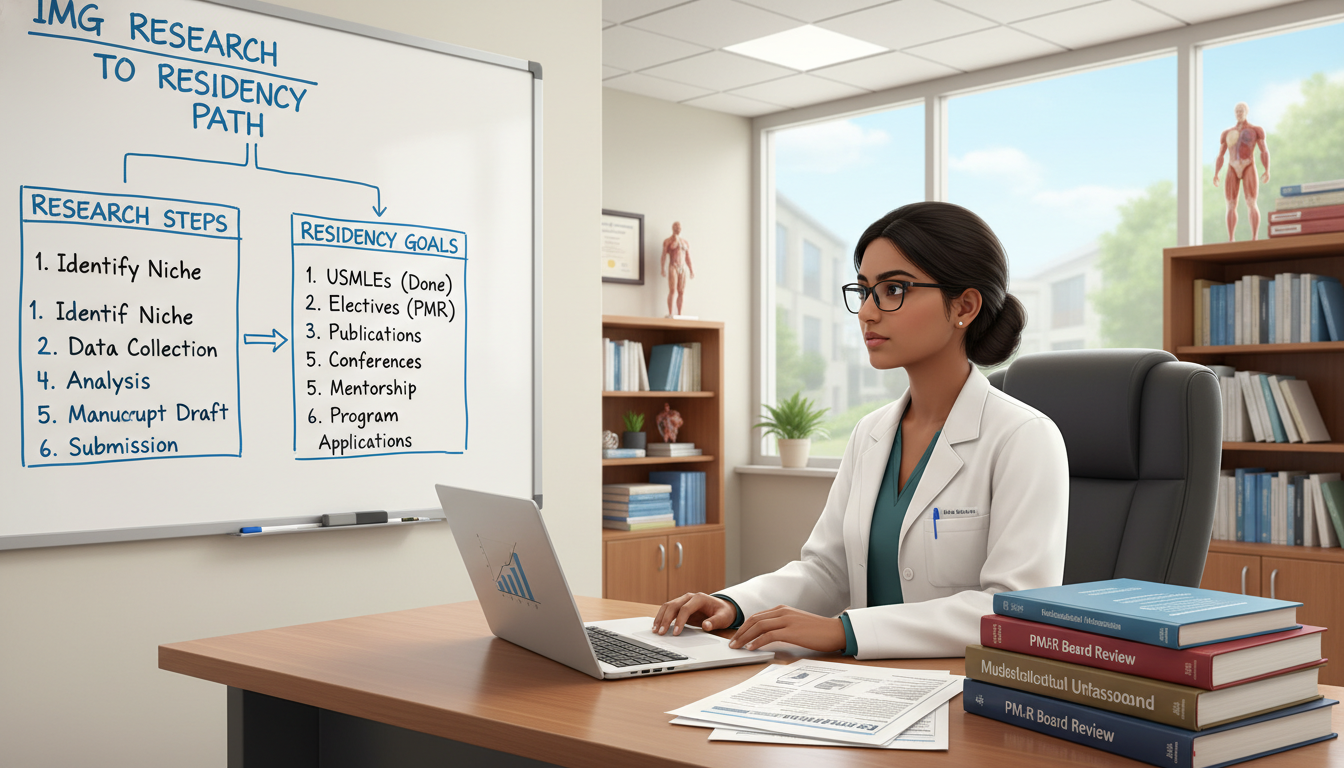
Step-by-Step Plan to Build a Strong PM&R Research Profile as an IMG
This section is an actionable roadmap—from zero to a competitive research portfolio.
Step 1: Clarify Your Timeline and Constraints
Before starting, define:
- When do you plan to apply? (e.g., 1–2 cycles from now)
- Where are you located? (in the U.S./Canada vs. abroad)
- Visa or funding limitations?
- Weekly hours you can realistically commit to research (consistent > intense)
Typical IMG scenarios:
IMG abroad, planning future U.S. application:
- Focus first on English writing skills, basic methods, and online collaborations
- Try to get at least 1–2 publications before coming to the U.S.
IMG currently in the U.S. on observership or research position:
- Prioritize networking with PM&R faculty
- Join existing projects with faster output (case reports, retrospective studies)
IMG in a research-only position (e.g., research fellow):
- Aim for multiple outputs and co-authorships
- Lead at least one project where you are first author
Step 2: Gain Fundamental Research Skills
You do not need a formal MPH or PhD, but you do need:
- Basic understanding of study designs: cross-sectional, cohort, RCT, retrospective, case-control, QI methodology
- Ability to read and critique PM&R literature
- Introductory statistics knowledge: p-values, confidence intervals, basic tests
Practical ways to build these:
- Free online courses (Coursera, edX) on research methods and biostatistics
- Institutional workshops (if you’re in a hospital or university setting)
- Reading key PM&R journals regularly (e.g., PM&R, Archives of Physical Medicine and Rehabilitation)
As an IMG, explicitly listing completed online courses or certifications under “Education” or “Certifications” can signal seriousness about research training.
Step 3: Find Mentors and Research Opportunities in PM&R
This is often the hardest part for IMGs, but also the most crucial.
Where to look:
- PM&R departments at academic medical centers (check their websites for faculty interests)
- Rehab hospitals and rehabilitation units within large hospitals
- Professional societies: AAPM&R, AAP, ISPRM, and local/regional PM&R societies
- National meetings (even virtual attendance can help you connect with authors and investigators)
How to approach potential mentors:
- Write concise, personalized emails (not mass messages)
- Mention your background, interests, specific skills (e.g., data analysis, systematic reviews, language proficiency), and your time availability
- Propose specific ways you might help:
- “I can help with literature review and data entry for ongoing projects.”
- “I am very comfortable with Excel/SPSS and eager to assist with data cleaning.”
Include:
- A brief CV (1–2 pages) highlighting any prior research or academic achievements
- Any previous publications or presentations (even if not PM&R)
Persistence is key: many mentors will be too busy or may not respond immediately. Sending polite follow-up emails (one after 7–10 days, then another after 2–3 weeks) is acceptable.
Step 4: Start With Feasible, Fast-Turnaround Projects
As an IMG, you want early successes to build confidence and your CV.
Good starter projects:
- Case reports / case series
- Chart-based retrospective studies with pre-existing datasets
- Reviews or mini-reviews (narrative or scoping reviews) under supervision
- QI projects in inpatient rehab or outpatient clinics
Example sequence for a 12–18 month plan:
- Months 1–3: Join an existing project (data collection, literature review)
- Months 3–6: Lead a case report or small case series
- Months 6–12: Co-author a retrospective study; submit an abstract for a conference
- Months 12–18: Aim for a more substantive project (larger retrospective study, structured review, or QI initiative)
Step 5: Learn to Write and Collaborate Effectively
Writing is often the limiting factor for IMGs.
To improve:
- Read published PM&R articles and case reports carefully for structure and style
- Ask your mentor for examples of well-written manuscripts
- Draft sections early and accept detailed feedback
Key writing tips:
- Keep sentences clear and direct
- Use journal templates and author guidelines precisely
- Be transparent about limitations and potential biases
Learn academic collaboration etiquette:
- Agree early on roles and authorship order
- Communicate regularly about deadlines and progress
- Respond promptly and professionally to emails
Step 6: Prepare Conference Abstracts and Presentations
Conferences are powerful multipliers:
- You showcase your work
- You network with attendings, fellows, and residents
- You demonstrate commitment specifically to PM&R
Look for:
- National meetings (e.g., AAPM&R, AAP)
- Regional PM&R meetings or multi-specialty conferences
- Virtual conferences if travel is difficult
Even if the work is not yet published, a poster or oral presentation helps your publications for match narrative and gives you material for ERAS and interviews.
Communicating Your Research in ERAS and Interviews
Doing the research is only half the job. You must also present it effectively to residency programs.
1. How to Enter Research in ERAS
For each project, include:
- Clear, descriptive title
- Your role (e.g., first author, data analyst, co-author, QI team member)
- Status: published, accepted, submitted, in preparation (honesty is critical)
- Venue: journal name, conference name, date
For in-progress projects, emphasize:
- Concrete steps already completed (e.g., “Data collection completed; analysis ongoing”)
- Expected next steps with realistic timelines
Avoid listing dozens of “in preparation” manuscripts; they appear weak unless close to submission and well described.
2. Personal Statement: Linking Research to PM&R Identity
Use your research to:
- Explain how you discovered PM&R
- Show you understand the specialty’s intellectual core
- Demonstrate consistency in your interests
Example angle:
- “Working on stroke rehabilitation outcomes taught me that medicine is not only about survival but restoring function and independence. This perspective drew me to PM&R, where my research and clinical passion align.”
Avoid turning your personal statement into a purely research-focused essay; balance it with clinical experiences and personal motivations.
3. Interview: Discussing Your Research with Confidence
Prepare for:
- “Tell me about your research.”
- “What was your role in this project?”
- “What were the main findings, and why do they matter?”
- “What were the limitations?”
- “If you had more time, what would you do next?”
Practice explaining:
- Study design in simple terms
- Core result in 2–3 sentences
- Clinical relevance to PM&R practice
Program directors are not testing whether you are a statistician; they want to see:
- Ownership of your work
- Analytical thinking
- Humility and honesty (it’s fine to say “I did not design the study, but I learned X from participating in data collection and analysis.”)
4. Letters of Recommendation Highlighting Research
If possible, obtain at least one letter from a mentor who:
- Supervised your research directly
- Can speak about your persistence, curiosity, teamwork, and communication
- Can connect your research work to your potential as a future physiatrist
Ask your mentor to address:
- Specific examples of your contributions (e.g., “led data cleaning,” “wrote first draft”)
- Your growth over time
- Your reliability and independence
Common Pitfalls and How IMGs Can Avoid Them
1. Overcommitting to Too Many Projects
It is tempting to say yes to everything, but:
- 2 completed projects > 8 unfinished ones
- Spreading yourself too thin can damage your reputation with mentors
Strategy:
- Start with 1–2 projects
- Add new ones gradually as you demonstrate that you can finish tasks
2. Not Aligning Research with PM&R
You may have previous research in other fields (cardiology, surgery, basic science). Use it, but also:
- Obtain at least one PM&R-related project before applying
- Show a clear narrative: how previous fields led you to function/disability-focused questions
3. Authorship and Ethical Issues
Be careful with:
- Gift authorship (being listed without actual contribution)
- Pressure to list “in preparation” papers that may never be submitted
- Data access and patient confidentiality
As an IMG, your credibility is crucial. Always:
- Clarify authorship expectations early
- Keep copies of drafts, emails, and contributions for transparency
- Decline offers that feel ethically dubious
4. Ignoring Your Own Learning
Don’t just “collect lines on a CV.” Use each project to:
- Learn at least one new skill (e.g., literature search strategy, basic stats, poster design)
- Reflect on how this experience will make you a better resident
Program directors can usually tell when research was purely transactional versus truly educational.
Putting It All Together: A Sample 18-Month Research Roadmap for an IMG
To make this concrete, here’s a realistic IMG residency guide style roadmap for someone aiming for the physiatry match in about 1.5 years.
Months 0–3: Foundation & First Contact
- Complete 1–2 online courses on research methods and basic stats
- Read at least 1–2 PM&R journal articles per week
- Identify 10–15 PM&R departments and faculty doing rehab research
- Send targeted emails to potential mentors; secure a role on an existing project
Months 3–6: First Outputs
- Contribute to data collection or literature review for a mentor’s project
- Identify at least one interesting clinical case and draft a case report
- Submit case report to a PM&R or general medical journal
- Prepare an abstract from existing data for a local or national conference
Months 6–12: Building Momentum
- Co-author a retrospective or QI project with your mentor
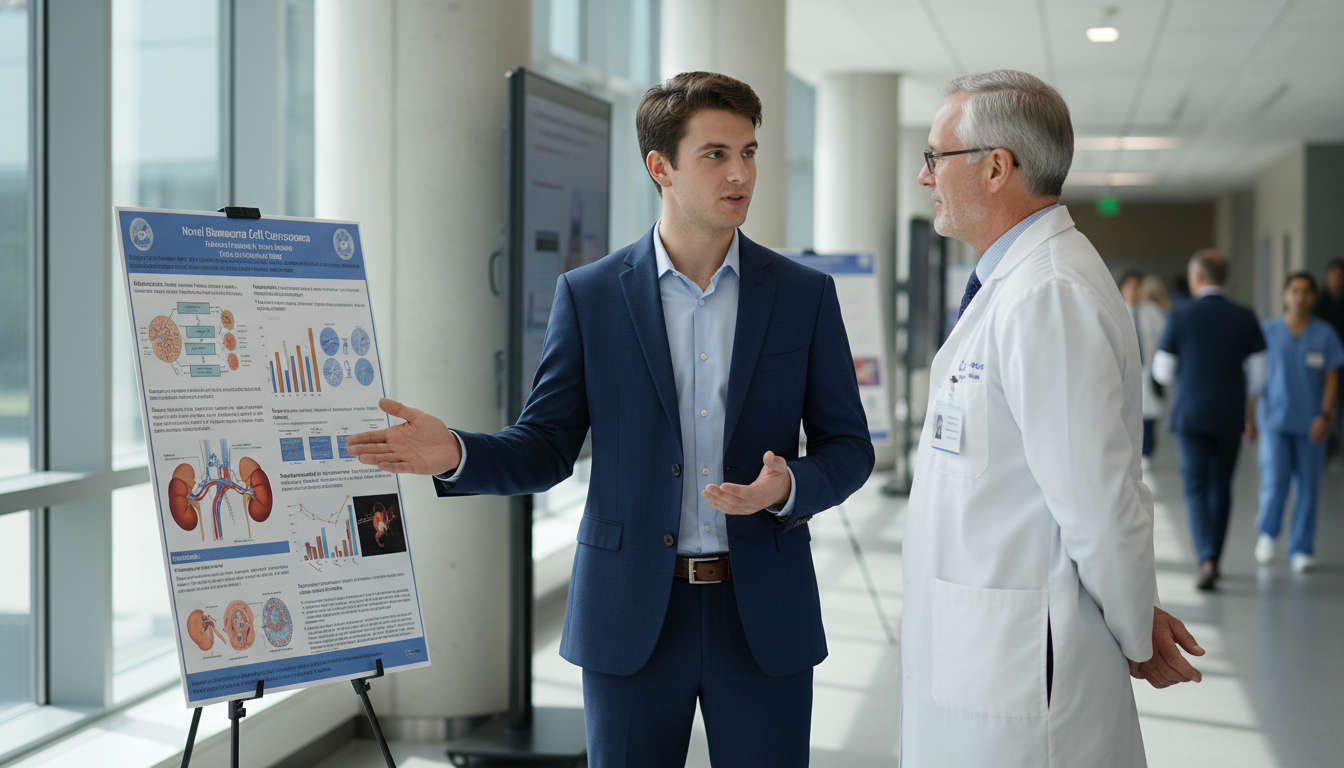
- Submit an abstract for a national PM&R conference (AAPM&R, AAP, etc.)
- Present a poster at a meeting (even virtual)
- Start a small but structured project where you take the lead (e.g., a small series or focused QI project)
Months 12–18: Consolidation Before Application
- Finalize manuscripts and submit to journals
- Update ERAS with accepted publications and abstracts
- Ask your research mentor for a strong letter of recommendation
- Practice articulating your research experience for interviews
If you follow this roadmap consistently, you will likely have:
- 2–4 total scholarly items (case report, poster, retrospective study, QI project)
- At least one PM&R-focused work
- A clear narrative connecting research and your passion for physiatry
FAQs: Research Profile Building for IMGs in PM&R
1. Is research absolutely required to match into PM&R as an IMG?
Not strictly, but it is highly advantageous, especially for IMGs. Some candidates match with minimal research if they have outstanding US clinical experience and strong letters. However, a thoughtful research profile significantly strengthens your application, offsets certain weaknesses (e.g., older graduation year), and proves your commitment to academic growth.
2. I have several publications, but none are in PM&R. Do they still help my application?
Yes. Any legitimate, peer-reviewed work demonstrates scholarly ability. However, try to add at least one PM&R-related project (even a case report or QI project) to show alignment with the specialty. During interviews, explicitly link your previous research skills and mindset to the functional, outcomes-focused nature of physiatry.
3. What if I start research late, just 6–9 months before applying?
Focus on feasible, short-term projects:
- Case reports or small case series
- Contributing to an ongoing retrospective study (e.g., data cleaning, literature review)
- Preparing conference abstracts and posters
You may not produce multiple full publications before applications, but even 1–2 concrete outputs—properly described and understood—are valuable.
4. Does basic science research count as much as clinical research for PM&R?
It counts, especially if it’s rigorous and you understand it well. However, PM&R program directors often value clinically and functionally relevant research more because it directly reflects the specialty’s practice. If your background is primarily basic science, aim to add at least one clinically or outcomes-oriented PM&R project to demonstrate that you can translate scientific thinking into patient-centered rehabilitation questions.
By approaching research strategically—focusing on feasible projects, strong mentorship, and clear communication—you can build a compelling research profile as an international medical graduate and significantly enhance your competitiveness for a PM&R residency.