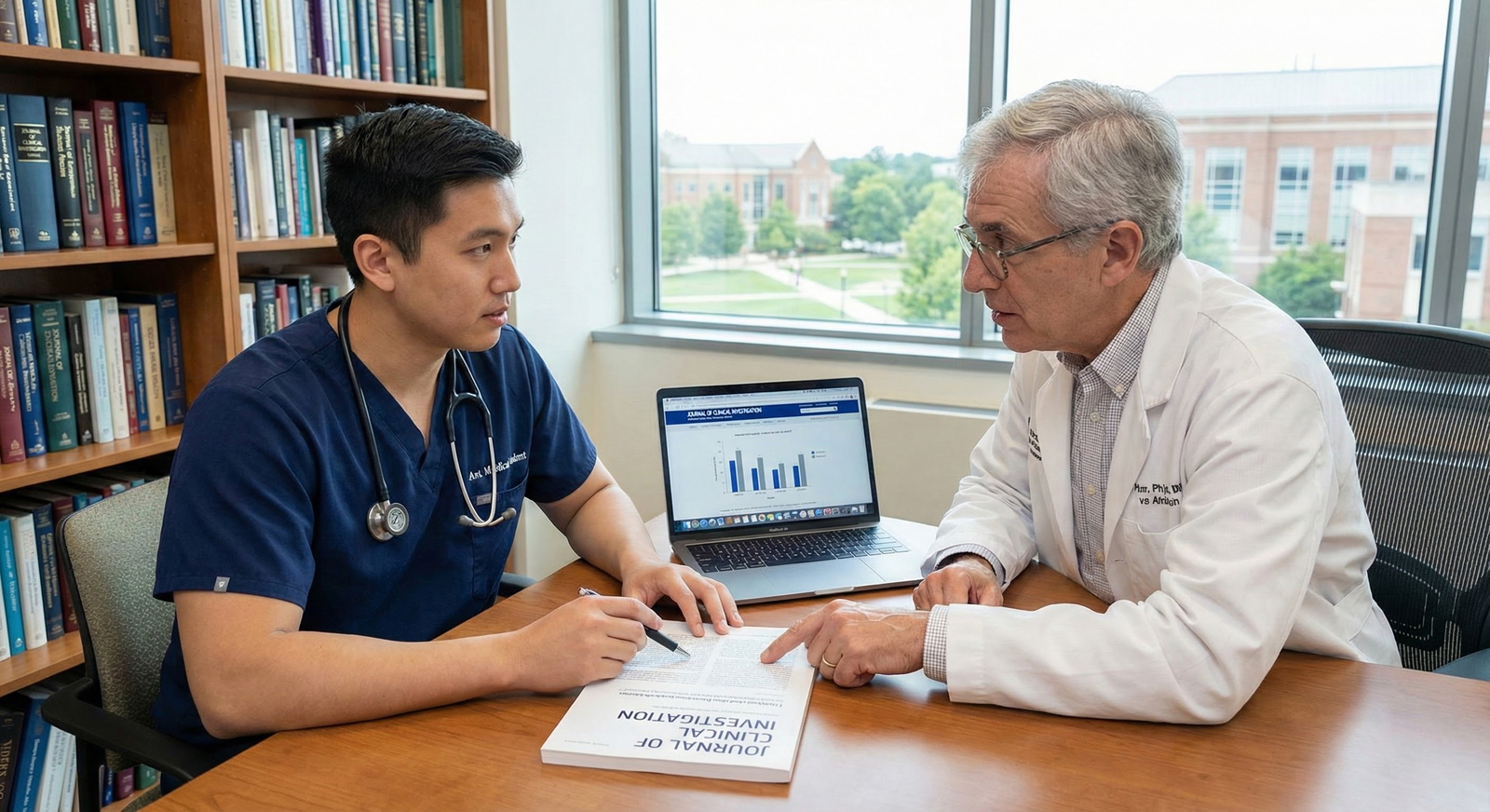
Understanding the Role of Research in Transitional Year Residency for IMGs
For an international medical graduate (IMG), a strong research profile can be a powerful differentiator when applying for a Transitional Year (TY) residency. While TY programs vary in how heavily they weigh research, evidence of scholarly activity signals that you are disciplined, academically engaged, and capable of contributing to a teaching hospital environment.
Transitional Year residencies are often stepping stones into highly competitive specialties (radiology, anesthesiology, dermatology, radiation oncology, neurology, PM&R, etc.). Program directors in these fields pay close attention to your research profile, even if the TY program itself is more flexible. For that reason, a solid research strategy during the pre- and mid-application phases can substantially improve both:
- Your chance of matching into a good TY program, and
- Your competitiveness for the advanced (categorical) specialty you’re ultimately targeting.
This IMG residency guide will walk you through what “research for residency” actually means in practice, how to plan a realistic research roadmap, and how to answer the inevitable question: “How many publications are needed?”—particularly for someone aiming for a Transitional Year.
What Counts as “Research” for TY Programs and the Match?
Core Types of Scholarly Work
Residency applications (ERAS) and program directors broadly consider the following as valid research and scholarly output:
Original Research
- Prospective or retrospective clinical studies
- Basic science or translational research
- Outcomes research, quality improvement (QI) with rigorous methods
- Example: A retrospective chart review on “30‑day readmission rates after heart failure hospitalization.”
Case Reports and Case Series
- Single patient (case report) or small group (case series) describing unusual presentations, rare complications, or important management lessons.
- Highly accessible for IMGs and often the fastest route to early publications.
Review Articles and Narrative Reviews
- Summaries of current knowledge on a focused topic, often done with a mentor.
- Some journals accept “mini‑reviews,” which can be realistic for early‑career authors.
Systematic Reviews and Meta‑Analyses
- Methodologically rigorous and time-consuming, but highly valued.
- Feasible remotely and especially practical for IMGs with limited U.S. clinical access.
Quality Improvement (QI) Projects
- Projects aiming to improve a process or outcome in clinical care (e.g., reducing medication errors).
- Often done in hospital settings and can be presented as posters, abstracts, or publications.
Conference Abstracts, Posters, and Oral Presentations
- Count as scholarly output even if not yet full manuscripts.
- Regional or national meetings (ACP, ACG, ASCO, RSNA, etc.) carry more weight than local/internal events, but all are useful.
Book Chapters and Educational Materials
- Book chapters, online educational modules, or contributions to institutional handbooks can also demonstrate academic engagement.
What Do TY Programs Actually Value?
Transitional Year programs differ significantly:
- Community TY programs may focus more on clinical performance and less on research.
- University-affiliated or academic TY programs place much stronger emphasis on research and scholarly productivity.
- TY linked to competitive advanced specialties (e.g., radiology, radiation oncology, anesthesia at major centers) often expect a research track record aligned with the advanced field.
For IMGs, your research signals:
- Ability to work in U.S. or international academic environments
- Familiarity with evidence-based medicine and literature
- Commitment to a specialty and intellectual curiosity
- Persistence and professionalism (since research requires follow‑through)
Programs do not expect you to have the profile of a PhD, but they do expect evidence that you understand and can participate in scholarly work at a basic level.
How Many Publications Are Needed for a Strong IMG Research Profile?
There is no universal cut-off, and program directors rarely think in strict numbers—but patterns and consistency matter. The question “how many publications needed?” is really about demonstrating a trajectory, not hitting a magic number.
General Ranges for IMGs Targeting Transitional Year
Below is a realistic framework (not a strict rule) for IMGs:
Minimal but acceptable scholarly exposure
- 0–1 publications,
- 1–3 posters/abstracts,
- Some evidence of participation in a project (even if not published yet).
- Suitable for less competitive community TY programs, especially if USMLE and clinical performance are strong.
Solid and competitive profile
- 2–4 publications (case reports, small clinical studies, or reviews),
- 3–6 posters/abstracts or oral presentations,
- Involvement in at least one ongoing or completed research project, preferably in your future specialty.
- Competitive for many university-affiliated TY programs and improves your standing for advanced programs.
Highly competitive / academic track profile
- 5+ publications for residency (including co‑authorships),
- Multiple conference presentations,
- Significant role in at least one substantial research project (e.g., data analysis, systematic review, clinical trial sub-study).
- Attractive to top‑tier academic TY programs and highly competitive advanced positions.
First vs. Co‑Author: Does It Matter?
For IMGs, it’s better to have a mix:
- First-author roles on smaller projects (case reports, small retrospective studies, review articles) show you can lead and drive a project to completion.
- Co-author roles on larger studies show you can contribute as part of a team.
Most program directors look at the totality and pattern of work rather than obsessing over first‑author vs co‑author, as long as you can clearly discuss your specific role in each project.
Timing: When Do Publications Count?
- Anything accepted (even if “in press”) can be listed in ERAS as a publication.
- Submitted but not yet accepted work should be categorized correctly as “submitted” or “in preparation,” and you must be honest.
- Projects started too late (just weeks before ERAS opens) often won’t produce a publication in time but can still yield abstracts, posters, or at least a “work in progress” description.
For an IMG, the strategic aim is to start early enough that at least some work matures into accepted publications or abstracts by the time you apply.

Step-by-Step Roadmap to Build a Strong Research Profile as an IMG
Step 1: Clarify Your Specialty Goals and Target Programs
Even though you’re applying to a Transitional Year program, your research should be aligned with the advanced specialty you aim to enter. Begin with:
- Identifying your future specialty (e.g., diagnostic radiology, anesthesiology, neurology, PM&R, radiation oncology, ophthalmology).
- Mapping out the kind of academic environment you want (community vs academic center).
- Checking program websites and FREIDA to understand how much they emphasize research.
Actionable tip:
Create a spreadsheet with columns for:
- Program name
- Type (community vs academic)
- Research expectations (from website, program director talks, resident profiles)
- Residents’ CVs or bios (to see typical research output)
Step 2: Understand Your Current Position and Constraints
Assess:
- Where you currently are (medical school, gap year, postgraduate internship, observerships, research fellowship).
- Your visa and geographic limitations for in-person research roles.
- Your time availability per week (realistically): 10–15 hours/week is typical for part-time research while studying or doing clinical work.
Be honest about:
- Statistical or methodological skills (basic? intermediate?)
- Writing ability in English
- Access to mentors (home country vs U.S. vs remote collaborations)
This assessment helps you choose projects that are feasible—so you actually finish them.
Step 3: Secure a Research Mentor and Environment
For IMGs, mentorship is often the make-or-break factor. You need a setting where you can contribute meaningfully and be given authorship.
Where to look for mentors:
U.S. clinical electives or observerships
- Ask attending physicians or fellows if they have ongoing projects.
- Offer to help with data collection, literature review, or manuscript drafting.
Research fellowships or volunteer positions
- Many large academic centers offer unpaid or low-paid research positions for IMGs.
- Search departmental websites (e.g., “Radiology research fellow international medical graduate”).
Your home institution or country
- Local faculty may have ongoing projects with less intense competition for authorship.
- These still count strongly in your research portfolio.
Remote collaborations
- Systematic reviews, meta-analyses, and educational writing can be done remotely.
- Look for projects via:
- Academic Twitter/X and LinkedIn groups
- Research collaboratives (e.g., student/trainee research networks)
- Former classmates working in research-intensive settings
How to approach a potential mentor (sample email structure):
- Brief introduction: who you are, IMG background, USMLE status.
- Your specialty interest and why.
- Very concise summary of any prior research exposure.
- A clear request: to assist with ongoing projects (data collection, abstracts, literature review).
- Attach a 1-page CV tailored to research.
Make it easy for them to say yes by emphasizing that you are willing to do the “less glamorous” parts of research, reliably and on time.
Step 4: Choose a Balanced Research Portfolio
An efficient research profile for an IMG aiming at a TY program should combine:
Quick-win projects (to get early outputs)
- Case reports and case series
- Short narrative reviews or mini‑reviews
- Small QI projects with poster potential
- Expected timeline: 2–6 months to acceptance (varies by journal)
Medium- to long-term projects
- Retrospective chart reviews with real data analysis
- Systematic reviews and meta‑analyses
- Multi-author clinical or educational research
- Expected timeline: 6–18 months to acceptance
Example balanced portfolio over 12–18 months:
- 2 case reports (first author)
- 1 narrative review (first or co-first author)
- 1 retrospective study (co-author, moderate contribution)
- 1 systematic review (co-author)
- 2–4 posters or oral presentations from the above projects
This kind of mix is highly persuasive in an ERAS application, especially when described with clarity in your personal statement and interviews.
Step 5: Build Practical Research Skills (Even as a Beginner)
You don’t need advanced biostatistics to start. Focus initially on:
Literature search and appraisal
- Learn to use PubMed efficiently (MeSH terms, filters).
- Practice summarizing 5–10 key articles on a focused question.
Basic data handling and descriptive statistics
- Become comfortable with Excel or Google Sheets.
- Understand mean, median, standard deviation, confidence intervals, and p‑values.
- If possible, pick up basic SPSS, R, or Stata exposure.
Academic writing fundamentals
- Structure: Introduction – Methods – Results – Discussion (IMRAD).
- Clarity, conciseness, and avoidance of overly complex language.
- Learn how to write abstracts and respond to reviewer comments.
Low-cost or free resources:
- Coursera/edX courses in “Clinical Research” or “Epidemiology.”
- University libraries or open-access courses on biostatistics.
- Institution-led research workshops (often available even to observers or volunteers).
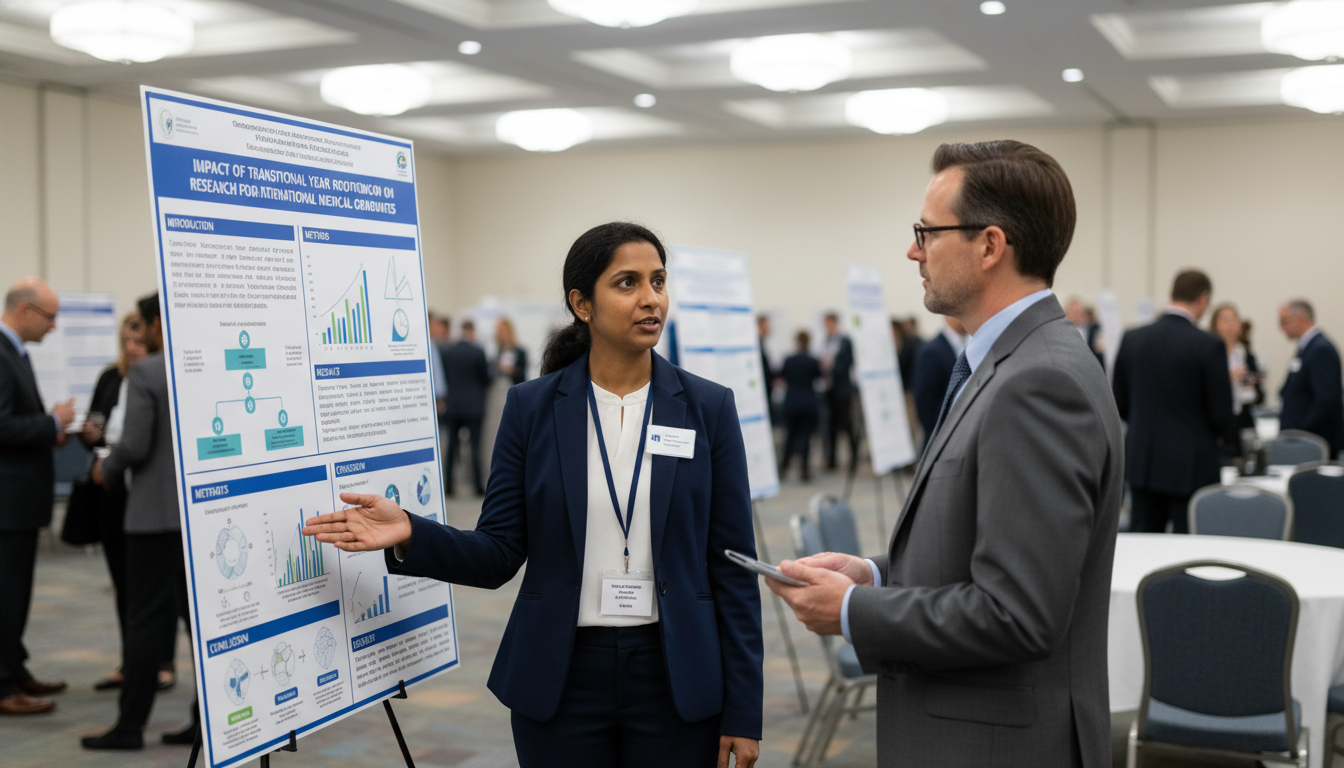
Strategically Presenting Your Research in the Residency Application
Building a strong research profile is only half the work; presenting it effectively in your application is equally important.
How to List Research on ERAS
Organize your entries to highlight:
- Peer-reviewed journal articles (published, in press, accepted)
- Conference abstracts, posters, and presentations
- Ongoing research projects (clearly labeled as “in progress” or “submitted”)
- Other scholarly work (book chapters, online modules, QI projects)
For each entry, include:
- Your role (first author, co-author; what you specifically did)
- Publication or presentation details (journal, conference name, date)
- Status (published, accepted, submitted)
Avoid inflating your role or misrepresenting authorship; faculty are adept at spotting inconsistencies.
Integrating Research into Your Personal Statement
Even for a Transitional Year residency, your personal statement should connect your research to:
- Your specialty choice and long-term goals
- Skills you developed (critical thinking, perseverance, teamwork)
- How research experiences shaped your approach to patient care
Example angle:
“As an IMG navigating a new academic environment, contributing to a retrospective study on perioperative complications in elderly patients taught me how to bridge clinical intuition with data-driven decisions. This experience reinforced my commitment to an academic career in anesthesiology and motivated me to seek a Transitional Year in a program where clinical training and scholarly inquiry are closely integrated.”
Discussing Research in Interviews
Program directors and interviewers often test:
- Whether you genuinely understand your own projects
- Your level of independent contribution vs. passive authorship
- How you handle setbacks (rejected manuscripts, failed hypotheses)
- How research fits into your future career plans
Be prepared to answer:
- “Tell me about your most significant research project.”
- “What was your specific role?”
- “What challenges did you face and how did you overcome them?”
- “How do you see research fitting into your career after residency?”
For a TY interview, tie your answer back to how your scholarly mindset will make you a better transitional year resident and a stronger colleague for the advanced specialty team.
Tailored Strategies for IMGs: Common Scenarios and Solutions
Scenario 1: IMG with No Prior Research Experience
Challenges:
No publications, minimal understanding of research methods, limited access to mentors.
Strategy:
- Start with a case report or case series during an observership or home-country rotation.
- Seek out a remote systematic review project with collaborators; act as the primary literature screener and extractor.
- Take a short online course in clinical research to build foundational vocabulary.
- Aim for:
- 1–2 case reports
- 1 review or systematic review
- At least 1–2 posters over 12–18 months
Scenario 2: IMG with Research from Home Country but No U.S. Experience
Challenges:
Concern that non-U.S. research won’t be valued; difficulty translating experience to U.S. context.
Strategy:
- Include all legitimate peer-reviewed work, regardless of country; it still counts.
- Focus on explaining clearly what your role was and what you learned.
- Secure at least one U.S.-based mentor or project (even a small involvement) to bridge your profile into the U.S. system.
- Use your home-country research to show long-term academic interest and continuity.
Scenario 3: IMG in a Full-Time Clinical Job with Little Time
Challenges:
Time constraints, fatigue, limited capacity for large projects.
Strategy:
- Prioritize small but realistic projects: case reports, narrative reviews, small QI.
- Join a larger team project where your role is defined but not overly time-consuming (e.g., data extraction for a meta-analysis).
- Protect a fixed number of hours per week (e.g., Saturday morning) solely for research activities.
- Focus on quality over quantity, but aim for at least 1–2 tangible outputs before application season.
Key Takeaways for IMGs Targeting Transitional Year Programs
- A strong research profile is not mandatory for every TY program but is a significant advantage, particularly for academic or specialty-linked TY positions.
- Think in terms of trajectory and consistency rather than chasing a rigid “how many publications needed” number.
- Combine quick-win projects (case reports, small reviews) with at least one more substantial project to show depth.
- Start early, secure reliable mentors, and choose projects that match your constraints and long-term specialty interests.
- Present your work clearly and honestly in ERAS, your personal statement, and interviews, emphasizing skills and insights gained.
For an international medical graduate, research is both a way to stand out and a way to demonstrate that you can thrive in the academic culture of U.S. medicine. Even modest but well-chosen scholarly activity can significantly strengthen your Transitional Year and advanced specialty applications.
FAQs: Research Profile Building for IMGs in Transitional Year
1. Is research mandatory to match into a Transitional Year program as an IMG?
No, research is not strictly mandatory for all TY programs, especially community-based ones. However, for university-affiliated or competitive TY slots—particularly those linked to advanced specialties like radiology, anesthesiology, or radiation oncology—a research background significantly improves your chances and strengthens your profile for the subsequent specialty match.
2. How many publications are realistically needed for a competitive IMG TY application?
There is no fixed requirement, but many successful IMGs applying to academic TY programs have around 2–4 publications for residency plus several abstracts or posters. More important than the raw number is demonstrating that you’ve engaged meaningfully in scholarly work, can explain your role clearly, and show a logical connection between your research, your specialty interest, and your career goals.
3. Does it matter if my research is not directly related to my future specialty?
Related research is ideal, but not mandatory. If your projects are in different specialties, emphasize the transferable skills: critical thinking, data analysis, literature review, and scientific writing. If possible, try to complete at least one project aligned with your chosen specialty (e.g., a case report in radiology if you’re applying to radiology), but do not discard valuable research just because it’s in another field.
4. What if I start research late and don’t have accepted publications by ERAS submission?
Even if your manuscripts are not yet accepted, you can still list submitted work, active projects, and conference abstracts on ERAS—as long as you label them accurately. Programs understand that research timelines are long. Use your personal statement and interviews to discuss what you’re working on, your role, and what you’ve learned so far. Starting late is not ideal, but honest and substantial engagement in ongoing research can still positively influence your application.