Understanding the Role of Research in a Preliminary Medicine Year
For an MD graduate residency applicant targeting a Preliminary Medicine (prelim IM) position, research can feel confusing. You’re doing one year of medicine, then moving on—so how much does your research profile actually matter? And in what way?
The answer: it matters, but differently than for categorical Internal Medicine or highly research-intensive specialties.
A Preliminary Medicine year is primarily a clinical training year. However, your research profile still plays several important roles:
Securing the prelim spot itself
- Many prelim IM programs share application pools with categorical Internal Medicine.
- Strong research (especially in internal medicine, subspecialties, or your advanced specialty) can distinguish you from other MD graduate residency applicants with similar board scores and grades.
Supporting your advanced specialty match
- Most MD graduates pursuing a prelim year are headed to:
- Neurology
- Anesthesiology
- Radiology / IR
- Ophthalmology
- Dermatology
- Radiation Oncology
- PM&R
- Some surgical subspecialties
- In these matches, your research profile built before and during your prelim year can be a major asset—sometimes more relevant than the prelim year itself.
- Most MD graduates pursuing a prelim year are headed to:
Signaling academic potential and professionalism
- Even if you’re not planning a fully academic career, research involvement tells programs:
- You can complete long-term projects.
- You understand data, evidence-based medicine, and critical appraisal.
- You can collaborate and communicate in teams.
- Even if you’re not planning a fully academic career, research involvement tells programs:
Creating backup and flexibility
- If circumstances change (e.g., you later pursue categorical internal medicine, a medicine subspecialty, or an academic role), your research profile becomes even more valuable.
In short, as an MD graduate, your research for residency should be strategically built to serve both your preliminary medicine application and your ultimate specialty goals.
What Program Directors Look For in a Research Profile
Before you start adding projects, it helps to understand how program directors think about publications for match.
1. It’s Not Just “How Many Publications Needed”
Applicants often ask: “How many publications needed for a strong application?”
There’s no universal number. Instead, programs evaluate:
Total scholarly output
- Publications (peer-reviewed)
- Abstracts, posters, and oral presentations
- Quality improvement (QI) and patient safety projects
- Case reports and case series
- Book chapters or online peer-reviewed educational content
Relevance to the field
- For prelim IM programs: internal medicine, hospital medicine, QI, patient safety, epidemiology.
- For your advanced specialty: research in that specialty (e.g., anesthesiology outcomes, neuroimaging, retinal disorders).
Consistency and progression
- A timeline that shows you stayed engaged with research across medical school and into your MD graduate residency application period is more impressive than a single rushed project.
Your role and contribution
- First-author or major contributor on a modest project can be more meaningful than a 10th author on a large multi-center trial with minimal involvement.
Practical Benchmarks (not strict cutoffs):
For an MD graduate from an allopathic medical school match pathway aiming for a competitive advanced specialty (e.g., derm, rads, ophtho) plus a Prelim Medicine year:
- Highly competitive track
- 3–5+ posters/abstracts
- 1–3+ peer-reviewed publications
- Some work clearly linked to your chosen specialty
For MD graduates entering moderately competitive specialties or more clinically focused paths:
- Solid, balanced profile
- 1–3 posters/abstracts
- 0–2 publications
- Demonstrated involvement in at least one substantial project (QI, retrospective study, or prospective work)
For MD graduates primarily concerned with securing a prelim IM slot (and advanced specialty is already secured or less research-heavy):
- Research is often beneficial but not mandatory. Even 1–2 small projects (e.g., case report, QI) can be enough to show initiative.
2. MD Graduate vs. DO/IMG Expectations
As an MD graduate from an allopathic medical school, some program directors may subtly expect:
- Familiarity with research exposure (even if you weren’t highly productive).
- Basic understanding of study design, statistics, and evidence-based medicine.
This doesn’t mean you must have multiple RCTs or high-impact publications—but it does mean that zero scholarly activity can appear as a missed opportunity.
3. Research Fit for Preliminary Medicine
For prelim IM, the best-aligned research is typically:
- Hospital medicine
- General internal medicine
- Cardiovascular, pulmonary, renal, infectious disease topics (common inpatient conditions)
- Quality improvement (e.g., hand-off safety, readmission reduction)
- Patient safety interventions
- Diagnostic accuracy and utilization (labs, imaging)
- Health systems and outcomes research
Think: “What would matter to a busy inpatient ward team and their leadership?”
Types of Research and Scholarly Work That Count (and How to Get Them)
You don’t need to be in a wet lab to build a strong research portfolio for a prelim IM year. In fact, most MD graduates succeed through clinical and outcomes research and QI projects.
1. Clinical Research (Retrospective and Prospective)
Retrospective chart reviews are ideal for MD graduates balancing rotations and studying for boards.
Examples relevant to a prelim IM profile:
- Outcomes of patients admitted with sepsis after implementation of a new protocol.
- Predictors of early readmission in patients with decompensated heart failure.
- Adherence to DVT prophylaxis guidelines on general medical wards.
How to get involved:
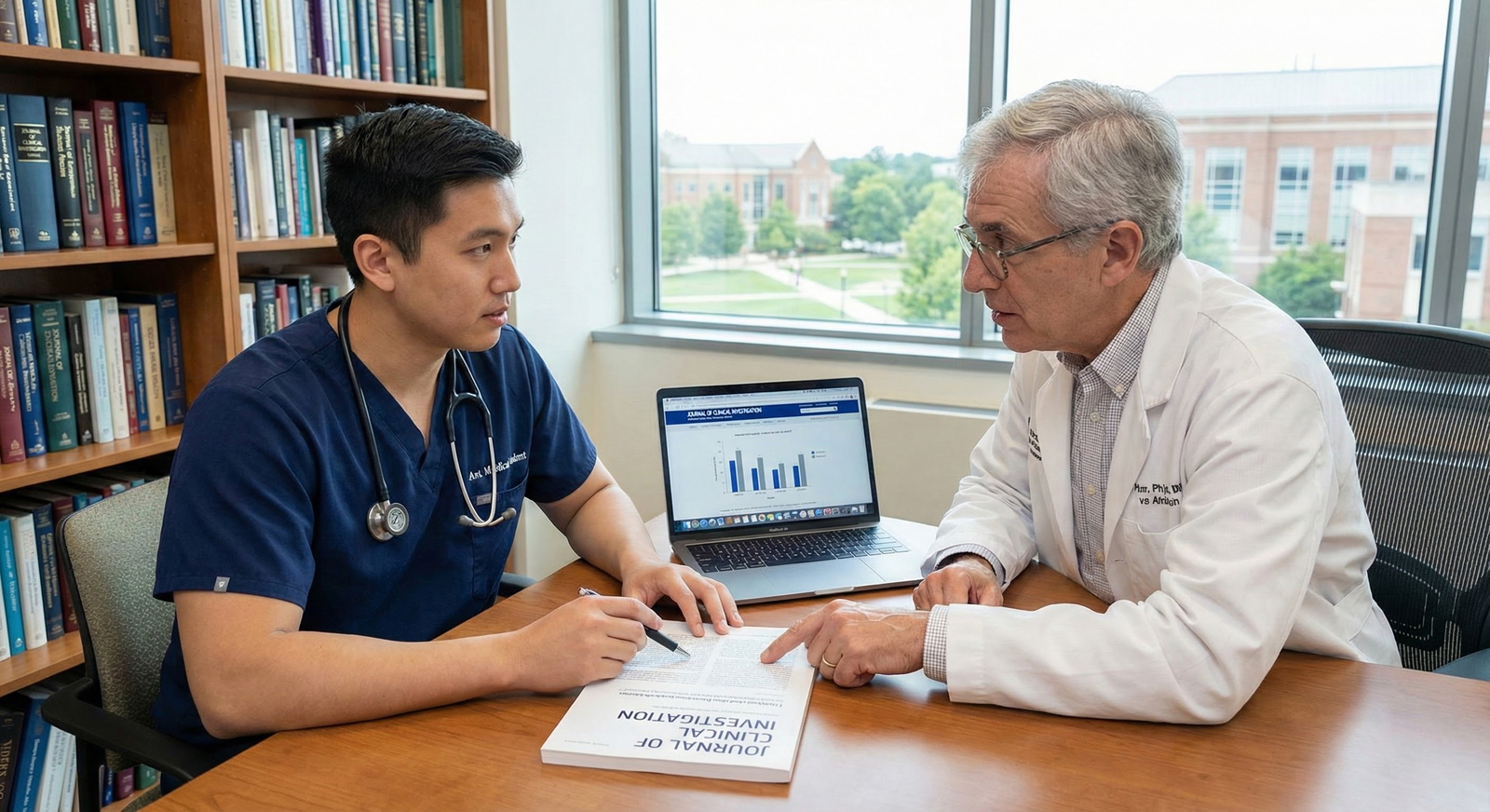
Identify faculty who publish in hospital medicine, general IM, or your advanced specialty.
Email a brief message:
- Introduce yourself as an MD graduate or M4/future prelim IM applicant.
- Express interest in helping with chart review, data entry, or manuscript drafting.
- Attach CV and, if applicable, a short paragraph on previous research.
Propose ideas if invited, but it’s often faster to join ongoing projects.
2. Quality Improvement (QI) and Patient Safety Projects
For preliminary medicine applicants, QI projects are extremely valuable and sometimes easier to complete within 6–12 months.
Common examples:
- Reducing unnecessary telemetry in a general medicine unit.
- Improving adherence to venous thromboembolism (VTE) prophylaxis.
- Standardizing discharge medication reconciliation.
- Decreasing delays in antibiotic administration for sepsis patients.
Why QI is powerful:
- Directly relevant to internal medicine and hospital operations.
- Often more feasible to conduct and present locally or at regional conferences.
- Viewed favorably by program directors because they link to patient care and systems-based practice.
3. Case Reports and Case Series
Case reports are an accessible way to start building publications for match, especially during sub-internships or early in your prelim year.
Tips:
- Look out for unusual presentations or rare complications during your medicine rotations.
- Ask your attending or resident if they’d be willing to co-author.
- Aim for journals receptive to case-based reports (many subspecialty and hospital medicine journals publish them).
- Even a couple of case reports can significantly enhance your MD graduate residency CV.
4. Educational Research and Scholarly Teaching
If you enjoy teaching or curriculum development:
- Develop a teaching module (e.g., teaching interns about electrolyte emergencies).
- Collect pre/post-test data and measure outcomes.
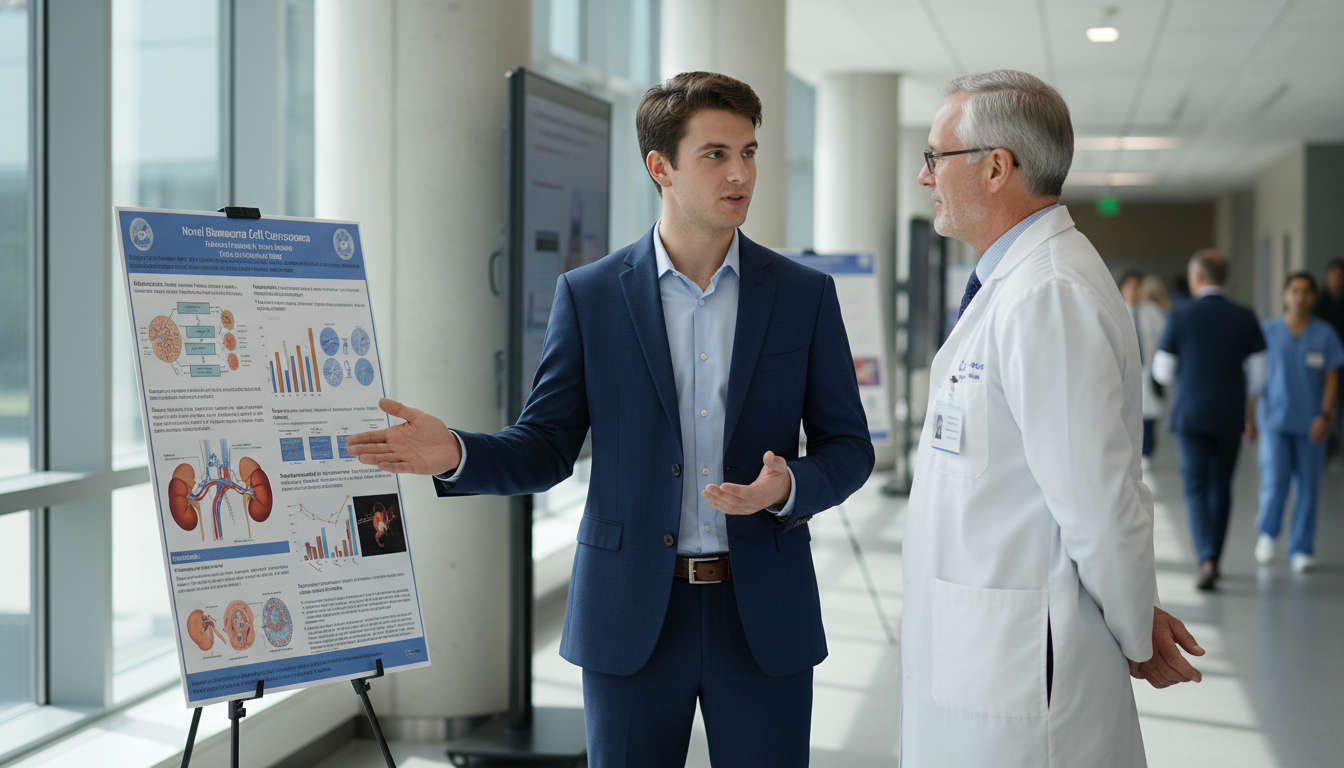
- Present your findings at education conferences (e.g., Clerkship directors, IM education meetings).
This type of work can be appealing to academic internal medicine and to specialties that value teaching.
5. Specialty-Aligned Projects
Remember that your advanced specialty often cares even more about your research than the prelim program.
Examples:
- For anesthesia: perioperative risk, hemodynamic monitoring, airway complications.
- For neurology: stroke outcomes, epilepsy, neuroimaging analysis.
- For radiology: imaging utilization, diagnostic performance, structured reporting.
- For ophthalmology: visual outcome predictors, surgical complications.
These projects can still strengthen your prelim IM application because they show scholarly engagement and often involve hospitalized patients or interdisciplinary care.
Step-by-Step Plan to Build Your Research Profile (12–24 Month Timeline)
This roadmap assumes you are a late M3, M4, or recent MD graduate entering the residency match and applications phase for a prelim IM spot.

Step 1: Clarify Your Target Programs and Specialty (Months 0–1)
Decide if your primary focus is:
- A very competitive advanced specialty (e.g., dermatology, ophthalmology, radiology, radiation oncology).
- A moderately competitive or less research-heavy field.
- Primarily the preliminary medicine year while keeping options open.
Answer these questions:
- Do I plan a long-term academic or research-career path?
- Which topics genuinely interest me enough to sustain long projects?
- What resources/faculty are accessible at my medical school or affiliated hospitals?
This shapes your research for residency strategy: number of projects, depth, and balance between prelim IM and your advanced field.
Step 2: Perform a Research Inventory (Months 0–1)
List everything you already have:
- Published papers
- Manuscripts in progress
- Posters, abstracts, oral presentations
- QI projects (even if not yet written up)
- Case reports partially drafted
- Data collected but not yet analyzed
Then ask:
- Can any of these be completed and submitted before ERAS opens?
- Can any be advanced to poster or abstract level for a conference?
- Are there opportunities to convert clinical experiences into case reports?
Often MD graduates underestimate how much they already have that could be completed quickly.
Step 3: Secure 1–2 Anchor Projects (Months 1–3)
An “anchor project” is something:
- Substantive enough to discuss in detail during interviews.
- Likely to result in at least a conference presentation or eventual publication.
Ideal anchor projects for a prelim IM–bound MD graduate might include:
- A retrospective study on inpatient outcomes.
- A QI initiative with measurable pre/post results.
- A multicenter study where you play a central coordinating role.
Commit to:
- One project aligned with internal/hospital medicine, and
- One project aligned with your future specialty (if applicable).
Step 4: Add 1–3 Smaller “Quick-Win” Projects (Months 3–9)
These support your main portfolio and increase your total scholarly activity:
- Case reports from interesting inpatient cases.
- Short QI reports for local hospital meetings or internal conferences.
- Secondary analyses of existing data from a mentor’s study.
Your goal: by the time you submit ERAS, you have a balanced CV:
- 1–2 anchor projects (in progress or completed).
- 2–4 smaller items (posters, case reports, short communications).
Step 5: Strategize Timing for ERAS and Interviews (Months 9–12)
As you approach the allopathic medical school match timeline:
Update ERAS entries to reflect:
- Submitted manuscripts (list as “submitted”).
- Accepted abstracts and posters.
- QI projects that have been implemented (even if not yet published).
Prepare brief, clear talking points for each project:
- Your role.
- The main question addressed.
- What you learned (both clinically and about research itself).
- Any impact on patient care or systems.
Program directors know that not all work will be fully published by application time. They value initiative, follow-through, and clarity.
Step 6: Use the Prelim Year to Extend Your Research Profile (Months 12–24)
Once you start your preliminary medicine year:
Identify interested faculty in:
- Hospital medicine
- Your advanced specialty (if your prelim hospital has that department)
- Quality and safety office or hospital administration
Leverage:
- Night-float observations of systems issues.
- Common errors, delays, or inefficiencies you witness daily.
- Cases with unusual or instructive clinical lessons.
Seek:
- Short-term QI projects (6–9 months).
- Opportunity to join ongoing clinical or outcomes research as a data collector or co-author.
- Continuation or completion of projects begun in medical school.
Even with a demanding prelim schedule, it is realistic to produce:
- 1–2 posters or abstracts, and possibly
- 1–2 case reports or short manuscripts over the course of the year.
These can be crucial if you’re reapplying for advanced spots, applying to fellowships early, or repositioning yourself into a more academic trajectory.
How to Talk About Your Research in Personal Statements and Interviews
Your research must not only exist; you must also present it effectively.
In Your Personal Statement (Prelim IM Focus)
For a Preliminary Medicine application:
- Highlight projects that show:
- Your engagement with inpatient medicine.
- Interest in systems-level care (QI, outcomes).
- Appreciation of complex multi-morbidity and hospital workflows.
Example angle:
“My work evaluating adherence to VTE prophylaxis protocols on a general medicine ward deepened my interest in systems-based practice and reinforced the importance of structured approaches to inpatient care—one of the reasons I am excited to train in a rigorous Preliminary Medicine year.”
In Your Personal Statement (Advanced Specialty Focus)
If writing a separate statement for the advanced specialty:
- Focus more heavily on specialty-aligned research.
- Connect each project to your curiosity about that field and your long-term career vision.
In Interviews
When asked about your research:
Start with a one-sentence summary:
- “This project evaluated whether implementing a standardized sepsis bundle improved time to antibiotics and mortality in our medical ward.”
Briefly cover:
- Why it mattered.
- Your specific role.
- One or two key findings.
- What you learned or changed in practice.
Be prepared for:
- Questions about limitations of your study.
- Basic statistics and design issues (e.g., retrospective vs prospective).
- How the project shaped your approach to patient care.
The goal is not to sound like a biostatistician, but like a thoughtful, reflective clinician who uses evidence appropriately.
Common Pitfalls and How to Avoid Them
1. Chasing Quantity Over Quality
Submitting your name to as many projects as possible without real involvement can backfire:
- In interviews, you may be unable to explain projects where you’re listed as an author.
- Faculty can read your CV and sense when projects are superficial.
Instead:
- Prioritize meaningful involvement in a smaller number of projects.
- Know each project well enough to discuss methods, results, and implications.
2. Waiting for the “Perfect” Large Study
Many ambitious MD graduates waste months or years aiming only for big RCTs or large cohort studies.
For the residency match and applications timeframe, you should:
- Combine large, longer-term projects (if available) with smaller, achievable wins (case reports, QI, abstracts).
- Accept that “good and finished” is more valuable than “perfect but incomplete.”
3. Ignoring Prelim-Relevant Topics
If all your research is in a niche unrelated to medicine (e.g., bench work in basic science with no patient-facing angle), it can be harder to connect your profile to a prelim IM program.
Solution:
- Add at least one project—even a QI or case report—that directly relates to inpatient internal medicine.
4. Poor Documentation and Follow-Up
Many projects die because of:
- Lost data
- Poor communication
- Missed deadlines for abstract submissions or journals
Protect your work:
Use organized data storage (institution-approved platforms).
Keep shared documents listing:
- Project aims
- Responsibilities
- Deadlines
- Submission targets
Regularly email mentors with concise updates and next-step proposals.
FAQs: Research Profile Building for MD Graduates in Preliminary Medicine
1. How many publications do I need for a strong prelim IM application?
There is no strict number. For prelim IM, many successful MD graduate applicants have:
- At least 1–2 pieces of scholarly work (posters, QI projects, or case reports).
- Some have 0 publications but show strong clinical performance, letters, and board scores.
If you’re also targeting a competitive advanced specialty, having 1–3 publications plus several abstracts/posters is more typical among successful applicants. Quality, relevance, and your role matter more than raw count.
2. Does research during my prelim year help if I’ve already matched into an advanced specialty?
Yes, but its role is different:
- It may not affect your already-secured advanced position.
- It can:
- Strengthen your CV for future fellowships or academic jobs.
- Help you build relationships with faculty in your advanced field.
- Provide material for future presentations, publications, and networking at conferences.
If you’ve already matched into your advanced field, focus your prelim-year research on either hospital medicine/QI (to be a better intern) or projects in your future specialty at the same institution.
3. I have no prior research. What’s the fastest way to start before applications?
Focus on high-yield, feasible projects:
- Join an existing retrospective study as a data collector and co-author.
- Start 1–2 case reports from notable inpatient cases during your rotations.
- Participate in a small QI initiative on your medicine service.
Aim to have at least one project that reaches the abstract/poster stage and another that is in-progress but clearly described on your ERAS application.
4. I trained at an allopathic medical school with limited research. Will this hurt my MD graduate residency chances?
Not necessarily, especially for prelim IM. Program directors understand that not all schools have strong research infrastructure. To mitigate:
- Maximize whatever opportunities are available (local QI, educational projects, case reports).
- Emphasize clinical excellence, strong letters, and commitment to learning.
- If you can, seek external or virtual collaborations (e.g., with faculty at affiliated hospitals or national specialty societies).
As long as you demonstrate initiative and thoughtful engagement, a modest research portfolio can still be very competitive for a Preliminary Medicine year and supportive of your overall residency match and applications journey.
By aligning your research activities with both your preliminary medicine goals and your future specialty trajectory, you can build a research profile that is realistic, persuasive, and sustainable—without sacrificing your clinical development or well-being during this crucial phase of your MD graduate residency pathway.