
Understanding the Role of Research in Med-Psych Residency
Building a thoughtful research profile is one of the most powerful ways to stand out as an applicant to a medicine psychiatry combined (med psych residency) program. Because these programs sit at the interface of internal medicine and psychiatry, they particularly value residents who think in systems, ask good questions, and can engage with evidence at a high level. A research track record is one of the clearest ways to demonstrate those qualities.
Unlike some highly research-intensive fellowships, med-psych residency programs rarely expect you to start residency with first-author NEJM papers. What they look for is:
- Evidence of curiosity and follow-through
- A pattern of engagement over time (not just one last-minute project)
- Exposure to both medicine and psychiatry themes (or at least a clear rationale for your focus)
- Skills that predict success in quality improvement, scholarly work, and interprofessional collaboration
This guide will walk you through:
- How to think strategically about your research profile in the context of combined training
- What counts as meaningful “research for residency” beyond traditional bench or clinical trials
- How many publications you realistically need and how to frame your work if your numbers are modest
- Concrete steps at different stages (M1–M4 / preclinical–clinical / gap year)
- How to present your work compellingly for the match
Throughout, remember that your goal is not just “more lines on ERAS” but a coherent narrative that supports why you are a strong fit for medicine-psychiatry combined training.
What Makes a Strong Research Profile for Medicine-Psychiatry?
Med-psych residency programs sit in a unique niche. They expect you to operate competently in acute medicine and complex psychiatric care while understanding how social determinants, neurobiology, and chronic disease intersect. A strong research profile for these programs therefore has several distinct characteristics.
1. Alignment with Med-Psych Themes
You do not need all your work to be explicitly dual-discipline (e.g., studies run by a med-psych department). But it helps if your portfolio, taken together, touches on:
Interface topics
- Delirium in hospitalized patients
- Psychosomatic medicine and consultation-liaison psychiatry
- Substance use disorders on medical wards
- Cardiometabolic risk in patients with severe mental illness
- Primary care integration of behavioral health
- Outcomes of collaborative care or integrated care models
Core internal medicine topics with thoughtful, humanistic or behavioral nuance
- Adherence to chronic disease treatment
- Hospital readmissions and psychosocial risk factors
- Palliative care communication
Core psychiatry topics with medical or systems relevance
- Antipsychotic metabolic side effects
- Psychopharmacology in medically complex patients
- Suicide risk in chronic illness
Having at least one project at the direct intersection of these domains is ideal, but programs also recognize that your opportunities may be constrained by your medical school environment. What matters is that you can articulate how your projects connect back to med-psych values.
2. Evidence of Longitudinal Engagement
Programs are more impressed by depth than by sporadic, superficial involvement. For example:
- Working with the same research group over 2–3 years, even if only one formal publication emerges
- Starting in a small role (data entry) and gradually taking on higher-level tasks (analysis, drafting)
- Developing a sustained interest area (e.g., integrated primary care) that ends up informing your residency goals statement
A scattered set of one-off poster presentations in unrelated fields can still help, but it’s stronger if you can tie them together thematically or through skills you built.
3. Variety in Scholarly Output
Residency committees view “research” broadly. A robust profile often includes several of the following:
- Peer-reviewed publications (original research, reviews, or case reports)
- Abstracts and poster presentations at local, regional, or national meetings
- Oral presentations or grand rounds
- Quality improvement (QI) projects with measurable outcomes
- Educational scholarship (curriculum development with evaluation, published teaching modules)
- Policy, health services, or implementation science projects
- Narrative or perspective pieces in journals, especially those focused on integrated care
You don’t need all categories, but showing that you can engage in some form of rigorous inquiry and dissemination is crucial.
4. Appropriate Level of Ownership
Programs know that as a student, you’re not usually the principal investigator. What matters is:
- Can you clearly explain your specific role?
- Do you understand the study design, limitations, and next steps?
- Did your responsibilities grow over time?
During interviews, “Tell me about your research” is often followed by technical or conceptual questions. Your goal is to show genuine understanding, not just your name on a paper.
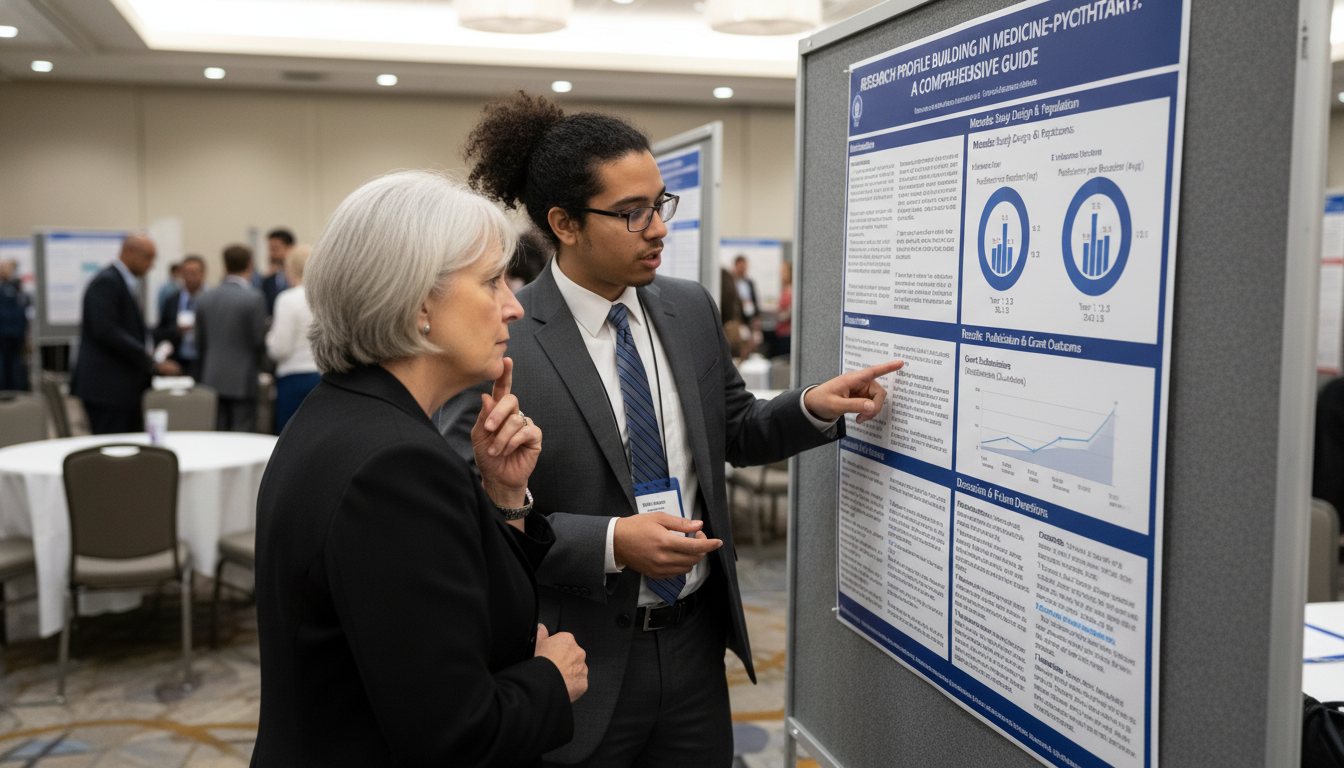
How Many Publications Do You Really Need for Med-Psych?
A recurring anxiety among applicants is “how many publications needed to match a medicine psychiatry combined program?” The honest answer: it depends on your overall profile and the competitiveness of specific programs, but there are clear patterns that can guide you.
General Ranges and What They Mean
For most med-psych programs:
0 publications, some research exposure
- You’ve helped on a project, maybe contributed to data collection or literature review, but nothing is published yet.
- This is adequate for many programs if:
- You can discuss the work thoughtfully
- You have strong clinical evaluations, good letters, and a compelling narrative
- You show clear motivation for med-psych and some engagement in scholarly thinking (e.g., QI, case presentations)
1–2 publications or accepted abstracts/posters
- Very solid for the vast majority of med-psych programs.
- Shows you can see a project through to some form of dissemination.
3–5+ publications, especially with first-author work or national presentations
- Distinguishes you for research-intensive or academic-leaning programs.
- Particularly valuable if they cluster thematically in med-psych-relevant domains.
Do not over-interpret raw counts. One single, well-executed first-author study that fits your narrative can be more impressive than six middle-author lab papers in an unrelated basic science field that you barely remember.
Context Matters More than the Number
When programs evaluate your “publications for match,” they consider:
- Timing – Did your work accumulate gradually or all during a single gap year? Both can be fine, but they tell different stories.
- Type of work – A first-author case series in a mid-tier journal may reflect more ownership than a 7th-author RCT in a top-tier journal.
- Relevance – A psychiatry-focused review on depression in chronic heart failure may be much more persuasive for med-psych than a distant project in orthopedic biomechanics.
If you’re light on formal publications, you can still present a credible scholarly identity by emphasizing:
- Posters and oral presentations
- QI work that has measurable impact (e.g., reducing 30-day readmissions for patients with comorbid SUD)
- In-progress manuscripts with clear roles and timelines
- Thoughtful electives in clinical research or implementation science
When to Consider a Research Gap Year
A dedicated research year is not mandatory to match into medicine-psychiatry, but it can be valuable if:
- You are strongly interested in an academic career, health services research, or implementation science
- You attend a school with limited access to med-psych-oriented mentors and want to train at a research-heavy institution
- Your academic record has weaknesses (e.g., average scores, one failed exam) and you need another way to demonstrate excellence and maturity
If you pursue a gap year, aim for:
- At least one project where you can plausibly be first or second author
- Tangible outputs (submitted or accepted abstracts, manuscripts under review) by the time ERAS opens
- Engagement with both medicine and psychiatry realms if possible (e.g., projects in consult-liaison, integrated primary care, or chronic disease and mental health)
Strategic Steps by Training Stage: Building Your Research Profile
The key to a strong research portfolio is starting early enough and being intentional, even if you begin with no prior experience.
Preclinical Years (M1–M2 or Equivalent)
Goals: exposure, skills, mentorship
Explore broadly but choose 1–2 main mentors
- Attend your school’s research fair or ask your med-psych interest group for leads.
- Look for investigators at the interface of internal medicine and psychiatry—often labeled as:
- Psychosomatic medicine / consultation-liaison psychiatry
- Behavioral health in primary care
- Addiction medicine or integrated SUD treatment
- Population health or health services using mental health measures
Start small and build trust
- Volunteer for manageable tasks: chart review, data entry, REDCap setup, building survey instruments.
- Reliability (meeting deadlines, clear communication) will lead quickly to more substantial roles.
Learn basic research literacy
- Take advantage of your school’s sessions on study design, statistics, EPIC data extraction, and IRB processes.
- If possible, take an introductory course in clinical epidemiology, biostatistics, or QI.
Aim for your first presentation
- Collaborate on a simple case report or a small retrospective chart review project that can result in a poster at a local or regional meeting.
- Even if this doesn’t become a full publication, you’ll gain confidence and a tangible line on your CV.
Clinical Years (M3–M4 or Equivalent)
Goals: depth, dissemination, and alignment with med-psych
Leverage clerkships for project ideas
- During internal medicine, notice patterns like delirium management, polypharmacy, or high-risk discharges with co-occurring depression or substance use.
- During psychiatry, note metabolic issues, chronic disease management, or coordination challenges with primary care.
- Bring these observations back to your mentors and ask: “Is there a way to systematically look at this?”
Combine QI with scholarship
- Many clerkships encourage QI projects (e.g., screening for tobacco use, depression, or fall risk).
- Work with a faculty mentor to design your project so it’s IRB-exempt or minimal risk and publishable as a QI report or brief communication.
Schedule a research elective
- A 2–4 week research elective can be a powerful way to push a nearly-complete project across the finish line.
- Use this time for data analysis, writing, or preparing a conference abstract.
Prioritize projects that can realistically finish before ERAS
- Poster accepted at a national/international meeting
- Manuscript drafted and submitted
- Local oral presentation or grand rounds
During M4, especially if you are applying to med-psych:
- Consider an away elective or sub-I at an institution with a strong medicine psychiatry combined program and ask to spend time with residents/faculty engaged in research.
- Use that exposure to refine your personal statement and clarify your scholarly interests.
Gap Year or Postgraduate Experience
Goals: consolidation, higher-level skills, leadership
If you take a dedicated research year:
Define clear deliverables with your mentor
- Number and type of projects you’ll join
- Expected authorship positions
- Conferences you’ll submit to
Build generalizable skills
- Data management (SQL, REDCap, basic R or Stata use)
- Qualitative methods (interviews, thematic analysis) for implementation or integrated care projects
- Project management and IRB navigation
Seek med-psych-adjacent projects
- For example, evaluating the impact of embedded behavioral health clinicians in primary care or inpatient delirium protocols jointly managed by IM and psychiatry.
By the end of the year, you should be able to articulate a coherent scholarly path: how your work shapes your understanding of complex medically and psychiatrically comorbid patients and how med-psych training will support your long-term goals.

Types of Research that Shine for Med-Psych Applicants
You can build a compelling profile even without traditional bench research. The following project types are particularly valued for medicine psychiatry combined training.
1. Clinical Interface Research
These projects explicitly bridge internal medicine and psychiatry, such as:
- Predictors of delirium among hospitalized older adults
- Outcomes of patients with co-occurring heart failure and depression
- Impact of integrated consult-liaison psychiatry on length of stay
- Management of alcohol withdrawal on general medicine floors
- Psychosocial determinants of readmission in COPD or CHF
Even if you start in a small role, these projects show you’re thinking at the core of med-psych practice.
2. Quality Improvement with Behavioral Components
Many programs strongly emphasize QI and systems-based practice. Examples include:
- Increasing rates of depression screening on primary care or cardiology clinics
- Implementing a benzodiazepine stewardship protocol for inpatients
- Standardizing delirium screening and management on a medicine unit
- Improving linkage to addiction treatment after medical detox
If you can measure process and outcome metrics (e.g., screening rates, length of stay, readmission), and present results at a conference, these projects can count as both QI and research for residency.
3. Health Services and Implementation Science
Med-psych graduates often practice in integrated systems, making health services research especially relevant:
- Evaluating collaborative care models for depression in primary care
- Studying telepsychiatry integration into rural medical clinics
- Analyzing patterns of ED use among patients with serious mental illness and chronic disease
- Implementation of smoking cessation programs in patients with schizophrenia and cardiovascular risk
Even participation in large, multi-site studies can be powerful if you understand the design and policy implications.
4. Education and Curriculum Projects
If your institution has dual-degree or interprofessional training, look for:
- Developing or evaluating curricula on managing psychiatric illness in general medical settings
- Teaching modules on psychotropic prescribing in medically complex patients
- Workshops on addiction treatment for internal medicine residents
When properly evaluated and disseminated, these count as legitimate scholarly work and show your commitment to teaching and systems improvement—both highly valued in med-psych.
5. Case Reports and Case Series
Case-based work is especially useful when:
- Cases highlight rare but important med-psych clinical scenarios (e.g., autoimmune encephalitis presenting as psychosis, serotonin syndrome in a polypharmacy patient, catatonia in the ICU).
- You use them to illustrate diagnostic reasoning at the interface of medicine and psychiatry.
While case reports alone won’t define your research trajectory, they are accessible entry points and good vehicles for demonstrating your ability to synthesize medical and psychiatric thinking.
Presenting Your Research Effectively in the Application and Interview
Your ERAS application, personal statement, and interviews are where your research portfolio becomes a compelling story instead of a bullet list.
Curating Your ERAS Experiences
Prioritize your most med-psych-relevant projects in the “Experiences” section
- Use descriptions to emphasize interface themes: collaboration across disciplines, medically complex psychiatric cases, or integrated care.
- Clarify your role (e.g., “co-led data extraction and preliminary analysis,” “drafted introduction and discussion”).
Avoid jargon-heavy descriptions
- Program directors may not be experts in your specific niche.
- Briefly state the clinical problem, what you did, and why it matters.
Integrating Research into Your Personal Statement
Your personal statement should not be a research CV in essay form. Instead:
Highlight 1–2 projects that:
- Shaped your understanding of med-psych
- Changed how you approach patients with comorbid medical and psychiatric illness
- Clarified your interest in integrated care, population health, or academic careers
Explicitly link your research exposure to:
- Your decision to pursue medicine psychiatry combined training
- The kind of resident and attending you hope to become (e.g., a clinician-educator in integrated primary care, an implementation scientist in collaborative care models, a med-psych inpatient leader)
Preparing for Common Research Interview Questions
You should be able to answer clearly:
- “Tell me about your most meaningful research project.”
- “What was your specific role?”
- “What did you learn?”
- “What were the main limitations, and what would be the next step?”
- “How do you see research fitting into your future career?”
For each major project, prepare a 60–90 second explanation in plain language:
- Clinical question
- Study design and your role
- Key findings (if available)
- Why it matters for patient care at the med-psych interface
Even if your work is still “in progress,” confidently explaining the rationale and methodology is often more impressive than a finished paper you barely remember.
Being Honest About Gaps
If your research profile is thinner than you’d like:
- Acknowledge constraints (e.g., limited institutional opportunities, entering school later in life, family obligations).
- Emphasize substitute experiences: strong clinical performance, teaching, leadership, or QI projects.
- Outline your future goals to remain engaged in scholarly activity during residency (e.g., joining a med-psych research group, leading QI on integrated care).
Programs often care more about your trajectory and self-awareness than your publication count.
FAQs: Research for Med-Psych Residency Applications
1. Do I need formal research to match into a med psych residency?
No. Many applicants match successfully with minimal traditional research. However, most competitive candidates have at least some scholarly involvement—case reports, QI projects, posters, or small clinical studies. What matters is that you can show curiosity, reliability, and reflection on how your work relates to practicing at the medicine-psychiatry interface.
2. How many publications are needed to be competitive?
There is no strict threshold. For most medicine psychiatry combined programs, 1–2 publications or conference abstracts/posters is very solid; 3–5+ is a bonus, especially if you have first-author work or med-psych-relevant topics. Even without publications, you can remain competitive if you have credible research exposure, strong clinical performance, and a focused med-psych narrative.
3. My research isn’t in psychiatry or internal medicine. Does it still help?
Yes. Research in other fields (e.g., surgery outcomes, basic science, global health) still demonstrates critical thinking, perseverance, and familiarity with scholarly methods. In your application and interviews, emphasize transferable skills (study design, data analysis, teamwork) and connect them to med-psych themes like complex care, systems improvement, or vulnerable populations. If possible, try to complement this with at least one project or case report closer to med-psych.
4. How can I quickly strengthen my research profile if I’m late in the process?
Focus on projects with shorter timelines and high yield:
- Case reports or case series from your medicine and psychiatry rotations
- Joining an ongoing data analysis project where the dataset is already collected
- A QI project on screening, transitions of care, or substance use that you can present at a local meeting
- Submitting an abstract to a regional or national conference (even if the manuscript isn’t finished)
Simultaneously, work on clearly articulating your role and insights gained, so you can discuss these experiences convincingly in your personal statement and interviews.
A deliberate, well-framed research profile can significantly enhance your med psych residency application, but it doesn’t have to be perfect or heavily publication-driven. Aim for coherence, relevance to integrated medicine-psychiatry care, and clear evidence that you are the kind of thoughtful, curious trainee who will thrive in complex, interdisciplinary environments.