Understanding the Role of Research for Non-US Citizen IMGs in Internal Medicine
For a non-US citizen IMG aiming for an internal medicine residency in the US, a strong research profile is no longer optional—it is one of the most powerful ways to stand out in a crowded, competitive IM match. While US clinical experience, exam scores, and letters of recommendation remain critical, meaningful research for residency applications can:
- Demonstrate academic curiosity and initiative
- Offset limitations (e.g., older year of graduation, lower Step score, fewer US clinical months)
- Show familiarity with the US academic system and evidence-based medicine
- Make program directors more comfortable sponsoring visas
- Support future fellowship aspirations (cardiology, GI, heme/onc, etc.)
However, as a foreign national medical graduate, you face unique barriers: distance from US institutions, limited access to mentors, visa issues, and sometimes fewer research resources at home. This article breaks down a practical, step-by-step approach to building a serious research profile tailored specifically for non-US citizen IMGs targeting internal medicine residency.
We will cover:
- What “counts” as research for IM residency programs
- How many publications are realistic and what types matter most
- How to start if you have no prior research
- Practical strategies to find research mentors in the US and abroad
- How to organize and present your research in ERAS and at interviews
Throughout, examples and concrete action steps are included to help you design a realistic research plan starting today.
What Actually Counts as Research for Internal Medicine Residency?
Many applicants focus only on PubMed-indexed manuscripts, but residency programs look at your entire scholarly footprint. Understanding the hierarchy of research activities will help you plan strategically.
1. Peer-Reviewed Original Research (Highest Value)
These are full research studies published in peer-reviewed journals. For internal medicine, examples include:
- Prospective or retrospective cohort studies (e.g., “Predictors of readmission in heart failure patients in a tertiary center”)
- Clinical trials
- Chart reviews and database studies
- Quality improvement (QI) projects with data and outcome analysis
Programs value these because they show you can:
- Formulate a research question
- Work with data and statistics
- Collaborate in a team
- See a project from idea to publication
If possible, aim to have at least one original research paper in internal medicine or a closely related field (cardiology, endocrinology, nephrology, pulmonology, ID, geriatrics, hospital medicine, etc.).
2. Review Articles and Systematic Reviews
Review articles and systematic reviews are especially achievable for IMGs working remotely, because they rely on literature synthesis rather than direct patient access.
- Narrative reviews: Summarizing current evidence on a topic (e.g., “Management of diabetes in older adults”).
- Systematic reviews ± meta-analyses: More structured, higher-impact methodology using predefined search and inclusion criteria.
These show that you understand evidence-based medicine and current guidelines. Some mentors prefer systematic reviews because they are easier to conduct collaboratively with remote team members.
3. Case Reports and Case Series
Case reports are often the first publications for many IMGs because they:
- Require fewer resources
- Can be done from home country settings
- Are welcomed by many journals, particularly if the case is rare or has educational value
Examples:
- “A rare presentation of sarcoidosis mimicking malignancy”
- “Refractory hyponatremia in a patient with adrenal insufficiency”
Case series (multiple similar cases) are slightly stronger than single case reports.
While case reports alone will not make you a “research-heavy” applicant, 3–6 well-chosen case reports can significantly strengthen your profile, especially if combined with at least one original or review article.
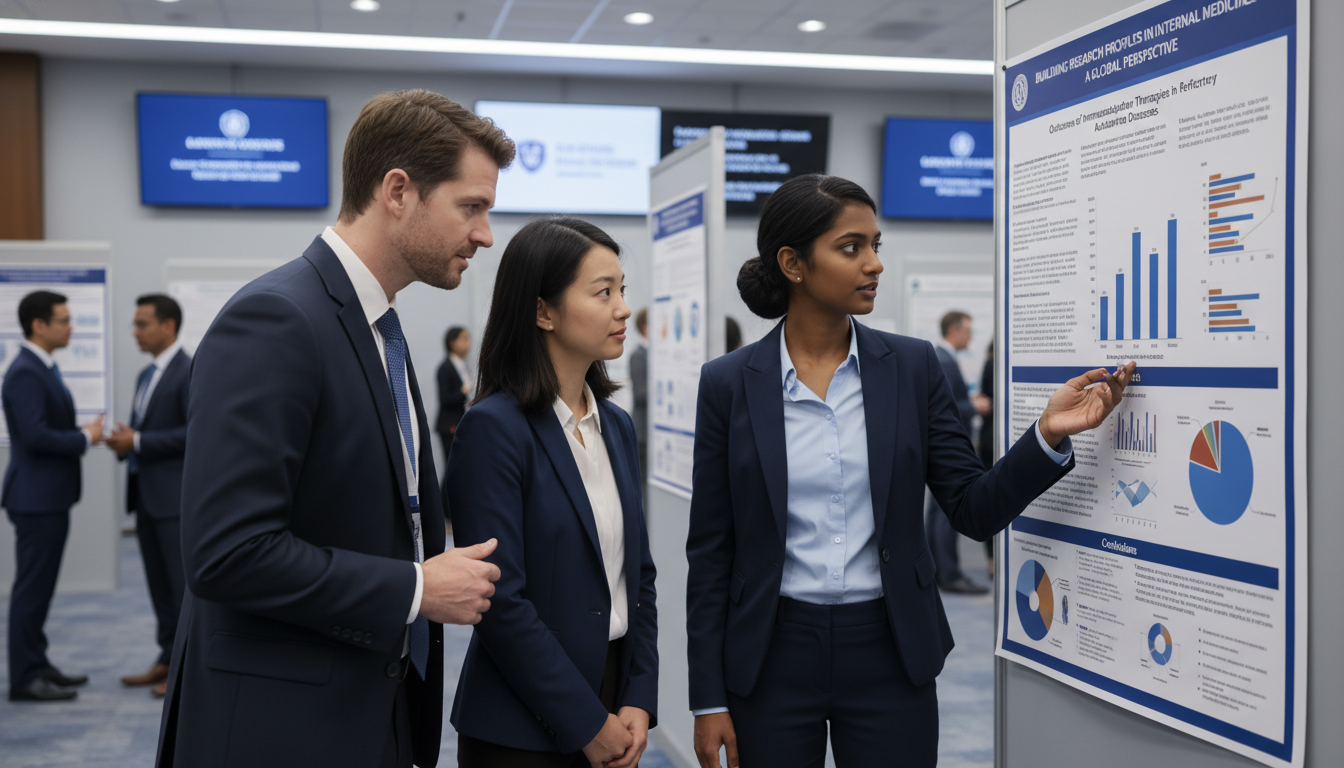
4. Abstracts, Posters, and Oral Presentations
These are more accessible short-term goals and are highly valued on residency applications:
- Conference abstracts (national, regional, or institutional)
- Poster presentations at professional society meetings (ACP, AHA, ATS, etc.)
- Oral presentations or case discussions at hospital grand rounds or specialty meetings
Residency programs see them as evidence that your work has been peer-reviewed and publicly presented, even if it isn’t yet fully published. For a foreign national medical graduate, presenting at US or international conferences also signals motivation and networking.
5. Quality Improvement (QI) and Audit Projects
Internal medicine programs are highly focused on systems-based practice and quality of care. QI projects are especially valued by IM program directors because they align directly with resident responsibilities.
Examples:
- Reducing unnecessary telemetry use in general medicine wards
- Improving diabetes foot exam documentation in clinic
- Increasing pneumococcal vaccination rates in hospitalized patients
If you are in a hospital setting (home country or US), QI projects are often easier to start than large-scale research and can still lead to abstracts, posters, or publications.
6. Other Scholarly Work
This category includes:
- Book chapters
- Educational content (clinical guidelines, curricula)
- Non-indexed local journal publications
- Online peer-reviewed educational platforms (if recognized and citable)
These are useful additions, especially early on, but should complement—not replace—more conventional research outputs.
How Many Publications Are Realistically Needed—and What Mix Is Ideal?
Many IMGs ask directly: how many publications needed to have a good shot at an internal medicine residency? There is no universal number; programs evaluate quality, relevance, and your role in the projects.
However, for a non-US citizen IMG targeting a broad range of IM programs (including some academic ones), the following is a realistic and competitive target profile:
Baseline Competitive Research Profile
Aim for, at minimum:
- 2–3 total peer-reviewed publications
- At least 1 in internal medicine or a closely related field
- At least 1 original research or systematic review if possible
- 3–6 conference abstracts/posters (regional, national, or international)
- Some combination of:
- 2–5 case reports / case series
- 1–2 QI projects (with data, outcomes, and ideally a poster or short paper)
If you are applying to highly academic internal medicine programs or planning for competitive fellowships later, try to move toward:
- 4–8 publications, including:
- At least 2 original research projects (even if small retrospective studies), and
- Several case reports and/or reviews.
This scale may take 1–2 dedicated research years in the US or remote collaborations with consistent effort.
First vs. Middle vs. Last Author
Programs recognize that as a student or early graduate you will rarely be first author on major studies, but your authorship position still matters:
- First author: Indicates you led the work; very valuable, especially for case reports, reviews, and smaller studies.
- Middle author: Still helpful; shows collaboration and contribution. Programs don’t expect you to explain every statistical detail, but you should be able to describe your specific role clearly.
- Last author: Usually reserved for senior authors/supervisors. As an IMG, this is uncommon unless it’s a student-led initiative you oversaw.
Be honest about your contribution; program directors can detect when applicants exaggerate.
Quality vs. Quantity
A smaller number of meaningful, well-explained projects is more impressive than dozens of superficial or predatory-journal publications.
Program directors look for:
- Reputable or at least legitimate journals (not obvious predatory outlets)
- Clear, coherent research narrative connected to internal medicine
- Ability to discuss the work in interviews in a thoughtful, detailed way
If you must choose, prioritize:
- A few solid internal medicine projects with good mentors
- Presentations at recognized conferences
- Depth of involvement over sheer volume
Starting From Zero: Building a Research Profile Step-by-Step
If you are a non-US citizen IMG with no publications for match, you can still build a strong research profile over 12–24 months with a structured plan.
Step 1: Clarify Your Timeframe and Constraints
Ask yourself:
- When do you intend to apply for the IM match? (Next cycle vs. in 2 years)
- Are you still in medical school, recently graduated, or several years out?
- Can you take a research year in the US (with appropriate visa) or must you work remotely from your home country?
- How many hours per week can you dedicate consistently (e.g., 10–15 hours vs. full-time)?
Your answers will determine whether you should:
- Focus heavily on case reports, reviews, and small retrospective projects, or
- Aim for more robust original research with substantial data analysis.
Step 2: Build Fundamental Skills (Short, Focused Learning)
Before approaching mentors, invest 2–4 weeks in self-training so you can contribute from day one:
Key topics to cover:
- Basics of study design: cohort vs. case-control vs. cross-sectional vs. RCT
- Fundamentals of biostatistics: p-values, confidence intervals, basic tests (t-test, chi-square)
- Literature search skills: PubMed, Embase, Google Scholar
- Using reference managers: Zotero, Mendeley, or EndNote
- Basics of research ethics and IRB concepts
This prepares you to say, “I can help with literature reviews, data collection, reference management, and manuscript drafting,” which is exactly what most busy mentors need.
Step 3: Start Local – Research in Your Home Institution
Even if your home country hospital doesn’t have a robust research culture, opportunities may exist under the surface:
- Ask internal medicine faculty if they have ongoing audits, registry data, or case logs that could become retrospective studies.
- Identify interesting cases and ask attendings if they’d support writing case reports.
- Propose simple QI projects (e.g., improving documentation, prophylaxis adherence, or discharge instructions).
Commonly feasible project ideas:
- Retrospective chart review on outcomes of pneumonia treatment in your hospital
- Pattern of antibiotic use and resistance in your internal medicine wards
- Prevalence of uncontrolled hypertension or diabetes in your outpatient clinic
If your hospital has no formal IRB, consider:
- Collaborating with a nearby academic institution that does
- Focusing on case reports and narrative reviews (often not IRB-required, depending on journal and regulations)
- Using de-identified, minimal datasets for safe retrospective analysis (checking local regulations)
Step 4: Seek Remote or In-Person US-Based Mentorship
For non-US citizen IMGs, a key turning point is finding US-based mentors. This can be done even from abroad.
Strategies:
Cold Emailing Faculty
- Identify internal medicine faculty with recent publications on topics that interest you.
- Target people who frequently publish and may supervise multiple projects.
- Include in your email:
- 2–3 sentence introduction (who you are, non-US citizen IMG interested in internal medicine)
- 1–2 sentence explanation of why you’re specifically reaching out to them
- Clear offer: skills, time commitment, willingness to help with data, literature review, etc.
- CV attached, concise and organized
- Expect many non-responses; success rates of 5–15% are normal. Persistence matters.
Connecting via Conferences and Webinars
- Attend free or low-cost virtual internal medicine webinars and meetings.
- Ask relevant questions; follow up with a polite email referencing the event.
Using Alumni Networks
- Reach out to graduates from your medical school who matched into IM or are in research in the US.
- Ask if they or their colleagues have open projects needing a motivated remote collaborator.
Formal Research Fellowships or Observership + Research
- Some US institutions offer paid or unpaid research positions open to foreign nationals (often on J-1 research or other visas).
- These can be 6–24 months and can significantly boost your research output and letters.
- Check for:
- Department of Medicine research fellow positions
- Outcomes research, hospitalist research, or subspecialty lab positions (cardiology, nephrology, etc.)
Step 5: Choose Projects Strategically
As opportunities arise, avoid overcommitting. Choose 3–5 active projects at a time, spread across:
- 1–2 case reports (shorter timeline; good early wins)
- 1 review or systematic review (medium timeline)
- 1–2 original research / QI projects (longer timeline but higher value)
Evaluate potential projects by asking:
- Is this related to internal medicine or a subspecialty?
- Is there a clear mentor who will guide the project to completion?
- Are roles and authorship expectations clear?
- Is the dataset accessible and realistic to handle in your timeframe?

Maximizing Impact: Execution, Productivity, and Presentation
Once you have projects, your goal is to execute efficiently and present them in a way that resonates with internal medicine program directors.
Working Effectively With Mentors
- Communicate regularly: Weekly or biweekly updates by email or scheduled calls.
- Be reliable: If you say you will complete data extraction or draft a section by a date, deliver or inform early if you’re delayed.
- Be proactive: Suggest next steps, propose target journals, ask to help with revisions and submission.
- Document your contribution: Keep a record of your roles—data collection, analysis, writing, etc.—to discuss confidently during interviews.
Timelines and Expectations
Typical approximate durations:
- Case report: 4–12 weeks from idea to submission (if data and images are ready)
- Narrative review: 2–4 months
- Systematic review: 4–8 months (depending on scope and team)
- Retrospective cohort study: 6–12+ months
- QI project: 4–12 months (including data collection pre- and post-intervention)
For the IM match, work backward from your planned ERAS submission date. Aim to:
- Have at least a few projects accepted or published by the time you apply
- List ongoing projects as “submitted,” “in revision,” or “in preparation” honestly, with realistic timelines
Avoiding Common Pitfalls for Non-US Citizen IMGs
Predatory Journals
- Be cautious of journals that:
- Guarantee acceptance with fast turnaround and high fees
- Are not indexed in PubMed or reputable databases
- When in doubt, ask a mentor or check if the journal appears on blacklists or lists of predatory publishers.
- Be cautious of journals that:
Authorship Disputes
- Clarify authorship order early in the project.
- Confirm expectations with mentors and team members.
- Document contributions and email agreements if needed.
Overcommitting
- Too many simultaneous projects lead to burnout and few completions.
- Prioritize depth and completion over starting many projects.
Data Integrity and Ethics
- Follow all ethical standards, including patient confidentiality and IRB requirements.
- Never fabricate or manipulate data; academic dishonesty can end your career.
Presenting Your Research in ERAS
When filling out ERAS:
- List all peer-reviewed publications, including e-publications ahead of print.
- Include:
- Full citation (authors, title, journal, year, volume, pages if available)
- Your exact authorship position
- For presentations, clearly label them as poster or oral, and include the conference name and year.
- For ongoing projects, use statuses such as: “In preparation,” “Submitted,” “Under review,” or “Accepted” (only if officially accepted).
During interviews:
- Be prepared to explain:
- Why you chose your research topics
- Your specific contribution to each project
- Basic methodology and key findings
- How the project relates to internal medicine practice or systems of care
Program directors are looking less for high-level statistics and more for evidence that you engaged intellectually and understand the clinical implications.
Tailoring Your Research Profile to Internal Medicine Goals and Fellowships
Internal medicine is diverse. Your research profile can either be broad or targeted toward your longer-term interests.
General Internal Medicine / Hospitalist Track
If you’re unsure about subspecialization:
- Aim for research across common IM conditions: heart failure, pneumonia, diabetes, hypertension, sepsis, COPD, CKD.
- QI projects in hospital workflows, readmission reduction, antimicrobial stewardship, or safety bundles are particularly powerful for future hospitalist roles.
Subspecialty-Oriented Profiles
If you already know your likely fellowship interest, you can subtly align your research:
- Cardiology: Heart failure, arrhythmias, ACS, cardio-oncology, imaging
- Pulmonology/Critical Care: ARDS, sepsis, mechanical ventilation, COPD, asthma
- Gastroenterology: Liver disease, IBD, GI bleeding, endoscopy outcomes
- Endocrinology: Diabetes, thyroid disease, obesity, osteoporosis
- Heme/Onc: Leukemias, lymphomas, solid tumors, thrombosis, chemo toxicity
You do not need everything in one field, but a noticeable cluster of projects in a subspecialty signals long-term interest and can help you match into academic IM programs that support that fellowship path.
As a Non-US Citizen IMG: Research and Visa Considerations
For foreign national medical graduates, research can indirectly influence visa sponsorship:
- Programs doing more research and hosting more fellows/residents on visas may be more comfortable sponsoring J-1 or H-1B.
- A strong research record suggests you will add academic value to the program, strengthening your application in the eyes of program leadership and GME offices.
While research itself doesn’t guarantee a visa, it can make you a more “worthwhile” applicant for programs that invest in visa sponsorship.
FAQs: Research Profile Building for Non-US Citizen IMGs in Internal Medicine
1. As a non-US citizen IMG, can I match internal medicine with no research at all?
Yes, it is still possible to match internal medicine without research, especially at community-based and less research-focused programs, particularly if you have:
- Strong USMLE scores
- Excellent US clinical experience and letters of recommendation
- No major red flags
However, as competition increases and many IMGs now have at least some research, having no research at all can place you at a disadvantage, especially as a foreign national applicant. Even a few case reports or one small study can significantly strengthen your profile and improve your odds.
2. What is the minimum research I should aim for if I’m applying in the next 12–18 months?
If your application timeline is relatively short, aim for:
- 2–3 case reports or case series
- 1–2 abstracts/posters (even if at small or virtual conferences)
- At least one ongoing or near-submission project (review or retrospective study)
In parallel, start any feasible QI project in your current setting. This minimal but focused portfolio shows initiative, growing academic skills, and relevance to internal medicine.
3. Does research in fields like surgery, radiology, or basic science help my internal medicine application?
Yes, but with caveats:
- Non-IM research is still better than no research at all. It demonstrates you can work systematically, write scientifically, and complete projects.
- Try to build at least some research directly related to internal medicine eventually. Even a few IM-focused projects (case reports, small studies) will help align your profile.
- In interviews, emphasize the transferable skills you gained (data analysis, scientific writing, teamwork) and how you plan to apply them in internal medicine.
4. How do I decide between doing a research year in the US vs. working on remote projects from abroad?
Consider:
Research year in the US:
- Pros: Stronger mentorship, access to data, higher chance of publications, US letters of recommendation, closer networking.
- Cons: Visa requirements, financial cost, needing to relocate and sometimes unpaid positions.
Remote research from abroad:
- Pros: Lower cost, can be combined with work or ongoing training, more flexible.
- Cons: Harder to find mentors, limited access to certain datasets, often slower progress, may not yield as many publications.
If feasible, a well-structured US research year can be transformative for a non-US citizen IMG’s IM match prospects, especially for academic programs. However, if that’s not possible, focused and consistent remote research can still build a solid profile when approached systematically.
By planning deliberately, targeting realistic goals, and steadily building your portfolio over time, you can turn research from a perceived weakness into one of the most compelling strengths in your internal medicine residency application—even as a non-US citizen IMG starting from scratch.